Introduction
Warehouse Management Systems (WMS) are software platforms designed to manage and optimize warehouse operations—from receiving goods to storage, picking, packing, and shipping. They provide real-time visibility into inventory and streamline workflows, helping businesses improve efficiency and accuracy.
In modern supply chains, warehouses are no longer just storage spaces—they are dynamic fulfillment hubs. With the rise of eCommerce, same-day delivery expectations, and global logistics, managing warehouse operations manually is no longer feasible. WMS tools automate processes, reduce errors, and ensure faster order fulfillment.
Common use cases include:
- Managing inventory across multiple warehouse locations
- Optimizing picking, packing, and shipping processes
- Automating inbound and outbound logistics
- Improving warehouse space utilization
- Enabling real-time inventory tracking
What buyers should evaluate:
- Real-time inventory visibility
- Warehouse automation capabilities
- Integration with ERP, OMS, and TMS
- Scalability for high transaction volumes
- Barcode/RFID support
- Labor and workflow management
- Reporting and analytics
- Ease of implementation
- Security and access control
- Cost and ROI
Best for: eCommerce companies, retailers, logistics providers, manufacturers, and enterprises managing large-scale warehouse operations.
Not ideal for: Very small businesses with limited inventory or operations that do not require warehouse automation.
Key Trends in Warehouse Management Systems
- AI-driven warehouse optimization and demand forecasting
- Automation of picking, packing, and routing workflows
- Integration with robotics and IoT devices
- Real-time inventory tracking with RFID and barcode systems
- Cloud-native WMS platforms for scalability
- Integration with end-to-end supply chain systems
- Predictive analytics for warehouse performance
- Support for omnichannel fulfillment
- API-first architectures for flexible integrations
- Focus on labor optimization and workforce management
How We Selected These Tools (Methodology)
- Market adoption and industry reputation
- Feature completeness across warehouse operations
- Integration capabilities with ERP, OMS, and supply chain systems
- Scalability for SMB and enterprise use cases
- Automation and workflow efficiency
- Security and compliance readiness
- Ease of use and onboarding
- Vendor support and ecosystem strength
- Performance in handling large warehouse operations
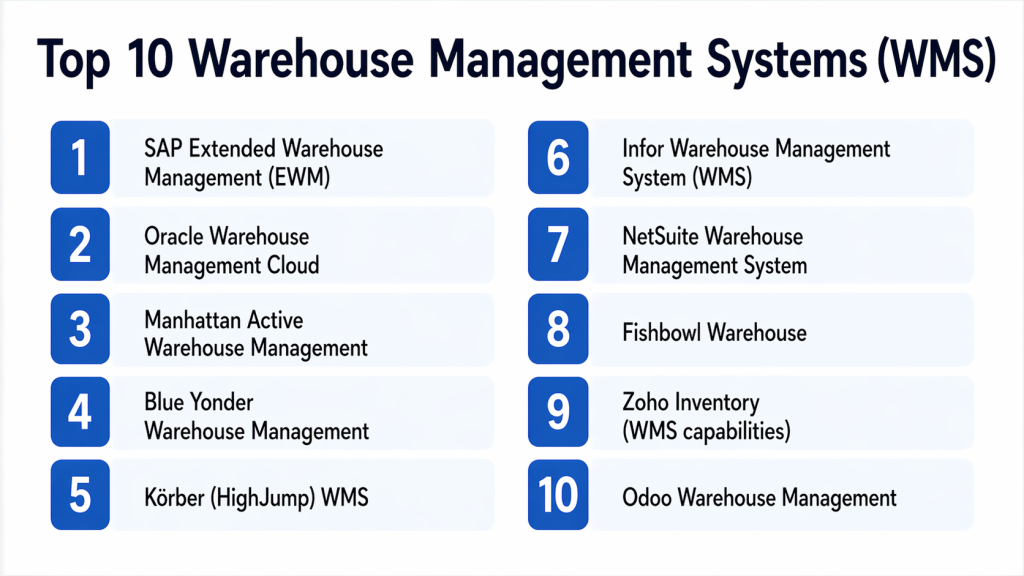
Top 10 Warehouse Management Systems (WMS)
#1 — SAP Extended Warehouse Management (EWM)
Short description:
SAP EWM is a comprehensive warehouse management solution designed for complex logistics environments. It provides advanced capabilities for inventory tracking, labor management, and automation. Ideal for large enterprises, it integrates seamlessly with SAP ERP systems. It supports high-volume operations and real-time analytics. Known for scalability and enterprise-grade performance.
Key Features
- Advanced warehouse automation
- Real-time inventory tracking
- Labor management
- Yard management
- Integration with SAP systems
Pros
- Enterprise-grade capabilities
- Strong integration with SAP ecosystem
Cons
- High implementation complexity
- Expensive
Platforms / Deployment
Cloud / On-premise
Security & Compliance
Not publicly stated
Integrations & Ecosystem
- SAP ERP
- APIs
Support & Community
Enterprise-level support.
#2 — Oracle Warehouse Management Cloud
Short description:
Oracle WMS Cloud is a scalable solution for managing warehouse operations across multiple locations. It offers advanced automation, real-time visibility, and analytics. Suitable for enterprises and large distribution centers. Known for reliability and performance. Integrates with Oracle ERP ecosystem.
Key Features
- Inventory tracking
- Warehouse automation
- Real-time analytics
- Multi-location support
- Workflow automation
Pros
- Highly scalable
- Strong analytics
Cons
- Complex setup
- Premium pricing
Platforms / Deployment
Cloud
Security & Compliance
Not publicly stated
Integrations & Ecosystem
- Oracle ERP
- APIs
Support & Community
Enterprise support.
#3 — Manhattan Active Warehouse Management
Short description:
Manhattan Active WMS is a leading solution for omnichannel fulfillment. It provides real-time inventory visibility and advanced order orchestration. Ideal for retail and eCommerce enterprises. Known for flexibility and scalability. Supports complex warehouse operations.
Key Features
- Omnichannel fulfillment
- Inventory visibility
- Labor management
- Automation workflows
- Analytics
Pros
- Strong omnichannel capabilities
- Scalable
Cons
- Expensive
- Complex implementation
Platforms / Deployment
Cloud
Security & Compliance
Not publicly stated
Integrations & Ecosystem
- ERP systems
- APIs
Support & Community
Enterprise support.
#4 — Blue Yonder Warehouse Management
Short description:
Blue Yonder WMS focuses on AI-driven warehouse optimization and supply chain visibility. It helps businesses improve efficiency and reduce operational costs. Suitable for enterprises and logistics providers. Offers advanced analytics and automation.
Key Features
- AI-driven optimization
- Inventory management
- Automation workflows
- Predictive analytics
- Labor management
Pros
- Advanced AI capabilities
- Strong analytics
Cons
- Complex setup
- High cost
Platforms / Deployment
Cloud
Security & Compliance
Not publicly stated
Integrations & Ecosystem
- Supply chain platforms
- APIs
Support & Community
Enterprise-level support.
#5 — Körber (HighJump) WMS
Short description:
Körber WMS (formerly HighJump) is a flexible warehouse management solution. It supports customization and automation for various industries. Suitable for mid-market and enterprise businesses. Known for adaptability and integration capabilities.
Key Features
- Inventory management
- Automation workflows
- Customization
- Reporting
- Integration support
Pros
- Highly flexible
- Scalable
Cons
- Requires configuration
- Learning curve
Platforms / Deployment
Cloud / On-premise
Security & Compliance
Not publicly stated
Integrations & Ecosystem
- ERP systems
- APIs
Support & Community
Good support.
#6 — Infor WMS
Short description:
Infor WMS is designed for large-scale warehouse operations. It provides advanced features for inventory, labor, and automation. Suitable for enterprises with complex logistics needs. Known for performance and scalability.
Key Features
- Inventory tracking
- Labor management
- Automation
- Analytics
- Workflow optimization
Pros
- Enterprise-ready
- Strong performance
Cons
- Complex implementation
- Expensive
Platforms / Deployment
Cloud
Security & Compliance
Not publicly stated
Integrations & Ecosystem
- ERP systems
- APIs
Support & Community
Enterprise support.
#7 — Fishbowl Warehouse
Short description:
Fishbowl Warehouse is designed for SMBs and manufacturers. It provides inventory tracking and warehouse automation features. Ideal for growing businesses. Known for ease of use and integration with accounting systems.
Key Features
- Inventory tracking
- Order management
- Automation workflows
- Reporting
- Integration with accounting
Pros
- Easy to use
- Affordable
Cons
- Limited enterprise features
- UI limitations
Platforms / Deployment
Cloud / On-premise
Security & Compliance
Not publicly stated
Integrations & Ecosystem
- QuickBooks
- APIs
Support & Community
Good SMB support.
#8 — NetSuite Warehouse Management
Short description:
NetSuite WMS is part of the NetSuite ERP platform. It provides real-time inventory tracking and warehouse automation. Suitable for mid-market and enterprise businesses. Offers strong integration with financial systems.
Key Features
- Inventory tracking
- Automation workflows
- Multi-location support
- Reporting
- ERP integration
Pros
- Strong ERP integration
- Scalable
Cons
- Expensive
- Setup complexity
Platforms / Deployment
Cloud
Security & Compliance
Not publicly stated
Integrations & Ecosystem
- NetSuite ERP
- APIs
Support & Community
Enterprise support.
#9 — Zoho Inventory (Warehouse Module)
Short description:
Zoho Inventory provides warehouse management features for SMBs. It supports inventory tracking and order management. Easy to use and affordable. Ideal for small businesses entering multi-channel selling.
Key Features
- Inventory tracking
- Warehouse management
- Order processing
- Reporting
- Automation
Pros
- Affordable
- Easy to use
Cons
- Limited advanced features
- Not ideal for large enterprises
Platforms / Deployment
Cloud
Security & Compliance
Not publicly stated
Integrations & Ecosystem
- Zoho ecosystem
- APIs
Support & Community
Good SMB support.
#10 — Unicommerce WMS
Short description:
Unicommerce WMS is designed for eCommerce and retail businesses. It supports multi-channel operations and warehouse automation. Ideal for fast-growing businesses. Known for scalability and integration capabilities.
Key Features
- Multi-channel warehouse management
- Inventory synchronization
- Automation workflows
- Reporting
- Integration support
Pros
- Strong eCommerce focus
- Scalable
Cons
- Complex setup
- Pricing varies
Platforms / Deployment
Cloud
Security & Compliance
Not publicly stated
Integrations & Ecosystem
- Marketplaces
- APIs
Support & Community
Enterprise support.
Comparison Table (Top 10)
| Tool Name | Best For | Platform(s) Supported | Deployment | Standout Feature | Public Rating |
|---|---|---|---|---|---|
| SAP EWM | Enterprise | Web | Hybrid | Advanced automation | N/A |
| Oracle WMS | Enterprise | Web | Cloud | Real-time analytics | N/A |
| Manhattan WMS | Retail | Web | Cloud | Omnichannel | N/A |
| Blue Yonder | Enterprise | Web | Cloud | AI optimization | N/A |
| Körber WMS | Mid-market | Web | Hybrid | Flexibility | N/A |
| Infor WMS | Enterprise | Web | Cloud | Performance | N/A |
| Fishbowl | SMB | Web | Hybrid | Ease of use | N/A |
| NetSuite WMS | Enterprise | Web | Cloud | ERP integration | N/A |
| Zoho Inventory | SMB | Web | Cloud | Affordability | N/A |
| Unicommerce | eCommerce | Web | Cloud | Multi-channel | N/A |
Evaluation & Scoring of Warehouse Management Systems
| Tool Name | Core (25%) | Ease (15%) | Integrations (15%) | Security (10%) | Performance (10%) | Support (10%) | Value (15%) | Weighted Total |
|---|---|---|---|---|---|---|---|---|
| SAP EWM | 9 | 6 | 9 | 8 | 9 | 8 | 6 | 8.1 |
| Oracle WMS | 9 | 7 | 9 | 8 | 9 | 8 | 7 | 8.3 |
| Manhattan WMS | 9 | 7 | 8 | 8 | 9 | 8 | 7 | 8.2 |
| Blue Yonder | 9 | 6 | 8 | 8 | 9 | 8 | 6 | 8.0 |
| Körber | 8 | 7 | 8 | 7 | 8 | 7 | 7 | 7.6 |
| Infor | 9 | 6 | 8 | 8 | 9 | 8 | 6 | 8.0 |
| Fishbowl | 7 | 9 | 7 | 6 | 7 | 7 | 9 | 7.6 |
| NetSuite | 9 | 7 | 9 | 8 | 9 | 8 | 7 | 8.3 |
| Zoho | 7 | 9 | 7 | 6 | 7 | 7 | 9 | 7.7 |
| Unicommerce | 8 | 7 | 8 | 7 | 8 | 8 | 7 | 7.8 |
How to interpret scores:
These scores are comparative and highlight strengths across functionality, usability, and value. Enterprise tools excel in scalability and integrations, while SMB tools rank higher in ease of use and affordability.
Which Warehouse Management System Is Right for You?
Solo / Freelancer
Not typically required unless handling physical inventory at scale.
SMB
Zoho Inventory or Fishbowl are suitable.
Mid-Market
Körber and NetSuite provide balanced features.
Enterprise
SAP EWM, Oracle WMS, and Manhattan WMS are best choices.
Budget vs Premium
Budget tools focus on simplicity, premium tools offer automation and scalability.
Feature Depth vs Ease of Use
Choose based on warehouse complexity.
Integrations & Scalability
Ensure compatibility with ERP and supply chain tools.
Security & Compliance Needs
Enterprises should prioritize governance and audit capabilities.
Frequently Asked Questions (FAQs)
1. What is a Warehouse Management System?
A WMS is software that helps manage and control daily warehouse operations, including receiving, storage, and shipping of goods.
2. Why is WMS important?
It improves efficiency, reduces errors, and provides real-time inventory visibility.
3. Who needs a WMS?
Businesses with warehouses, including eCommerce, retail, and manufacturing companies.
4. How does WMS improve efficiency?
By automating processes and optimizing workflows.
5. Can WMS integrate with ERP systems?
Yes, most WMS tools integrate with ERP systems.
6. What features should a WMS have?
Inventory tracking, automation, reporting, and integrations.
7. Is WMS expensive?
Costs vary based on features and scale.
8. What are common implementation challenges?
Integration complexity and training requirements.
9. Can WMS handle multiple warehouses?
Yes, most modern systems support multi-location management.
10. What are alternatives to WMS?
Manual systems or ERP modules, though less efficient.
Conclusion
Warehouse Management Systems are critical for modern supply chain operations, enabling businesses to manage inventory, optimize warehouse workflows, and improve fulfillment efficiency. From SMB-friendly tools to enterprise-grade platforms, WMS solutions offer a wide range of capabilities tailored to different business needs. The best choice depends on your warehouse complexity, integration requirements, and scalability goals. Instead of selecting a tool based solely on features, focus on how well it aligns with your operations and long-term growth plans. Start by shortlisting a few options, test them in real-world scenarios, and evaluate their impact before making a final decision.