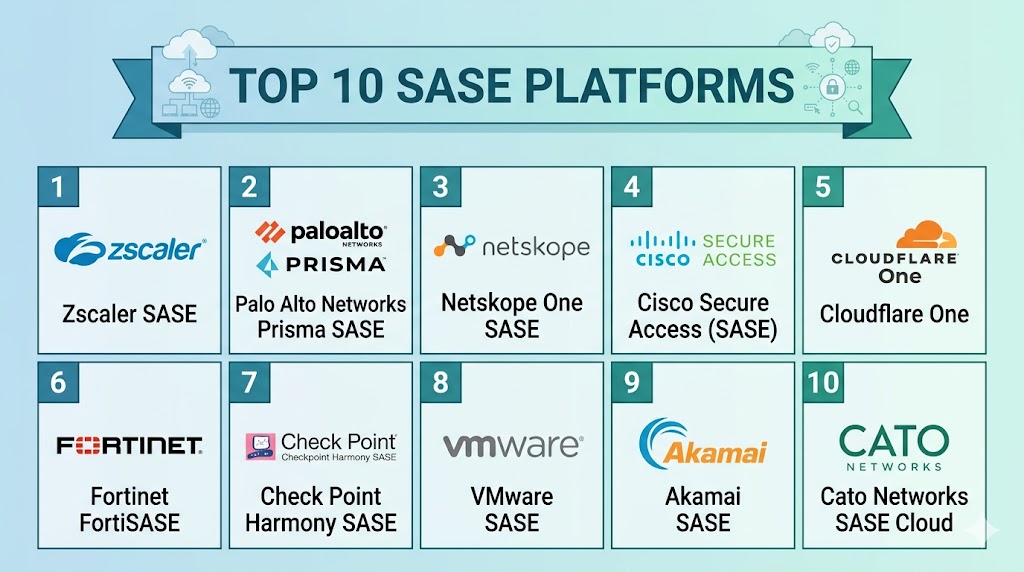
Secure Access Service Edge (SASE) is a cloud-delivered architecture that combines networking and security into a single unified platform. Instead of managing separate tools like VPN, firewalls, and web gateways, SASE integrates capabilities such as SD-WAN, SWG, CASB, FWaaS, and ZTNA into one service delivered from the cloud edge.
This shift is driven by modern IT environments—remote work, cloud apps, and distributed users—which traditional perimeter-based security cannot effectively protect. SASE ensures secure, fast, and consistent access to applications regardless of user location, device, or network.
Common Use Cases
- Secure remote access for distributed workforce
- Replacing VPN and legacy network architectures
- Securing SaaS and cloud application access
- Enforcing Zero Trust access policies
- Unifying networking and security operations
What Buyers Should Evaluate
- Integration of networking + security (true SASE vs partial)
- Global Points of Presence (PoPs) and performance
- Zero Trust and identity-based access controls
- Support for SWG, CASB, ZTNA, FWaaS
- Ease of deployment and centralized management
- Scalability for remote and hybrid environments
- Automation and AI-driven threat detection
- Integration with existing security stack
- Cost vs operational efficiency
Best for: Enterprises, distributed organizations, hybrid workforce environments, and security teams modernizing network architecture.
Not ideal for: Small teams with simple networking needs or organizations not using cloud-based infrastructure.
Key Trends in SASE Platforms
- AI-driven predictive security and AIOps replacing reactive models
- Shift toward single-vendor SASE platforms for simplicity
- Expansion of Zero Trust across all access points
- Convergence of networking and security stacks
- Cloud-native architectures replacing hardware appliances
- Identity-first security policies and contextual access control
- Automation of policy enforcement and remediation
- Support for machine-to-machine (M2M) security
- Global edge networks improving latency and performance
- Integration with SSE (Security Service Edge) models
How We Selected These Tools (Methodology)
- Strong market adoption and leadership position
- Proven full SASE capabilities (not partial solutions)
- Integration with core components (SD-WAN, SWG, CASB, ZTNA)
- Availability of cloud-native deployment models
- Support for Zero Trust architecture
- Scalability across global enterprise environments
- Strong documentation, ecosystem, and support
- Balance between enterprise-grade and flexible solutions
Top 10 SASE Platforms
#1 — Zscaler SASE (ZIA + ZPA)
Short description: A leading cloud-native SASE platform delivering secure access and web security globally.
Key Features
- Zero Trust access (ZPA)
- Secure Web Gateway (ZIA)
- Cloud firewall
- Data protection
- Global PoP network
- AI-driven threat detection
Pros
- Strong cloud-native architecture
- Global scalability
Cons
- Premium pricing
- Requires expertise
Platforms / Deployment
- Cloud
Security & Compliance
- RBAC, encryption
- Compliance support varies
Integrations & Ecosystem
- Identity providers
- APIs
- Security tools
Support & Community
Enterprise-grade support.
#2 — Palo Alto Networks Prisma SASE
Short description: A unified SASE platform combining networking and advanced security capabilities.
Key Features
- SD-WAN integration
- ZTNA
- Threat prevention
- Cloud firewall
- CASB capabilities
Pros
- Strong enterprise features
- Integrated ecosystem
Cons
- Complex setup
- Higher cost
Platforms / Deployment
- Cloud
Security & Compliance
- RBAC, encryption
Integrations & Ecosystem
- Palo Alto ecosystem
- APIs
Support & Community
Enterprise support.
#3 — Netskope One SASE
Short description: A cloud-first SASE platform providing visibility and control across web and cloud environments.
Key Features
- SWG and CASB
- ZTNA
- Data protection
- Risk analytics
- Cloud-native architecture
Pros
- Strong cloud visibility
- Unified platform
Cons
- Complex deployment
- Requires tuning
Platforms / Deployment
- Cloud
Security & Compliance
- Not publicly stated
Integrations & Ecosystem
- APIs
- Security tools
Support & Community
Enterprise support.
#4 — Cisco Secure Access (SASE)
Short description: Cisco’s SASE solution combining networking, security, and identity-based access.
Key Features
- SD-WAN
- ZTNA
- SWG
- Threat intelligence
- Identity integration
Pros
- Strong networking foundation
- Enterprise scalability
Cons
- Complex ecosystem
- Requires Cisco stack
Platforms / Deployment
- Cloud / Hybrid
Security & Compliance
- Not publicly stated
Integrations & Ecosystem
- Cisco ecosystem
- APIs
Support & Community
Strong enterprise support.
#5 — Cloudflare One (SASE)
Short description: A global edge-based SASE platform delivering high-performance secure access.
Key Features
- Zero Trust access
- Web security
- DNS protection
- Global network edge
- Identity integration
Pros
- High performance
- Easy deployment
Cons
- Limited deep enterprise features
- Requires ecosystem adoption
Platforms / Deployment
- Cloud
Security & Compliance
- Not publicly stated
Integrations & Ecosystem
- APIs
- Identity providers
Support & Community
Strong developer ecosystem.
#6 — Fortinet FortiSASE
Short description: A unified SASE platform combining SD-WAN and security fabric capabilities.
Key Features
- SD-WAN
- ZTNA
- Firewall-as-a-Service
- Web filtering
- Threat protection
Pros
- Strong security fabric
- Flexible deployment
Cons
- Complex setup
- Requires expertise
Platforms / Deployment
- Cloud / Hybrid
Security & Compliance
- Not publicly stated
Integrations & Ecosystem
- Fortinet ecosystem
- APIs
Support & Community
Enterprise support.
#7 — Check Point Harmony SASE
Short description: A cloud-native SASE solution offering secure access and threat prevention.
Key Features
- ZTNA
- SWG
- Threat prevention
- Policy enforcement
- Cloud-native architecture
Pros
- Easy deployment
- Integrated platform
Cons
- Limited customization
- Growing ecosystem
Platforms / Deployment
- Cloud
Security & Compliance
- Not publicly stated
Integrations & Ecosystem
- APIs
- Security tools
Support & Community
Good support.
#8 — VMware SASE
Short description: A SASE platform built on VMware’s networking and SD-WAN capabilities.
Key Features
- SD-WAN
- ZTNA
- Cloud security
- Network optimization
- Policy management
Pros
- Strong networking performance
- Enterprise-ready
Cons
- Requires VMware ecosystem
- Complex setup
Platforms / Deployment
- Cloud
Security & Compliance
- Not publicly stated
Integrations & Ecosystem
- VMware tools
- APIs
Support & Community
Enterprise support.
#9 — Akamai SASE
Short description: A global edge-based SASE platform focused on performance and security.
Key Features
- ZTNA
- Web security
- Global edge network
- Threat detection
- Identity-based access
Pros
- High performance
- Strong global presence
Cons
- Premium pricing
- Complex configuration
Platforms / Deployment
- Cloud
Security & Compliance
- Not publicly stated
Integrations & Ecosystem
- APIs
- Identity providers
Support & Community
Enterprise support.
#10 — Cato Networks SASE
Short description: A fully integrated single-vendor SASE platform combining networking and security.
Key Features
- SD-WAN
- ZTNA
- SWG
- Firewall-as-a-Service
- Centralized management
Pros
- True single-vendor SASE
- Easy management
Cons
- Limited customization
- Smaller ecosystem
Platforms / Deployment
- Cloud
Security & Compliance
- Not publicly stated
Integrations & Ecosystem
- APIs
- Security tools
Support & Community
Good enterprise support.
Comparison Table (Top 10)
| Tool Name | Best For | Platform(s) Supported | Deployment | Standout Feature | Public Rating |
|---|---|---|---|---|---|
| Zscaler | Enterprise | Web | Cloud | Cloud-native SASE | N/A |
| Prisma SASE | Enterprise | Web | Cloud | Integrated platform | N/A |
| Netskope | Cloud security | Web | Cloud | SaaS visibility | N/A |
| Cisco | Enterprise | Web | Hybrid | Networking strength | N/A |
| Cloudflare | Performance | Web | Cloud | Global edge | N/A |
| Fortinet | Security fabric | Web | Hybrid | Integrated stack | N/A |
| Check Point | SMB/Enterprise | Web | Cloud | Easy deployment | N/A |
| VMware | Networking | Web | Cloud | SD-WAN strength | N/A |
| Akamai | Global enterprise | Web | Cloud | Performance | N/A |
| Cato Networks | Unified SASE | Web | Cloud | Single-vendor model | N/A |
Evaluation & Scoring of SASE Platforms
| Tool Name | Core (25%) | Ease (15%) | Integrations (15%) | Security (10%) | Performance (10%) | Support (10%) | Value (15%) | Weighted Total |
|---|---|---|---|---|---|---|---|---|
| Zscaler | 9 | 7 | 9 | 9 | 9 | 8 | 7 | 8.5 |
| Prisma SASE | 9 | 7 | 9 | 9 | 9 | 8 | 7 | 8.5 |
| Netskope | 9 | 7 | 9 | 9 | 9 | 8 | 7 | 8.5 |
| Cisco | 8 | 7 | 9 | 9 | 9 | 8 | 7 | 8.2 |
| Cloudflare | 8 | 9 | 8 | 8 | 9 | 8 | 8 | 8.3 |
| Fortinet | 8 | 7 | 8 | 8 | 8 | 8 | 7 | 7.9 |
| Check Point | 7 | 8 | 7 | 7 | 7 | 7 | 8 | 7.4 |
| VMware | 8 | 7 | 8 | 8 | 8 | 8 | 7 | 7.9 |
| Akamai | 9 | 7 | 8 | 9 | 9 | 8 | 7 | 8.4 |
| Cato Networks | 8 | 8 | 7 | 8 | 8 | 8 | 8 | 8.0 |
How to interpret scores:
- Scores are comparative across tools
- Higher scores indicate stronger overall capabilities
- Enterprise platforms lead in integrations and scalability
- Cloud-native platforms excel in performance and ease of use
- Choose based on architecture maturity and scale
Which SASE Platform Is Right for You?
Solo / Freelancer
Use Cloudflare One for simplicity and performance.
SMB
Use Cato Networks or Check Point Harmony SASE.
Mid-Market
Use Cloudflare or Fortinet FortiSASE.
Enterprise
Use Zscaler, Prisma SASE, or Netskope.
Budget vs Premium
- Budget: Cloudflare, Cato
- Premium: Zscaler, Prisma
Feature Depth vs Ease of Use
- Deep features: Prisma SASE
- Ease of use: Cloudflare
Integrations & Scalability
Best: Netskope, Cisco
Security & Compliance Needs
Best: Zscaler, Prisma
Frequently Asked Questions (FAQs)
1. What is SASE?
A cloud-based model combining networking and security.
2. What components are included?
SD-WAN, SWG, CASB, FWaaS, and ZTNA.
3. Is SASE replacing VPN?
It complements and often replaces VPN.
4. Is SASE cloud-based?
Yes, it is cloud-native.
5. Who should use SASE?
Organizations with distributed users and cloud apps.
6. Does SASE support Zero Trust?
Yes, it is built on Zero Trust principles.
7. Is SASE expensive?
Pricing varies by features and scale.
8. Can SASE improve performance?
Yes, via global edge networks.
9. Does SASE include DLP?
Many platforms include DLP features.
10. What is the biggest benefit?
Unified security and networking.
Conclusion
SASE platforms represent a major shift in how organizations approach networking and security by unifying them into a single cloud-delivered architecture. This convergence simplifies operations, improves performance, and enhances security for modern distributed environments. As remote work, cloud adoption, and digital transformation continue to grow, SASE provides a scalable and flexible solution to meet evolving demands. While enterprise platforms offer deep integrations and global capabilities, smaller organizations can still benefit from simplified, cloud-native solutions. The best approach is to evaluate your network architecture, shortlist a few platforms, and validate how well they align with your performance, security, and operational requirements.