Introduction
Single Sign-On (SSO) tools are identity solutions that allow users to access multiple applications and systems with one set of login credentials. Instead of managing multiple passwords across different platforms, SSO centralizes authentication—improving both security and user experience.
As organizations adopt more SaaS applications, cloud platforms, and remote work models, managing identities becomes increasingly complex. SSO tools simplify this by providing seamless access while reducing password fatigue and lowering the risk of credential-based attacks. Modern SSO platforms also integrate with Multi-Factor Authentication (MFA), Zero Trust frameworks, and identity governance systems to deliver a more secure and scalable access control strategy.
Real-world use cases include:
- Enabling employees to access multiple SaaS tools with one login
- Securing enterprise applications and internal systems
- Simplifying user authentication for remote teams
- Managing access across cloud environments
- Enhancing user experience for customer-facing applications
What buyers should evaluate:
- Supported authentication protocols (SAML, OAuth, OpenID Connect)
- Integration with SaaS and enterprise applications
- Multi-factor authentication capabilities
- User provisioning and lifecycle management
- Ease of deployment and user experience
- Security features and access policies
- Scalability across teams and environments
- Reporting and audit capabilities
- Cost versus value
Best for: IT teams, enterprises, SaaS companies, and organizations managing multiple applications and user identities.
Not ideal for: Small teams using only one or two applications with simple authentication needs.
Key Trends in Single Sign-On (SSO)
- Adoption of passwordless authentication
- Integration with Zero Trust security models
- AI-driven risk-based authentication
- Expansion of identity federation across platforms
- Deep integration with cloud and SaaS ecosystems
- Increased focus on user experience and frictionless login
- API-first identity platforms
- Enhanced security with adaptive authentication
- Growth of customer identity (CIAM) solutions
- Integration with DevSecOps workflows
How We Selected These Tools (Methodology)
- Evaluated market adoption and credibility
- Assessed SSO protocol support and flexibility
- Reviewed security features and authentication capabilities
- Considered integration with SaaS and enterprise ecosystems
- Compared ease of deployment and usability
- Included tools suitable for SMB and enterprise use cases
- Analyzed scalability and performance
- Evaluated identity lifecycle and provisioning features
- Focused on real-world usability and reliability
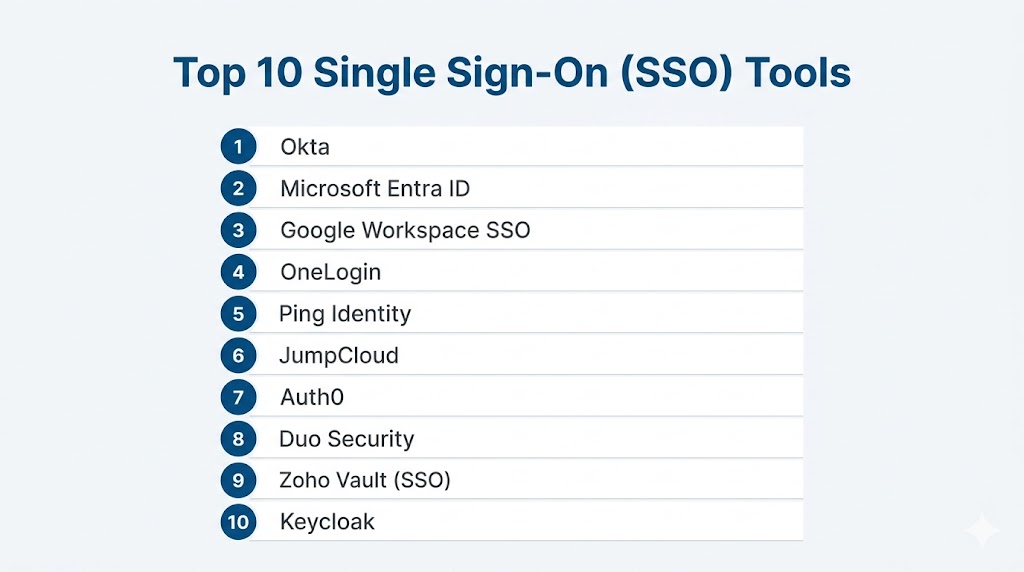
Top 10 Single Sign-On (SSO) Tools
#1 — Okta
Short description: A leading cloud-based identity platform offering secure SSO, authentication, and user lifecycle management.
Key Features
- Single Sign-On across thousands of apps
- Multi-factor authentication
- Adaptive authentication
- User lifecycle management
- API access management
- Directory integration
Pros
- Easy to deploy
- Extensive integration ecosystem
Cons
- Premium pricing
- Advanced features require configuration
Platforms / Deployment
Web
Cloud
Security & Compliance
MFA, RBAC, audit logs (details not publicly stated)
Integrations & Ecosystem
Okta integrates with a wide range of SaaS and enterprise applications.
- Cloud apps
- APIs
- DevOps tools
Support & Community
Strong documentation and large community.
#2 — Microsoft Entra ID
Short description: A cloud-based identity and SSO solution integrated with Microsoft ecosystem.
Key Features
- Single Sign-On
- Multi-factor authentication
- Conditional access policies
- Identity protection
- Directory services
Pros
- Strong Microsoft integration
- Scalable
Cons
- Complex licensing
- Best suited for Microsoft environments
Platforms / Deployment
Web
Cloud
Security & Compliance
MFA, RBAC, encryption (details not publicly stated)
Integrations & Ecosystem
Deep integration with Microsoft services.
- Office apps
- Azure services
- APIs
Support & Community
Extensive documentation and support.
#3 — Google Workspace SSO
Short description: A simple and effective SSO solution for organizations using Google Workspace.
Key Features
- Single Sign-On
- Directory integration
- Security controls
- User management
- Access policies
Pros
- Easy to use
- Seamless Google integration
Cons
- Limited advanced features
- Best within Google ecosystem
Platforms / Deployment
Web
Cloud
Security & Compliance
Not publicly stated
Integrations & Ecosystem
Works well within Google ecosystem.
- Google services
- APIs
Support & Community
Strong support and documentation.
#4 — OneLogin
Short description: A cloud IAM solution offering SSO with strong usability and security features.
Key Features
- Single Sign-On
- Multi-factor authentication
- User provisioning
- Directory integration
- Access control
Pros
- Easy deployment
- User-friendly
Cons
- Smaller ecosystem
- Limited advanced features
Platforms / Deployment
Web
Cloud
Security & Compliance
Not publicly stated
Integrations & Ecosystem
Integrates with SaaS applications.
- APIs
- Cloud apps
Support & Community
Good documentation and support.
#5 — Ping Identity
Short description: An enterprise-grade identity platform offering secure SSO and identity federation.
Key Features
- Single Sign-On
- Identity federation
- Multi-factor authentication
- API security
- Risk-based authentication
Pros
- Strong enterprise capabilities
- Flexible deployment
Cons
- Complex setup
- Premium pricing
Platforms / Deployment
Cloud / On-premises
Hybrid
Security & Compliance
Not publicly stated
Integrations & Ecosystem
Supports enterprise integrations.
- APIs
- Security tools
Support & Community
Enterprise-level support.
#6 — JumpCloud
Short description: A cloud directory platform offering SSO, device management, and identity services.
Key Features
- Single Sign-On
- Directory services
- Device management
- MFA
- User lifecycle management
Pros
- All-in-one platform
- Easy to use
Cons
- Limited advanced customization
- Smaller ecosystem
Platforms / Deployment
Web
Cloud
Security & Compliance
Not publicly stated
Integrations & Ecosystem
Supports integration with cloud apps.
- APIs
- SaaS tools
Support & Community
Growing community and support.
#7 — Auth0
Short description: A developer-focused identity platform offering customizable SSO and authentication features.
Key Features
- Single Sign-On
- API authentication
- Custom workflows
- Identity federation
- SDKs and APIs
Pros
- Highly customizable
- Developer-friendly
Cons
- Requires technical expertise
- Pricing complexity
Platforms / Deployment
Web
Cloud
Security & Compliance
Not publicly stated
Integrations & Ecosystem
Strong developer ecosystem.
- APIs
- SDKs
Support & Community
Strong developer community.
#8 — Duo Security
Short description: A security platform focused on SSO and strong authentication.
Key Features
- Single Sign-On
- Multi-factor authentication
- Device trust
- Risk-based authentication
- Access control
Pros
- Strong security features
- Easy deployment
Cons
- Limited advanced SSO features
- Best as part of broader security stack
Platforms / Deployment
Web
Cloud
Security & Compliance
Not publicly stated
Integrations & Ecosystem
Integrates with enterprise systems.
- APIs
- Security tools
Support & Community
Good support and documentation.
#9 — Zoho Vault (SSO)
Short description: A password management tool with SSO capabilities for small to mid-sized businesses.
Key Features
- Single Sign-On
- Password management
- Access sharing
- User management
- Security controls
Pros
- Affordable
- Easy to use
Cons
- Limited enterprise features
- Smaller ecosystem
Platforms / Deployment
Web
Cloud
Security & Compliance
Not publicly stated
Integrations & Ecosystem
Supports integration with Zoho ecosystem.
- Zoho apps
- APIs
Support & Community
Good support for SMB users.
#10 — Keycloak
Short description: An open-source identity and access management solution providing SSO and authentication features.
Key Features
- Single Sign-On
- Identity federation
- User management
- Open-source flexibility
- API support
Pros
- Free and open-source
- Highly customizable
Cons
- Requires technical expertise
- Self-hosted complexity
Platforms / Deployment
Web
Self-hosted / Cloud
Security & Compliance
Not publicly stated
Integrations & Ecosystem
Supports integration with various platforms.
- APIs
- Custom apps
Support & Community
Strong open-source community.
Comparison Table (Top 10)
| Tool Name | Best For | Platform(s) Supported | Deployment | Standout Feature | Public Rating |
|---|---|---|---|---|---|
| Okta | SMB/Enterprise | Web | Cloud | App integrations | N/A |
| Microsoft Entra ID | Enterprise | Web | Cloud | Microsoft ecosystem | N/A |
| Google Workspace | SMB | Web | Cloud | Simplicity | N/A |
| OneLogin | SMB | Web | Cloud | Ease of use | N/A |
| Ping Identity | Enterprise | Hybrid | Hybrid | Federation | N/A |
| JumpCloud | SMB | Web | Cloud | All-in-one platform | N/A |
| Auth0 | Developers | Web | Cloud | Customization | N/A |
| Duo Security | SMB/Enterprise | Web | Cloud | MFA integration | N/A |
| Zoho Vault | SMB | Web | Cloud | Affordability | N/A |
| Keycloak | Developers | Web | Self-hosted | Open-source | N/A |
Evaluation & Scoring of SSO Tools
| Tool Name | Core (25%) | Ease (15%) | Integrations (15%) | Security (10%) | Performance (10%) | Support (10%) | Value (15%) | Weighted Total (0–10) |
|---|---|---|---|---|---|---|---|---|
| Okta | 9 | 9 | 9 | 8 | 8 | 8 | 7 | 8.4 |
| Microsoft Entra ID | 9 | 8 | 9 | 9 | 8 | 8 | 8 | 8.6 |
| Google Workspace | 7 | 9 | 7 | 7 | 7 | 7 | 9 | 7.6 |
| OneLogin | 7 | 9 | 7 | 7 | 7 | 7 | 8 | 7.5 |
| Ping Identity | 9 | 6 | 8 | 9 | 8 | 8 | 6 | 8.0 |
| JumpCloud | 7 | 8 | 7 | 7 | 7 | 7 | 8 | 7.4 |
| Auth0 | 9 | 7 | 8 | 8 | 8 | 8 | 7 | 8.0 |
| Duo Security | 8 | 8 | 7 | 9 | 8 | 8 | 7 | 7.9 |
| Zoho Vault | 6 | 9 | 6 | 7 | 6 | 7 | 9 | 7.2 |
| Keycloak | 8 | 6 | 7 | 8 | 7 | 7 | 9 | 7.6 |
How to interpret these scores:
These scores are comparative and based on common use cases across organizations. Enterprise tools score higher in integrations and security, while SMB tools excel in ease of use and affordability. Choose based on your infrastructure and requirements.
Which Single Sign-On Tool Is Right for You?
Solo / Freelancer
Basic authentication or password managers may be sufficient.
SMB
Google Workspace, OneLogin, and JumpCloud are easy and cost-effective options.
Mid-Market
Okta and Microsoft Entra ID provide scalability and strong integrations.
Enterprise
Ping Identity, Auth0, and Okta offer advanced security and customization.
Budget vs Premium
Budget tools provide basic SSO, while premium tools offer advanced security and automation.
Feature Depth vs Ease of Use
Advanced tools offer deeper control but require expertise, while simpler tools focus on usability.
Integrations & Scalability
Choose tools that integrate with your existing applications and scale with your organization.
Security & Compliance Needs
Organizations with strict requirements should prioritize tools with strong authentication and access control.
Frequently Asked Questions (FAQs)
1. What is Single Sign-On (SSO)?
SSO allows users to access multiple applications using one login.
2. How does SSO improve security?
It reduces password reuse and supports strong authentication methods.
3. What protocols are used in SSO?
Common protocols include SAML, OAuth, and OpenID Connect.
4. Is SSO suitable for small businesses?
Yes, especially if they use multiple SaaS applications.
5. Can SSO integrate with cloud platforms?
Yes, most tools support cloud integrations.
6. What is the difference between SSO and MFA?
SSO simplifies login, while MFA adds extra security layers.
7. Can SSO be used with mobile apps?
Yes, many tools support mobile authentication.
8. Is SSO required for compliance?
Many frameworks recommend it for secure access management.
9. Does SSO reduce IT workload?
Yes, it simplifies user management and reduces password issues.
10. How do I choose the right SSO tool?
Evaluate based on integrations, security, and scalability.
Conclusion
Single Sign-On tools play a crucial role in simplifying authentication while enhancing security across modern digital environments. As organizations adopt more cloud applications and remote workflows, managing access efficiently becomes essential. SSO platforms reduce complexity, improve user experience, and strengthen security through centralized control and advanced authentication methods. The right choice depends on your infrastructure, scale, and security requirements. Start by identifying your key needs, shortlist a few tools, and test them to ensure they align with your organization’s workflows and long-term goals.