A farmer has to make many decisions in a year. Which paddy variety suits the field? Is a government scheme worth applying for? Where should the harvest be sold? How should a small goat shed be planned? Many people still search for answers in scattered places, and the answers are often written in complex or technical language.
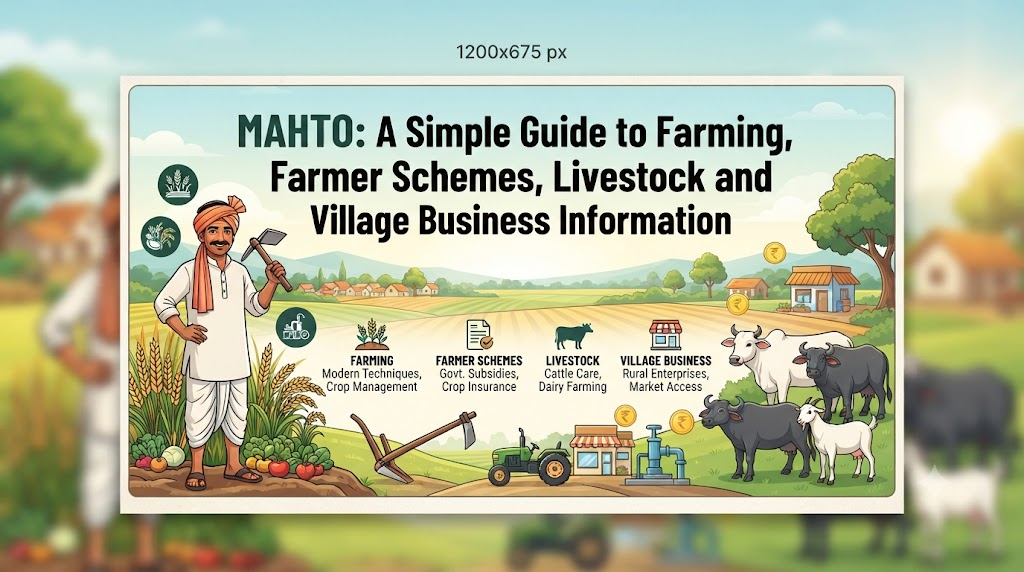
MAHTO is a Hindi-first rural knowledge platform built for Indian farmers, agricultural families, rural entrepreneurs, and village communities. It covers agriculture, farmer schemes, livestock, mandi prices, weather-related farming guidance, and village business opportunities. This article explains what the platform covers and how readers can use this kind of information to make careful, practical decisions.
What Is MAHTO?
MAHTO is an information platform for rural India. Its main goal is to explain useful topics in simple language rather than in complicated official or technical wording.
It serves farmers, members of agricultural households, people who want to start a small rural business, and anyone interested in village development. Its subject areas include:
- Crop guidance, irrigation, soil testing, fertilizers, pest control, crop calendars, and organic farming
- Government schemes such as PM-Kisan, PM Fasal Bima Yojana, Kisan Credit Card, Soil Health Card, and state-level farmer schemes
- Livestock topics such as dairy farming, poultry, fish farming, goat farming, vaccination, and animal nutrition
- Mandi-price information and weather-related farming guidance
- Village business ideas and other ways to explore additional income
Simple explanations matter because a person may miss a benefit or make a costly mistake just because a form, rule, or farming term was hard to understand. A short, clear explanation of eligibility, documents, or steps can save time and confusion. Agriculture, schemes, animals, and small businesses are also closely linked in village life. A family may grow crops, keep a few animals, need a loan, and look for a side business, all in the same year.
Why Reliable Rural Information Matters
Farming decisions carry real risk. A wrong choice of seed, a missed document, or an unplanned investment can cost money and effort that a family cannot easily recover.
Good information helps in several ways:
- Crop decisions: Understanding soil, water, and season helps farmers avoid practices that do not suit their land.
- Government benefits: Knowing the eligibility rules and documents in advance reduces rejected or delayed applications.
- Market decisions: Knowing how prices differ across markets helps farmers plan when and where to sell.
- Animal care: Understanding feed, housing, and vaccination helps prevent avoidable losses.
- Income planning: Looking at demand, cost, and risk before investing protects a family’s savings.
No article, including this one, can replace current official instructions or local expert advice. Scheme rules change, prices move daily, and every district has its own soil and weather. The best use of any information source is to learn the basics, prepare questions, and then confirm the details locally.
Understanding Agriculture Through Simple Guidance
Many farmers prefer to learn in their own language. Clear farming information in Hindi helps them follow topics such as crop selection, soil preparation, irrigation, fertilizer use, pest control, seasonal planning, and harvest preparation without getting stuck on difficult terms.
Take soil testing as an example. A soil test shows the nutrient status and other soil conditions of a field. With that knowledge, a farmer can discuss fertilizer needs with a local agricultural officer instead of guessing. A crop calendar works in a similar way. It gives a general idea of the sowing and harvesting periods for a region, so that work and spending can be planned ahead.
The right approach always depends on the crop variety, soil type, rainfall, and local conditions. A practice that works well in one district may not suit another. General guidance is a starting point, and local advice should shape the final decision.
Understanding Farmer Welfare Schemes
Government schemes can support farmers in areas such as income, insurance, credit, and soil care. The challenge is that the rules, forms, and documents can be hard to follow. Anyone researching government schemes for farmers should look at the same set of points for each scheme:
- Eligibility: Who can apply, and who cannot?
- Benefits: What does the scheme actually provide?
- Documents: What papers are needed, and do the names and numbers match across them?
- Application steps: Where and how is the application made?
- Status checks: How can the applicant track progress?
The schemes commonly discussed in this space include PM-Kisan, PM Fasal Bima Yojana (crop insurance), Kisan Credit Card, and Soil Health Card, along with schemes run by individual states. Not every farmer qualifies for every scheme, and conditions can differ by state or by farm. The official scheme portal or the nearest agriculture office is the right place to confirm current rules.
PM-Kisan Verification
PM-Kisan is a income-support scheme for eligible farmer families. Under this scheme, eKYC refers to an identity verification step linked to a beneficiary’s record. Readers who search for PM Kisan eKYC should understand that verification methods and instructions can be updated over time.
A sensible approach is to:
- Check the official PM-Kisan portal or a local common service centre for the latest instructions.
- Make sure the name, Aadhaar details, and bank account information are consistent across records.
- Ask a local agriculture office if there is a mismatch or an error that cannot be fixed easily.
Deadlines, payment dates, and verification methods should only be taken from official sources, not from forwarded messages or unverified posts.
Learning About Agricultural Credit
A Kisan Credit Card is designed to help eligible farmers access credit for farming-related needs through banks. Farmers researching this option should ask the bank about:
- Current eligibility conditions
- Documents required, such as identity proof, address proof, and land records
- Interest conditions and repayment terms
- The credit limit that may apply to their situation
- Which banks and branches handle the process locally
Approval and loan amounts are decided by the lending institution. No one can promise either in advance, so beware of anyone who does.
Understanding Mandi Prices
Selling at the right time and place can affect how much a farmer earns from a harvest. That is why many farmers want to know how to check mandi prices. Prices are usually available through government market-information portals, local mandi boards, and farmer-focused information services. A farmer can also ask the local market committee directly.
When comparing prices, look at these factors:
- Crop and variety: Different varieties may sell at different rates.
- Market location: Nearby mandis can show different prices on the same day.
- Date: Prices change daily and seasonally, so old data can mislead.
- Quality and grade: Moisture, cleanliness, and grade can change the rate.
- Price unit: Prices may be shown per quintal, per kilogram, or another unit. Always check which one.
Prices differ because supply, demand, transport cost, quality, and local conditions are different in each market. For this reason, a price seen in a message or a video should never be treated as today’s price unless it comes from a verified source.
Learning Paddy Cultivation
Paddy is one of the most widely grown crops in India, and the way it is grown varies a great deal by region. For readers who want to understand how to grow paddy, the main stages are as follows.
- Choosing a variety: Select a variety suited to the local climate, water availability, and growing season. Local agricultural universities or extension offices can suggest options.
- Preparing the field: Ploughing, levelling, and bunding prepare the field to hold water properly.
- Seed and nursery: In the transplanting method, seedlings are raised in a nursery bed first. Seed treatment and good seed quality help early growth.
- Transplanting or direct sowing: Seedlings are moved to the main field, or seeds are sown directly, depending on the method and the region.
- Water and nutrient management: Water level and fertilizer timing matter at different growth stages. A soil test helps in deciding fertilizer needs.
- Weed and pest control: Regular field checks help farmers spot weeds and pests early, so they can follow local recommendations for control.
- Harvest planning: Harvesting at the right maturity and drying the grain properly help protect quality.
Timing, water use, and methods depend on the area, soil, climate, and variety. No single method suits every location, so local guidance is important.
Exploring Goat Farming
Goat farming attracts many rural families because it can be started on a small scale. Anyone thinking about how to start goat farming should plan these points first:
- Purpose and scale: Is the aim meat, milk, breeding, or a mix? Starting small allows a person to learn before expanding.
- Breed choice: Choose breeds that suit the local climate and the intended purpose. A local veterinary officer can advise.
- Housing: Goats need a dry, clean, well-ventilated shelter that protects them from heat, rain, and predators.
- Feed and water: A regular supply of fodder, suitable feed, and clean water is essential.
- Veterinary support: Identify a nearby veterinarian before buying animals.
- Vaccination and disease prevention: Follow a vaccination and deworming schedule advised by a qualified veterinarian.
- Breeding and records: Keep simple records of births, health, feed, and expenses.
- Costs: Include the initial costs, such as animals and shelter, and regular costs, such as feed and medicine.
- Market demand: Find out who buys goats locally and when demand rises.
Income from goat farming depends on many factors and cannot be guaranteed.
Exploring Organic Farming
Organic farming focuses on keeping the soil healthy and reducing dependence on synthetic inputs where it is suitable. Farmers who want to know how to start organic farming should understand these basics:
- Soil health: Compost, farmyard manure, and green manure can improve soil structure and fertility.
- Crop rotation: Rotating crops can help manage pests and maintain soil nutrients.
- Responsible pest management: Regular field monitoring and carefully chosen methods can reduce the need for chemical pesticides.
- Transition planning: Moving from conventional to organic farming can take time, and yields may change during the transition.
- Certification: If produce will be sold as certified organic, the farmer must meet the certification requirements. These should be checked with the relevant authority.
Organic farming is not automatically cheaper or more profitable. Costs, yields, and selling prices vary, so it is wise to start on a small plot and seek guidance from local experts.
Understanding Livestock Management
Healthy animals are the base of any dairy, poultry, fish, or goat activity. Good livestock farming information covers:
- Nutrition: Balanced feed and clean water support growth and production.
- Clean housing: Dry, hygienic shelter reduces the spread of disease.
- Vaccination: Timely vaccination protects animals from common diseases.
- Breeding management: Planned breeding and good records help a farmer manage the herd or flock.
- Veterinary care: A qualified veterinarian should diagnose and treat illness.
Home remedies and advice from unverified sources can harm animals. When an animal looks sick, the right step is to call a veterinarian, not to experiment with treatment.
Exploring Rural Income Opportunities
Many families look for extra income alongside farming. Village business ideas that are often discussed include dairy activities, poultry, goat rearing, food processing, local services, and businesses that support agriculture, such as input supply or equipment rental.
Before starting, a person should look at:
- Local demand: Will people nearby buy the product or service?
- Investment: How much money is needed to start, and how much is available?
- Skills: Does the person have the knowledge, or can they learn it first?
- Resources: Are space, water, electricity, labour, and transport available?
- Operating costs and risks: What are the regular expenses, and what can go wrong?
Income from a new business depends on many things, and profit is never assured.
Connecting Information With Practical Decisions
Information is most useful when it leads to better questions. A reader can use rural knowledge resources to learn the basics, note down what is unclear, and then take those questions to the right person. That may be a local agricultural officer, a bank manager, a veterinary professional, or an extension service worker. This habit keeps decisions grounded in local reality.
A Hypothetical Example
Imagine a farmer who wants to try a new crop next season. He first reads basic guidance on the crop, then checks local weather information and a soil test report. Next, he compares a couple of suitable methods and estimates the costs. Finally, he visits the local agriculture office to confirm the variety and timing before buying seed. He has not taken a risky decision based on a single source. He has used general knowledge to prepare, and local advice to decide.
A Practical Five-Step Process
- Identify the question. Decide whether it concerns farming, a scheme, livestock, or a business.
- Find relevant information. Look for recent, clear guidance on that specific topic.
- Check official or local sources. Confirm requirements and recommendations with official portals or local offices.
- Compare options, costs, and risks. Write down the expected expenses and what could go wrong.
- Seek qualified advice. Talk to an agricultural, veterinary, or banking professional before making an important decision.
Common Mistakes to Avoid
- Relying on outdated scheme information: Rules and procedures change, so always check the latest official details.
- Missing a required document: One missing or mismatched paper can delay an application.
- Trusting unverified mandi prices: Prices from forwarded messages may be old or wrong.
- Using the same method everywhere: A method that suits one region may fail in another.
- Ignoring soil and water conditions: These decide what a field can support.
- Starting livestock farming without a cost plan: Feed, shelter, and medical costs add up quickly.
- Expecting guaranteed profit from a business: Every business carries risk.
- Treating animals without veterinary guidance: Wrong treatment can make an illness worse.
Useful Table: Information to Verify Before Acting
| Area | What to check | Where to confirm |
|---|---|---|
| Government schemes | Eligibility, documents, steps, status | Official scheme portal, local agriculture office |
| Kisan Credit Card | Terms, interest conditions, documents | Bank branch |
| Mandi prices | Date, market, grade, unit | Government market portal, local mandi |
| Paddy cultivation | Variety, timing, water, nutrients | Agricultural university, extension office |
| Goat or livestock farming | Breed, shelter, vaccination, costs | Veterinary officer |
| Village business | Demand, investment, risks | Local market, relevant department |
Frequently Asked Questions
Where can farmers find farming information in Hindi?
Farmers can use Hindi-language rural knowledge platforms, local agriculture offices, farmer helplines, and extension services. It helps to compare information from more than one reliable source.
What should farmers check before applying for a government scheme?
They should check eligibility, benefits, required documents, the application process, and the latest official instructions.
What does PM Kisan eKYC mean?
It refers to an identity verification step connected to a farmer’s record under the PM-Kisan scheme. Current methods should be confirmed on the official portal.
What should people understand about a Kisan Credit Card?
It is a credit option for eligible farmers for farming needs. Approval, limits, and terms are decided by the bank, so farmers should confirm the details with it.
Why do mandi prices vary between markets?
Supply, demand, quality, transport costs, and local conditions differ from market to market and from day to day.
What factors matter in paddy cultivation?
Variety, soil, water availability, climate, nutrient management, and pest control all matter.
What should be planned before starting goat farming?
Plan the purpose, breed, shelter, feed, veterinary support, vaccination, costs, and local demand.
What should beginners know about organic farming?
They should know that it relies on soil health and careful management, that the transition takes time, and that certification may be needed for selling certified organic produce.
What should farmers consider before starting a village business?
Consider demand, investment, skills, resources, operating costs, and risks.
Why is veterinary guidance important in livestock farming?
A qualified veterinarian can correctly diagnose illness and suggest safe treatment and vaccination, which protects the animals and the farmer’s investment.
Conclusion
Rural families make important decisions about crops, schemes, animals, and small businesses, and clear information makes those decisions easier. MAHTO brings these topics together in simple language so readers can understand the basics and know what to ask next. The most useful habit is to learn the general idea, confirm current details through official or local sources, and seek qualified advice before acting. That approach keeps choices practical and grounded in real conditions.