Introduction
Day trading looks exciting from the outside. People see charts moving up and down, green profit arrows, and the idea of making money from home in just a few hours. Because of this image, thousands of new participants enter the markets every year.
However, statistics show that the vast majority of day traders lose money over time. This happens because trading is not a game of luck; it is a high-pressure environment that tests human psychology and decision-making.
When people start trading, they often focus entirely on how to make a profit. They spend hours looking for the “best indicator” or the “secret strategy.” But experienced market participants know a simpler truth: surviving in the market is mostly about avoiding costly mistakes.
This article explores the most common mistakes intraday traders make daily, why those mistakes happen, and how you can fix them to protect your hard-earned money.
What Is Intraday Trading?
Intraday trading—often called day trading—is the practice of buying and selling stocks, currencies, or other assets within the same trading day. All positions are closed before the market closes for the day. No positions are carried overnight.
Why Does It Matter?
Because trades last only minutes or hours, day traders try to profit from small price movements. This requires fast decisions, constant attention, and strict control over emotions. A small mistake that a long-term investor might ignore can wipe out an intraday trader in seconds.
The Most Common Intraday Trading Mistakes
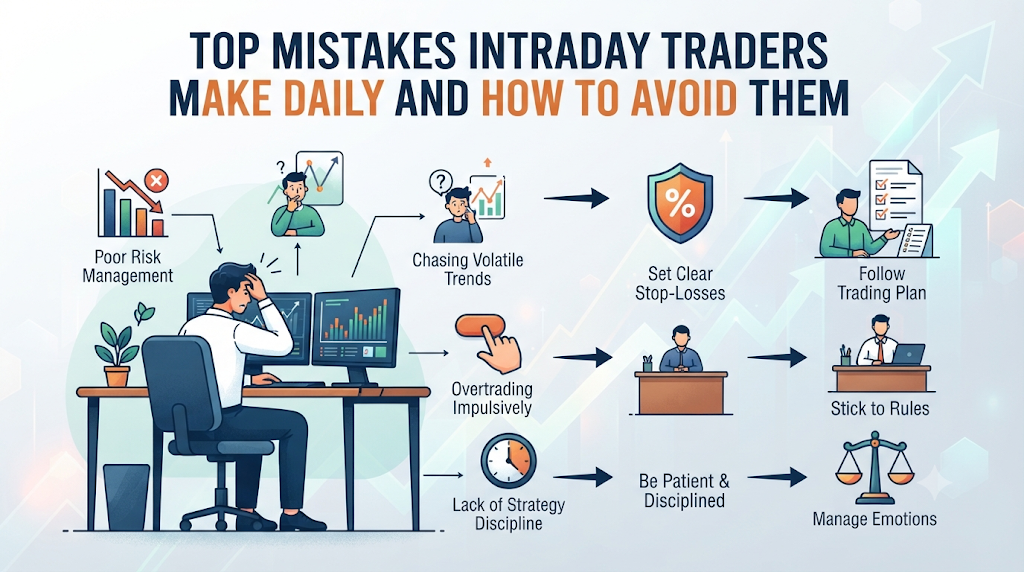
1. Trading Without a Stop-Loss
A stop-loss is an order set with a broker to automatically sell a security when its price drops to a certain level. It acts as a safety net to limit how much money you can lose on a single trade.
- What traders do: They enter a trade without setting a stop-loss, hoping the price will bounce back if it moves against them.
- Why they do it: Hope and optimism. Admitting a trade is wrong feels uncomfortable, so traders wait and pray for a market reversal.
- Why it causes problems: The market can move fast. A small loss can quickly turn into a massive disaster that wipes out weeks of profits.
- What to do instead: Always decide your maximum acceptable loss before entering a trade. Place your stop-loss immediately when you execute the order, and never move it further away to give a losing trade more “room to breathe.”
2. Overtrading Out of Boredom or Frustration
Overtrading happens when a trader places too many trades or trades with sizes that are too large for their account.
- What traders do: They take low-quality setups just to stay active, or they jump back into the market immediately after a loss to try and win their money back.
- Why they do it: Boredom during slow market hours, or emotional anger (often called “revenge trading”) after taking a loss.
- Why it causes problems: Every trade costs money in broker fees and commissions. More trades also mean more exposure to market risk, which quickly drains your trading account.
- What to do instead: Accept that waiting is a core part of trading. Set a strict daily limit on the number of trades you will take. If you hit your loss limit for the day, close your trading platform and walk away.
3. Chasing the Market (FOMO)
FOMO stands for “Fear Of Missing Out.” It happens when a stock price shoots up rapidly, and a trader jumps in late because they cannot bear watching others make money.
- What traders do: They buy a stock near its peak because it is green and moving fast, ignoring technical levels or risk management.
- Why they do it: Greed and social pressure. Seeing a fast-moving chart triggers an emotional rush.
- Why it causes problems: Markets move in waves. When a stock rises quickly without a pause, early buyers are ready to take their profits. If you buy at the top, you become the person they sell to—leaving you holding the bag when the price crashes.
- What to do instead: Wait for a pullback or a consolidation phase. If a big move happens without you, let it go. There is always another trading opportunity around the corner.
4. Holding Losing Positions Too Long and Cutting Winners Short
This is one of the most destructive psychological traps in trading.
- What traders do: When a trade goes into profit, they panic and sell immediately to lock in a tiny gain. But when a trade goes into a loss, they hold onto it for hours, hoping it will turn around.
- Why they do it: Human psychology prefers the comfort of being right over the math of making money. Taking a small profit feels good, while accepting a loss feels like failure.
- Why it causes problems: If your average winning trade makes $20, but your average losing trade costs $200, you need an extremely high win rate just to break even. Math will eventually destroy an account run this way.
- What to do instead: Let your winning trades run toward your target levels, and cut your losing trades quickly according to your plan. Focus on your risk-to-reward ratio.
5. Ignoring the Broader Market Trend
Many beginners focus only on a single stock chart, ignoring what the major market indices (like the S&P 500, Nifty, or Nasdaq) are doing.
- What traders do: They buy a stock because it looks strong on a 5-minute chart, even while the overall stock market is in a heavy downward spiral.
- Why they do it: Tunnel vision. Traders get so focused on a specific pattern that they forget context.
- Why it causes problems: A rising tide lifts all boats, and a crashing tide drags everything down. Most individual stocks follow the general direction of the broader market. Fighting the main trend is like swimming against a strong river current.
- What to do instead: Always check the daily chart of the main market index before your trading session begins. Align your intraday trades with the direction of the broader market.
Why Intraday Trading Fails for Most People
Trading looks simple on paper: buy low, sell high. But execution is difficult because it requires fighting your own natural instincts.
When humans face danger or financial loss, our brains trigger a “fight or flight” response. In trading, this causes panic selling, stubborn holding of losers, and emotional revenge trades. Success in day trading does not come from finding a magical indicator. It comes from emotional control, risk management, and treating trading like a disciplined business rather than a casino.
Practical Example: A Tale of Two Traders
- Trader A (The Beginner): Opens a trading account with $2,000. Sees a tech stock shooting up. Buys without a stop-loss out of FOMO. The stock drops 5%. Trader A holds, hoping for a bounce. The stock drops 15%. Panicked, Trader A sells at a massive loss. Angry, Trader A immediately enters three more bad trades to win the money back, wiping out half their account by lunchtime.
- Trader B (The Disciplined Trader): Opens an account with $2,000. Checks the morning market trend. Identifies a stock near a strong support level. Enters the trade with a clear stop-loss set 1% below support, risking only $20. The trade goes down, hits the stop-loss automatically, and Trader B accepts the small, controlled loss. Later, another clean setup appears, resulting in a $60 profit. Trader B ends the day ahead because losses were small and controlled.
A Simple Decision-Making Framework for Every Trade
Before you click the buy or sell button on any trade, run through this quick mental checklist:
- What is the overall market trend? (Are we going up, down, or sideways?)
- Where is my entry point? (Is it based on a clear rule or pattern?)
- Where will I place my stop-loss? (What is my maximum risk?)
- Where is my profit target? (Is the potential reward at least double the risk?)
- Am I trading because of logic or because of FOMO/anger?
If your answer to the last question points to emotion, close the platform immediately.
Key Terms
- Stop-Loss Order: An automatic instruction given to a broker to sell a security when it reaches a specific price, limiting potential losses.
- Risk-to-Reward Ratio: A comparison of the potential profit of a trade versus its potential loss (for example, risking $50 to make $150 is a 1:3 ratio).
- FOMO (Fear Of Missing Out): An emotional state where a trader rushes into a trade out of anxiety that they will miss a profitable market move.
- Overtrading: The habit of placing too many trades or trading with excessive size, leading to high transaction costs and unnecessary risk.
- Support Level: A price level where a falling stock tends to stop falling because buying interest is strong.
- Resistance Level: A price level where a rising stock tends to stop rising because selling pressure is strong.
Frequently Asked Questions
Can I do intraday trading with a small amount of money?
Yes, most modern brokers allow you to start with small amounts. However, day trading requires managing risk carefully. Starting small helps you learn without risking significant financial harm.
Do I need a complicated strategy to succeed?
No. Many successful day traders use simple strategies based on support, resistance, and moving averages. Consistency and risk management matter much more than a complex strategy.
How much time do I need to spend day trading?
Intraday trading is a full-time commitment during market hours. Even if you only place one or two trades, you need to monitor charts, wait for setups, and manage open positions actively.
What is the biggest difference between investing and day trading?
Investing involves holding assets for months or years based on business fundamentals. Day trading involves buying and selling within the same day based on short-term price movements and technical charts.
How do I stop revenge trading?
The best way to stop revenge trading is to set a daily loss limit. Once your account hits that loss limit, your trading platform goes off for the rest of the day, with no exceptions.
Is intraday trading a guaranteed source of income?
No. In fact, studies show that most day traders lose money. It requires skill, discipline, emotional control, and continuous practice.
Conclusion
Intraday trading can be rewarding, but it is also unforgiving. The market does not care about your hopes, your feelings, or how badly you need money. It simply rewards discipline and punishes mistakes.
By eliminating common errors like trading without stop-losses, chasing price spikes, and revenge trading, you give yourself a fighting chance. Protect your capital first, focus on the process rather than the daily profit, and treat every loss as a cheap lesson in market survival.