Introduction
Lakehouse Platforms are modern data architectures that combine the flexibility of data lakes with the structured performance of data warehouses. They allow organizations to store, process, and analyze all types of data including structured, semi-structured, and unstructured data in a single unified system.
Traditional data architectures often separate data lakes and data warehouses, which leads to duplication, higher cost, and complex pipelines. Lakehouse platforms solve this by unifying both layers into a single architecture optimized for analytics, machine learning, and real-time processing.
Common use cases include business intelligence, machine learning pipelines, real-time analytics, data engineering workflows, and enterprise data consolidation.
Key evaluation factors include scalability, performance, query speed, data governance, AI/ML integration, support for open table formats, security, and ease of use.
Best for data engineers, analytics teams, AI/ML developers, and enterprises managing large-scale data systems. Not ideal for simple applications or small datasets.
Key Trends in Lakehouse Platforms
- Strong shift toward unified data architectures
- Rapid adoption of open table formats like Delta Lake, Iceberg, and Hudi
- Integration of AI and machine learning workflows
- Real-time + batch processing convergence
- Serverless lakehouse adoption increasing
- Strong focus on data governance and lineage tracking
- Multi-cloud and hybrid deployment strategies
- Performance optimization for analytics workloads
- Expansion of SQL + AI hybrid systems
- Growing enterprise adoption across industries
How We Selected These Tools (Methodology)
- Enterprise adoption and market presence
- Performance and scalability under heavy workloads
- Support for structured and unstructured data
- Integration with AI and analytics ecosystems
- Query performance and reliability
- Cloud-native architecture maturity
- Security and governance capabilities
- Open-source ecosystem strength
- Ease of deployment and operations
- Innovation in lakehouse architecture
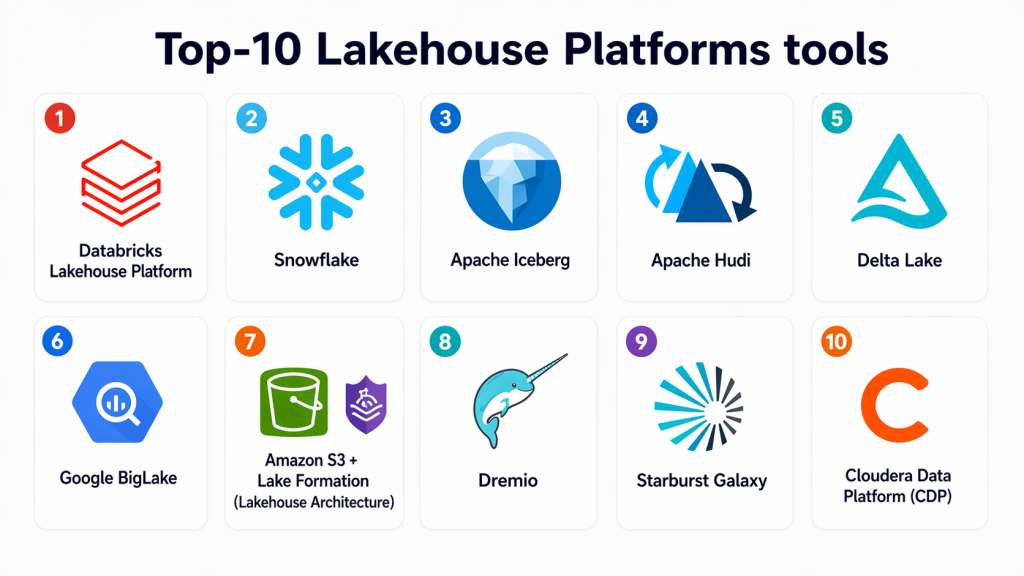
Top 10 Lakehouse Platforms
1 — Databricks Lakehouse Platform
Databricks is one of the most widely used lakehouse platforms combining data engineering, analytics, and AI in a single system.
Key Features
- Unified lakehouse architecture
- Delta Lake storage layer
- Real-time and batch processing
- Built-in machine learning tools
- Apache Spark-based engine
- Data governance features
- Collaborative notebooks
Pros
- Strong AI/ML capabilities
- Highly scalable architecture
- Unified analytics platform
Cons
- Complex learning curve
- Can be expensive at scale
Platforms / Deployment
Cloud / Hybrid
Security & Compliance
Role-based access control, encryption support, enterprise governance
Integrations & Ecosystem
Apache Spark, BI tools, AI frameworks, cloud storage
Support & Community
Strong enterprise adoption and developer ecosystem
2 — Snowflake
Snowflake provides a cloud-native data platform with strong lakehouse capabilities for structured and semi-structured data.
Key Features
- Separation of compute and storage
- Multi-cloud support
- High concurrency performance
- Secure data sharing
- Time travel capabilities
- Semi-structured data support
- Elastic scaling
Pros
- Easy to use
- Strong performance
- Highly scalable
Cons
- Expensive at scale
- Cloud dependency
Platforms / Deployment
Cloud (multi-cloud)
Security & Compliance
Encryption, RBAC, enterprise-grade compliance
Integrations & Ecosystem
BI tools, ETL pipelines, ML platforms, analytics systems
Support & Community
Strong global enterprise support
3 — Apache Iceberg
Apache Iceberg is an open table format designed for large-scale lakehouse architectures.
Key Features
- Open table format
- Schema evolution support
- Time travel capabilities
- Partition evolution
- High-performance querying
- Engine compatibility
- Scalable metadata layer
Pros
- Open-source flexibility
- Strong scalability
- Engine-agnostic design
Cons
- Not a full platform alone
- Requires ecosystem setup
Platforms / Deployment
Cloud / Self-hosted / Hybrid
Security & Compliance
Depends on underlying infrastructure
Integrations & Ecosystem
Spark, Flink, Trino, cloud storage systems
Support & Community
Strong open-source community
4 — Apache Hudi
Apache Hudi is a lakehouse framework focused on incremental processing and streaming ingestion.
Key Features
- Incremental data processing
- Streaming ingestion support
- Upserts and deletes
- Data versioning
- Real-time analytics support
- Integration with big data tools
- Scalable architecture
Pros
- Strong streaming support
- Efficient updates
- Open-source flexibility
Cons
- Complex setup
- Requires ecosystem knowledge
Platforms / Deployment
Cloud / Hybrid
Security & Compliance
Depends on storage layer
Integrations & Ecosystem
Spark, Flink, Hadoop ecosystem
Support & Community
Active open-source community
5 — Delta Lake
Delta Lake is a storage layer that brings reliability and performance to data lake architectures.
Key Features
- ACID transactions
- Schema enforcement
- Time travel
- Batch and streaming support
- Optimized storage
- Data versioning
- Spark integration
Pros
- Strong data consistency
- Reliable lakehouse foundation
- Easy Spark integration
Cons
- Spark dependency
- Requires tuning
Platforms / Deployment
Cloud / Hybrid
Security & Compliance
Encryption, RBAC support
Integrations & Ecosystem
Databricks, Spark, cloud storage systems
Support & Community
Strong enterprise adoption
6 — Google BigLake
BigLake is Google’s unified storage layer for lakehouse analytics.
Key Features
- Unified lake and warehouse access
- Serverless architecture
- BigQuery integration
- Multi-format support
- Fine-grained access control
- Scalable querying
- AI integration support
Pros
- Strong Google ecosystem
- Serverless scalability
- Easy integration
Cons
- Google dependency
- Pricing complexity
Platforms / Deployment
Cloud
Security & Compliance
IAM-based access control, encryption
Integrations & Ecosystem
BigQuery, AI tools, data pipelines
Support & Community
Strong enterprise support
7 — Amazon S3 + Lake Formation
AWS Lakehouse architecture built using S3 and governance tools.
Key Features
- Centralized storage
- Fine-grained governance
- Data cataloging
- Scalable architecture
- Analytics integration
- Access control management
- Query engine support
Pros
- Highly scalable
- Strong AWS ecosystem
- Flexible architecture
Cons
- Complex setup
- Multiple services required
Platforms / Deployment
Cloud (AWS)
Security & Compliance
IAM, encryption, enterprise compliance
Integrations & Ecosystem
Redshift, Athena, EMR, ML services
Support & Community
Enterprise AWS support
8 — Dremio
Dremio is a lakehouse platform focused on fast SQL analytics.
Key Features
- SQL acceleration engine
- Data virtualization
- Apache Iceberg support
- Semantic layer
- Query optimization
- Self-service analytics
- Cloud-native architecture
Pros
- Fast query performance
- Easy analytics access
- Strong SQL layer
Cons
- Requires tuning
- Enterprise features complex
Platforms / Deployment
Cloud / Hybrid
Security & Compliance
RBAC, encryption, governance
Integrations & Ecosystem
BI tools, cloud storage, data lakes
Support & Community
Strong enterprise adoption
9 — Starburst Galaxy
Starburst is a distributed SQL engine for lakehouse analytics.
Key Features
- Distributed SQL engine
- Data federation
- High-performance queries
- Iceberg support
- Multi-source querying
- Scalable architecture
- Real-time analytics
Pros
- Fast distributed queries
- Strong federation support
- Cloud-native design
Cons
- Complex architecture
- Requires SQL expertise
Platforms / Deployment
Cloud / Hybrid
Security & Compliance
Enterprise-grade controls, encryption
Integrations & Ecosystem
Data lakes, BI tools, cloud storage
Support & Community
Strong enterprise support
10 — Cloudera Data Platform (CDP)
Cloudera CDP is an enterprise lakehouse platform with strong governance and hybrid capabilities.
Key Features
- Unified data platform
- Hybrid cloud support
- Data governance tools
- Streaming and batch processing
- Security framework
- Machine learning integration
- Scalable storage
Pros
- Strong enterprise governance
- Hybrid flexibility
- Big data support
Cons
- Complex setup
- High cost
Platforms / Deployment
Cloud / Hybrid / On-premise
Security & Compliance
Enterprise security, advanced governance
Integrations & Ecosystem
Hadoop ecosystem, BI tools, AI platforms
Support & Community
Strong enterprise support
Comparison Table (Top 10)
| Tool | Best For | Platform | Deployment | Standout Feature | Public Rating |
|---|---|---|---|---|---|
| Databricks | AI + analytics | Cross-platform | Cloud | Lakehouse engine | N/A |
| Snowflake | Cloud analytics | Cross-platform | Cloud | Hybrid architecture | N/A |
| Iceberg | Open table format | Cross-platform | Hybrid | Schema evolution | N/A |
| Hudi | Streaming data | Cross-platform | Hybrid | Incremental processing | N/A |
| Delta Lake | Reliable storage | Cross-platform | Hybrid | ACID support | N/A |
| BigLake | Google ecosystem | Google Cloud | Cloud | Unified access layer | N/A |
| AWS Lakehouse | AWS analytics | AWS | Cloud | S3-based lakehouse | N/A |
| Dremio | SQL analytics | Cross-platform | Hybrid | Query acceleration | N/A |
| Starburst | Distributed SQL | Cross-platform | Hybrid | Data federation | N/A |
| Cloudera CDP | Enterprise big data | Cross-platform | Hybrid | Governance layer | N/A |
Evaluation & Scoring
| Tool | Core (25%) | Ease (15%) | Integrations (15%) | Security (10%) | Performance (10%) | Support (10%) | Value (15%) | Total |
|---|---|---|---|---|---|---|---|---|
| Databricks | 9 | 8 | 9 | 9 | 10 | 9 | 8 | 8.9 |
| Snowflake | 9 | 9 | 9 | 9 | 9 | 9 | 8 | 8.9 |
| Iceberg | 8 | 7 | 9 | 8 | 9 | 8 | 9 | 8.3 |
| Hudi | 8 | 7 | 8 | 8 | 8 | 8 | 9 | 8.0 |
| Delta Lake | 9 | 8 | 9 | 8 | 9 | 9 | 8 | 8.6 |
| BigLake | 8 | 8 | 9 | 9 | 9 | 9 | 8 | 8.5 |
| AWS Lakehouse | 9 | 7 | 9 | 9 | 9 | 9 | 8 | 8.5 |
| Dremio | 8 | 8 | 8 | 8 | 9 | 8 | 8 | 8.3 |
| Starburst | 8 | 7 | 8 | 8 | 9 | 8 | 8 | 8.1 |
| Cloudera CDP | 9 | 6 | 8 | 9 | 9 | 9 | 7 | 8.2 |
Which Lakehouse Platform Should You Choose?
Solo developers can start with Delta Lake or Apache Iceberg for flexible data experimentation. SMBs and SaaS companies often prefer Dremio or Snowflake for balanced performance and ease of use. Mid-market organizations benefit from Databricks or Starburst for advanced analytics and scalability. Enterprises typically choose Databricks, Snowflake, or Cloudera CDP for governance-heavy and AI-driven workloads. Budget users can rely on open-source options like Iceberg and Hudi, while premium enterprise users prefer Databricks and Snowflake.
Frequently Asked Questions
What is a lakehouse platform?
It combines data lake flexibility with data warehouse performance.
Why is lakehouse architecture used?
It reduces complexity and unifies data storage and analytics.
Is Databricks a lakehouse platform?
Yes, it is one of the leading lakehouse platforms.
What is Delta Lake used for?
It provides reliability and ACID transactions for data lakes.
Is Snowflake a lakehouse?
It supports lakehouse capabilities through hybrid architecture.
What is Apache Iceberg?
It is an open table format for scalable lakehouse systems.
Can lakehouses handle real-time data?
Yes, most support streaming and batch processing.
Do lakehouse platforms use SQL?
Yes, most support SQL-based querying.
What industries use lakehouses?
Finance, SaaS, healthcare, retail, and AI-driven companies.
Is lakehouse better than data warehouse?
It depends on use case; lakehouse offers more flexibility.
Conclusion
Lakehouse Platforms are transforming modern data architectures by unifying data lakes and warehouses into a single scalable system. They support analytics, AI, and real-time processing within one environment. Each platform has unique strengths depending on performance, ecosystem, and governance needs. Choosing the right solution depends on workload complexity and cloud strategy. A pilot-based evaluation is recommended before final deployment.