Introduction
AIOps Platforms (Artificial Intelligence for IT Operations) are tools that use AI, machine learning, and big data analytics to automate and enhance IT operations. These platforms analyze massive volumes of telemetry data—logs, metrics, and events—to detect anomalies, predict issues, and automate incident resolution.
In modern IT environments driven by cloud computing, microservices, and distributed systems, traditional monitoring tools struggle with data overload and alert noise. AIOps platforms solve this by correlating events, reducing noise, and identifying root causes faster, enabling teams to shift from reactive troubleshooting to proactive operations.
Real-World Use Cases
- Detecting anomalies and predicting outages
- Automating incident response and remediation
- Reducing alert noise and prioritizing issues
- Root cause analysis across distributed systems
- Optimizing cloud and infrastructure performance
What Buyers Should Evaluate
- AI/ML capabilities and automation depth
- Event correlation and noise reduction
- Integration with monitoring and ITSM tools
- Scalability across hybrid/multi-cloud environments
- Real-time analytics and dashboards
- Root cause analysis accuracy
- Ease of deployment and usability
- Cost and ROI
Best for: Enterprises, DevOps teams, SREs, and IT operations teams managing complex, large-scale infrastructure.
Not ideal for: Small teams with simple systems or minimal monitoring needs.
Key Trends in AIOps Platforms
- AI-driven root cause analysis and automation
- Integration with observability platforms
- Adoption of OpenTelemetry and unified data pipelines
- Event correlation and alert noise reduction
- Predictive analytics and proactive issue detection
- ChatOps and automation workflows
- Multi-cloud and hybrid environment support
- Integration with ITSM tools like Jira and ServiceNow
- AI agents and autonomous operations (AgentOps evolution)
- Focus on reducing MTTR and operational costs
How We Selected These Tools (Methodology)
- Industry adoption and market presence
- Depth of AI/ML capabilities
- Integration with DevOps and ITSM ecosystems
- Scalability and reliability
- Automation and workflow orchestration
- Security and compliance considerations
- Balance of enterprise and modern cloud-native tools
- Real-world usage across industries
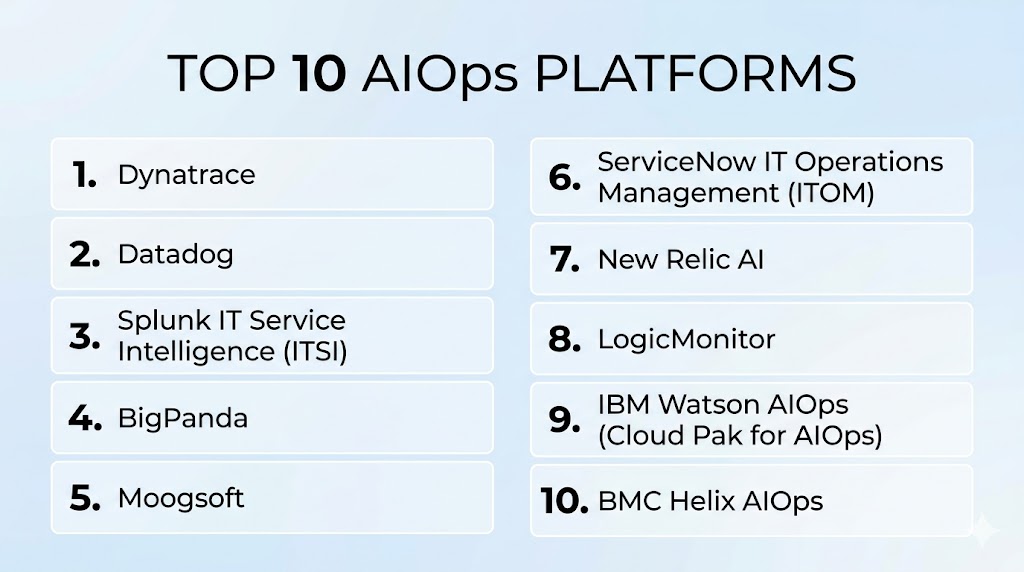
Top 10 AIOps Platforms
#1 — Dynatrace
Short description: A leading AIOps platform with AI-powered observability and automated root cause analysis.
Key Features
- AI engine (Davis AI)
- Full-stack observability
- Automatic root cause analysis
- Cloud-native monitoring
- Business analytics
Pros
- Strong AI automation
- Deep system visibility
Cons
- Expensive
- Learning curve
Platforms / Deployment
Web
Cloud / Hybrid
Security & Compliance
RBAC, audit logs
Not publicly stated
Integrations & Ecosystem
- Cloud platforms
- Kubernetes
- DevOps tools
Support & Community
Enterprise-grade support
#2 — Datadog
Short description: A unified observability platform with built-in AIOps capabilities.
Key Features
- AI anomaly detection
- Metrics, logs, traces
- Alert correlation
- Dashboards
- Cloud integrations
Pros
- Strong integrations
- Easy to use
Cons
- Pricing complexity
- Expensive at scale
Platforms / Deployment
Web
Cloud
Security & Compliance
RBAC, encryption
Not publicly stated
Integrations & Ecosystem
- AWS, Azure
- CI/CD tools
Support & Community
Strong community
#3 — Splunk AIOps
Short description: An enterprise platform combining observability, analytics, and AI-driven insights.
Key Features
- Log and event analytics
- AI-driven insights
- Incident correlation
- Real-time monitoring
- Dashboards
Pros
- Powerful analytics
- Enterprise-ready
Cons
- Expensive
- Complex setup
Platforms / Deployment
Web
Cloud / Hybrid
Security & Compliance
RBAC, encryption
Not publicly stated
Integrations & Ecosystem
- DevOps tools
- Enterprise systems
Support & Community
Enterprise support
#4 — Moogsoft
Short description: A dedicated AIOps platform focused on event correlation and noise reduction.
Key Features
- Event correlation
- Alert noise reduction
- Root cause analysis
- Automation workflows
- AI insights
Pros
- Strong AIOps focus
- Reduces alert fatigue
Cons
- Niche tool
- Limited ecosystem
Platforms / Deployment
Web
Cloud
Security & Compliance
Not publicly stated
Integrations & Ecosystem
- Monitoring tools
- ITSM platforms
Support & Community
Growing support
#5 — BigPanda
Short description: A platform specializing in event correlation and incident intelligence.
Key Features
- Event correlation
- Incident automation
- Root cause analysis
- Alerts
- Analytics
Pros
- Strong alert reduction
- Enterprise-ready
Cons
- Expensive
- Requires integration
Platforms / Deployment
Web
Cloud
Security & Compliance
Not publicly stated
Integrations & Ecosystem
- Monitoring tools
- ITSM tools
Support & Community
Enterprise support
#6 — ServiceNow ITOM (AIOps)
Short description: An enterprise IT operations platform with built-in AIOps capabilities.
Key Features
- Incident automation
- Event management
- AI insights
- Workflow automation
- ITSM integration
Pros
- Strong enterprise ecosystem
- Scalable
Cons
- Expensive
- Complex setup
Platforms / Deployment
Web
Cloud / Hybrid
Security & Compliance
RBAC, audit logs
Not publicly stated
Integrations & Ecosystem
- ServiceNow ecosystem
- DevOps tools
Support & Community
Enterprise support
#7 — New Relic AI
Short description: A modern observability platform with AI-driven anomaly detection and insights.
Key Features
- Anomaly detection
- Event correlation
- Distributed tracing
- Alerts
- Dashboards
Pros
- Developer-friendly
- Flexible pricing
Cons
- Complex UI
- Data costs
Platforms / Deployment
Web
Cloud
Security & Compliance
RBAC, encryption
Not publicly stated
Integrations & Ecosystem
- Cloud platforms
- DevOps tools
Support & Community
Strong documentation
#8 — LogicMonitor (Edwin AI)
Short description: A monitoring platform with AI-driven automation and anomaly detection.
Key Features
- AI-powered insights
- Anomaly detection
- Root cause analysis
- Monitoring
- Alerts
Pros
- Strong automation
- Easy monitoring
Cons
- Paid solution
- Limited customization
Platforms / Deployment
Web
Cloud
Security & Compliance
Not publicly stated
Integrations & Ecosystem
- Cloud platforms
- DevOps tools
Support & Community
Enterprise support
#9 — OpsRamp
Short description: A unified IT operations platform with AIOps capabilities.
Key Features
- Event correlation
- Incident management
- Automation workflows
- Monitoring
- Analytics
Pros
- Unified platform
- Strong automation
Cons
- Learning curve
- Pricing
Platforms / Deployment
Web
Cloud
Security & Compliance
Not publicly stated
Integrations & Ecosystem
- Monitoring tools
- ITSM systems
Support & Community
Enterprise support
#10 — OpenObserve
Short description: An AI-native observability platform with AIOps capabilities.
Key Features
- Log and metrics analysis
- AI insights
- Real-time monitoring
- Dashboards
- Observability integration
Pros
- Modern architecture
- Scalable
Cons
- Newer platform
- Smaller ecosystem
Platforms / Deployment
Web
Cloud / Self-hosted
Security & Compliance
Not publicly stated
Integrations & Ecosystem
- Observability tools
- Cloud platforms
Support & Community
Growing support
Comparison Table (Top 10)
| Tool Name | Best For | Platform(s) Supported | Deployment | Standout Feature | Public Rating |
|---|---|---|---|---|---|
| Dynatrace | Enterprise | Web | Hybrid | AI root cause analysis | N/A |
| Datadog | Cloud teams | Web | Cloud | Unified observability | N/A |
| Splunk | Enterprise | Web | Hybrid | Data analytics | N/A |
| Moogsoft | AIOps focus | Web | Cloud | Noise reduction | N/A |
| BigPanda | Incident correlation | Web | Cloud | Event intelligence | N/A |
| ServiceNow | ITSM integration | Web | Hybrid | Workflow automation | N/A |
| New Relic | Dev teams | Web | Cloud | Flexibility | N/A |
| LogicMonitor | Monitoring | Web | Cloud | AI insights | N/A |
| OpsRamp | IT ops | Web | Cloud | Unified platform | N/A |
| OpenObserve | Modern teams | Web | Hybrid | AI-native | N/A |
Evaluation & Scoring of AIOps Platforms
| Tool Name | Core | Ease | Integrations | Security | Performance | Support | Value | Weighted Total |
|---|---|---|---|---|---|---|---|---|
| Dynatrace | 10 | 7 | 9 | 10 | 9 | 9 | 7 | 9.0 |
| Datadog | 10 | 8 | 10 | 9 | 9 | 9 | 7 | 9.0 |
| Splunk | 10 | 7 | 9 | 9 | 9 | 9 | 6 | 8.8 |
| Moogsoft | 9 | 7 | 8 | 8 | 8 | 8 | 7 | 8.2 |
| BigPanda | 9 | 7 | 8 | 8 | 8 | 8 | 7 | 8.2 |
| ServiceNow | 10 | 7 | 9 | 10 | 9 | 9 | 6 | 8.9 |
| New Relic | 9 | 8 | 9 | 9 | 8 | 9 | 8 | 8.7 |
| LogicMonitor | 9 | 8 | 8 | 8 | 9 | 8 | 7 | 8.4 |
| OpsRamp | 9 | 7 | 8 | 8 | 9 | 8 | 7 | 8.3 |
| OpenObserve | 8 | 8 | 7 | 7 | 8 | 7 | 9 | 8.0 |
How to interpret scores:
These scores compare platforms based on AI capabilities, usability, and value. Enterprise tools excel in automation and compliance, while newer platforms offer flexibility and cost efficiency.
Which AIOps Platform Is Right for You?
Solo / Freelancer
OpenObserve or New Relic for simplicity and cost efficiency.
SMB
Datadog and LogicMonitor for ease of use and scalability.
Mid-Market
OpsRamp and BigPanda for automation and integrations.
Enterprise
Dynatrace and ServiceNow for advanced AI and workflows.
Budget vs Premium
- Budget: OpenObserve
- Premium: Dynatrace, Splunk
Feature Depth vs Ease of Use
- Feature-rich: Dynatrace
- Easy-to-use: Datadog
Integrations & Scalability
- Best integrations: Datadog
- Scalable: ServiceNow
Security & Compliance Needs
- Strong security: ServiceNow
- Moderate: New Relic
Frequently Asked Questions (FAQs)
What is AIOps?
AIOps uses AI and machine learning to automate IT operations and improve efficiency.
Why is AIOps important?
It reduces alert noise, detects issues early, and automates resolution.
How does AIOps work?
It analyzes logs, metrics, and events to detect anomalies and automate responses.
Do AIOps tools replace monitoring tools?
No, they enhance and integrate with existing monitoring systems.
Are AIOps platforms expensive?
Enterprise tools can be costly; newer platforms offer flexible pricing.
Do they integrate with ITSM tools?
Yes, most integrate with tools like ServiceNow and Jira.
Can small teams use AIOps?
Yes, but benefits are higher in complex environments.
What data do AIOps tools analyze?
Logs, metrics, traces, and events.
Do they support automation?
Yes, automation is a core feature.
What is the best AIOps platform?
Depends on your infrastructure, scale, and requirements.
Conclusion
AIOps Platforms are transforming IT operations by combining AI, automation, and observability into a unified approach. They help teams reduce noise, identify root causes faster, and automate repetitive tasks—leading to improved reliability and efficiency. While enterprise tools like Dynatrace and ServiceNow offer deep capabilities, modern platforms like OpenObserve provide flexibility and cost efficiency. The best choice depends on your system complexity, team size, and budget. Start by shortlisting a few tools, testing them in your environment, and validating their ability to deliver actionable insights and automation.