Introduction
Firewall Management Tools are software solutions that help organizations configure, monitor, optimize, and automate firewall policies across networks. Instead of manually managing individual firewall devices, these tools provide centralized control, visibility, and compliance management for security teams.
With increasing cyber threats, distributed networks, and hybrid cloud environments, firewall management has become more complex than ever. Misconfigured firewall rules are one of the most common causes of security breaches. Modern tools address this challenge by offering automation, policy analysis, risk detection, and compliance auditing capabilities.
Real-world use cases include:
- Managing firewall rules across multiple vendors and locations
- Auditing and ensuring compliance with security policies
- Detecting risky or redundant firewall rules
- Automating policy updates and change management
- Improving visibility into network traffic and threats
What buyers should evaluate:
- Multi-vendor firewall support
- Policy automation and orchestration
- Risk analysis and compliance features
- Ease of use and centralized management
- Integration with SIEM and security tools
- Scalability across hybrid and cloud environments
- Real-time monitoring and alerting
- Reporting and audit capabilities
- Cost versus value
Best for: Security teams, network administrators, enterprises, MSPs, and organizations managing complex or multi-vendor firewall environments.
Not ideal for: Small businesses with single firewall setups or basic security requirements.
Key Trends in Firewall Management Tools
- AI-driven policy analysis and risk detection
- Automation of firewall rule lifecycle management
- Cloud-native firewall orchestration
- Integration with Zero Trust security frameworks
- Centralized visibility across hybrid environments
- Compliance automation for regulatory standards
- API-first platforms for DevSecOps workflows
- Real-time threat intelligence integration
- Increased focus on misconfiguration detection
- Subscription-based SaaS deployment models
How We Selected These Tools (Methodology)
- Evaluated market presence and industry adoption
- Assessed feature depth and innovation
- Reviewed policy management and automation capabilities
- Considered security and compliance features
- Analyzed integration with broader security ecosystems
- Included tools for enterprise and mid-market use cases
- Compared ease of deployment and usability
- Looked at scalability and performance
- Focused on real-world applicability and flexibility
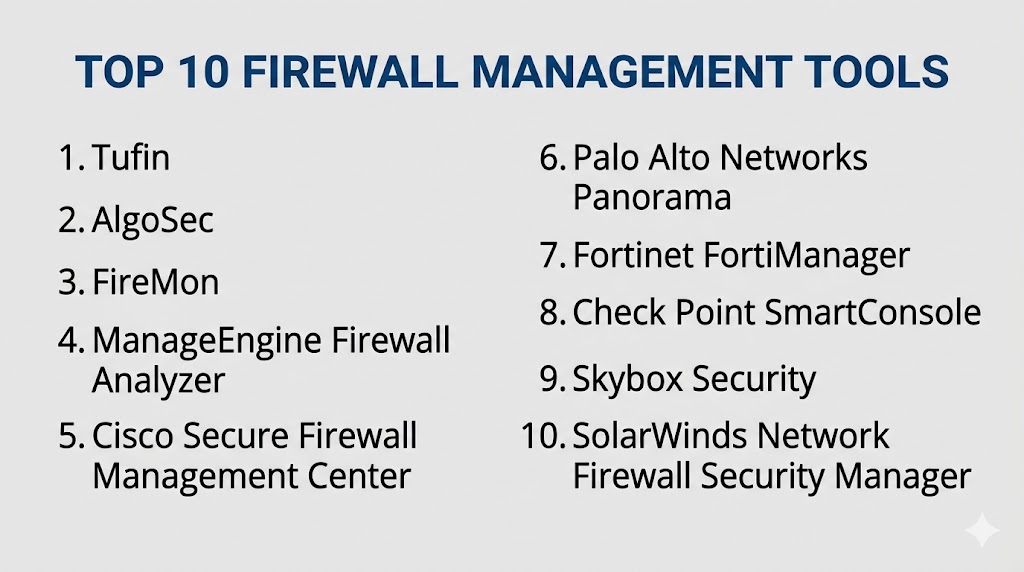
Top 10 Firewall Management Tools
#1 — Tufin
Short description: A leading firewall management platform focused on policy automation, compliance, and multi-vendor network security orchestration.
Key Features
- Centralized firewall policy management
- Automated rule lifecycle management
- Risk analysis and compliance auditing
- Multi-vendor support
- Network topology visualization
- Change management workflows
Pros
- Strong automation capabilities
- Excellent multi-vendor support
Cons
- Complex setup
- High cost
Platforms / Deployment
Web / Appliance
Hybrid
Security & Compliance
RBAC, audit logs (certifications not publicly stated)
Integrations & Ecosystem
Tufin integrates with major security and networking tools for centralized control.
- SIEM platforms
- Network devices
- APIs for automation
Support & Community
Enterprise-level support and strong documentation.
#2 — AlgoSec
Short description: A comprehensive firewall and network security management solution focused on policy optimization and compliance.
Key Features
- Firewall rule analysis
- Automated policy management
- Risk and compliance reporting
- Application-centric visibility
- Change automation
- Multi-vendor support
Pros
- Strong compliance features
- User-friendly interface
Cons
- Premium pricing
- Requires training for advanced features
Platforms / Deployment
Web
Cloud / Hybrid
Security & Compliance
RBAC, compliance automation (specific certifications not publicly stated)
Integrations & Ecosystem
Broad integration with enterprise security ecosystems.
- SIEM tools
- Cloud platforms
- APIs
Support & Community
Strong enterprise support and training resources.
#3 — FireMon
Short description: A firewall security management platform offering visibility, compliance, and risk reduction across networks.
Key Features
- Policy management and optimization
- Real-time risk analysis
- Compliance reporting
- Traffic flow analysis
- Change monitoring
- Multi-vendor support
Pros
- Strong visibility features
- Effective compliance tracking
Cons
- UI can feel outdated
- Complex deployment
Platforms / Deployment
Web / Appliance
Hybrid
Security & Compliance
RBAC, audit logs (details not publicly stated)
Integrations & Ecosystem
Integrates with major enterprise security tools.
- SIEM platforms
- Network devices
- APIs
Support & Community
Good documentation and enterprise support.
#4 — ManageEngine Firewall Analyzer
Short description: A cost-effective firewall monitoring and management tool focused on traffic analysis and compliance.
Key Features
- Firewall log analysis
- Bandwidth monitoring
- Compliance reporting
- Alerting and notifications
- Traffic visualization
Pros
- Affordable
- Easy to deploy
Cons
- Limited advanced automation
- Less suitable for large enterprises
Platforms / Deployment
Windows / Linux
On-premises
Security & Compliance
Not publicly stated
Integrations & Ecosystem
Works within ManageEngine ecosystem and supports various firewalls.
- Network devices
- Reporting tools
Support & Community
Strong documentation and active community.
#5 — Cisco Secure Firewall Management Center
Short description: A centralized management platform for Cisco firewalls offering advanced security and policy control.
Key Features
- Centralized policy management
- Threat detection and analytics
- Integration with Cisco ecosystem
- Real-time monitoring
- Automation capabilities
Pros
- Deep Cisco integration
- Strong security capabilities
Cons
- Vendor lock-in
- Complex configuration
Platforms / Deployment
Appliance / Cloud
Hybrid
Security & Compliance
Encryption, RBAC (certifications not publicly stated)
Integrations & Ecosystem
Extensive Cisco ecosystem integration.
- Cisco devices
- Threat intelligence
- APIs
Support & Community
Enterprise-grade support and large community.
#6 — Palo Alto Networks Panorama
Short description: A centralized firewall management solution designed for Palo Alto Networks environments.
Key Features
- Centralized policy management
- Log aggregation and analysis
- Automation and orchestration
- Device group management
- Security policy enforcement
Pros
- Strong performance
- Scalable for enterprises
Cons
- Vendor-specific
- Expensive
Platforms / Deployment
Appliance / Cloud
Hybrid
Security & Compliance
RBAC, encryption (details not publicly stated)
Integrations & Ecosystem
Tightly integrated with Palo Alto ecosystem.
- Palo Alto firewalls
- Security tools
Support & Community
Strong enterprise support and resources.
#7 — Fortinet FortiManager
Short description: A centralized management solution for Fortinet firewalls with automation and scalability features.
Key Features
- Centralized policy control
- Device management
- Automation workflows
- Logging and reporting
- Multi-site management
Pros
- Scalable
- Strong Fortinet integration
Cons
- Vendor dependency
- Complex UI
Platforms / Deployment
Appliance / Cloud
Hybrid
Security & Compliance
RBAC, encryption (details not publicly stated)
Integrations & Ecosystem
Integrated within Fortinet ecosystem.
- Fortinet devices
- Security tools
Support & Community
Enterprise support with strong documentation.
#8 — Check Point SmartConsole
Short description: A unified management platform for Check Point firewalls offering centralized control and monitoring.
Key Features
- Centralized policy management
- Threat prevention integration
- Logging and monitoring
- Automation features
- Multi-domain management
Pros
- Strong security features
- Unified management
Cons
- Learning curve
- Vendor lock-in
Platforms / Deployment
Windows
On-premises / Cloud
Security & Compliance
RBAC, encryption (details not publicly stated)
Integrations & Ecosystem
Integrated with Check Point ecosystem.
- Security tools
- APIs
Support & Community
Strong enterprise support and documentation.
#9 — Skybox Security
Short description: A cybersecurity platform with firewall management, risk analysis, and vulnerability management capabilities.
Key Features
- Risk visualization
- Firewall policy analysis
- Vulnerability management
- Attack surface mapping
- Compliance reporting
Pros
- Strong risk analysis
- Good visualization tools
Cons
- Expensive
- Complex setup
Platforms / Deployment
Web
Hybrid
Security & Compliance
Not publicly stated
Integrations & Ecosystem
Integrates with enterprise security tools.
- SIEM platforms
- Vulnerability scanners
Support & Community
Enterprise support and professional services.
#10 — SolarWinds Network Firewall Security Manager
Short description: A firewall management tool focused on rule management, compliance, and policy automation.
Key Features
- Rule lifecycle management
- Compliance auditing
- Change tracking
- Risk analysis
- Reporting
Pros
- Easy to use
- Good compliance features
Cons
- Limited scalability
- Smaller ecosystem
Platforms / Deployment
Windows
On-premises
Security & Compliance
Not publicly stated
Integrations & Ecosystem
Supports integration with network devices.
- Firewalls
- Reporting tools
Support & Community
Moderate support and documentation.
Comparison Table (Top 10)
| Tool Name | Best For | Platform(s) Supported | Deployment | Standout Feature | Public Rating |
|---|---|---|---|---|---|
| Tufin | Enterprise | Web/Appliance | Hybrid | Policy automation | N/A |
| AlgoSec | Enterprise | Web | Hybrid | Compliance management | N/A |
| FireMon | Enterprise | Web/Appliance | Hybrid | Risk visibility | N/A |
| ManageEngine Firewall Analyzer | SMB | Windows/Linux | On-premises | Log analysis | N/A |
| Cisco Secure Firewall | Enterprise | Appliance/Cloud | Hybrid | Threat analytics | N/A |
| Palo Alto Panorama | Enterprise | Appliance/Cloud | Hybrid | Centralized control | N/A |
| Fortinet FortiManager | Enterprise | Appliance/Cloud | Hybrid | Device management | N/A |
| Check Point SmartConsole | Enterprise | Windows | Hybrid | Unified control | N/A |
| Skybox Security | Enterprise | Web | Hybrid | Risk mapping | N/A |
| SolarWinds Firewall Manager | SMB | Windows | On-premises | Rule tracking | N/A |
Evaluation & Scoring of Firewall Management Tools
| Tool Name | Core (25%) | Ease (15%) | Integrations (15%) | Security (10%) | Performance (10%) | Support (10%) | Value (15%) | Weighted Total (0–10) |
|---|---|---|---|---|---|---|---|---|
| Tufin | 9 | 7 | 9 | 8 | 9 | 8 | 6 | 8.1 |
| AlgoSec | 9 | 8 | 8 | 8 | 8 | 8 | 7 | 8.2 |
| FireMon | 8 | 7 | 8 | 8 | 8 | 7 | 7 | 7.8 |
| ManageEngine | 7 | 9 | 7 | 6 | 7 | 8 | 9 | 7.8 |
| Cisco | 9 | 6 | 9 | 9 | 9 | 9 | 6 | 8.4 |
| Palo Alto | 9 | 6 | 9 | 9 | 9 | 9 | 6 | 8.4 |
| Fortinet | 8 | 7 | 8 | 8 | 8 | 8 | 7 | 7.9 |
| Check Point | 8 | 6 | 8 | 9 | 8 | 8 | 6 | 7.8 |
| Skybox | 8 | 6 | 8 | 8 | 8 | 7 | 6 | 7.5 |
| SolarWinds | 7 | 8 | 6 | 6 | 7 | 7 | 8 | 7.2 |
Interpretation:
These scores are comparative and reflect typical enterprise and SMB use cases. Higher scores indicate stronger overall capabilities, but the best choice depends on your infrastructure, vendor ecosystem, and budget. Enterprise tools excel in features and integrations, while SMB tools offer better ease of use and cost efficiency.
Which Firewall Management Tool Is Right for You?
Solo / Freelancer
Basic firewall setups do not require advanced management tools. Lightweight monitoring tools may be sufficient.
SMB
ManageEngine and SolarWinds provide affordable and easy-to-use solutions for small to mid-sized environments.
Mid-Market
AlgoSec and FireMon offer a balance of automation, compliance, and usability.
Enterprise
Tufin, Cisco, Palo Alto, and Fortinet are ideal for complex, multi-vendor, and large-scale environments.
Budget vs Premium
Budget tools focus on monitoring and reporting, while premium tools deliver automation, compliance, and scalability.
Feature Depth vs Ease of Use
Advanced tools offer deeper control but require expertise, while simpler tools prioritize usability.
Integrations & Scalability
Large organizations need tools that integrate with multiple vendors and scale across environments.
Security & Compliance Needs
Highly regulated industries should prioritize tools with strong compliance and audit capabilities.
Frequently Asked Questions (FAQs)
1. What are firewall management tools used for?
They help centralize, automate, and optimize firewall policy management across networks.
2. Are these tools necessary for all organizations?
Not always. Smaller environments may manage firewalls manually.
3. Do these tools support multiple firewall vendors?
Many enterprise tools support multi-vendor environments.
4. Can firewall management tools improve security?
Yes, they reduce misconfigurations and improve policy enforcement.
5. Are there cloud-based firewall management tools?
Yes, many modern tools offer cloud or hybrid deployment options.
6. Do these tools help with compliance?
Yes, they provide reporting and auditing features for compliance requirements.
7. Can these tools automate firewall changes?
Yes, advanced tools include automation workflows.
8. How complex are these tools to use?
Enterprise tools can be complex, while SMB tools are easier to use.
9. What integrations are important?
SIEM, cloud platforms, and network devices are key integrations.
10. How do I choose the right tool?
Evaluate based on scale, budget, security needs, and integration requirements.
Conclusion
Firewall Management Tools are essential for maintaining secure, efficient, and compliant network environments in today’s complex infrastructure landscape. As networks grow and security requirements become more demanding, manual firewall management is no longer sufficient. Enterprise-grade solutions offer automation, visibility, and scalability, while SMB-focused tools provide simplicity and cost efficiency. The right choice depends on your organization’s size, existing infrastructure, and security priorities. Start by identifying your key requirements, shortlist a few tools, and test them in a controlled environment to ensure they align with your operational and security goals.