Introduction
Data Lake Platforms are centralized storage systems designed to store vast amounts of raw data in its native format, including structured, semi-structured, and unstructured data. Unlike traditional databases or data warehouses, data lakes prioritize flexibility and scalability over predefined schemas, making them ideal for modern big data and AI-driven workloads.
Organizations today generate massive volumes of data from applications, IoT devices, logs, APIs, and customer interactions. Data lake platforms allow businesses to store this raw data at scale and process it later for analytics, machine learning, and business intelligence.
Common use cases include:
- Big data analytics and processing
- Machine learning model training datasets
- IoT and sensor data storage
- Log and event data aggregation
- Data archival and long-term storage
- Real-time and batch data processing pipelines
Key evaluation factors include storage scalability, performance, security, integration with analytics tools, cost efficiency, data governance, and support for data processing frameworks.
Best for data engineers, data scientists, AI teams, and enterprises dealing with large-scale raw data. Not ideal for small structured datasets or simple transactional applications.
Key Trends in Data Lake Platforms
- Shift toward lakehouse architecture integration
- Strong adoption of cloud-native object storage systems
- Increasing use of AI and machine learning on lake data
- Growth of real-time streaming data ingestion
- Strong governance and data cataloging improvements
- Expansion of multi-cloud and hybrid lake strategies
- Better support for structured + unstructured data fusion
- Serverless data lake processing becoming standard
- Integration with open table formats like Iceberg and Delta Lake
- Increased automation in data lifecycle management
How We Selected These Tools (Methodology)
- Market adoption across enterprise data ecosystems
- Scalability and performance under large datasets
- Storage efficiency and cost optimization
- Integration with analytics and AI tools
- Security and governance capabilities
- Support for batch and streaming data processing
- Cloud-native readiness and flexibility
- Ecosystem maturity and vendor support
- Compatibility with open data formats
- Real-world enterprise usage
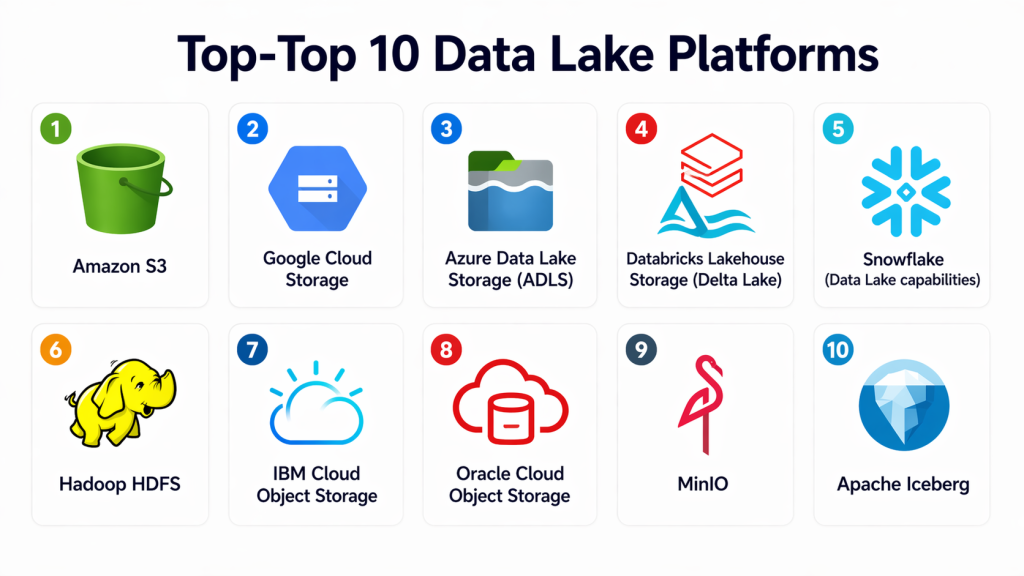
Top 10 Data Lake Platforms
1 — Amazon S3
Amazon S3 is one of the most widely used object storage systems forming the backbone of modern data lake architectures.
Key Features
- Highly scalable object storage
- Low-cost storage tiers
- High durability and availability
- Integration with AWS analytics services
- Lifecycle management policies
- Data encryption support
- Event-driven architecture support
Pros
- Extremely scalable
- Cost-efficient storage
- Strong AWS ecosystem integration
Cons
- Requires additional tools for analytics
- Complex configuration at scale
Platforms / Deployment
Cloud (AWS)
Security & Compliance
IAM-based access control, encryption at rest and transit, enterprise compliance support
Integrations & Ecosystem
AWS analytics tools, machine learning services, ETL pipelines, BI platforms
Support & Community
Strong enterprise AWS support
2 — Google Cloud Storage
Google Cloud Storage is a scalable object storage service used for building data lake architectures on Google Cloud.
Key Features
- Multi-region storage
- High scalability
- Object versioning support
- Strong data consistency
- Lifecycle rules
- Event-based processing
- Integration with BigQuery
Pros
- Easy integration with analytics tools
- Strong scalability
- High reliability
Cons
- Google ecosystem dependency
- Pricing complexity at scale
Platforms / Deployment
Cloud (Google Cloud)
Security & Compliance
IAM security model, encryption by default, enterprise-grade compliance
Integrations & Ecosystem
BigQuery, AI/ML tools, data pipelines, analytics systems
Support & Community
Strong Google enterprise support
3 — Azure Data Lake Storage (ADLS)
Azure Data Lake Storage is a scalable storage service optimized for analytics workloads in the Microsoft ecosystem.
Key Features
- Hierarchical namespace support
- High scalability
- Integration with Azure analytics tools
- Strong security model
- Fine-grained access control
- Big data optimization
- Event-driven processing
Pros
- Strong Azure integration
- Enterprise-ready security
- Good performance for analytics
Cons
- Complex setup
- Azure ecosystem dependency
Platforms / Deployment
Cloud (Azure)
Security & Compliance
Advanced RBAC, encryption, enterprise compliance support
Integrations & Ecosystem
Azure Synapse, Power BI, ML services, data pipelines
Support & Community
Strong Microsoft enterprise support
4 — Databricks Lakehouse Storage Layer
Databricks combines data lake storage with advanced processing capabilities using Delta Lake.
Key Features
- Delta Lake storage format
- ACID transactions
- Batch and streaming support
- Scalable architecture
- Machine learning integration
- Data versioning
- Real-time analytics support
Pros
- Strong AI/ML integration
- Unified data processing
- High scalability
Cons
- Cost increases with scale
- Requires learning curve
Platforms / Deployment
Cloud / Hybrid
Security & Compliance
RBAC, encryption, enterprise governance features
Integrations & Ecosystem
Spark, BI tools, AI frameworks, cloud storage systems
Support & Community
Strong enterprise adoption
5 — Snowflake Data Lake Storage
Snowflake supports data lake capabilities by enabling structured and semi-structured data storage.
Key Features
- External table support
- Multi-cloud storage compatibility
- High scalability
- Secure data sharing
- Time travel capability
- Semi-structured data handling
- Elastic compute separation
Pros
- Easy to manage
- Strong performance
- Scalable architecture
Cons
- Expensive at scale
- Cloud dependency
Platforms / Deployment
Cloud (multi-cloud)
Security & Compliance
Encryption, RBAC, enterprise compliance support
Integrations & Ecosystem
BI tools, ETL pipelines, analytics platforms, ML systems
Support & Community
Strong global enterprise adoption
6 — Apache Hadoop HDFS
HDFS is a distributed file system widely used as the foundation for on-premise data lake architectures.
Key Features
- Distributed storage system
- Fault tolerance
- High throughput access
- Horizontal scalability
- Data replication
- Batch processing support
- Big data ecosystem integration
Pros
- Strong scalability
- Reliable distributed storage
- Mature ecosystem
Cons
- Complex management
- Slower compared to cloud storage
Platforms / Deployment
Self-hosted / Hybrid
Security & Compliance
Kerberos authentication, enterprise security configurations
Integrations & Ecosystem
Spark, Hive, Hadoop ecosystem, big data tools
Support & Community
Strong enterprise and open-source support
7 — IBM Cloud Object Storage
IBM COS is a scalable object storage system used for enterprise data lake deployments.
Key Features
- Highly durable storage
- Geo-redundancy support
- Lifecycle policies
- Scalable architecture
- Security controls
- Data tiering options
- Cloud-native integration
Pros
- Strong enterprise reliability
- Cost-efficient storage
- Scalable design
Cons
- Smaller ecosystem
- Complex integration in hybrid setups
Platforms / Deployment
Cloud / Hybrid
Security & Compliance
Encryption, RBAC, enterprise compliance support
Integrations & Ecosystem
IBM analytics tools, BI platforms, data pipelines
Support & Community
Strong IBM enterprise support
8 — Oracle Cloud Object Storage
Oracle Object Storage is a cloud storage system designed for enterprise data lake use cases.
Key Features
- High durability storage
- Data lifecycle management
- Strong security model
- Scalable architecture
- Integration with Oracle analytics
- Event-driven processing
- Multi-region replication
Pros
- Strong enterprise integration
- High reliability
- Good performance
Cons
- Oracle ecosystem dependency
- Complex pricing
Platforms / Deployment
Cloud
Security & Compliance
Encryption, RBAC, enterprise-grade compliance
Integrations & Ecosystem
Oracle analytics, BI tools, enterprise systems
Support & Community
Strong Oracle enterprise support
9 — MinIO
MinIO is an open-source object storage system designed for high-performance data lakes.
Key Features
- S3-compatible storage
- High performance
- Scalable architecture
- Cloud-native design
- Kubernetes integration
- Encryption support
- Multi-cloud deployment
Pros
- Open-source flexibility
- High performance
- Easy cloud integration
Cons
- Requires manual management
- Limited enterprise tools
Platforms / Deployment
Self-hosted / Cloud / Hybrid
Security & Compliance
Encryption, access control, RBAC support
Integrations & Ecosystem
Kubernetes, AI tools, analytics systems
Support & Community
Strong open-source community
10 — Apache Iceberg (Data Lake Layer)
Apache Iceberg is an open table format used for managing large-scale data lake storage.
Key Features
- Open table format
- Schema evolution
- Time travel support
- Partition optimization
- Engine independence
- Scalable metadata handling
- High-performance querying
Pros
- Flexible architecture
- Strong scalability
- Open ecosystem
Cons
- Not a full platform alone
- Requires ecosystem tools
Platforms / Deployment
Cloud / Hybrid / Self-hosted
Security & Compliance
Depends on underlying storage system
Integrations & Ecosystem
Spark, Trino, Flink, cloud storage systems
Support & Community
Strong open-source adoption
Comparison Table (Top 10)
| Tool | Best For | Platform | Deployment | Standout Feature | Public Rating |
|---|---|---|---|---|---|
| Amazon S3 | Cloud data lakes | AWS | Cloud | Object storage scale | N/A |
| Google Cloud Storage | Analytics lakes | Google Cloud | Cloud | High consistency | N/A |
| ADLS | Enterprise analytics | Azure | Cloud | Hierarchical namespace | N/A |
| Databricks | AI + analytics | Cross-platform | Hybrid | Delta Lake engine | N/A |
| Snowflake | Cloud analytics | Multi-cloud | Cloud | External tables | N/A |
| Hadoop HDFS | Big data systems | Cross-platform | Hybrid | Distributed storage | N/A |
| IBM COS | Enterprise storage | IBM Cloud | Hybrid | Durable storage | N/A |
| Oracle Storage | Enterprise apps | Oracle Cloud | Cloud | Secure integration | N/A |
| MinIO | Open-source storage | Cross-platform | Hybrid | S3 compatibility | N/A |
| Apache Iceberg | Table management | Cross-platform | Hybrid | Schema evolution | N/A |
Evaluation & Scoring
| Tool | Core (25%) | Ease (15%) | Integrations (15%) | Security (10%) | Performance (10%) | Support (10%) | Value (15%) | Total |
|---|---|---|---|---|---|---|---|---|
| Amazon S3 | 9 | 9 | 9 | 9 | 9 | 9 | 8 | 8.9 |
| Google Storage | 9 | 8 | 9 | 9 | 9 | 9 | 8 | 8.7 |
| ADLS | 9 | 8 | 9 | 9 | 9 | 9 | 8 | 8.7 |
| Databricks | 9 | 8 | 9 | 9 | 10 | 9 | 8 | 8.9 |
| Snowflake | 9 | 9 | 9 | 9 | 9 | 9 | 8 | 8.9 |
| HDFS | 8 | 6 | 8 | 8 | 9 | 8 | 9 | 7.9 |
| IBM COS | 8 | 7 | 8 | 9 | 8 | 8 | 8 | 8.1 |
| Oracle Storage | 8 | 7 | 8 | 9 | 8 | 8 | 7 | 7.9 |
| MinIO | 8 | 8 | 8 | 8 | 9 | 8 | 9 | 8.4 |
| Iceberg | 8 | 7 | 9 | 8 | 9 | 8 | 9 | 8.3 |
Which Data Lake Platform Should You Choose?
Solo developers and small teams can start with MinIO or Apache Iceberg for flexible experimentation. SMBs and SaaS companies often prefer Amazon S3 or Google Cloud Storage for scalability and simplicity. Mid-market organizations benefit from Databricks or ADLS for analytics and AI workflows. Enterprises typically choose AWS, Azure, or Snowflake-based lake architectures for large-scale data operations. Budget users prefer open-source tools like HDFS or MinIO, while premium users rely on Databricks and Snowflake ecosystems. The choice depends on scalability needs, cloud strategy, and data complexity.
Frequently Asked Questions
What is a data lake?
It is a centralized storage system that holds raw data in its native format.
Why are data lakes used?
They enable scalable storage and advanced analytics on large datasets.
What is Amazon S3 used for?
It is used as a core storage layer for cloud-based data lakes.
Is Hadoop a data lake?
Hadoop provides the foundation for building on-premise data lakes.
What is Delta Lake?
It is a storage layer that improves reliability in data lakes.
What is the difference between data lake and warehouse?
Data lakes store raw data, while warehouses store structured processed data.
Can data lakes handle real-time data?
Yes, many modern systems support streaming ingestion.
Are data lakes cloud-based?
Most modern implementations are cloud-native.
Which industries use data lakes?
Finance, healthcare, SaaS, retail, and AI-driven companies.
Is Apache Iceberg a database?
No, it is an open table format for managing data lakes.
Conclusion
Data Lake Platforms are essential for modern organizations that need to store and process massive volumes of raw and diverse data. They provide the foundation for analytics, machine learning, and real-time data processing systems. Each platform offers unique strengths in scalability, performance, and ecosystem integration. Choosing the right solution depends on workload type, cloud strategy, and data complexity. A pilot-based evaluation approach is recommended before production deployment.