Introduction
Relational Database Management Systems (RDBMS) are software platforms designed to store, organize, manage, and retrieve structured data using tables, rows, and relationships. These systems rely on structured query language (SQL) to perform operations such as querying, updating, and maintaining data integrity across applications.
RDBMS remains the backbone of modern data infrastructure, powering everything from enterprise applications to small-scale systems. With growing data volumes and increasing demand for performance and scalability, modern RDBMS platforms now support cloud deployment, distributed architectures, high availability, and advanced analytics capabilities.
Common Use Cases
- Transactional systems (banking, e-commerce, ERP)
- Data warehousing and reporting
- Application backends for web and mobile apps
- Financial and operational data management
- Inventory and customer data systems
What Buyers Should Evaluate
- Performance and scalability
- SQL support and query optimization
- Data integrity and consistency features
- High availability and backup capabilities
- Cloud and hybrid deployment options
- Integration with analytics and BI tools
- Security and access control features
- Cost and licensing model
Best for: Enterprises, developers, data engineers, and organizations handling structured data with transactional requirements.
Not ideal for: Use cases involving unstructured or highly flexible data models, where NoSQL databases may be more suitable.
Key Trends in Relational Database Management Systems
- Growth of cloud-native RDBMS solutions
- Increased adoption of managed database services
- Integration with analytics and AI workloads
- Distributed and horizontally scalable architectures
- Automation of database operations and tuning
- Hybrid and multi-cloud database strategies
- Enhanced security and compliance features
- Real-time data processing capabilities
- Integration with DevOps pipelines
- Improved support for JSON and semi-structured data
How We Selected These Tools (Methodology)
- Strong global adoption and industry usage
- Proven reliability and performance
- Feature completeness for enterprise and developer needs
- Integration capabilities with modern ecosystems
- Scalability across different workloads
- Security and compliance readiness
- Suitability for SMB, mid-market, and enterprise use cases
- Product maturity and continuous innovation
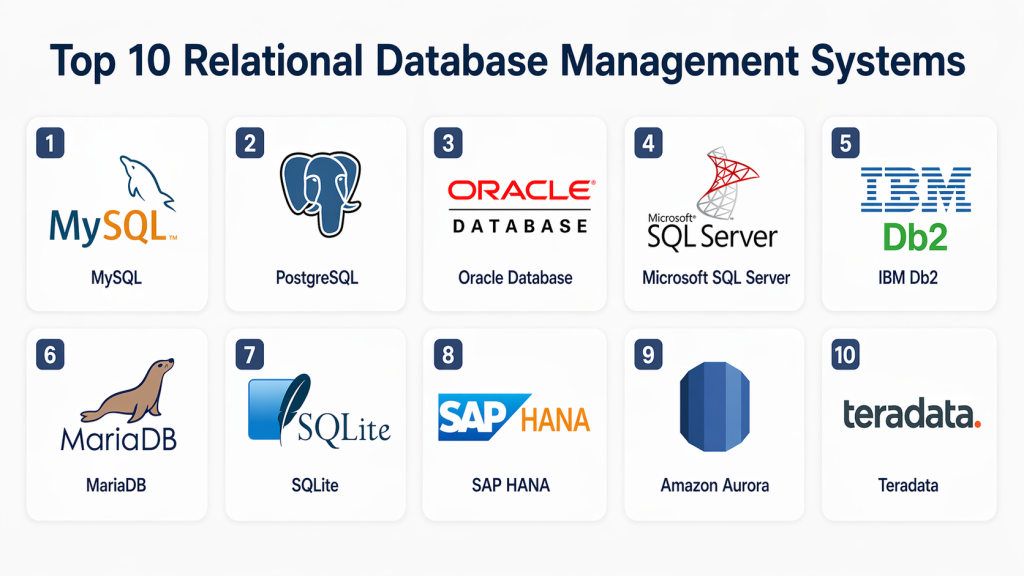
Top 10 Relational Database Management Systems
#1 — MySQL
Short description: Widely used open-source RDBMS known for reliability, performance, and ease of use.
Key Features
- SQL-based data management
- High performance
- Replication support
- Cross-platform compatibility
- Open-source flexibility
Pros
- Easy to learn and use
- Strong community support
Cons
- Limited advanced features compared to enterprise DBs
- Performance tuning required at scale
Platforms / Deployment
Windows / Linux / macOS / Cloud
Security & Compliance
Not publicly stated
Integrations & Ecosystem
- Web applications
- Cloud platforms
- APIs and frameworks
Support & Community
Large global community and enterprise support options.
#2 — PostgreSQL
Short description: Advanced open-source RDBMS known for extensibility and standards compliance.
Key Features
- Advanced SQL support
- Extensibility
- ACID compliance
- JSON support
- High reliability
Pros
- Highly flexible
- Strong performance
Cons
- Complex for beginners
- Requires expertise for tuning
Platforms / Deployment
Windows / Linux / macOS / Cloud
Security & Compliance
Not publicly stated
Integrations & Ecosystem
- APIs
- Data tools
- Analytics platforms
Support & Community
Active community and enterprise support.
#3 — Oracle Database
Short description: Enterprise-grade RDBMS designed for large-scale applications and high-performance workloads.
Key Features
- Advanced analytics
- High availability
- Security features
- Scalability
- Automation
Pros
- Enterprise-ready
- Strong performance
Cons
- Expensive
- Complex setup
Platforms / Deployment
Cloud / On-premises
Security & Compliance
Not publicly stated
Integrations & Ecosystem
- Enterprise systems
- Cloud platforms
- APIs
Support & Community
Enterprise-level support.
#4 — Microsoft SQL Server
Short description: Popular enterprise RDBMS integrated with Microsoft ecosystem and tools.
Key Features
- SQL support
- Business intelligence tools
- High availability
- Security features
- Performance tuning
Pros
- Strong Microsoft integration
- User-friendly tools
Cons
- Licensing cost
- Windows dependency (partially)
Platforms / Deployment
Windows / Linux / Cloud
Security & Compliance
Not publicly stated
Integrations & Ecosystem
- Azure services
- Microsoft tools
- APIs
Support & Community
Strong enterprise and community support.
#5 — IBM Db2
Short description: Enterprise RDBMS offering high performance and scalability for large organizations.
Key Features
- Data management
- High availability
- AI integration
- Performance optimization
- Security features
Pros
- Strong enterprise capabilities
- Reliable performance
Cons
- Complex configuration
- Expensive
Platforms / Deployment
Cloud / On-premises
Security & Compliance
Not publicly stated
Integrations & Ecosystem
- Enterprise systems
- APIs
- Analytics tools
Support & Community
Enterprise support.
#6 — MariaDB
Short description: Open-source fork of MySQL with enhanced performance and features.
Key Features
- SQL compatibility
- Performance optimization
- Replication
- Open-source flexibility
- Security features
Pros
- Compatible with MySQL
- Improved performance
Cons
- Ecosystem fragmentation
- Limited enterprise features
Platforms / Deployment
Windows / Linux / macOS / Cloud
Security & Compliance
Not publicly stated
Integrations & Ecosystem
- Web apps
- APIs
- Cloud platforms
Support & Community
Strong open-source community.
#7 — SQLite
Short description: Lightweight embedded RDBMS used for local storage in applications.
Key Features
- Embedded database
- Zero configuration
- Lightweight
- High reliability
- Cross-platform
Pros
- Simple and fast
- No server required
Cons
- Not suitable for large-scale systems
- Limited concurrency
Platforms / Deployment
Embedded / Cross-platform
Security & Compliance
Not publicly stated
Integrations & Ecosystem
- Mobile apps
- Embedded systems
Support & Community
Large community support.
#8 — SAP HANA
Short description: In-memory RDBMS designed for real-time analytics and enterprise applications.
Key Features
- In-memory processing
- Real-time analytics
- High performance
- Data integration
- Advanced analytics
Pros
- Extremely fast
- Strong enterprise features
Cons
- Expensive
- Requires specialized skills
Platforms / Deployment
Cloud / On-premises
Security & Compliance
Not publicly stated
Integrations & Ecosystem
- SAP ecosystem
- Enterprise apps
- APIs
Support & Community
Enterprise support.
#9 — Amazon Aurora
Short description: Cloud-native relational database service compatible with MySQL and PostgreSQL.
Key Features
- High availability
- Scalability
- Performance optimization
- Automated backups
- Cloud-native design
Pros
- Fully managed
- High performance
Cons
- AWS dependency
- Pricing complexity
Platforms / Deployment
Cloud
Security & Compliance
Not publicly stated
Integrations & Ecosystem
- AWS services
- APIs
- Cloud tools
Support & Community
Strong AWS support.
#10 — Teradata
Short description: Enterprise data warehouse platform designed for large-scale analytics and structured data management.
Key Features
- Data warehousing
- High scalability
- Performance optimization
- Advanced analytics
- Data integration
Pros
- Strong analytics capabilities
- Scalable
Cons
- Expensive
- Complex setup
Platforms / Deployment
Cloud / On-premises
Security & Compliance
Not publicly stated
Integrations & Ecosystem
- Enterprise systems
- Analytics tools
- APIs
Support & Community
Enterprise support.
Comparison Table (Top 10)
| Tool Name | Best For | Platform(s) Supported | Deployment | Standout Feature | Public Rating |
|---|---|---|---|---|---|
| MySQL | Web apps | Multi | Cloud/Local | Ease of use | N/A |
| PostgreSQL | Advanced apps | Multi | Cloud/Local | Extensibility | N/A |
| Oracle DB | Enterprise | Web | Cloud/On-prem | High performance | N/A |
| SQL Server | Microsoft users | Multi | Cloud/Local | BI integration | N/A |
| IBM Db2 | Enterprise | Web | Cloud/On-prem | Reliability | N/A |
| MariaDB | Open-source | Multi | Cloud/Local | MySQL compatibility | N/A |
| SQLite | Embedded | Multi | Local | Lightweight | N/A |
| SAP HANA | Analytics | Web | Cloud/On-prem | In-memory DB | N/A |
| Aurora | Cloud apps | Web | Cloud | Managed DB | N/A |
| Teradata | Data warehousing | Web | Cloud/On-prem | Analytics | N/A |
Evaluation & Scoring of RDBMS Tools
| Tool Name | Core (25%) | Ease (15%) | Integrations (15%) | Security (10%) | Performance (10%) | Support (10%) | Value (15%) | Weighted Total |
|---|---|---|---|---|---|---|---|---|
| MySQL | 8 | 9 | 8 | 7 | 8 | 9 | 9 | 8.4 |
| PostgreSQL | 9 | 7 | 9 | 8 | 9 | 9 | 9 | 8.8 |
| Oracle | 10 | 6 | 9 | 9 | 10 | 10 | 6 | 8.8 |
| SQL Server | 9 | 8 | 9 | 9 | 9 | 9 | 7 | 8.7 |
| IBM Db2 | 9 | 7 | 8 | 9 | 9 | 9 | 7 | 8.4 |
| MariaDB | 8 | 8 | 8 | 7 | 8 | 8 | 9 | 8.2 |
| SQLite | 7 | 10 | 6 | 6 | 7 | 8 | 10 | 7.9 |
| SAP HANA | 10 | 6 | 9 | 9 | 10 | 9 | 6 | 8.6 |
| Aurora | 9 | 8 | 9 | 8 | 9 | 9 | 7 | 8.6 |
| Teradata | 9 | 6 | 8 | 9 | 10 | 9 | 6 | 8.3 |
How to interpret scores:
These scores provide a comparative overview based on key evaluation criteria. Higher scores indicate stronger overall capability, but the best choice depends on your specific workload, environment, and business needs.
Which RDBMS Is Right for You?
Solo / Freelancer
SQLite and MySQL are simple and easy to use.
SMB
MySQL and MariaDB offer cost-effective solutions.
Mid-Market
PostgreSQL and SQL Server provide scalability and features.
Enterprise
Oracle, SAP HANA, and IBM Db2 deliver advanced capabilities.
Budget vs Premium
- Budget: MySQL, SQLite
- Premium: Oracle, SAP HANA
Feature Depth vs Ease of Use
- Easy: MySQL, SQLite
- Advanced: Oracle, PostgreSQL
Integrations & Scalability
Choose PostgreSQL or Aurora for scalability.
Security & Compliance Needs
Enterprise tools offer stronger compliance features.
Frequently Asked Questions (FAQs)
What is an RDBMS?
A system that manages structured data using tables and relationships.
Why use an RDBMS?
It ensures data integrity and supports complex queries.
Are RDBMS scalable?
Yes, modern systems support large-scale workloads.
Can RDBMS handle cloud environments?
Yes, many support cloud and hybrid deployments.
What is SQL?
A language used to interact with relational databases.
Are RDBMS secure?
Most provide strong security features.
Can small businesses use RDBMS?
Yes, many are suitable for SMBs.
What are alternatives?
NoSQL databases for unstructured data.
Do RDBMS support analytics?
Yes, many include analytics features.
Can RDBMS integrate with tools?
Yes, they support APIs and integrations.
Conclusion
Relational Database Management Systems remain a cornerstone of modern data infrastructure, providing reliable, structured data management for a wide range of applications. From lightweight embedded databases to enterprise-grade platforms, RDBMS solutions offer flexibility, scalability, and strong data integrity. The right choice depends on your workload, budget, and technical requirements, with some systems prioritizing ease of use while others deliver advanced enterprise capabilities. Instead of selecting a single “best” option, focus on aligning the system with your application needs and growth plans. Start by evaluating a few platforms, testing performance and integrations, and ensuring they meet your long-term data management goals.