Introduction
Multi-touch Attribution Tools help businesses understand how multiple marketing touchpoints contribute to leads, conversions, pipeline, revenue, and customer growth. Instead of giving all credit to the first or last interaction, these tools distribute credit across channels such as paid search, paid social, email, organic search, referrals, webinars, content, retargeting, and sales interactions.
Modern customer journeys are rarely linear. A buyer may discover a brand through an ad, return through search, read comparison content, engage with email, and finally convert after a sales call. Multi-touch Attribution Tools help teams see the full journey and make better decisions about budget allocation, campaign optimization, and revenue impact.
Common real-world use cases include:
- Measuring campaign influence across multiple channels
- Connecting marketing activity with pipeline and revenue
- Understanding customer journey paths before conversion
- Comparing first-touch, last-touch, and multi-touch models
- Improving spend allocation across paid and organic channels
Buyers evaluating Multi-touch Attribution Tools should consider:
- Attribution model flexibility
- CRM and advertising integrations
- Customer journey tracking accuracy
- Revenue and pipeline reporting
- Cross-channel data coverage
- Dashboard and visualization quality
- Privacy-safe tracking workflows
- Ease of implementation
- Security and access controls
- Scalability for growing marketing operations
Best for: B2B marketing teams, SaaS companies, ecommerce brands, agencies, performance marketers, revenue operations teams, and enterprises managing complex multi-channel campaigns.
Not ideal for: very small businesses with only one marketing channel, teams without reliable conversion tracking, or organizations that lack clean campaign, CRM, or revenue data.
Key Trends in Multi-touch Attribution Tools
- Privacy-first attribution is becoming more important as browser-based tracking becomes less reliable.
- Server-side tracking is improving data quality and reducing signal loss.
- B2B companies are prioritizing account-based journey attribution across buying committees.
- Ecommerce brands are combining multi-touch attribution with blended ROAS reporting.
- AI-powered journey analysis is helping teams identify high-impact campaign sequences faster.
- Attribution platforms are increasingly integrating with CRM, warehouse, and BI systems.
- Incrementality testing is being used alongside attribution to validate true campaign impact.
- Multi-touch reporting is shifting from channel credit to decision-ready revenue insights.
- Cross-device and cross-session identity resolution remain major challenges.
- Marketing and finance teams are demanding attribution reports tied to pipeline, revenue, and profitability.
How We Selected These Tools
The tools included in this list were selected based on attribution depth, reporting quality, integration support, scalability, and usability across different business models.
Evaluation factors included:
- Multi-touch attribution model support
- Customer journey visibility
- CRM and advertising platform integrations
- B2B and ecommerce suitability
- Revenue and pipeline reporting
- Dashboard quality and usability
- Privacy and tracking reliability
- Security and governance capabilities
- Ease of onboarding and maintenance
- Overall value for marketing decision-making
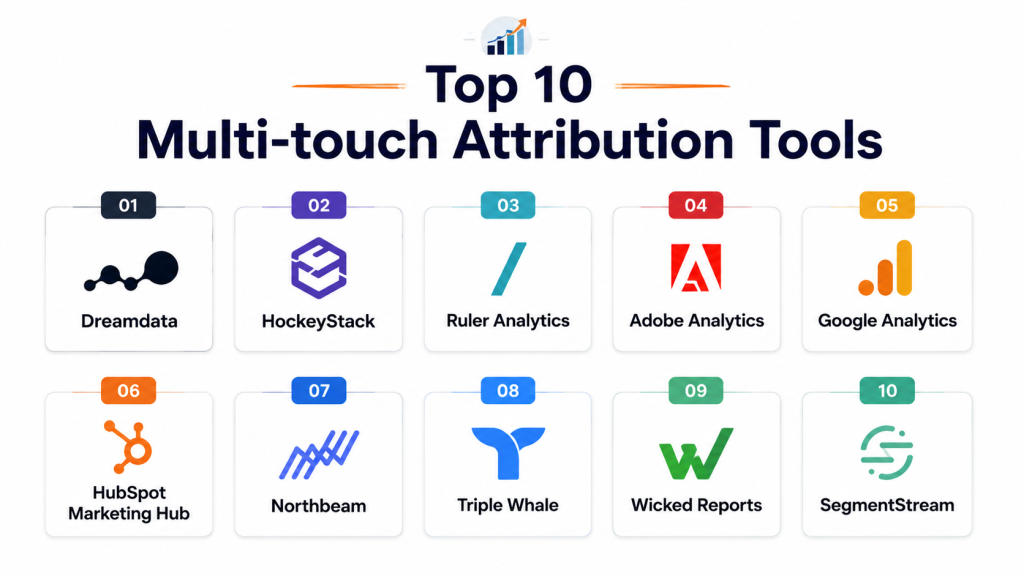
Top 10 Multi-touch Attribution Tools
#1 — Dreamdata
Short description: Dreamdata is a B2B revenue attribution platform designed for companies with long and complex customer journeys. It connects marketing, sales, product, and CRM touchpoints to show how campaigns influence pipeline and revenue. It is especially useful for SaaS and B2B teams running account-based marketing and demand generation programs.
Key Features
- Multi-touch revenue attribution
- Account-based journey tracking
- Pipeline analytics
- Campaign ROI dashboards
- CRM and ad platform integrations
- Funnel visibility
- Customer journey timelines
Pros
- Strong B2B revenue attribution workflows
- Good account-level visibility
- Useful for SaaS and revenue operations teams
Cons
- Less suitable for ecommerce attribution
- Requires clean CRM and campaign data
- Implementation may require planning
Platforms / Deployment
- Web
- Cloud
Security & Compliance
- GDPR support
- Access controls
- Enterprise governance workflows
- Additional certifications not publicly stated
Integrations & Ecosystem
Dreamdata integrates with B2B marketing, CRM, and sales systems to centralize journey and revenue attribution.
- Salesforce
- HubSpot
- Google Ads
- LinkedIn Ads
- Segment
- Data warehouse workflows
Support & Community
Dreamdata provides strong onboarding and implementation guidance for B2B marketing, revenue operations, and SaaS growth teams.
#2 — HockeyStack
Short description: HockeyStack is a B2B analytics and attribution platform focused on customer journeys, funnel analytics, pipeline influence, and revenue reporting. It helps marketing and revenue teams understand how campaigns contribute to opportunities and closed revenue. It is especially useful for SaaS companies and B2B demand generation teams.
Key Features
- Multi-touch attribution
- Funnel analytics
- Account-level journey tracking
- Campaign performance dashboards
- Pipeline attribution
- Website behavior analytics
- CRM integration workflows
Pros
- Strong B2B journey analytics
- Good pipeline and funnel visibility
- Useful for revenue-focused marketing teams
Cons
- Less suited for ecommerce brands
- CRM data quality affects accuracy
- Advanced setup may require onboarding
Platforms / Deployment
- Web
- Cloud
Security & Compliance
- Access controls
- GDPR support
- Additional certifications not publicly stated
Integrations & Ecosystem
HockeyStack connects marketing and sales data across CRM, advertising, and website behavior workflows.
- Salesforce
- HubSpot
- Google Ads
- LinkedIn Ads
- Website analytics
- CRM systems
Support & Community
HockeyStack provides onboarding support and practical resources for B2B revenue teams and SaaS marketers.
#3 — Ruler Analytics
Short description: Ruler Analytics is a marketing attribution platform designed for lead-generation businesses, agencies, and B2B marketing teams. It tracks website visitors, forms, phone calls, CRM opportunities, and revenue outcomes to show which campaigns influence conversions. It is especially useful for closed-loop attribution workflows.
Key Features
- Multi-touch attribution
- Call tracking
- Form tracking
- Customer journey mapping
- CRM revenue attribution
- Campaign ROI reporting
- Lead source analysis
Pros
- Strong lead-generation attribution
- Good call and form tracking support
- Useful for agencies and service businesses
Cons
- Less optimized for ecommerce
- Requires proper CRM setup
- Attribution accuracy depends on tracking quality
Platforms / Deployment
- Web
- Cloud
Security & Compliance
- GDPR support
- Access controls
- Privacy management workflows
- Additional certifications not publicly stated
Integrations & Ecosystem
Ruler Analytics integrates with CRM, advertising, analytics, and call tracking systems.
- Salesforce
- HubSpot
- Google Ads
- Meta Ads
- Google Analytics
- Call tracking systems
Support & Community
Ruler Analytics offers useful onboarding and support for agencies, B2B marketers, and revenue teams.
#4 — Adobe Analytics
Short description: Adobe Analytics is an enterprise analytics platform that supports advanced attribution modeling, segmentation, and customer journey analysis. It is best suited for large organizations that need flexible analytics, deep customization, and integration with enterprise marketing ecosystems.
Key Features
- Advanced attribution modeling
- Customer journey analytics
- Cross-channel reporting
- Segmentation workflows
- Real-time analytics
- Predictive analytics support
- Enterprise dashboarding
Pros
- Strong enterprise analytics depth
- Excellent segmentation capabilities
- Highly flexible for advanced teams
Cons
- Complex implementation
- Requires analytics expertise
- Premium pricing structure
Platforms / Deployment
- Web
- Cloud
Security & Compliance
- SSO/SAML support
- RBAC controls
- Enterprise governance workflows
- GDPR support
Integrations & Ecosystem
Adobe Analytics integrates deeply with Adobe Experience Cloud and enterprise analytics systems.
- Adobe Experience Platform
- Adobe Campaign
- Adobe Target
- CRM systems
- Data warehouses
- Business intelligence tools
Support & Community
Adobe provides strong enterprise onboarding, partner support, training resources, and customer success programs.
#5 — Google Analytics
Short description: Google Analytics is a widely used web analytics platform that supports conversion path reporting and data-driven attribution. It helps businesses understand traffic sources, events, campaign performance, and conversion journeys across websites and apps. It is useful for teams that need accessible attribution and analytics in one system.
Key Features
- Data-driven attribution
- Conversion path reporting
- Event-based analytics
- Campaign tracking
- Funnel exploration
- Audience segmentation
- Advertising integration support
Pros
- Accessible and widely adopted
- Strong web analytics foundation
- Good Google Ads integration
Cons
- Advanced attribution can be difficult to interpret
- Revenue reporting requires proper setup
- Privacy and consent setup needs careful configuration
Platforms / Deployment
- Web
- Cloud
Security & Compliance
- Access controls
- Consent configuration support
- GDPR support depends on implementation
- Additional certifications not publicly stated
Integrations & Ecosystem
Google Analytics integrates with advertising, reporting, ecommerce, and data workflows.
- Google Ads
- Looker Studio
- Google Search Console
- Tag management systems
- Ecommerce platforms
- Data export workflows
Support & Community
Google Analytics has extensive documentation, a large user community, and broad availability of training resources.
#6 — HubSpot Marketing Hub
Short description: HubSpot Marketing Hub combines marketing automation, CRM, campaign reporting, and attribution tools. It helps teams connect emails, forms, landing pages, campaigns, deals, and revenue in one platform. It is especially useful for B2B companies that already use HubSpot CRM.
Key Features
- Multi-touch attribution reporting
- CRM-connected revenue attribution
- Campaign analytics
- Lead source reporting
- Marketing automation workflows
- Funnel reporting
- Contact journey visibility
Pros
- Strong CRM and marketing alignment
- Easy for non-technical teams
- Good B2B attribution workflows
Cons
- Advanced attribution may require higher plans
- Less flexible than dedicated analytics platforms
- Reporting quality depends on CRM hygiene
Platforms / Deployment
- Web
- Cloud
Security & Compliance
- MFA support
- SSO support on higher plans
- RBAC capabilities
- GDPR support
Integrations & Ecosystem
HubSpot integrates with sales, marketing, advertising, CRM, and reporting workflows.
- Salesforce
- Google Ads
- Meta Ads
- LinkedIn Ads
- Slack
- Reporting tools
Support & Community
HubSpot has a large community, strong documentation, training programs, and accessible onboarding resources.
#7 — Northbeam
Short description: Northbeam is a marketing intelligence and multi-touch attribution platform built for ecommerce and performance marketing teams. It helps brands analyze customer journeys, channel contribution, creative performance, and media spend efficiency. It is especially useful for DTC brands with complex paid media programs.
Key Features
- Multi-touch attribution
- Ecommerce customer journey tracking
- Media performance dashboards
- Spend efficiency analysis
- Campaign forecasting
- Creative performance reporting
- Revenue analytics
Pros
- Strong ecommerce attribution depth
- Good customer journey visibility
- Useful for performance marketing teams
Cons
- Less suited for B2B pipeline attribution
- Requires disciplined tracking setup
- Premium pricing may not fit smaller stores
Platforms / Deployment
- Web
- Cloud
Security & Compliance
- Access controls
- Privacy management workflows
- Additional certifications not publicly stated
Integrations & Ecosystem
Northbeam integrates with ecommerce, advertising, and marketing performance systems.
- Shopify
- Google Ads
- Meta Ads
- TikTok Ads
- Klaviyo
- Data export workflows
Support & Community
Northbeam provides onboarding and support for ecommerce operators, media buyers, and performance marketing teams.
#8 — Triple Whale
Short description: Triple Whale is an ecommerce analytics and attribution platform designed for DTC and Shopify brands. It centralizes ad spend, revenue, customer behavior, creative performance, and profitability data into easy-to-read dashboards. It is useful for brands that need attribution alongside business performance reporting.
Key Features
- Ecommerce attribution dashboards
- Blended ROAS reporting
- Customer journey insights
- Ad performance tracking
- Profit and revenue analytics
- Creative performance reporting
- Marketing spend optimization
Pros
- Strong DTC and ecommerce focus
- Easy dashboard experience
- Good Shopify ecosystem support
Cons
- Less suitable for B2B attribution
- Advanced customization may vary
- Best value for ecommerce workflows
Platforms / Deployment
- Web
- Cloud
Security & Compliance
- Access controls
- GDPR support
- Additional certifications not publicly stated
Integrations & Ecosystem
Triple Whale connects with ecommerce, advertising, and marketing systems used by DTC brands.
- Shopify
- Google Ads
- Meta Ads
- TikTok Ads
- Klaviyo
- Ecommerce apps
Support & Community
Triple Whale has strong adoption among ecommerce operators with practical onboarding support and community resources.
#9 — Wicked Reports
Short description: Wicked Reports is a revenue attribution platform focused on customer lifetime value, campaign ROI, and multi-touch customer journeys. It is commonly used by ecommerce brands, direct response marketers, and agencies that need better visibility into long-term revenue performance.
Key Features
- Multi-touch attribution
- Customer lifetime value reporting
- Campaign ROI tracking
- Funnel analytics
- Email and ad attribution
- Cohort reporting
- Revenue journey tracking
Pros
- Strong revenue-focused reporting
- Useful lifetime value insights
- Good fit for ecommerce and agencies
Cons
- Interface may require learning
- Tracking quality affects reporting accuracy
- Less enterprise-focused than larger platforms
Platforms / Deployment
- Web
- Cloud
Security & Compliance
- GDPR support
- Access controls
- Additional certifications not publicly stated
Integrations & Ecosystem
Wicked Reports integrates with advertising, email, CRM, and ecommerce systems.
- Shopify
- Google Ads
- Meta Ads
- Klaviyo
- ActiveCampaign
- CRM platforms
Support & Community
Wicked Reports provides onboarding and training support for ecommerce marketers, agencies, and direct response teams.
#10 — SegmentStream
Short description: SegmentStream is a multi-touch attribution and predictive analytics platform designed for B2B and enterprise marketing teams. It focuses on first-party data workflows, customer journey analysis, and revenue impact measurement. It is useful for organizations with long buying cycles and complex campaign structures.
Key Features
- Multi-touch attribution
- Predictive analytics
- First-party data workflows
- Cross-channel reporting
- Pipeline and revenue tracking
- Customer journey analysis
- B2B account visibility
Pros
- Strong first-party attribution workflows
- Useful for complex B2B journeys
- Good predictive reporting support
Cons
- Requires marketing operations maturity
- Enterprise setup may be complex
- Less suited for simple SMB use cases
Platforms / Deployment
- Web
- Cloud
Security & Compliance
- Access controls
- GDPR support
- Enterprise governance workflows
- Additional certifications not publicly stated
Integrations & Ecosystem
SegmentStream connects attribution data across CRM, advertising, analytics, and warehouse environments.
- Salesforce
- HubSpot
- Google Ads
- LinkedIn Ads
- Data warehouses
- APIs
Support & Community
SegmentStream provides onboarding and implementation guidance for enterprise B2B and marketing operations teams.
Comparison Table
| Tool Name | Best For | Platform(s) Supported | Deployment | Standout Feature | Public Rating |
|---|---|---|---|---|---|
| Dreamdata | B2B SaaS revenue teams | Web | Cloud | Account-based attribution | N/A |
| HockeyStack | B2B pipeline analytics | Web | Cloud | Funnel and journey visibility | N/A |
| Ruler Analytics | Lead-generation businesses | Web | Cloud | Call and form attribution | N/A |
| Adobe Analytics | Enterprise analytics teams | Web | Cloud | Advanced attribution modeling | N/A |
| Google Analytics | General digital analytics | Web | Cloud | Data-driven attribution | N/A |
| HubSpot Marketing Hub | B2B inbound teams | Web | Cloud | CRM-connected attribution | N/A |
| Northbeam | Ecommerce performance teams | Web | Cloud | Customer-level attribution | N/A |
| Triple Whale | DTC ecommerce brands | Web | Cloud | Blended ecommerce analytics | N/A |
| Wicked Reports | Ecommerce and agencies | Web | Cloud | Lifetime value attribution | N/A |
| SegmentStream | Enterprise B2B attribution | Web | Cloud | First-party attribution workflows | N/A |
Evaluation & Scoring of Multi-touch Attribution Tools
| Tool Name | Core 25% | Ease 15% | Integrations 15% | Security 10% | Performance 10% | Support 10% | Value 15% | Weighted Total |
|---|---|---|---|---|---|---|---|---|
| Dreamdata | 9.1 | 8.1 | 8.8 | 8.3 | 8.7 | 8.6 | 8.0 | 8.6 |
| HockeyStack | 8.9 | 8.3 | 8.5 | 8.1 | 8.6 | 8.5 | 8.2 | 8.5 |
| Ruler Analytics | 8.6 | 8.4 | 8.4 | 8.0 | 8.4 | 8.5 | 8.4 | 8.4 |
| Adobe Analytics | 9.4 | 7.2 | 9.2 | 8.9 | 9.1 | 8.8 | 7.2 | 8.6 |
| Google Analytics | 8.4 | 8.2 | 9.2 | 8.0 | 8.6 | 8.0 | 9.1 | 8.6 |
| HubSpot Marketing Hub | 8.8 | 9.0 | 8.8 | 8.3 | 8.5 | 8.8 | 8.3 | 8.7 |
| Northbeam | 8.9 | 8.2 | 8.6 | 8.0 | 8.8 | 8.4 | 8.1 | 8.5 |
| Triple Whale | 8.8 | 9.0 | 8.7 | 7.9 | 8.8 | 8.5 | 8.5 | 8.7 |
| Wicked Reports | 8.5 | 8.0 | 8.3 | 7.8 | 8.3 | 8.4 | 8.3 | 8.3 |
| SegmentStream | 8.8 | 7.8 | 8.8 | 8.2 | 8.7 | 8.4 | 8.0 | 8.5 |
These scores are comparative rather than absolute. B2B attribution tools tend to score higher for pipeline, account journeys, and revenue visibility, while ecommerce tools perform better for ad spend, ROAS, and customer purchase paths. Enterprise analytics platforms provide deeper customization and governance but usually require more technical implementation. Buyers should choose based on data quality, business model, marketing channels, and reporting maturity.
Which Multi-touch Attribution Tools Tool Is Right for You?
Solo / Freelancer
Solo marketers and consultants usually need simple, accessible attribution workflows. Google Analytics is a practical starting point for web and campaign tracking, while Triple Whale may be useful for freelancers supporting Shopify or DTC clients. These options provide enough visibility without requiring large operational teams.
SMB
SMBs need attribution tools that are easy to implement and connect campaign performance with leads or revenue. HubSpot Marketing Hub, Ruler Analytics, Google Analytics, and Triple Whale are strong options depending on whether the business is B2B, service-based, or ecommerce-focused.
Mid-Market
Mid-market teams often require deeper attribution across CRM, paid channels, email, website behavior, and customer journeys. Dreamdata, HockeyStack, Northbeam, Wicked Reports, and SegmentStream can help teams improve revenue visibility and campaign optimization across more complex journeys.
Enterprise
Enterprises should prioritize Adobe Analytics, SegmentStream, Dreamdata, or advanced CRM-connected attribution ecosystems because they provide stronger governance, customization, integration depth, and scalability across business units.
Budget vs Premium
Budget-conscious teams can start with Google Analytics or CRM-native attribution workflows. Premium buyers should evaluate Adobe Analytics, Dreamdata, Northbeam, SegmentStream, or Triple Whale when they need deeper journey analytics, better revenue visibility, and stronger operational support.
Feature Depth vs Ease of Use
HubSpot and Triple Whale offer easier workflows for business users, while Adobe Analytics and SegmentStream provide deeper technical flexibility. Dreamdata and HockeyStack are strong middle-ground choices for B2B revenue teams needing depth without excessive complexity.
Integrations & Scalability
Teams with complex CRM, warehouse, advertising, ecommerce, and BI systems should prioritize tools with strong connector ecosystems. Adobe Analytics, SegmentStream, Dreamdata, HubSpot, Northbeam, and Google Analytics are better suited for scalable reporting environments.
Security & Compliance Needs
Organizations handling sensitive customer and revenue data should evaluate SSO, RBAC, audit logs, consent management, privacy controls, and data retention policies. Enterprise platforms usually provide stronger governance controls than lightweight attribution tools.
Frequently Asked Questions
1. What is a Multi-touch Attribution Tool?
A Multi-touch Attribution Tool helps businesses assign credit to multiple marketing interactions across a customer journey. It shows how different channels and campaigns contribute to leads, conversions, pipeline, or revenue.
2. How is multi-touch attribution different from last-click attribution?
Last-click attribution gives all credit to the final interaction before conversion. Multi-touch attribution distributes credit across several interactions, giving teams a more complete view of how marketing influences customer decisions.
3. Why is multi-touch attribution important?
Multi-touch attribution helps marketers avoid overvaluing one channel and undervaluing earlier influence points. It improves campaign planning, budget allocation, and understanding of the full customer journey.
4. Are Multi-touch Attribution Tools useful for B2B companies?
Yes. B2B companies often have long buying journeys involving multiple stakeholders and touchpoints. Multi-touch attribution helps connect marketing campaigns with pipeline, opportunities, and closed revenue.
5. Are Multi-touch Attribution Tools useful for ecommerce?
Yes. Ecommerce brands use these tools to analyze paid ads, email campaigns, retargeting, customer journeys, creative performance, and revenue contribution across multiple channels.
6. What data is needed for multi-touch attribution?
Most tools need campaign tracking data, website events, conversion data, CRM records, ad platform data, and revenue information. Better data quality usually leads to more reliable attribution reporting.
7. Do these tools replace media mix modeling?
No. Multi-touch attribution and media mix modeling answer different questions. Attribution focuses on journey-level touchpoints, while media mix modeling evaluates aggregated channel performance and broader budget allocation.
8. What are common mistakes in attribution?
Common mistakes include relying only on last-click reports, poor campaign tagging, disconnected CRM data, duplicate conversions, missing offline touchpoints, and treating attribution as perfectly exact instead of directional.
9. Are Multi-touch Attribution Tools secure?
Most modern platforms include access controls and privacy features. Enterprise buyers should review SSO, RBAC, audit logs, consent handling, data retention, and administrative governance before selecting a tool.
10. What are alternatives to Multi-touch Attribution Tools?
Alternatives include web analytics tools, CRM reporting, spreadsheet models, platform-native ad dashboards, media mix modeling, incrementality testing, and business intelligence dashboards. These can help but may be harder to scale across complex journeys.
Conclusion
Multi-touch Attribution Tools help businesses understand how different campaigns, channels, and customer interactions work together to influence conversions and revenue. The right platform depends on business model, marketing complexity, CRM quality, ecommerce setup, reporting needs, and team maturity. B2B companies may prefer Dreamdata, HockeyStack, Ruler Analytics, HubSpot, or SegmentStream for pipeline and account-based attribution, while ecommerce brands may benefit from Northbeam, Triple Whale, or Wicked Reports for purchase journey and ROAS visibility. Enterprises with advanced analytics needs should evaluate Adobe Analytics or more customizable attribution ecosystems. The best next step is to shortlist two or three tools, validate tracking accuracy, test integrations, review security controls, and compare reporting clarity before making a long-term decision.