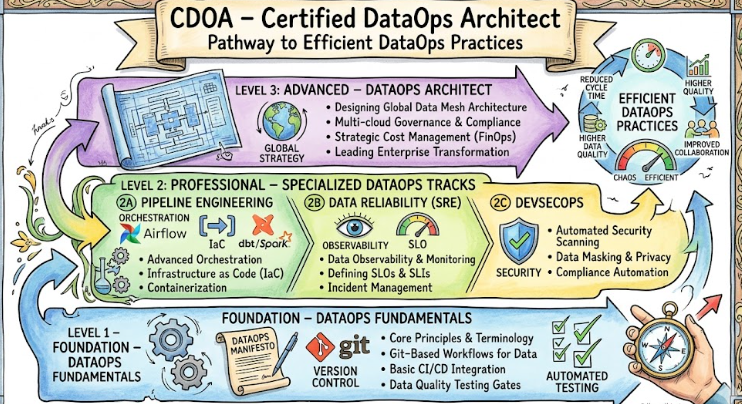
The modern data landscape is being transformed by the necessity for speed, quality, and reliability. As organizations move away from traditional, siloed data management, a more agile approach is being adopted. This guide is designed to explore the Certified DataOps Architect (CDOA) program, which serves as a cornerstone for professionals looking to master the intersection of data engineering and operational excellence.
What is CDOA – Certified DataOps Architect
The CDOA – Certified DataOps Architect is a professional designation that focuses on the automation and integration of data flows within an organization. It is built upon the principles of DevOps but is specifically tailored for the data lifecycle. The primary objective of this certification is to ensure that data delivery is made seamless, repeatable, and scalable. By achieving this credential, the ability to design architectures that reduce the cycle time of data analytics is demonstrated.
Why it matters today?
In the current market, data is generated at an unprecedented velocity. Traditional methods of data handling are often found to be too slow and prone to errors. Decisions are frequently delayed because of bottlenecks in data processing. CDOA matters because it provides a framework where data quality is monitored automatically, and delivery is accelerated. Business value is extracted much faster when a structured DataOps methodology is followed.
Why CDOA – Certified DataOps Architect certifications are important
The importance of this certification is rooted in the standardization of data practices. When a CDOA certification is held, a clear understanding of automated testing, continuous integration, and continuous delivery for data (Data CI/CD) is validated. It provides a competitive edge in a crowded job market where specialized data infrastructure skills are in high demand. Furthermore, organizational trust in data outputs is increased when architects are trained in these rigorous operational standards.
Why Choose DataOpsSchool?
DataOpsSchool is chosen by many because the curriculum is designed to meet the actual needs of the industry. The focus is kept on practical implementation rather than just theoretical concepts. Access to high-quality resources and expert guidance is provided, ensuring that the certification journey is both comprehensive and effective. A deep commitment to the success of data professionals is maintained throughout the program.
Certification Deep-Dive: CDOA – Certified DataOps Architect
What is this certification?
The CDOA certification is a high-level program created to validate the skills required to design and manage automated data pipelines. It focuses on the architectural aspects of DataOps, including orchestration and quality control.
Who should take this certification?
This program is ideally suited for Data Engineers, Cloud Architects, and DevOps professionals who are responsible for data infrastructure. Engineering Managers seeking to streamline data operations will also find significant value here.
Certification Overview Table
| Track | Level | Who it’s for | Prerequisites | Skills Covered | Recommended Order |
| DataOps Foundation | Entry | Beginners | Basic IT knowledge | DataOps Principles | First |
| DataOps Professional | Associate | Engineers | Foundation Level | CI/CD for Data | Second |
| CDOA (Architect) | Master | Senior Leads | Professional Level | Pipeline Orchestration | Third |
| DataOps Security | Specialist | Security Leads | Professional Level | Data Governance | Optional |
| DataOps for Leaders | Management | Managers | Basic understanding | Strategy & ROI | Optional |
Skills you will gain
- The ability to design automated data pipelines is developed.
- Proficiency in version control for data and schemas is achieved.
- Techniques for automated data quality testing are mastered.
- Knowledge of orchestration tools and cloud-native data services is gained.
- Expertise in monitoring and observability for data flows is established.
Real-world projects you should be able to do after this certification
- An end-to-end automated data ingestion pipeline can be built for a large-scale enterprise.
- A “Data Sandbox” environment can be created to allow data scientists to work without disrupting production.
- Automated regression testing for data transformations can be implemented.
- A cross-functional DataOps culture can be established within a technical team.
Preparation Plan
7–14 Days Plan (Rapid Review)
- The core DataOps Manifesto should be studied thoroughly.
- The architecture of existing data pipelines should be reviewed daily.
- Practice exams should be taken to identify knowledge gaps.
30 Days Plan (Standard Pace)
- Each week should be dedicated to a specific domain: Orchestration, Quality, Monitoring, and Culture.
- Hands-on labs should be completed at least three times a week.
- Group discussions or study forums should be joined to clarify complex concepts.
60 Days Plan (Deep Dive)
- The first month should be spent building a personal project that reflects CDOA principles.
- The second month should focus on fine-tuning theoretical knowledge and advanced troubleshooting.
- Detailed notes should be created for each architectural pattern covered in the syllabus.
Common mistakes to avoid
- Focusing only on tools rather than the underlying DataOps philosophy.
- Ignoring the cultural shifts required for successful DataOps implementation.
- Underestimating the importance of automated data testing.
- Neglecting the security and compliance aspects of data movement.
Best next certification after this
- Same track: Advanced DataOps Security Specialist.
- Cross-track: MLOps Engineer Certification.
- Leadership / management: Strategic Data Leadership Program.
Choose Your Learning Path
DevOps Path
This path is best for those coming from a software background. The focus is shifted from application code to data code. It is ideal for engineers who want to apply CI/CD rigor to data warehouses.
DevSecOps Path
Security and compliance are integrated into the data lifecycle here. This path is perfect for professionals in highly regulated industries like finance or healthcare where data privacy is paramount.
Site Reliability Engineering (SRE) Path
Data reliability and uptime are the primary goals. This path is chosen by those who want to ensure that data systems are as resilient as the applications they support.
AIOps / MLOps Path
This path is designed for those working with machine learning models. It bridges the gap between data engineering and AI by ensuring that models are fed with high-quality, timely data.
DataOps Path
The most direct route for data professionals. Every aspect of the data flow, from source to consumption, is optimized. It is best for Data Engineers looking to modernize their workflow.
FinOps Path
Cost management of data infrastructure is the focus. This path is suitable for those responsible for cloud spending who want to ensure that data operations remain cost-effective.
Role → Recommended Certifications Mapping
| Current Role | Recommended Certification | Primary Goal |
| DevOps Engineer | CDOA – DataOps Architect | Transition to Data Infrastructure |
| Site Reliability Engineer | DataOps Professional | Improve Data System Reliability |
| Platform Engineer | CDOA – DataOps Architect | Build Internal Data Platforms |
| Cloud Engineer | Cloud DataOps Specialist | Optimize Cloud Data Services |
| Security Engineer | DevSecOps for Data | Secure Data Pipelines |
| Data Engineer | CDOA – DataOps Architect | Master Pipeline Automation |
| FinOps Practitioner | DataOps Cost Optimization | Control Data Storage Costs |
| Engineering Manager | Strategic DataOps Leadership | Lead Data Transformation |
Next Certifications to Take
One same-track certification
The DataOps Security Specialist certification is a logical next step. It allows for a deeper exploration of how sensitive information is handled within an automated environment.
One cross-track certification
The MLOps Engineer program is highly recommended. By combining DataOps with Machine Learning operations, a holistic view of the modern AI-driven enterprise is obtained.
One leadership-focused certification
The Certified Engineering Manager in DataOps is an excellent choice. Leadership skills are refined here, enabling the management of large teams through complex technical transitions.
Training & Certification Support Institutions
DevOpsSchool
Comprehensive support for various IT certifications is provided by this institution. A focus on career growth and technical mastery is maintained through their expert-led programs.
Cotocus
Specialized training for cloud and infrastructure roles is offered here. The curriculum is regularly updated to reflect the latest changes in the technology landscape.
ScmGalaxy
A wealth of knowledge regarding software configuration management and automation is shared. Community-driven learning and practical workshops are frequently organized.
BestDevOps
Top-tier training programs for aspiring DevOps and DataOps professionals are delivered. The emphasis is placed on creating job-ready skills for the global market.
devsecopsschool.com
Education regarding the integration of security into the development lifecycle is the focus. Practical methods for building secure software are taught here.
sreschool.com
The principles of site reliability engineering are covered in great detail. Engineers are taught how to build and maintain highly available systems.
aiopsschool.com
The intersection of artificial intelligence and operations is explored. Professionals are prepared for the future of automated IT management.
dataopsschool.com
This institution is dedicated entirely to the field of DataOps. The highest standard of training for the CDOA and other data-related certifications is provided.
finopsschool.com
Cloud financial management is taught to help organizations optimize their spending. Expertise in balancing cost, speed, and quality is shared.
FAQs Section
What is the difficulty level of the CDOA exam?
The exam is considered moderate to challenging because it requires a mix of theoretical knowledge and practical understanding.
How much time is required to prepare for the CDOA certification?
Approximately 30 to 60 days are usually needed, depending on the prior experience held by the candidate.
Are there any specific prerequisites for taking the CDOA course?
A basic understanding of data engineering and cloud concepts is recommended before starting this program.
In what sequence should these certifications be taken?
The Foundation level is typically started first, followed by the Professional level, and finally the Architect level.
What is the career value of being a Certified DataOps Architect?
Significant career growth is often seen, as the certification validates a niche but highly sought-after skill set in the data industry.
What job roles can be pursued after obtaining this certification?
Roles such as DataOps Engineer, Senior Data Engineer, and Infrastructure Architect are commonly available to certified individuals.
How does CDOA differ from a standard DevOps certification?
CDOA is specifically focused on the unique challenges of data, such as schema changes and data quality, which are not usually covered in DevOps.
Is the CDOA certification recognized globally?
Yes, the standards taught in the program are applicable to organizations across various global markets.
Can an Engineering Manager benefit from this certification?
Yes, a strategic understanding of how to implement DataOps within a team is gained by managers who take this course.
Is there a focus on specific tools like Jenkins or Airflow?
The principles of orchestration are taught, which can be applied to any modern toolset used in the industry.
How often does the certification need to be renewed?
Standard industry practices are followed, and periodic updates are usually recommended to keep skills current.
Are hands-on labs included in the training support?
Yes, practical experience is emphasized by the supporting institutions to ensure the concepts are fully understood.
CDOA – Certified DataOps Architect Specific FAQs
- What is the primary focus of the CDOA curriculum?
The design and management of automated, scalable, and reliable data architectures are the main focus areas.
- How does the CDOA program handle data quality?
Automated testing frameworks are integrated into the pipeline to ensure that quality checks are performed at every stage.
- Is cloud knowledge required for the CDOA certification?
A general familiarity with cloud services is helpful, as most modern DataOps architectures are built on cloud platforms.
- Does the CDOA certification cover data governance?
Yes, the principles of maintaining data integrity and compliance within an automated flow are included in the syllabus.
- What is the difference between a Data Engineer and a DataOps Architect?
A Data Engineer builds pipelines, while a DataOps Architect designs the entire system for automation, scalability, and operational excellence.
- Are real-world case studies used in the training?
Yes, practical examples from various industries are used to illustrate how DataOps solves common business problems.
- How does the CDOA help in reducing “Data Debt”?
By implementing automated testing and version control, the accumulation of unmanaged and low-quality data is significantly reduced.
- What is the expected growth for DataOps roles in the next few years?
Demand is expected to rise sharply as more companies realize that traditional data management cannot keep up with modern business needs.
Testimonials
Aarav
The CDOA program provided immense clarity on how to automate our data flows. The shift from manual processing to an automated pipeline has significantly boosted our team’s confidence.
Meera
After completing the certification, the ability to design resilient data architectures was gained. The practical projects were especially helpful in understanding how to handle real-world data bottlenecks.
Liam
Career growth was experienced shortly after becoming a Certified DataOps Architect. The skills learned have been directly applied to our cloud infrastructure, leading to much better data reliability.
Priya
The gap between data engineering and operations was finally bridged through this course. A much deeper understanding of data quality and monitoring was achieved, which has been invaluable for our recent projects.
Chen
As an Engineering Manager, the strategic insights provided by the CDOA were exactly what was needed. A clear plan for implementing DataOps within the organization was developed with great success.
1 Conclusion
Future career paths are secured when the principles of DataOps architecture are mastered. The complexities of modern data environments are effectively navigated by professionals who hold the CDOA – Certified DataOps Architect designation. Through the implementation of automated workflows and standardized practices, a significant impact is made on organizational efficiency. Long-term success in the evolving tech landscape is ensured by staying committed to these advanced operational standards. High-value opportunities are consistently found by those who prioritize this specialized architectural knowledge.