Introduction
GraphQL Tooling refers to the ecosystem of platforms, libraries, and developer tools used to design, build, test, manage, and optimize GraphQL APIs. Unlike traditional REST APIs, GraphQL allows clients to request exactly the data they need, making it highly efficient for modern applications.
As applications become more data-driven and distributed, GraphQL tooling has become essential for managing schema complexity, improving developer experience, and ensuring performance at scale. These tools support everything from API design and testing to caching, monitoring, and schema governance.
Common Use Cases
- Building GraphQL APIs and backends
- Testing and debugging queries
- Managing schemas and versioning
- Optimizing performance and caching
- Visualizing API structures
What Buyers Should Evaluate
- Schema management and governance
- Developer experience (IDE, debugging tools)
- Integration with frontend frameworks
- Performance optimization (caching, CDN)
- Security and access control
- Deployment flexibility
- Observability and analytics
- Ecosystem maturity
Best for: Full-stack developers, API architects, frontend engineers, and teams building data-intensive applications or microservices.
Not ideal for: Simple applications where REST APIs are sufficient or teams with minimal API complexity.
Key Trends in GraphQL Tooling
- Growth of federated GraphQL architectures (supergraphs)
- Rise of AI-assisted schema design and query optimization
- Increased adoption of edge caching for GraphQL APIs
- Expansion of developer-focused IDEs and tooling
- Integration with type-safe systems and code generation
- Stronger emphasis on observability and performance monitoring
- Growth of GraphQL-native headless CMS platforms
- Support for multi-source data federation
- Shift toward managed GraphQL platforms
- Improved security testing and vulnerability detection tools
How We Selected These Tools (Methodology)
- Industry adoption and developer popularity
- Coverage across the GraphQL lifecycle (design → deploy → monitor)
- Feature depth and innovation
- Performance and scalability signals
- Integration with modern tech stacks
- Developer experience and usability
- Ecosystem strength and community support
- Flexibility across different use cases
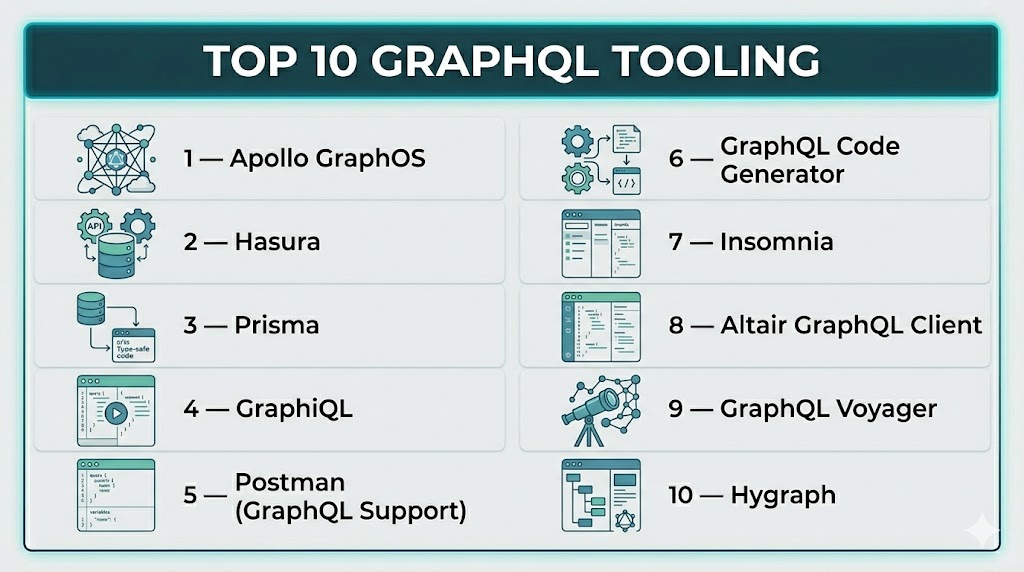
Top 10 GraphQL Tooling
#1 — Apollo GraphOS
Short description: A comprehensive GraphQL platform for building, managing, and scaling federated APIs.
Key Features
- Apollo Federation for multi-service graphs
- Schema registry and governance
- Query analytics and usage insights
- GraphQL IDE (Explorer)
- Client libraries
Pros
- Industry-standard ecosystem
- Strong enterprise capabilities
Cons
- Expensive for smaller teams
- Some vendor lock-in
Platforms / Deployment
Cloud
Security & Compliance
RBAC, access control
Integrations & Ecosystem
Apollo integrates with frontend frameworks and backend systems seamlessly.
- React, Angular
- CI/CD tools
- Cloud services
Support & Community
Extensive documentation and large developer community
#2 — Hasura
Short description: A real-time GraphQL engine that instantly generates APIs from databases.
Key Features
- Auto-generated GraphQL APIs
- Real-time subscriptions
- Role-based access control
- Database integrations
- Event triggers
Pros
- Fast setup
- Real-time capabilities
Cons
- Limited customization for complex logic
- Dependency on database structure
Platforms / Deployment
Cloud / Self-hosted
Security & Compliance
RBAC, authentication
Integrations & Ecosystem
- PostgreSQL
- REST APIs
- Event systems
Support & Community
Active open-source community
#3 — Prisma
Short description: A database toolkit commonly used with GraphQL for building scalable backends.
Key Features
- ORM for databases
- Type-safe queries
- Schema modeling
- Migration tools
- Integration with GraphQL servers
Pros
- Developer-friendly
- Strong type safety
Cons
- Requires backend setup
- Not a full GraphQL platform
Platforms / Deployment
Cloud / Self-hosted
Security & Compliance
Not publicly stated
Integrations & Ecosystem
Prisma works with multiple GraphQL servers and frameworks.
- Apollo Server
- GraphQL Yoga
- Databases
Support & Community
Strong developer community
#4 — GraphiQL
Short description: An interactive IDE for exploring and testing GraphQL APIs.
Key Features
- Query editor
- Schema explorer
- Auto-completion
- Debugging tools
- Plugin support
Pros
- Easy debugging
- Developer-friendly
Cons
- Limited production features
- Requires setup
Platforms / Deployment
Web / Desktop
Security & Compliance
Not publicly stated
Integrations & Ecosystem
- GraphQL APIs
- Developer tools
Support & Community
Widely used and supported
#5 — Postman (GraphQL Support)
Short description: A popular API platform with strong GraphQL testing and collaboration features.
Key Features
- Query testing
- API collections
- Automation
- Monitoring
- Collaboration
Pros
- Easy to use
- Strong collaboration
Cons
- Not GraphQL-specific
- Limited schema governance
Platforms / Deployment
Web / Desktop (Cloud)
Security & Compliance
RBAC, access control
Integrations & Ecosystem
- CI/CD tools
- API workflows
Support & Community
Large developer ecosystem
#6 — GraphQL Code Generator
Short description: A tool for generating type-safe code from GraphQL schemas.
Key Features
- Type generation
- Schema integration
- Plugin system
- Multi-language support
- Automation
Pros
- Improves developer productivity
- Strong type safety
Cons
- Requires configuration
- Limited UI
Platforms / Deployment
CLI / Cloud
Security & Compliance
Not publicly stated
Integrations & Ecosystem
- TypeScript
- GraphQL clients
Support & Community
Strong open-source support
#7 — Insomnia
Short description: A developer-friendly API client with strong GraphQL support.
Key Features
- GraphQL query builder
- Debugging tools
- Environment management
- Automation
- Plugin system
Pros
- Clean UI
- Easy testing
Cons
- Limited enterprise features
- Smaller ecosystem
Platforms / Deployment
Web / Desktop
Security & Compliance
Not publicly stated
Integrations & Ecosystem
- APIs
- Dev tools
Support & Community
Active developer community
#8 — Altair GraphQL Client
Short description: A lightweight GraphQL client for testing and debugging APIs.
Key Features
- Query editor
- Schema explorer
- Environment variables
- Request history
- Debugging tools
Pros
- Lightweight
- Easy to use
Cons
- Limited advanced features
- Smaller community
Platforms / Deployment
Web / Desktop
Security & Compliance
Not publicly stated
Integrations & Ecosystem
- GraphQL APIs
Support & Community
Moderate community support
#9 — GraphQL Voyager
Short description: A visualization tool for exploring GraphQL schemas.
Key Features
- Schema visualization
- Graph representation
- Interactive exploration
- Documentation support
Pros
- Excellent visualization
- Improves understanding
Cons
- Limited functionality beyond visualization
- Not a full tooling platform
Platforms / Deployment
Web
Security & Compliance
Not publicly stated
Integrations & Ecosystem
- GraphQL APIs
Support & Community
Open-source community
#10 — Hygraph
Short description: A GraphQL-native headless CMS for content-driven applications.
Key Features
- GraphQL-first content API
- Content modeling
- API federation
- Workflow automation
- AI-assisted content tools
Pros
- GraphQL-native design
- Strong CMS capabilities
Cons
- Limited for non-content use cases
- Pricing varies
Platforms / Deployment
Cloud
Security & Compliance
Not publicly stated
Integrations & Ecosystem
Hygraph integrates with modern frontend and backend tools.
- Frontend frameworks
- APIs
- Content pipelines
Support & Community
Growing ecosystem
Comparison Table (Top 10)
| Tool Name | Best For | Platform(s) Supported | Deployment | Standout Feature | Public Rating |
|---|---|---|---|---|---|
| Apollo GraphOS | Enterprise GraphQL | Web | Cloud | Federation | N/A |
| Hasura | Real-time APIs | Web | Cloud/Self-hosted | Auto APIs | N/A |
| Prisma | Backend dev | CLI/Web | Cloud/Self-hosted | ORM | N/A |
| GraphiQL | Debugging | Web/Desktop | Local | IDE | N/A |
| Postman | Testing | Web/Desktop | Cloud | Collaboration | N/A |
| Code Generator | Type safety | CLI | Local/Cloud | Code generation | N/A |
| Insomnia | API testing | Web/Desktop | Local | UI | N/A |
| Altair | Lightweight client | Web/Desktop | Local | Simplicity | N/A |
| Voyager | Visualization | Web | Local | Graph view | N/A |
| Hygraph | CMS | Web | Cloud | Content API | N/A |
Evaluation & Scoring of GraphQL Tooling
| Tool Name | Core (25%) | Ease (15%) | Integrations (15%) | Security (10%) | Performance (10%) | Support (10%) | Value (15%) | Weighted Total |
|---|---|---|---|---|---|---|---|---|
| Apollo | 10 | 7 | 9 | 9 | 9 | 9 | 6 | 8.7 |
| Hasura | 9 | 8 | 8 | 8 | 9 | 8 | 8 | 8.5 |
| Prisma | 8 | 8 | 9 | 7 | 8 | 8 | 8 | 8.2 |
| GraphiQL | 7 | 9 | 6 | 6 | 7 | 7 | 8 | 7.4 |
| Postman | 8 | 9 | 8 | 7 | 7 | 8 | 8 | 7.9 |
| Code Generator | 8 | 7 | 8 | 6 | 8 | 7 | 8 | 7.7 |
| Insomnia | 7 | 9 | 7 | 6 | 7 | 7 | 8 | 7.5 |
| Altair | 6 | 9 | 6 | 5 | 7 | 6 | 8 | 7.0 |
| Voyager | 6 | 8 | 5 | 5 | 6 | 6 | 7 | 6.5 |
| Hygraph | 8 | 8 | 8 | 7 | 8 | 7 | 7 | 7.9 |
How to interpret scores:
- Full platforms score higher in overall capability
- Developer tools score higher in ease of use
- Choose based on whether you need full lifecycle management or specific tooling
- Scores are comparative, not absolute
Which GraphQL Tool Is Right for You?
Solo / Freelancer
- Best: GraphiQL, Altair
- Simple debugging and testing
SMB
- Best: Postman, Hasura
- Balance of ease and functionality
Mid-Market
- Best: Prisma, Code Generator
- Need scalability and type safety
Enterprise
- Best: Apollo GraphOS, Hasura
- Require governance and performance
Budget vs Premium
- Budget: Open-source tools
- Premium: Apollo, Hygraph
Feature Depth vs Ease of Use
- Deep features: Apollo
- Easy tools: GraphiQL, Postman
Integrations & Scalability
- Strong integrations: Apollo, Prisma
- Moderate: Standalone tools
Security & Compliance Needs
- Enterprise: Apollo, Hasura
- Basic: Client tools
Frequently Asked Questions (FAQs)
What is GraphQL tooling?
It includes tools for building, testing, and managing GraphQL APIs.
Why is GraphQL tooling important?
It simplifies development and improves performance and scalability.
Do I need multiple tools?
Yes, most teams use a combination of tools across the lifecycle.
Is GraphQL better than REST?
It depends on use case; GraphQL offers more flexibility.
Can I use GraphQL with existing APIs?
Yes, it can layer over REST and databases.
Are these tools free?
Many have free tiers or open-source versions.
Do they support real-time data?
Yes, many tools support subscriptions.
Is GraphQL secure?
Security depends on implementation and tooling.
Can I scale GraphQL APIs?
Yes, with proper tooling and architecture.
What are alternatives?
REST APIs or gRPC-based systems.
Conclusion
GraphQL tooling plays a crucial role in building efficient, scalable, and developer-friendly APIs. From full platforms like Apollo to specialized tools like GraphiQL and Prisma, each serves a unique purpose in the GraphQL ecosystem. The right choice depends on your project complexity, team size, and workflow requirements. Focus on tools that improve developer experience while ensuring performance and scalability. Start with a small stack and expand as your needs grow.