Introduction
Test Data Management Tools help organizations create, mask, subset, provision, refresh, and govern test data used in software development and QA environments. Instead of relying on risky production copies or outdated spreadsheets, these platforms provide secure and controlled data for testing teams.
As privacy regulations tighten and software release cycles accelerate, managing test data has become a strategic priority. QA teams need realistic datasets for functional testing, automation, performance testing, and user acceptance testing without exposing sensitive customer information. Modern test data management tools improve compliance, speed, consistency, and release confidence.
Common use cases include:
- Test data masking
- Synthetic data generation
- Environment refreshes
- Database subsetting
- Dev/Test provisioning
- CI/CD test automation support
- Compliance readiness
- Faster QA cycles
Buyers should evaluate:
- Data masking quality
- Synthetic data generation
- Database support
- Provisioning speed
- Self-service workflows
- Compliance controls
- CI/CD integrations
- Scalability
- Reporting and governance
- Pricing and support quality
Best for: QA teams, DevOps teams, enterprises, regulated industries, software vendors, data teams, and large engineering organizations.
Not ideal for: Tiny projects with no structured QA process, products using minimal datasets, or teams without compliance or test environment complexity.
Key Trends in Test Data Management Tools
- AI-assisted synthetic data generation rising
- Privacy-first masking becoming mandatory
- Self-service provisioning demand increasing
- DevOps pipeline integrations growing
- Faster environment cloning becoming standard
- Cloud database support expanding
- DataOps alignment improving
- Compliance automation increasing
- Shift-left test data strategies growing
- Hybrid multi-database support improving
How We Selected These Tools (Methodology)
These tools were selected based on:
- Market recognition and trust
- Data masking depth
- Provisioning capabilities
- Synthetic data support
- Database ecosystem coverage
- Enterprise scalability
- Compliance relevance
- Automation compatibility
- Support quality
- Long-term relevance
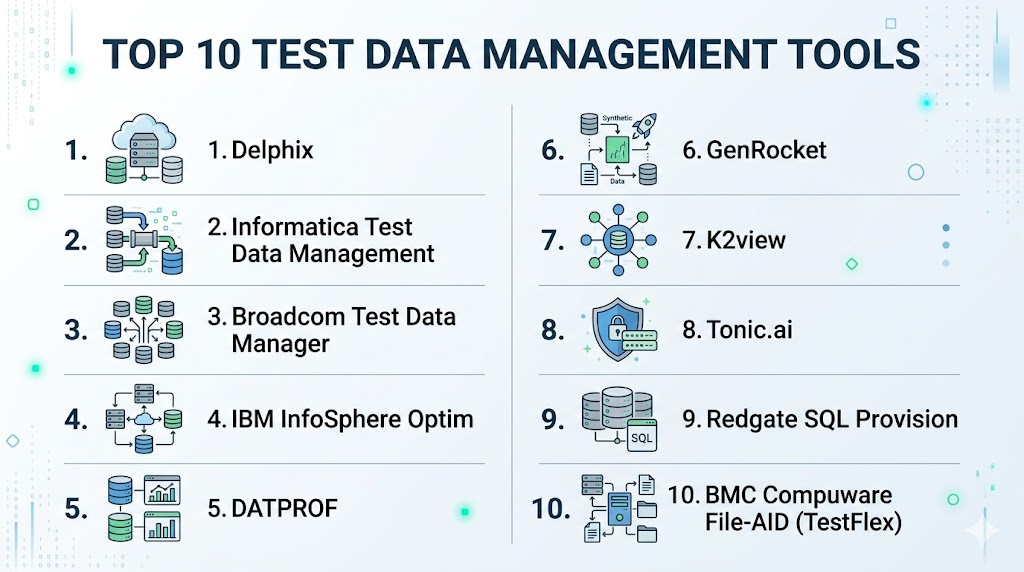
Top 10 Test Data Management Tools
#1 — Delphix
Short description:
Enterprise-grade platform known for virtualized data environments, fast provisioning, and secure test data workflows.
Key Features
- Data virtualization
- Fast cloning
- Masking workflows
- Environment refresh automation
- Self-service provisioning
- Multi-environment support
- Governance controls
Pros
- Strong enterprise performance
- Rapid environment delivery
- Mature platform reputation
Cons
- Premium pricing
- Better for larger organizations
- Implementation planning required
Platforms / Deployment
Cloud / Self-hosted / Hybrid
Security & Compliance
RBAC, masking controls, audit features vary by plan.
Integrations & Ecosystem
Strong enterprise database ecosystem compatibility.
Support & Community
Commercial enterprise support.
#2 — Informatica Test Data Management
Short description:
Enterprise data platform focused on secure test data creation, masking, and governance.
Key Features
- Data masking
- Data subsetting
- Provisioning workflows
- Synthetic data options
- Metadata controls
- Compliance support
- Enterprise integrations
Pros
- Strong enterprise trust
- Broad data management depth
- Good compliance alignment
Cons
- Premium pricing
- Complex enterprise implementations
- Best for larger environments
Platforms / Deployment
Cloud / Hybrid
Security & Compliance
Masking, RBAC, governance controls.
Integrations & Ecosystem
Strong enterprise data ecosystem compatibility.
Support & Community
Commercial support model.
#3 — Broadcom Test Data Manager
Short description:
Enterprise solution designed for secure and efficient management of non-production test data.
Key Features
- Data masking
- Synthetic data generation
- Provisioning tools
- Compliance workflows
- Large dataset handling
- Role controls
- Automation integrations
Pros
- Strong enterprise focus
- Good governance features
- Broad workload support
Cons
- Premium pricing
- Smaller mainstream visibility
- Implementation effort required
Platforms / Deployment
Cloud / Hybrid
Security & Compliance
RBAC, masking, audit controls.
Integrations & Ecosystem
Useful in enterprise QA environments.
Support & Community
Commercial support available.
#4 — IBM InfoSphere Optim
Short description:
Trusted enterprise platform for archiving, masking, and managing data for development and testing.
Key Features
- Data masking
- Database subsetting
- Test data provisioning
- Archiving workflows
- Governance controls
- Enterprise scalability
- Reporting tools
Pros
- Strong enterprise heritage
- Broad governance capabilities
- Good for regulated sectors
Cons
- Complex deployments possible
- Premium pricing
- Best for enterprise buyers
Platforms / Deployment
Cloud / Self-hosted / Hybrid
Security & Compliance
Masking, auditability, enterprise controls.
Integrations & Ecosystem
Strong enterprise database compatibility.
Support & Community
Commercial enterprise support.
#5 — DATPROF
Short description:
Modern test data platform focused on masking, subsetting, and automated provisioning.
Key Features
- Data masking
- Subsetting tools
- Provisioning automation
- Workflow orchestration
- Synthetic data support
- Multi-database support
- DevOps integrations
Pros
- Strong modern workflows
- Good automation support
- Practical enterprise usability
Cons
- Smaller global brand recognition
- Premium pricing tiers vary
- Deep niche requirements vary
Platforms / Deployment
Cloud / Hybrid
Security & Compliance
Masking controls, permissions, governance features.
Integrations & Ecosystem
Good fit for DevOps-enabled teams.
Support & Community
Commercial support model.
#6 — GenRocket
Short description:
Synthetic test data platform designed to generate realistic data without copying production records.
Key Features
- Synthetic data generation
- On-demand datasets
- CI/CD integration
- API-driven workflows
- Scalable generation
- Secure non-production use
- Multi-environment support
Pros
- Excellent privacy-first model
- Great for automation teams
- Avoids production data risk
Cons
- Synthetic-only preference may not fit all use cases
- Learning curve for complex models
- Premium pricing varies
Platforms / Deployment
Cloud / Hybrid
Security & Compliance
Strong privacy-centric workflows.
Integrations & Ecosystem
Strong automation pipeline compatibility.
Support & Community
Commercial support available.
#7 — K2view
Short description:
Data platform focused on delivering fit-for-purpose data products for testing and operational workflows.
Key Features
- Data provisioning
- Real-time data views
- Test data delivery
- Privacy controls
- Large-scale performance
- Automation workflows
- Multi-source support
Pros
- Strong enterprise innovation
- Good complex data landscape fit
- Scalable architecture
Cons
- Advanced enterprise focus
- Smaller mainstream awareness
- Requires planning maturity
Platforms / Deployment
Cloud / Hybrid
Security & Compliance
Privacy controls, governance features.
Integrations & Ecosystem
Useful for complex enterprise ecosystems.
Support & Community
Commercial enterprise support.
#8 — Tonic.ai
Short description:
Modern platform known for realistic and privacy-safe synthetic or de-identified data workflows.
Key Features
- Data de-identification
- Synthetic data workflows
- Developer-friendly UX
- Secure provisioning
- Compliance alignment
- Fast onboarding
- Modern integrations
Pros
- Strong privacy focus
- Modern user experience
- Good for fast-moving teams
Cons
- Newer market presence
- Enterprise depth varies by plan
- Specific data sources vary
Platforms / Deployment
Cloud
Security & Compliance
Privacy controls and masking workflows.
Integrations & Ecosystem
Strong modern engineering fit.
Support & Community
Growing adoption.
#9 — Redgate SQL Provision
Short description:
Database-focused provisioning tool designed for fast SQL Server test database cloning.
Key Features
- SQL Server cloning
- Fast provisioning
- Lightweight copies
- Developer workflows
- Environment refreshes
- Automation support
- Reduced storage overhead
Pros
- Excellent for SQL Server teams
- Fast provisioning value
- Strong developer productivity
Cons
- SQL-focused scope
- Narrower use case than full suites
- Best for aligned ecosystems
Platforms / Deployment
Windows / Hybrid
Security & Compliance
Depends on SQL environment controls.
Integrations & Ecosystem
Strong Microsoft SQL ecosystem fit.
Support & Community
Commercial support model.
#10 — BMC Compuware File-AID
Short description:
Enterprise data management solution often used for mainframe and complex structured data testing workflows.
Key Features
- Data masking
- Mainframe data handling
- Test data extraction
- Governance controls
- Structured data support
- Enterprise workflows
- Compliance readiness
Pros
- Strong legacy enterprise relevance
- Good regulated environment fit
- Specialized capabilities
Cons
- Niche compared with cloud-first tools
- Enterprise complexity
- Best for specific environments
Platforms / Deployment
Self-hosted / Enterprise environments
Security & Compliance
Governance controls, masking features.
Integrations & Ecosystem
Useful in legacy enterprise ecosystems.
Support & Community
Commercial enterprise support.
Comparison Table (Top 10)
| Tool Name | Best For | Platform(s) Supported | Deployment | Standout Feature | Public Rating |
|---|---|---|---|---|---|
| Delphix | Large enterprises | Multi-platform | Hybrid | Data virtualization | N/A |
| Informatica | Governance-heavy teams | Multi-platform | Hybrid | Enterprise data depth | N/A |
| Broadcom TDM | Enterprise QA | Multi-platform | Hybrid | Governance | N/A |
| IBM Optim | Regulated sectors | Multi-platform | Hybrid | Data control | N/A |
| DATPROF | Modern enterprises | Multi-platform | Hybrid | Automation workflows | N/A |
| GenRocket | Synthetic data teams | Cloud | Hybrid | On-demand synthetic data | N/A |
| K2view | Complex data estates | Multi-platform | Hybrid | Real-time delivery | N/A |
| Tonic.ai | Privacy-first teams | Cloud | Cloud | De-identified data | N/A |
| SQL Provision | SQL Server teams | Windows | Hybrid | Fast cloning | N/A |
| File-AID | Mainframe teams | Enterprise | Self-hosted | Legacy data expertise | N/A |
Evaluation & Scoring of Test Data Management Tools
| Tool Name | Core | Ease | Integrations | Security | Performance | Support | Value | Weighted Total |
|---|---|---|---|---|---|---|---|---|
| Delphix | 9 | 7 | 9 | 9 | 9 | 9 | 6 | 8.3 |
| Informatica | 9 | 7 | 9 | 9 | 8 | 9 | 6 | 8.1 |
| Broadcom TDM | 8 | 7 | 8 | 9 | 8 | 8 | 6 | 7.7 |
| IBM Optim | 8 | 6 | 8 | 9 | 8 | 8 | 6 | 7.5 |
| DATPROF | 8 | 8 | 8 | 8 | 8 | 8 | 7 | 7.9 |
| GenRocket | 8 | 8 | 8 | 9 | 8 | 8 | 7 | 8.0 |
| K2view | 8 | 7 | 8 | 9 | 9 | 8 | 6 | 7.8 |
| Tonic.ai | 8 | 9 | 8 | 9 | 8 | 7 | 8 | 8.2 |
| SQL Provision | 7 | 8 | 7 | 8 | 9 | 8 | 8 | 7.8 |
| File-AID | 7 | 6 | 7 | 9 | 8 | 8 | 6 | 7.2 |
These scores are comparative benchmarks. The best choice depends on privacy needs, database complexity, provisioning speed, and budget.
Which Test Data Management Tool Is Right for You?
Solo / Freelancer
Usually lightweight synthetic tools or masked sample datasets are enough.
SMB
Choose Tonic.ai, DATPROF, or GenRocket.
Mid-Market
Choose DATPROF, GenRocket, or SQL Provision.
Enterprise
Choose Delphix, Informatica, IBM Optim, Broadcom, or K2view.
Budget vs Premium
Budget: SQL Provision, targeted niche tools
Premium: Delphix, Informatica
Feature Depth vs Ease of Use
Depth: Delphix, Informatica, IBM Optim
Ease: Tonic.ai, GenRocket
Integrations & Scalability
Strong options: Delphix, DATPROF, Informatica.
Security & Compliance Needs
Strong choices: Delphix, Informatica, Tonic.ai.
Frequently Asked Questions (FAQs)
1. What is test data management?
It manages safe and realistic data for development and testing.
2. Why not copy production data?
It may expose sensitive customer information.
3. What is data masking?
It hides or transforms sensitive values while keeping usefulness.
4. What is synthetic data?
Artificially generated data resembling real patterns.
5. Which tool is best for enterprises?
Delphix and Informatica are common choices.
6. Which tool is best for privacy-first teams?
Tonic.ai and GenRocket are strong options.
7. Can TDM integrate with CI/CD?
Yes, many modern tools support automation pipelines.
8. Is SQL Provision only for SQL Server?
It is strongly aligned with SQL Server use cases.
9. What should I evaluate first?
Privacy controls, provisioning speed, and data source support.
10. Is TDM only for QA teams?
No, DevOps, developers, and compliance teams also benefit.
Conclusion
Test Data Management Tools are essential for balancing software speed with privacy, compliance, and reliable testing outcomes. The best platform depends on your data complexity, regulatory needs, team maturity, and infrastructure scale. Some organizations need enterprise-grade virtualization and governance, while others prioritize synthetic data and developer agility. Security controls, provisioning speed, and automation compatibility should drive your decision. Shortlist two or three tools, run a pilot with real workflows, and choose the platform that best supports long-term quality delivery.