Introduction
Service Mesh Platforms help organizations manage communication between microservices in distributed applications. Instead of embedding networking, security, retries, observability, and traffic rules directly into application code, a service mesh handles these functions at the infrastructure layer. This makes modern application environments easier to secure, monitor, and scale.
As businesses adopt Kubernetes, containers, and microservices architectures, service mesh platforms have become increasingly important. They simplify east-west traffic management, improve resilience, enforce zero-trust networking principles, and provide visibility across complex systems.
Common use cases include:
- Microservices traffic management
- Secure service-to-service communication
- Zero-downtime releases
- Observability across distributed systems
- Multi-cluster networking
- Compliance-driven workload segmentation
Buyers should evaluate:
- Ease of deployment
- Performance overhead
- Security features
- Traffic routing controls
- Observability depth
- Kubernetes compatibility
- Multi-cluster support
- Policy management
- Ecosystem integrations
- Operational complexity
Best for: DevOps teams, platform engineers, enterprises using Kubernetes, SaaS businesses, and organizations operating microservices at scale.
Not ideal for: Small teams with monolithic apps, simple static websites, or environments without distributed services complexity.
Key Trends in Service Mesh Platforms
- eBPF-based networking reducing sidecar overhead
- Zero Trust service identity adoption growing
- Multi-cluster mesh architectures increasing
- GitOps-driven policy management rising
- AI-assisted traffic anomaly detection
- Stronger observability integrations
- Gateway API adoption expanding
- Sidecarless mesh models gaining traction
- Cost optimization through lightweight meshes
- Security-first mesh adoption in regulated sectors
How We Selected These Tools (Methodology)
These tools were selected based on:
- Industry recognition and adoption
- Traffic management maturity
- Security capabilities
- Kubernetes ecosystem relevance
- Observability integrations
- Multi-cluster readiness
- Operational simplicity
- Community and vendor backing
- Performance efficiency
- Long-term strategic relevance
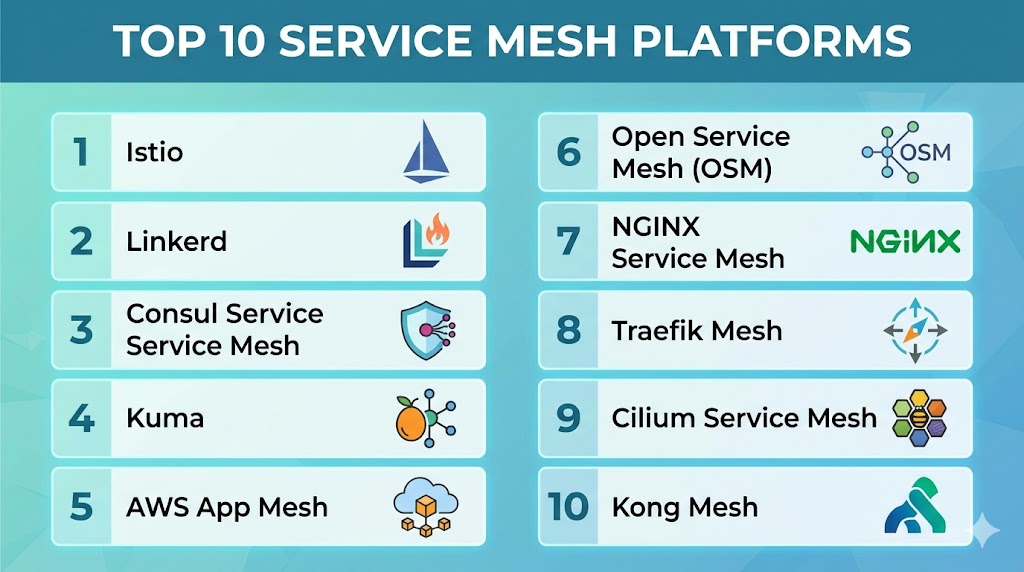
Top 10 Service Mesh Platforms
#1 — Istio
Short description:
One of the most widely known service mesh platforms offering deep traffic control, security, and observability for Kubernetes environments.
Key Features
- Advanced traffic routing
- Mutual TLS support
- Policy enforcement
- Telemetry collection
- Multi-cluster support
- Canary deployments
- Gateway integrations
Pros
- Powerful enterprise feature set
- Strong ecosystem adoption
- Mature traffic controls
Cons
- Operational complexity
- Learning curve for beginners
- Resource overhead in some setups
Platforms / Deployment
Cloud / Self-hosted / Hybrid
Security & Compliance
mTLS, RBAC, policy controls, workload identity.
Integrations & Ecosystem
Strong compatibility with Kubernetes observability and gateway tools.
Support & Community
Large global open-source community.
#2 — Linkerd
Short description:
Lightweight service mesh known for simplicity, strong security defaults, and lower operational overhead.
Key Features
- Lightweight architecture
- Automatic mTLS
- Reliability metrics
- Traffic splitting
- Easy installation
- Kubernetes-native focus
- Low latency design
Pros
- Easier than heavier meshes
- Strong security defaults
- Good performance efficiency
Cons
- Fewer advanced controls than some rivals
- Kubernetes-focused scope
- Smaller ecosystem than leaders
Platforms / Deployment
Cloud / Self-hosted / Hybrid
Security & Compliance
Automatic mTLS, identity controls, policy support.
Integrations & Ecosystem
Works well with Kubernetes observability stacks.
Support & Community
Strong open-source community.
#3 — Consul Service Mesh
Short description:
A service networking platform combining service discovery, mesh security, and multi-environment support.
Key Features
- Service discovery
- Secure service identity
- Traffic controls
- Multi-datacenter support
- Hybrid environment support
- Health checks
- Policy management
Pros
- Strong hybrid use cases
- Useful beyond Kubernetes
- Good networking depth
Cons
- Broader platform complexity
- Best fit with service networking needs
- Learning curve for new teams
Platforms / Deployment
Cloud / Self-hosted / Hybrid
Security & Compliance
mTLS, ACL controls, service identity.
Integrations & Ecosystem
Works across VMs, containers, and hybrid systems.
Support & Community
Strong commercial and open-source presence.
#4 — Kuma
Short description:
Modern service mesh platform focused on simplicity, multi-zone networking, and broad deployment flexibility.
Key Features
- Universal mesh model
- Multi-zone support
- Built-in policies
- Traffic routing
- Security controls
- Kubernetes support
- VM support
Pros
- Flexible deployment model
- Easier onboarding than some rivals
- Good multi-zone design
Cons
- Smaller market visibility
- Ecosystem narrower than leaders
- Advanced needs may vary
Platforms / Deployment
Cloud / Self-hosted / Hybrid
Security & Compliance
mTLS, access policies, service identity.
Integrations & Ecosystem
Supports Kubernetes and non-Kubernetes workloads.
Support & Community
Growing open-source ecosystem.
#5 — AWS App Mesh
Short description:
Managed service mesh built for microservices networking in cloud-native environments.
Key Features
- Managed mesh control plane
- Traffic shaping
- Service discovery integration
- Observability hooks
- Security controls
- Cloud-native scaling
- Resilience features
Pros
- Reduced management burden
- Strong cloud integration
- Good for cloud-native teams
Cons
- Best fit in same ecosystem
- Less portable than open meshes
- Managed platform dependencies
Platforms / Deployment
Cloud
Security & Compliance
Identity controls, encryption options, policies.
Integrations & Ecosystem
Strong compatibility with cloud-native networking and monitoring services.
Support & Community
Commercial support model.
#6 — Open Service Mesh (OSM)
Short description:
A lightweight service mesh focused on simplicity and Kubernetes-native service management.
Key Features
- Traffic policies
- mTLS support
- Traffic splitting
- Access controls
- Observability integrations
- Kubernetes-native operations
- Simpler architecture
Pros
- Easier onboarding
- Good for learning and smaller environments
- Open-source flexibility
Cons
- Smaller ecosystem
- Lower enterprise mindshare
- Feature depth varies
Platforms / Deployment
Cloud / Self-hosted / Hybrid
Security & Compliance
mTLS, policy controls.
Integrations & Ecosystem
Works in Kubernetes-centered environments.
Support & Community
Open-source community support.
#7 — NGINX Service Mesh
Short description:
Service mesh built for organizations already using NGINX networking technologies.
Key Features
- Traffic routing
- Security policies
- Kubernetes integration
- Metrics visibility
- NGINX alignment
- Canary support
- Ingress compatibility
Pros
- Good for NGINX users
- Strong traffic handling heritage
- Familiar networking model
Cons
- Smaller ecosystem footprint
- Best fit in aligned environments
- Less common than leaders
Platforms / Deployment
Cloud / Self-hosted / Hybrid
Security & Compliance
mTLS, policy controls, access rules.
Integrations & Ecosystem
Strong fit with ingress and API traffic environments.
Support & Community
Commercial and community options.
#8 — Traefik Mesh
Short description:
Lightweight service mesh option designed for teams wanting simpler Kubernetes traffic management.
Key Features
- Lightweight deployment
- Traffic routing
- Metrics support
- Kubernetes focus
- Simpler operations
- Security basics
- Easy onboarding
Pros
- Simpler than heavyweight meshes
- Good SMB engineering teams
- Fast setup
Cons
- Smaller ecosystem
- Fewer advanced controls
- Narrower enterprise adoption
Platforms / Deployment
Cloud / Self-hosted / Hybrid
Security & Compliance
Encryption and policy support vary by setup.
Integrations & Ecosystem
Works with Kubernetes ingress environments.
Support & Community
Community-driven adoption.
#9 — Cilium Service Mesh
Short description:
Modern service mesh using eBPF networking for performance-focused and sidecarless architectures.
Key Features
- eBPF data plane
- Sidecarless options
- Network security policies
- Observability tools
- High performance routing
- Kubernetes-native design
- Scalability focus
Pros
- Lower overhead potential
- Strong modern architecture
- Excellent security networking alignment
Cons
- More advanced learning curve
- Best for technical teams
- Newer operational model for some users
Platforms / Deployment
Cloud / Self-hosted / Hybrid
Security & Compliance
Identity policies, encryption, network enforcement.
Integrations & Ecosystem
Strong fit with modern Kubernetes networking stacks.
Support & Community
Fast-growing technical community.
#10 — Kong Mesh
Short description:
Enterprise service mesh platform built for traffic governance, security, and large-scale service connectivity.
Key Features
- Traffic governance
- Multi-zone support
- Security controls
- Policy management
- Observability hooks
- Gateway alignment
- Enterprise operations tools
Pros
- Good enterprise governance features
- Strong traffic control focus
- Multi-zone support
Cons
- Premium positioning
- More advanced than simple needs require
- Smaller mindshare than leaders
Platforms / Deployment
Cloud / Self-hosted / Hybrid
Security & Compliance
mTLS, policy controls, identity features.
Integrations & Ecosystem
Strong alignment with gateway and API management environments.
Support & Community
Commercial enterprise support options.
Comparison Table (Top 10)
| Tool Name | Best For | Platform(s) Supported | Deployment | Standout Feature | Public Rating |
|---|---|---|---|---|---|
| Istio | Enterprise Kubernetes | Multi-platform | Hybrid | Advanced traffic control | N/A |
| Linkerd | Simplicity | Multi-platform | Hybrid | Lightweight mesh | N/A |
| Consul Service Mesh | Hybrid ops | Multi-platform | Hybrid | Service networking | N/A |
| Kuma | Multi-zone teams | Multi-platform | Hybrid | Universal mesh | N/A |
| AWS App Mesh | Cloud-native teams | Cloud | Cloud | Managed mesh | N/A |
| OSM | Lightweight Kubernetes | Multi-platform | Hybrid | Simplicity | N/A |
| NGINX Service Mesh | NGINX users | Multi-platform | Hybrid | Ingress alignment | N/A |
| Traefik Mesh | SMB teams | Multi-platform | Hybrid | Easy setup | N/A |
| Cilium Service Mesh | Performance teams | Multi-platform | Hybrid | eBPF model | N/A |
| Kong Mesh | Governance teams | Multi-platform | Hybrid | Enterprise traffic control | N/A |
Evaluation & Scoring of Service Mesh Platforms
| Tool Name | Core | Ease | Integrations | Security | Performance | Support | Value | Weighted Total |
|---|---|---|---|---|---|---|---|---|
| Istio | 10 | 6 | 10 | 10 | 8 | 9 | 8 | 8.7 |
| Linkerd | 8 | 9 | 8 | 9 | 9 | 8 | 9 | 8.6 |
| Consul Service Mesh | 9 | 7 | 9 | 9 | 8 | 8 | 8 | 8.3 |
| Kuma | 8 | 8 | 7 | 8 | 8 | 7 | 8 | 7.8 |
| AWS App Mesh | 8 | 8 | 8 | 8 | 8 | 8 | 7 | 7.9 |
| OSM | 7 | 8 | 7 | 8 | 8 | 7 | 8 | 7.6 |
| NGINX Service Mesh | 7 | 7 | 8 | 8 | 8 | 7 | 7 | 7.4 |
| Traefik Mesh | 7 | 8 | 7 | 7 | 8 | 7 | 8 | 7.4 |
| Cilium Service Mesh | 9 | 7 | 8 | 9 | 10 | 8 | 8 | 8.4 |
| Kong Mesh | 8 | 7 | 8 | 9 | 8 | 8 | 7 | 7.9 |
These scores are comparative benchmarks. The best platform depends on architecture complexity, internal expertise, compliance needs, and Kubernetes maturity.
Which Service Mesh Platform Is Right for You?
Solo / Freelancer
Choose lightweight options or avoid service mesh unless truly needed.
SMB
Choose Linkerd, Traefik Mesh, or OSM.
Mid-Market
Choose Linkerd, Kuma, or Cilium Service Mesh.
Enterprise
Choose Istio, Consul Service Mesh, Kong Mesh, or Open-source advanced meshes.
Budget vs Premium
Budget: Linkerd, OSM
Premium: Istio, Kong Mesh
Feature Depth vs Ease of Use
Depth: Istio, Consul Service Mesh
Ease: Linkerd, Traefik Mesh
Integrations & Scalability
Strong options: Istio, Cilium Service Mesh, Consul Service Mesh.
Security & Compliance Needs
Strong choices: Istio, Linkerd, Kong Mesh.
Frequently Asked Questions (FAQs)
1. What is a service mesh?
It manages communication between microservices at the infrastructure layer.
2. Do all Kubernetes apps need a service mesh?
No. Simpler apps may not need one.
3. Is Istio the market leader?
It is one of the most recognized platforms.
4. What is mTLS?
Mutual TLS encrypts and authenticates service-to-service traffic.
5. Which mesh is easiest to start with?
Linkerd is often praised for simplicity.
6. What is sidecarless mesh?
A model that reduces proxy sidecar overhead using modern networking methods.
7. Can service mesh improve security?
Yes, through identity, encryption, and policy controls.
8. Is service mesh only for Kubernetes?
Some platforms support VMs and hybrid environments too.
9. What should I test first?
Latency impact, observability, routing controls, and operational complexity.
10. Is service mesh expensive?
Open-source options exist, but operational cost depends on expertise and scale.
Conclusion
Service Mesh Platforms play a major role in securing and managing modern microservices environments, especially at scale. The best choice depends on your Kubernetes maturity, operational skills, traffic complexity, and compliance needs. Some teams need lightweight simplicity, while others require deep traffic governance and multi-cluster controls. Performance overhead, security, and observability should guide your evaluation process. Shortlist two or three platforms, test them in staging, and validate operational impact before production rollout.