Introduction
Healthcare Interoperability APIs based on HL7 and FHIR standards help hospitals, healthcare providers, EHR vendors, payers, health information exchanges, digital health startups, and healthcare analytics companies securely exchange healthcare data across systems. These platforms improve interoperability, patient data accessibility, care coordination, analytics, regulatory compliance, and digital healthcare innovation.
As healthcare organizations increasingly rely on connected digital ecosystems, traditional point-to-point integrations and siloed healthcare systems are no longer sustainable. Modern interoperability APIs now combine FHIR-native architectures, RESTful APIs, AI-driven data normalization, SMART on FHIR support, event-driven integration workflows, cloud interoperability services, and secure healthcare data exchange capabilities to support scalable healthcare interoperability operations.
Real-world use cases include:
- EHR and EMR interoperability
- Patient data exchange and care coordination
- Healthcare application integration workflows
- Population health analytics and reporting
- Digital health and telemedicine integrations
Buyers evaluating Healthcare Interoperability APIs should focus on:
- HL7 and FHIR standards support
- API scalability and performance capabilities
- Integration with EHRs, payer systems, and healthcare platforms
- SMART on FHIR and OAuth support
- Real-time healthcare data exchange functionality
- Security and healthcare compliance capabilities
- API governance and lifecycle management
- Cloud-native interoperability flexibility
- Workflow automation and analytics support
- Ease of developer adoption and deployment usability
Best for: Hospitals, health systems, EHR vendors, healthcare startups, payer organizations, interoperability teams, healthcare analytics providers, and digital health platforms.
Not ideal for: Small clinics with minimal integration requirements or organizations without modern healthcare interoperability initiatives.
Key Trends in Healthcare Interoperability APIs
- FHIR-first healthcare architectures becoming standard
- API-driven healthcare ecosystems replacing legacy interfaces
- SMART on FHIR accelerating digital health application adoption
- AI-driven healthcare normalization improving interoperability quality
- Real-time healthcare data exchange becoming mission-critical
- Cloud-native interoperability platforms improving scalability
- Event-driven healthcare APIs increasing operational responsiveness
- API security and zero-trust healthcare architectures expanding rapidly
- Healthcare analytics and patient engagement applications increasing API demand
- Government interoperability mandates accelerating FHIR adoption
How We Selected These Tools Methodology
- Adoption across healthcare and interoperability ecosystems
- HL7 and FHIR standards capability depth
- Integration with EHRs and healthcare platforms
- API scalability and performance support
- Security and governance functionality
- Workflow automation and analytics support
- Cloud-native deployment flexibility
- SMART on FHIR and OAuth compatibility
- Ease of developer adoption and usability
- Balance between enterprise, open-source, and cloud-native interoperability solutions
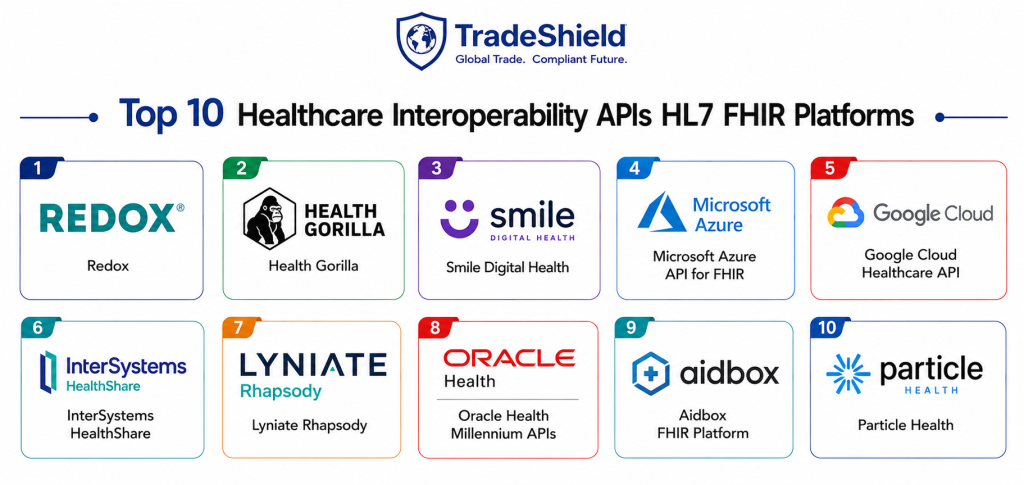
Top 10 Healthcare Interoperability APIs HL7 FHIR Platforms
1- Google Cloud Healthcare API
Short description:
Google Cloud Healthcare API provides scalable HL7 and FHIR interoperability services supporting healthcare data exchange, analytics, and AI-driven healthcare operations.
Key Features
- FHIR and HL7v2 support
- DICOM interoperability services
- RESTful healthcare APIs
- AI and analytics integrations
- Real-time healthcare data exchange
- Cloud-native scalability
- Operational monitoring dashboards
Pros
- Strong cloud scalability capabilities
- Excellent AI and analytics ecosystem integration
- Reliable healthcare interoperability support
Cons
- Cloud-native expertise required
- Enterprise implementation complexity
- Premium cloud infrastructure pricing
Platforms / Deployment
- Cloud
- API
Security & Compliance
Supports encryption, RBAC, audit logging, OAuth, HIPAA-aligned workflows, and governance capabilities.
Integrations & Ecosystem
- EHR systems
- APIs
- Healthcare analytics platforms
- AI environments
- Cloud services
Support & Community
Large cloud and healthcare developer ecosystem.
2- Microsoft Azure Health Data Services
Short description:
Microsoft Azure Health Data Services provides FHIR-native interoperability services supporting healthcare APIs, analytics, and secure healthcare data exchange workflows.
Key Features
- FHIR-native API services
- Healthcare data normalization
- SMART on FHIR support
- Real-time interoperability workflows
- Analytics integration support
- API lifecycle management
- Operational KPI dashboards
Pros
- Strong Microsoft ecosystem integration
- Excellent enterprise cloud scalability
- Reliable interoperability governance workflows
Cons
- Enterprise deployment requirements
- Advanced customization complexity
- Premium cloud operational pricing
Platforms / Deployment
- Cloud
- API
Security & Compliance
Supports RBAC, MFA, encryption, OAuth, audit logging, and governance workflows.
Integrations & Ecosystem
- Microsoft healthcare environments
- APIs
- Analytics systems
- EHR platforms
Support & Community
Strong enterprise cloud ecosystem.
3- AWS HealthLake
Short description:
AWS HealthLake provides cloud-native FHIR interoperability and healthcare data management services supporting analytics and healthcare application integration.
Key Features
- FHIR data storage support
- Healthcare API services
- NLP and AI integrations
- Interoperability workflow automation
- Operational analytics dashboards
- Data normalization capabilities
- Cloud-native scalability
Pros
- Strong AWS ecosystem support
- Good AI and analytics integration capabilities
- Reliable scalability for healthcare applications
Cons
- Cloud architecture expertise required
- Enterprise deployment complexity
- Premium cloud operational pricing
Platforms / Deployment
- Cloud
- API
Security & Compliance
Supports encryption, RBAC, OAuth, audit logging, and governance workflows.
Integrations & Ecosystem
- AWS services
- APIs
- Healthcare analytics platforms
- EHR systems
Support & Community
Large cloud-native developer ecosystem.
4- Redox
Short description:
Redox provides healthcare interoperability APIs simplifying EHR integration and healthcare data exchange workflows for digital health applications.
Key Features
- FHIR and HL7 integration support
- EHR connectivity workflows
- Real-time healthcare APIs
- Event-driven interoperability support
- API management capabilities
- Workflow automation tools
- Operational analytics dashboards
Pros
- Strong EHR integration capabilities
- Excellent developer usability support
- Reliable interoperability workflow flexibility
Cons
- Enterprise implementation pricing
- Advanced healthcare customizations may vary
- Dependent on healthcare ecosystem integrations
Platforms / Deployment
- Cloud
- API
Security & Compliance
Supports secure APIs, OAuth, RBAC, encryption, and governance workflows.
Integrations & Ecosystem
- EHR systems
- APIs
- Digital health applications
- Healthcare platforms
Support & Community
Strong digital health ecosystem.
5- InterSystems IRIS for Health
Short description:
InterSystems IRIS for Health provides enterprise interoperability and healthcare data integration workflows supporting HL7, FHIR, and healthcare analytics operations.
Key Features
- HL7 and FHIR interoperability
- Healthcare integration engine
- Real-time data exchange support
- API lifecycle management
- Analytics integration capabilities
- Workflow automation support
- Operational monitoring dashboards
Pros
- Strong enterprise interoperability support
- Excellent healthcare integration capabilities
- Reliable scalability for healthcare operations
Cons
- Enterprise deployment complexity
- Premium licensing structure
- Advanced implementation expertise required
Platforms / Deployment
- Cloud / Hybrid
- API
Security & Compliance
Supports RBAC, encryption, OAuth, audit logging, and governance workflows.
Integrations & Ecosystem
- EHR systems
- APIs
- Healthcare analytics environments
- Interoperability platforms
Support & Community
Strong enterprise healthcare ecosystem.
6- Smile Digital Health
Short description:
Smile Digital Health provides FHIR-native interoperability and healthcare data exchange workflows designed for scalable digital health ecosystems.
Key Features
- FHIR server support
- SMART on FHIR capabilities
- Healthcare API management
- Real-time interoperability workflows
- Workflow automation tools
- Analytics integration support
- Operational KPI monitoring
Pros
- Strong FHIR-native architecture
- Good interoperability flexibility
- Reliable cloud scalability support
Cons
- Smaller enterprise ecosystem
- Advanced customization may require expertise
- Enterprise deployment complexity
Platforms / Deployment
- Cloud
- API
Security & Compliance
Supports OAuth, RBAC, encryption, secure APIs, and governance workflows.
Integrations & Ecosystem
- FHIR systems
- APIs
- Healthcare applications
- EHR environments
Support & Community
Growing interoperability ecosystem.
7- Lyniate Rhapsody
Short description:
Lyniate Rhapsody provides healthcare integration and interoperability workflows supporting HL7, FHIR, API management, and healthcare data orchestration.
Key Features
- HL7 and FHIR interoperability
- Healthcare API orchestration
- Workflow automation support
- Data transformation capabilities
- Operational analytics dashboards
- Event-driven healthcare workflows
- Real-time monitoring visibility
Pros
- Strong healthcare integration support
- Good workflow orchestration flexibility
- Reliable operational visibility capabilities
Cons
- Enterprise deployment requirements
- Advanced workflow customization complexity
- Premium operational pricing
Platforms / Deployment
- Cloud / Hybrid
- API
Security & Compliance
Supports RBAC, encryption, OAuth, audit logging, and governance workflows.
Integrations & Ecosystem
- Healthcare systems
- APIs
- Analytics platforms
- EHR environments
Support & Community
Strong healthcare interoperability ecosystem.
8- Firely Server
Short description:
Firely Server provides developer-focused FHIR server infrastructure and interoperability APIs supporting modern healthcare application ecosystems.
Key Features
- FHIR server management
- RESTful healthcare APIs
- SMART on FHIR support
- Validation and conformance tools
- Workflow automation support
- Developer SDK capabilities
- Operational interoperability dashboards
Pros
- Strong developer experience support
- Excellent FHIR conformance workflows
- Reliable interoperability flexibility
Cons
- Requires technical implementation expertise
- Smaller enterprise governance ecosystem
- Advanced operational analytics limited compared to enterprise platforms
Platforms / Deployment
- Cloud / Hybrid
- API
Security & Compliance
Supports OAuth, secure APIs, encryption, RBAC, and governance workflows.
Integrations & Ecosystem
- FHIR systems
- APIs
- Healthcare applications
- Interoperability environments
Support & Community
Strong FHIR developer ecosystem.
9- Oracle Health Interoperability
Short description:
Oracle Health Interoperability provides enterprise healthcare integration and API workflows supporting HL7, FHIR, and healthcare operations management.
Key Features
- Healthcare API orchestration
- HL7 and FHIR interoperability
- Operational analytics support
- Workflow automation capabilities
- Real-time healthcare data exchange
- API governance management
- Interoperability monitoring dashboards
Pros
- Strong enterprise healthcare support
- Good interoperability governance capabilities
- Reliable cloud operational scalability
Cons
- Enterprise deployment complexity
- Premium operational pricing
- Advanced customization may require expertise
Platforms / Deployment
- Cloud / Hybrid
- API
Security & Compliance
Supports RBAC, MFA, encryption, OAuth, audit logging, and governance workflows.
Integrations & Ecosystem
- Healthcare systems
- APIs
- Oracle cloud services
- EHR environments
Support & Community
Large enterprise healthcare ecosystem.
10- HAPI FHIR
Short description:
HAPI FHIR is one of the most widely used open-source FHIR frameworks supporting healthcare interoperability APIs and healthcare application development workflows.
Key Features
- Open-source FHIR framework
- RESTful healthcare APIs
- SMART on FHIR support
- Validation and terminology services
- Developer SDK support
- Workflow automation capabilities
- FHIR conformance tools
Pros
- Strong open-source community support
- Excellent developer flexibility
- Reliable standards-based interoperability workflows
Cons
- Technical implementation expertise required
- Enterprise governance functionality limited
- Operational scalability depends on deployment architecture
Platforms / Deployment
- API
- Cloud / Hybrid
Security & Compliance
Deployment-dependent security and governance capabilities.
Integrations & Ecosystem
- FHIR systems
- APIs
- Healthcare applications
- Interoperability platforms
Support & Community
Large global open-source healthcare developer ecosystem.
Comparison Table
| Tool Name | Best For | Platforms Supported | Deployment | Standout Feature | Public Rating |
|---|---|---|---|---|---|
| Google Cloud Healthcare API | Cloud healthcare interoperability | API, Cloud | Cloud | AI-enabled healthcare APIs | N/A |
| Microsoft Azure Health Data Services | Enterprise FHIR interoperability | API, Cloud | Cloud | Microsoft healthcare ecosystem | N/A |
| AWS HealthLake | Cloud-native healthcare analytics | API, Cloud | Cloud | AI and NLP healthcare integration | N/A |
| Redox | Simplified EHR integration | API, Cloud | Cloud | Developer-friendly interoperability | N/A |
| InterSystems IRIS for Health | Enterprise healthcare integration | API, Hybrid | Hybrid | High-scale interoperability engine | N/A |
| Smile Digital Health | FHIR-native healthcare APIs | API, Cloud | Cloud | SMART on FHIR support | N/A |
| Lyniate Rhapsody | Healthcare integration orchestration | API, Hybrid | Hybrid | Workflow-driven interoperability | N/A |
| Firely Server | Developer-focused FHIR APIs | API, Hybrid | Hybrid | FHIR conformance support | N/A |
| Oracle Health Interoperability | Enterprise healthcare governance | API, Hybrid | Hybrid | Enterprise interoperability management | N/A |
| HAPI FHIR | Open-source healthcare APIs | API | Hybrid | Open-source FHIR ecosystem | N/A |
Evaluation & Scoring of Healthcare Interoperability APIs HL7 FHIR
| Tool Name | Core 25% | Ease 15% | Integrations 15% | Security 10% | Performance 10% | Support 10% | Value 15% | Weighted Total |
|---|---|---|---|---|---|---|---|---|
| Google Cloud Healthcare API | 9.6 | 8.2 | 9.5 | 9.4 | 9.5 | 9.2 | 8.4 | 9.2 |
| Microsoft Azure Health Data Services | 9.5 | 8.3 | 9.4 | 9.4 | 9.4 | 9.2 | 8.4 | 9.1 |
| AWS HealthLake | 9.4 | 8.1 | 9.3 | 9.3 | 9.4 | 9.1 | 8.5 | 9.0 |
| Redox | 9.1 | 8.8 | 9.1 | 9.0 | 9.1 | 9.0 | 8.7 | 8.9 |
| InterSystems IRIS for Health | 9.4 | 8.0 | 9.5 | 9.3 | 9.4 | 9.2 | 8.3 | 9.1 |
| Smile Digital Health | 9.0 | 8.5 | 9.0 | 8.9 | 9.0 | 8.8 | 8.8 | 8.8 |
| Lyniate Rhapsody | 9.1 | 8.3 | 9.1 | 9.0 | 9.1 | 8.9 | 8.6 | 8.9 |
| Firely Server | 8.9 | 8.6 | 9.0 | 8.8 | 8.9 | 8.7 | 8.9 | 8.8 |
| Oracle Health Interoperability | 9.2 | 8.1 | 9.2 | 9.2 | 9.2 | 9.0 | 8.4 | 8.9 |
| HAPI FHIR | 8.8 | 8.5 | 9.1 | 8.6 | 8.8 | 8.8 | 9.1 | 8.8 |
These scores are comparative and intended to help organizations evaluate Healthcare Interoperability APIs based on interoperability depth, API flexibility, integrations, scalability, governance, and long-term healthcare data exchange value.
Which Healthcare Interoperability API Platform Is Right for You?
Small Digital Health Teams and Lightweight Interoperability Projects
Best suited: HAPI FHIR, Firely Server
These provide flexible open-source interoperability capabilities.
SMB Healthcare and Startup Ecosystems
Best suited: Redox, Smile Digital Health
These balance developer usability and interoperability flexibility.
Mid-Market Healthcare Integration Teams
Best suited: Lyniate Rhapsody, AWS HealthLake
These provide stronger orchestration and cloud interoperability capabilities.
Large Enterprise Healthcare Ecosystems
Best suited: Google Cloud Healthcare API, Microsoft Azure Health Data Services, InterSystems IRIS for Health
These offer enterprise scalability, advanced governance, and deep interoperability intelligence.
Budget vs Premium
Budget-friendly: HAPI FHIR, Firely Server
Premium enterprise: Google Cloud Healthcare API, InterSystems IRIS for Health
Feature Depth vs Ease of Use
Deep enterprise functionality: InterSystems IRIS for Health, Oracle Health Interoperability
Ease of use: Redox, Smile Digital Health
Integrations & Scalability
Best integrations: Google Cloud Healthcare API, Microsoft Azure Health Data Services, InterSystems IRIS for Health
Best scalability: Google Cloud Healthcare API, AWS HealthLake
Security & Compliance Needs
Organizations managing regulated healthcare environments should prioritize systems supporting RBAC, MFA, encryption, OAuth, audit logging, secure APIs, HIPAA-aligned workflows, and comprehensive interoperability governance controls.
Frequently Asked Questions
1. What are Healthcare Interoperability APIs?
They are API platforms that enable secure healthcare data exchange between EHRs, healthcare applications, analytics systems, and digital health platforms using standards such as HL7 and FHIR.
2. Why are HL7 and FHIR APIs important?
They improve interoperability, patient data accessibility, care coordination, analytics quality, and healthcare innovation.
3. Can these APIs integrate with EHR systems?
Yes, most interoperability APIs integrate with EHRs, payer systems, analytics platforms, healthcare applications, and interoperability environments.
4. What analytics capabilities are common?
Operational interoperability dashboards, API monitoring, healthcare data analytics, workflow visibility, and operational KPI tracking are commonly supported.
5. Are cloud-native interoperability APIs common?
Yes, cloud-native interoperability platforms are increasingly common because they improve scalability, API flexibility, and healthcare data accessibility.
6. What security features are important?
RBAC, MFA, encryption, OAuth, audit logging, secure APIs, and healthcare governance controls are critical for healthcare interoperability environments.
7. Which industries use healthcare interoperability APIs most?
Hospitals, health systems, EHR vendors, payers, healthcare analytics providers, digital health startups, and telehealth organizations heavily rely on these APIs.
8. Can these platforms support SMART on FHIR?
Yes, many modern interoperability platforms support SMART on FHIR authentication, authorization, and healthcare application workflows.
9. What are common implementation challenges?
EHR integration, API governance, terminology normalization, interoperability mapping, workforce training, and security configuration are common deployment challenges.
10. How should organizations choose an interoperability API platform?
Organizations should evaluate standards support, scalability, integrations, API flexibility, security, governance, and long-term interoperability strategy.
Conclusion
Healthcare Interoperability APIs based on HL7 and FHIR standards have become foundational infrastructure for modern digital healthcare ecosystems. Modern platforms now combine FHIR-native interoperability, AI-driven normalization, workflow automation, cloud scalability, API governance, and operational analytics to support intelligent healthcare data exchange operations and improve interoperability readiness. Enterprise solutions such as Google Cloud Healthcare API, Microsoft Azure Health Data Services, and InterSystems IRIS for Health provide deep operational functionality and advanced interoperability intelligence, while platforms like HAPI FHIR and Firely Server offer flexible and open-source workflows for developer-focused interoperability projects. The best solution ultimately depends on healthcare integration complexity, API scalability requirements, governance priorities, operational scale, and long-term digital healthcare strategy. A structured evaluation process combined with pilot deployments and workflow validation can significantly improve interoperability consistency, operational efficiency, patient data accessibility, and long-term healthcare ecosystem resilience.