Introduction
Customer Consent & Preferences Centers help organizations collect, manage, synchronize, and honor customer communication preferences, privacy choices, consent records, and data permissions across digital channels. These platforms allow customers to control how brands use their data, what communications they receive, and which channels or topics they prefer.
As privacy regulations become stricter and customers expect more transparency, organizations need centralized systems that support compliant data collection while improving customer trust and engagement. Modern preference centers are no longer just unsubscribe pages. They now act as customer-facing privacy hubs that manage consent, communication frequency, personalization preferences, zero-party data, and cross-channel privacy choices.
Common real-world use cases include:
- Managing email, SMS, and push notification preferences
- Centralizing consent records across channels
- Supporting GDPR and privacy compliance workflows
- Collecting zero-party customer data
- Reducing unsubscribe rates with granular communication controls
Buyers evaluating Customer Consent & Preferences Centers should consider:
- Consent and preference synchronization capabilities
- Privacy regulation support
- Omnichannel preference management
- Integration ecosystem maturity
- Customer self-service usability
- Audit logging and governance controls
- Zero-party data collection support
- Real-time preference propagation
- Scalability across brands and regions
- Security and authentication workflows
Best for: enterprises, ecommerce brands, financial services organizations, healthcare providers, SaaS companies, publishers, retail brands, marketing operations teams, and organizations operating under strict privacy and communication compliance requirements.
Not ideal for: very small businesses with minimal communication workflows, teams using only basic email unsubscribe functionality, or organizations without centralized customer communication systems.
Key Trends in Customer Consent & Preferences Centers
- Preference centers are evolving into full privacy experience platforms.
- Zero-party data collection is becoming a major strategic priority.
- Omnichannel consent synchronization is increasingly important.
- Real-time preference updates are replacing batch synchronization workflows.
- Consent management and customer preference management are converging into unified systems.
- AI-driven personalization is increasing demand for granular preference data.
- First-party data strategies are replacing third-party tracking dependencies.
- Accessibility and user-friendly privacy experiences are becoming competitive differentiators.
- Privacy-safe customer engagement is becoming central to marketing operations.
- Enterprises are increasingly adopting centralized preference orchestration layers.
How We Selected These Tools
The tools included in this list were selected based on consent management depth, preference orchestration capabilities, compliance readiness, scalability, and operational usability.
Evaluation factors included:
- Consent and preference management functionality
- Omnichannel synchronization support
- Privacy and governance controls
- Customer self-service experience
- Integration ecosystem maturity
- Real-time preference propagation
- Enterprise scalability
- Security and authentication capabilities
- Ease of implementation and administration
- Industry adoption and reputation
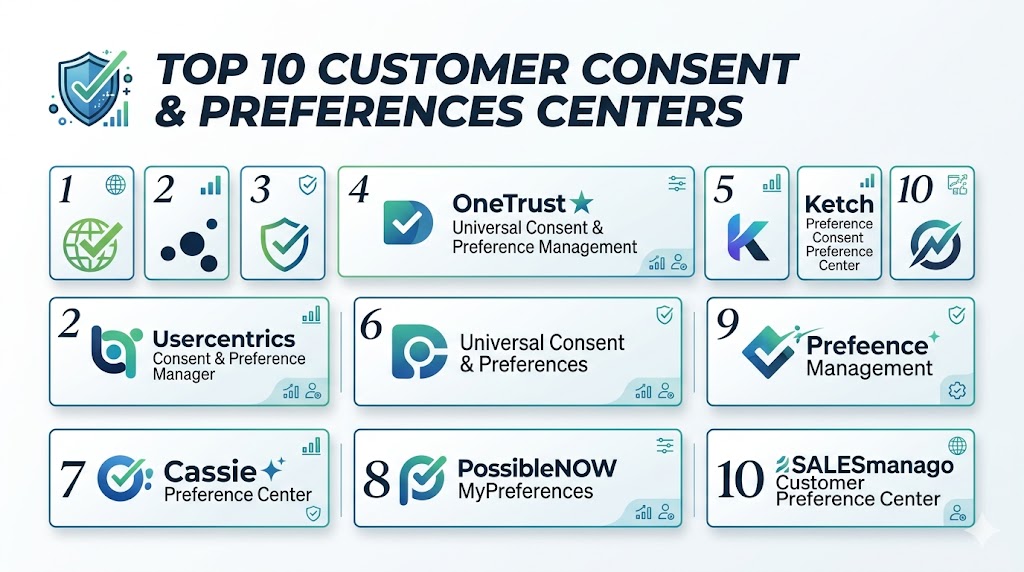
Top 10 Customer Consent & Preferences Centers
#1 — OneTrust Universal Consent & Preference Management
Short description: OneTrust Universal Consent & Preference Management helps organizations centralize customer consent, communication preferences, and first-party data management across websites, apps, marketing systems, and digital channels. It is widely used by enterprises managing global privacy compliance and customer engagement workflows.
Key Features
- Centralized consent management
- Omnichannel preference orchestration
- Customer self-service portals
- Zero-party data collection
- Real-time synchronization
- Privacy workflow automation
- Regulatory compliance support
Pros
- Strong enterprise privacy ecosystem
- Extensive integration support
- Good governance and compliance capabilities
Cons
- Enterprise implementation complexity
- Premium pricing structure
- Learning curve for advanced workflows
Platforms / Deployment
- Web
- Cloud
Security & Compliance
- RBAC controls
- Audit logging
- Governance workflows
- GDPR support
- Consent compliance workflows
Integrations & Ecosystem
OneTrust integrates with CRM, marketing, analytics, and customer engagement ecosystems for centralized preference orchestration.
- Salesforce
- Marketo
- HubSpot
- Adobe Experience Platform
- CRM systems
- APIs
Support & Community
Strong enterprise onboarding, implementation services, and customer success support resources.
#2 — Usercentrics Preference Manager
Short description: Usercentrics Preference Manager enables businesses to collect, manage, and activate customer preferences and consent data across websites and applications. It supports privacy-focused personalization and zero-party data collection workflows.
Key Features
- Granular preference capture
- Cross-channel preference management
- Consent orchestration
- Zero-party data workflows
- Customizable preference widgets
- Privacy compliance support
- Preference synchronization
Pros
- Strong privacy-first architecture
- Good user experience customization
- Useful first-party data collection support
Cons
- Advanced workflows require onboarding
- Enterprise customization may take time
- Complex implementations may require support
Platforms / Deployment
- Web
- Cloud
Security & Compliance
- GDPR support
- Access controls
- Audit management
- Governance workflows
Integrations & Ecosystem
Usercentrics integrates with marketing technology, analytics, and customer engagement platforms.
- Marketing automation tools
- CRM systems
- Analytics platforms
- APIs
- Ecommerce systems
- Consent workflows
Support & Community
Provides onboarding, implementation support, and privacy-focused educational resources.
#3 — TrustArc Consent & Preference Manager
Short description: TrustArc Consent & Preference Manager helps organizations manage customer consent, communication preferences, and privacy workflows across websites, apps, and marketing ecosystems. It supports centralized orchestration for customer trust and compliance initiatives.
Key Features
- Cross-channel preference management
- Consent orchestration
- Preference history visibility
- Accessibility-focused workflows
- Real-time synchronization
- Customer privacy portals
- Audit and governance support
Pros
- Strong enterprise governance workflows
- Good real-time synchronization support
- Useful accessibility capabilities
Cons
- Enterprise-focused onboarding
- Complex deployments may require expertise
- Smaller businesses may not need full feature set
Platforms / Deployment
- Web
- Cloud
Security & Compliance
- RBAC controls
- Audit logging
- WCAG accessibility support
- GDPR workflows
- Governance controls
Integrations & Ecosystem
TrustArc integrates with marketing, CRM, and customer communication systems for centralized preference synchronization.
- Salesforce
- HubSpot
- Marketo
- BigQuery
- Twilio
- APIs
Support & Community
Strong enterprise onboarding and customer success support for compliance and marketing operations teams.
#4 — Didomi Preference Management
Short description: Didomi Preference Management helps organizations collect and synchronize customer preferences and consent across web, mobile, and offline environments. It focuses on transparency, customer trust, and privacy-compliant engagement workflows.
Key Features
- Cross-platform preference synchronization
- Consent management
- Customer preference centers
- Omnichannel workflows
- Privacy compliance support
- Zero-party data collection
- Customer communication controls
Pros
- Strong omnichannel support
- User-friendly interfaces
- Useful compliance workflows
Cons
- Enterprise configuration complexity
- Performance impact may vary
- Advanced workflows may require planning
Platforms / Deployment
- Web
- Cloud
Security & Compliance
- Access controls
- Governance workflows
- GDPR support
- Compliance management support
Integrations & Ecosystem
Didomi integrates with customer engagement, marketing automation, and analytics ecosystems.
- CRM systems
- Marketing automation platforms
- Mobile applications
- APIs
- Analytics systems
- Ecommerce platforms
Support & Community
Strong onboarding resources and customer support for privacy and customer engagement teams.
#5 — Osano Unified Consent & Preference Hub
Short description: Osano Unified Consent & Preference Hub combines consent management and preference orchestration into a centralized privacy platform. It helps businesses synchronize customer choices across systems while maintaining compliance and personalization capabilities.
Key Features
- Unified consent management
- Real-time preference updates
- Segmentation capabilities
- Cross-system synchronization
- Privacy governance workflows
- Consent records management
- Omnichannel preference support
Pros
- Strong real-time synchronization
- Good privacy-focused workflows
- Useful segmentation capabilities
Cons
- Enterprise workflows may require configuration
- Advanced customization can be technical
- Smaller teams may not need full capabilities
Platforms / Deployment
- Web
- Cloud
Security & Compliance
- Access controls
- Governance workflows
- GDPR support
- Privacy compliance controls
Integrations & Ecosystem
Osano integrates with CRM, marketing, analytics, and customer communication systems.
- CRM systems
- Marketing automation tools
- APIs
- Analytics platforms
- Customer communication systems
- Ecommerce environments
Support & Community
Provides implementation support and privacy-focused onboarding resources.
#6 — Clarip Universal Consent & Preferences
Short description: Clarip Universal Consent & Preferences enables organizations to manage customer preferences and consent across channels in real time. It supports personalized engagement workflows while maintaining privacy and compliance controls.
Key Features
- Real-time preference management
- Omnichannel synchronization
- Consent orchestration
- API-driven workflows
- Customer profile management
- Privacy-safe personalization
- Segmentation support
Pros
- Strong API-driven architecture
- Useful real-time segmentation support
- Good omnichannel capabilities
Cons
- Enterprise implementation may require expertise
- Smaller ecosystem than larger vendors
- Advanced workflows can be technical
Platforms / Deployment
- Web
- Cloud
Security & Compliance
- Access controls
- Governance workflows
- GDPR support
- Consent management support
Integrations & Ecosystem
Clarip integrates with marketing, CRM, analytics, and customer engagement systems.
- CRM platforms
- Marketing automation systems
- APIs
- Analytics tools
- Customer communication platforms
- Data workflows
Support & Community
Provides enterprise onboarding and operational support for customer engagement workflows.
#7 — Cassie Preference Center
Short description: Cassie Preference Center by Syrenis provides centralized customer preference and consent management workflows for enterprises operating in regulated industries and customer-centric sectors. It focuses on secure preference synchronization and customer self-service experiences.
Key Features
- Centralized preference portals
- Granular communication controls
- Real-time updates
- Secure customer access
- Consent synchronization
- API integrations
- Customer service portal support
Pros
- Strong customer self-service workflows
- Good real-time synchronization support
- Useful enterprise governance capabilities
Cons
- Enterprise-focused onboarding
- Advanced integrations may require support
- Complex implementations can take time
Platforms / Deployment
- Web
- Cloud
Security & Compliance
- Secure authentication workflows
- Access controls
- Governance features
- GDPR support
- Audit support
Integrations & Ecosystem
Cassie integrates with CRM, email, customer service, and marketing systems to centralize customer preferences.
- CRM systems
- Email platforms
- APIs
- Marketing systems
- Customer service platforms
- Analytics workflows
Support & Community
Strong implementation support for regulated industries and enterprise communication environments.
#8 — PossibleNOW MyPreferences
Short description: PossibleNOW MyPreferences is an enterprise preference management platform focused on customer communication controls, consent management, and omnichannel engagement workflows. It supports multilingual and large-scale customer communication environments.
Key Features
- Centralized preference management
- Omnichannel communication controls
- Do Not Contact compliance
- Multilingual preference centers
- Preference propagation engine
- Zero-party data collection
- Customer communication governance
Pros
- Strong enterprise communication support
- Useful compliance workflows
- Good omnichannel preference synchronization
Cons
- Complex enterprise setup
- Learning curve for advanced features
- Premium enterprise pricing
Platforms / Deployment
- Web
- Cloud
Security & Compliance
- Governance controls
- Access management
- Do Not Contact compliance support
- GDPR workflows
Integrations & Ecosystem
PossibleNOW integrates with communication, CRM, and marketing systems for enterprise preference orchestration.
- CRM systems
- Marketing automation platforms
- Call center systems
- APIs
- Analytics systems
- Customer engagement tools
Support & Community
Provides enterprise onboarding and customer success support for communication governance initiatives.
#9 — Ketch Preference Management
Short description: Ketch Preference Management helps businesses capture, manage, and apply customer data preferences and consent choices across enterprise systems. It focuses on privacy-aware data operations and customer trust workflows.
Key Features
- Preference orchestration
- Consent management
- Data permission workflows
- Customer privacy controls
- Governance support
- API integrations
- Real-time synchronization
Pros
- Strong enterprise privacy positioning
- Useful unified permissioning workflows
- Good governance capabilities
Cons
- Enterprise-focused onboarding
- Technical implementation requirements
- Advanced workflows require operational maturity
Platforms / Deployment
- Web
- Cloud
Security & Compliance
- Access controls
- Governance workflows
- Privacy management support
- GDPR compliance workflows
Integrations & Ecosystem
Ketch integrates with enterprise data infrastructure and customer engagement systems for unified consent orchestration.
- CRM systems
- Data warehouses
- Marketing automation platforms
- APIs
- Customer engagement tools
- Analytics systems
Support & Community
Provides enterprise implementation support and privacy governance guidance.
#10 — SALESmanago Customer Preference Center
Short description: SALESmanago Customer Preference Center helps ecommerce businesses collect and activate zero-party customer data through interactive preference experiences. It supports segmentation, recommendations, and omnichannel marketing personalization.
Key Features
- Zero-party data collection
- Customer preference centers
- Segmentation workflows
- Personalized recommendations
- Omnichannel campaign support
- Dashboard analytics
- Ecommerce-focused workflows
Pros
- Strong ecommerce personalization support
- Useful zero-party data collection tools
- Good marketing activation capabilities
Cons
- Ecommerce-focused feature set
- Enterprise governance varies by implementation
- Advanced segmentation may require setup
Platforms / Deployment
- Web
- Cloud
Security & Compliance
- Access controls
- Privacy-focused workflows
- Governance support
- Additional certifications not publicly stated
Integrations & Ecosystem
SALESmanago integrates with ecommerce, CRM, marketing automation, and customer engagement ecosystems.
- Ecommerce platforms
- CRM systems
- Marketing automation tools
- APIs
- Analytics platforms
- Recommendation systems
Support & Community
Provides onboarding support and ecommerce-focused implementation resources.
Comparison Table
| Tool Name | Best For | Platform(s) Supported | Deployment | Standout Feature | Public Rating |
|---|---|---|---|---|---|
| OneTrust Universal Consent & Preference Management | Enterprise privacy operations | Web | Cloud | Unified consent orchestration | N/A |
| Usercentrics Preference Manager | Privacy-focused personalization | Web | Cloud | Zero-party preference capture | N/A |
| TrustArc Consent & Preference Manager | Enterprise governance workflows | Web | Cloud | Cross-channel synchronization | N/A |
| Didomi Preference Management | Omnichannel consent workflows | Web | Cloud | Cross-platform preference synchronization | N/A |
| Osano Unified Consent & Preference Hub | Real-time consent synchronization | Web | Cloud | Unified privacy orchestration | N/A |
| Clarip Universal Consent & Preferences | API-driven preference workflows | Web | Cloud | Real-time segmentation support | N/A |
| Cassie Preference Center | Regulated industries | Web | Cloud | Granular customer self-service controls | N/A |
| PossibleNOW MyPreferences | Enterprise communication governance | Web | Cloud | Omnichannel preference propagation | N/A |
| Ketch Preference Management | Enterprise privacy infrastructure | Web | Cloud | Unified permissioning workflows | N/A |
| SALESmanago Customer Preference Center | Ecommerce personalization | Web | Cloud | Zero-party ecommerce data collection | N/A |
Evaluation & Scoring of Customer Consent & Preferences Centers
| Tool Name | Core 25% | Ease 15% | Integrations 15% | Security 10% | Performance 10% | Support 10% | Value 15% | Weighted Total |
|---|---|---|---|---|---|---|---|---|
| OneTrust Universal Consent & Preference Management | 9.4 | 7.4 | 9.2 | 9.1 | 9.0 | 8.9 | 7.8 | 8.8 |
| Usercentrics Preference Manager | 8.9 | 8.0 | 8.6 | 8.7 | 8.6 | 8.5 | 8.4 | 8.5 |
| TrustArc Consent & Preference Manager | 9.0 | 7.6 | 8.8 | 9.0 | 8.8 | 8.7 | 7.9 | 8.6 |
| Didomi Preference Management | 8.7 | 8.2 | 8.4 | 8.6 | 8.5 | 8.5 | 8.4 | 8.5 |
| Osano Unified Consent & Preference Hub | 8.8 | 8.0 | 8.5 | 8.8 | 8.5 | 8.4 | 8.3 | 8.5 |
| Clarip Universal Consent & Preferences | 8.6 | 7.7 | 8.4 | 8.7 | 8.4 | 8.2 | 8.2 | 8.3 |
| Cassie Preference Center | 8.7 | 7.8 | 8.3 | 8.9 | 8.5 | 8.5 | 8.1 | 8.4 |
| PossibleNOW MyPreferences | 8.8 | 7.6 | 8.5 | 8.8 | 8.6 | 8.5 | 8.0 | 8.4 |
| Ketch Preference Management | 8.9 | 7.5 | 8.7 | 9.0 | 8.7 | 8.5 | 8.0 | 8.5 |
| SALESmanago Customer Preference Center | 8.4 | 8.3 | 8.1 | 8.2 | 8.4 | 8.2 | 8.6 | 8.3 |
These scores are comparative rather than absolute. Enterprise privacy platforms generally score higher in governance, compliance, and orchestration depth, while ecommerce-focused solutions perform better in personalization and operational usability. Organizations should prioritize the categories most aligned with their communication workflows, privacy obligations, and customer engagement strategies.
Which Customer Consent & Preferences Center Is Right for You?
Solo / Freelancer
Solo users and freelancers usually do not require enterprise consent orchestration platforms. Lightweight email preference management and basic privacy tools are often enough unless they manage large-scale customer communications.
SMB
SMBs often benefit from platforms that balance simplicity, compliance, and marketing usability. Usercentrics, Didomi, Osano, and SALESmanago can provide practical preference management workflows without excessive enterprise complexity.
Mid-Market
Mid-market organizations usually need centralized preference synchronization across marketing, CRM, and communication systems. TrustArc, Clarip, Ketch, and PossibleNOW provide stronger governance and orchestration support.
Enterprise
Large enterprises should prioritize OneTrust, TrustArc, Ketch, Cassie, or enterprise-scale omnichannel preference management platforms because of their governance capabilities, integration depth, and compliance workflows.
Budget vs Premium
Budget-conscious organizations may start with lighter preference management workflows tied to email and CRM systems. Premium platforms provide broader governance, orchestration, accessibility, and real-time synchronization capabilities.
Feature Depth vs Ease of Use
Usercentrics and Didomi generally offer more accessible user experiences, while OneTrust, Ketch, and TrustArc provide deeper enterprise governance and orchestration flexibility.
Integrations & Scalability
Organizations with CRM, CDP, warehouse, marketing automation, and omnichannel communication ecosystems should prioritize platforms with mature API and integration ecosystems.
Security & Compliance Needs
Regulated industries should prioritize audit logging, governance workflows, accessibility compliance, consent histories, authentication controls, and real-time synchronization capabilities.
Frequently Asked Questions
1. What is a Customer Consent & Preferences Center?
A Customer Consent & Preferences Center is a platform that allows customers to manage communication preferences, privacy choices, consent settings, and data permissions across channels and systems.
2. Why are preference centers important?
Preference centers help organizations improve customer trust, reduce unsubscribe rates, support compliance workflows, and collect more accurate first-party and zero-party data.
3. What is zero-party data?
Zero-party data is information customers intentionally share with a business, such as communication preferences, product interests, personalization choices, or marketing preferences.
4. How are consent management and preference management different?
Consent management focuses on legal permission for data collection and processing, while preference management focuses on customer communication choices and personalization preferences. Modern platforms increasingly combine both functions.
5. Are these platforms useful for ecommerce?
Yes. Ecommerce brands use preference centers to manage communication frequency, personalization, loyalty preferences, and marketing subscriptions while improving customer engagement.
6. Can preference centers reduce unsubscribe rates?
Yes. Granular communication controls allow customers to modify preferences instead of fully unsubscribing from all communications.
7. Do these platforms support real-time updates?
Many modern preference management platforms support real-time synchronization so customer choices are updated across connected systems immediately.
8. Are these platforms secure?
Enterprise-grade platforms usually include RBAC controls, audit logging, governance workflows, secure authentication, and privacy-focused compliance capabilities.
9. What are common implementation challenges?
Common challenges include integration complexity, inconsistent customer identifiers, governance alignment, legacy communication systems, and synchronization across multiple channels.
10. What are alternatives to Customer Consent & Preferences Centers?
Alternatives include email unsubscribe systems, CRM-native preference fields, custom-built portals, and marketing automation workflows. These may work for smaller organizations but can become difficult to scale.
Conclusion
Customer Consent & Preferences Centers are becoming critical infrastructure for privacy-safe customer engagement, first-party data strategies, and regulatory compliance. The right platform depends on organizational size, communication complexity, integration requirements, privacy obligations, and operational maturity. Enterprises with complex governance requirements may prefer OneTrust, TrustArc, Ketch, or PossibleNOW, while organizations prioritizing usability and personalization may choose Usercentrics, Didomi, or SALESmanago. Ecommerce businesses often benefit from zero-party data collection and preference-driven personalization workflows, while regulated industries require stronger audit and governance capabilities. Instead of choosing a platform based only on compliance features, organizations should evaluate customer experience quality, synchronization reliability, integration depth, and operational scalability before implementing a long-term consent and preference management strategy.