Introduction
Data Integration & ETL (Extract, Transform, Load) Tools are platforms designed to collect data from multiple sources, transform it into a usable format, and load it into target systems such as data warehouses, data lakes, or analytics platforms. These tools are essential for building modern data pipelines and enabling data-driven decision-making.
In today’s digital ecosystem, data is generated from SaaS applications, databases, APIs, cloud services, IoT devices, and logs. Without integration tools, this data remains fragmented and unusable for analytics or business intelligence.
Common use cases include:
- Building enterprise data pipelines
- Migrating data between systems
- Real-time data streaming and processing
- Data warehousing and analytics preparation
- Cloud data synchronization
- Business intelligence reporting
Key evaluation criteria include:
- Data connectivity and source support
- Transformation capabilities
- Batch vs real-time processing support
- Scalability and performance
- Ease of use and orchestration features
- Security and compliance support
- Cloud and hybrid deployment flexibility
- Monitoring and error handling
Best for data engineers, analytics teams, SaaS companies, and enterprises managing complex data ecosystems. Not ideal for small applications with minimal data movement needs.
Key Trends in Data Integration & ETL Tools
- Shift from batch ETL to real-time ELT pipelines
- Strong adoption of cloud-native integration platforms
- Increased use of AI-driven data mapping and transformation
- Rise of no-code and low-code data pipeline tools
- Growing importance of API-based integrations
- Expansion of streaming data pipelines
- Strong focus on data governance and lineage tracking
- Multi-cloud and hybrid data integration strategies
- Automation of data quality and validation processes
- Integration with modern data stacks (lakehouse, warehouse, AI systems)
How We Selected These Tools (Methodology)
- Market adoption across enterprise data ecosystems
- Data source connectivity and integration capabilities
- Performance for batch and real-time processing
- Scalability and distributed architecture support
- Ease of use and developer experience
- Cloud-native readiness and flexibility
- Security and compliance capabilities
- Ecosystem maturity and vendor support
- Automation and orchestration features
- Real-world production usage and reliability
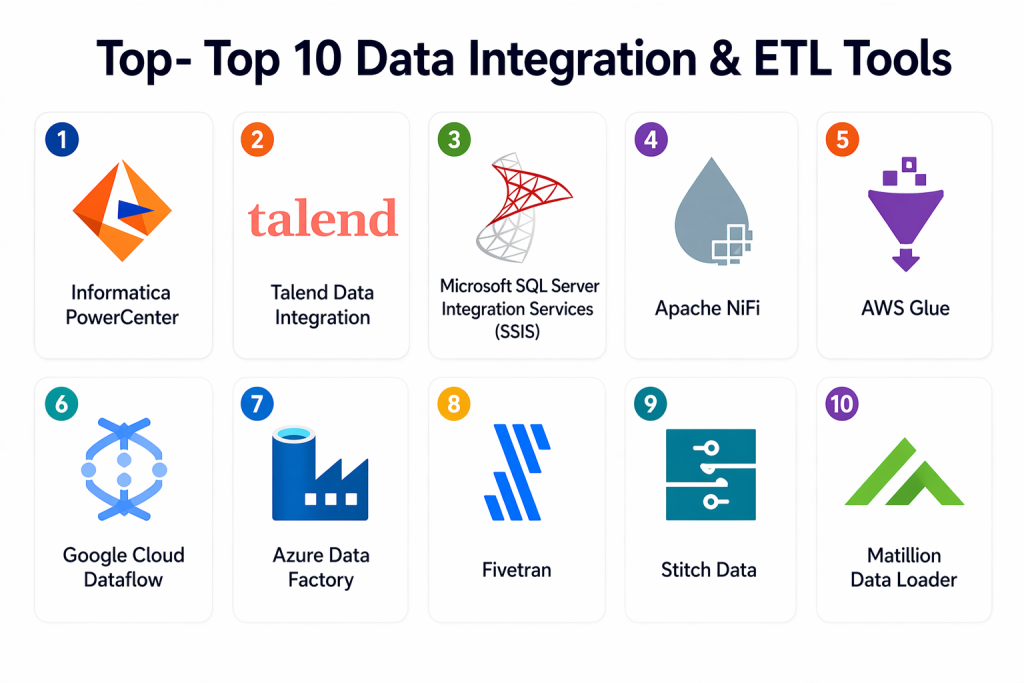
Top 10 Data Integration & ETL Tools
1 — Informatica PowerCenter
Informatica PowerCenter is a leading enterprise-grade ETL platform used for large-scale data integration and transformation.
Key Features
- Advanced ETL data pipeline creation
- Strong data transformation engine
- Metadata management and lineage tracking
- High scalability for enterprise workloads
- Data quality and validation tools
- Batch and scheduled processing
- Enterprise connectivity support
Pros
- Highly reliable enterprise solution
- Strong governance and metadata control
- Scalable architecture
Cons
- Complex setup and configuration
- High cost for small businesses
Platforms / Deployment
Cloud / On-premise / Hybrid
Security & Compliance
Enterprise-grade security, RBAC, encryption, compliance support
Integrations & Ecosystem
Databases, cloud platforms, BI tools, ERP systems
Support & Community
Strong enterprise support and global adoption
2 — Talend Data Integration
Talend is an open-source-based data integration platform designed for ETL and data quality management.
Key Features
- Graphical ETL pipeline design
- Data quality and profiling tools
- Real-time and batch processing
- API integration support
- Cloud and on-premise deployment
- Metadata management
- Extensive connector library
Pros
- Open-source flexibility
- Strong data quality features
- Easy visual interface
Cons
- Performance tuning required at scale
- Enterprise features can be expensive
Platforms / Deployment
Cloud / On-premise / Hybrid
Security & Compliance
Encryption, access control, enterprise compliance support
Integrations & Ecosystem
Cloud services, databases, APIs, BI tools
Support & Community
Active open-source and enterprise community
3 — Microsoft SSIS (SQL Server Integration Services)
SSIS is a data integration tool from Microsoft used for ETL workflows within the SQL Server ecosystem.
Key Features
- Drag-and-drop ETL design
- Tight SQL Server integration
- Workflow automation
- Data transformation components
- Scheduled execution support
- Data cleansing capabilities
- On-premise integration
Pros
- Strong Microsoft ecosystem integration
- Easy for SQL users
- Cost-effective
Cons
- Limited cloud-native features
- Less flexible outside Microsoft stack
Platforms / Deployment
On-premise / Hybrid
Security & Compliance
Windows-based security model, encryption support
Integrations & Ecosystem
SQL Server, Azure services, BI tools
Support & Community
Strong Microsoft enterprise support
4 — Apache NiFi
Apache NiFi is an open-source data flow automation tool designed for real-time data ingestion and processing.
Key Features
- Real-time data flow automation
- Visual pipeline design
- Strong streaming support
- Backpressure handling
- Data provenance tracking
- Highly scalable architecture
- Flexible routing and transformation
Pros
- Excellent real-time processing
- Open-source and flexible
- Strong data flow control
Cons
- Requires setup expertise
- UI can be complex for beginners
Platforms / Deployment
Cloud / On-premise / Hybrid
Security & Compliance
Role-based access, encryption, secure data flow
Integrations & Ecosystem
Streaming systems, APIs, databases, cloud platforms
Support & Community
Strong open-source community
5 — AWS Glue
AWS Glue is a serverless ETL service designed for cloud-based data integration.
Key Features
- Serverless ETL processing
- Automatic schema discovery
- Data catalog management
- Scalable data pipelines
- Integration with AWS services
- Job scheduling and orchestration
- Python and Spark-based transformations
Pros
- No infrastructure management
- Highly scalable
- Strong AWS integration
Cons
- AWS dependency
- Complex pricing model
Platforms / Deployment
Cloud (AWS)
Security & Compliance
IAM-based access control, encryption, AWS compliance support
Integrations & Ecosystem
S3, Redshift, Athena, EMR, ML services
Support & Community
Enterprise AWS support
6 — Google Cloud Dataflow
Dataflow is a fully managed data processing service for stream and batch ETL pipelines.
Key Features
- Unified stream and batch processing
- Apache Beam-based engine
- Auto scaling infrastructure
- Real-time analytics support
- Serverless execution model
- Strong pipeline orchestration
- Fault-tolerant processing
Pros
- Fully managed service
- Strong scalability
- Real-time processing capability
Cons
- Google Cloud dependency
- Learning curve for Apache Beam
Platforms / Deployment
Cloud (Google Cloud)
Security & Compliance
IAM security, encryption, enterprise compliance
Integrations & Ecosystem
BigQuery, Pub/Sub, AI tools, cloud storage
Support & Community
Strong Google enterprise support
7 — Azure Data Factory
Azure Data Factory is a cloud-based ETL and data integration service from Microsoft.
Key Features
- Visual pipeline builder
- Hybrid data integration support
- Data transformation workflows
- Scheduling and orchestration
- Data movement automation
- Integration with Azure ecosystem
- Mapping data flows
Pros
- Strong Azure integration
- Easy orchestration
- Scalable architecture
Cons
- Azure dependency
- Complex pricing structure
Platforms / Deployment
Cloud (Azure)
Security & Compliance
RBAC, encryption, enterprise security
Integrations & Ecosystem
Azure Synapse, Power BI, storage systems, ML tools
Support & Community
Strong Microsoft enterprise support
8 — Fivetran
Fivetran is a modern automated data integration platform focused on ELT pipelines.
Key Features
- Fully automated data pipelines
- Pre-built connectors
- Schema drift handling
- Real-time sync
- Cloud-native architecture
- Minimal maintenance required
- Data replication support
Pros
- Very easy to use
- Low maintenance
- Strong automation
Cons
- Limited transformation capabilities
- Can become expensive at scale
Platforms / Deployment
Cloud
Security & Compliance
Encryption, RBAC, enterprise compliance support
Integrations & Ecosystem
Data warehouses, SaaS applications, BI tools
Support & Community
Strong enterprise adoption
9 — Stitch Data
Stitch is a lightweight cloud-based ETL tool for data replication and integration.
Key Features
- Simple data pipeline creation
- Pre-built connectors
- Automated data replication
- Cloud-based architecture
- Real-time syncing support
- Scalable ingestion
- Minimal configuration
Pros
- Easy setup
- Lightweight and fast
- Good for SMBs
Cons
- Limited advanced transformation
- Smaller feature set
Platforms / Deployment
Cloud
Security & Compliance
Encryption, access control support
Integrations & Ecosystem
Data warehouses, SaaS platforms, BI tools
Support & Community
Moderate enterprise support
10 — Matillion Data Loader
Matillion is a cloud-native ETL tool designed for modern data warehouses.
Key Features
- Cloud-native ETL workflows
- Visual pipeline builder
- Data transformation tools
- Pre-built connectors
- Scalable architecture
- Scheduling and orchestration
- Warehouse optimization
Pros
- Strong cloud integration
- Easy to use interface
- Optimized for modern warehouses
Cons
- Cloud dependency
- Pricing can scale
Platforms / Deployment
Cloud
Security & Compliance
RBAC, encryption, enterprise compliance support
Integrations & Ecosystem
Snowflake, Redshift, BigQuery, BI tools
Support & Community
Strong enterprise adoption
Comparison Table (Top 10)
| Tool | Best For | Platform | Deployment | Standout Feature | Public Rating |
|---|---|---|---|---|---|
| Informatica | Enterprise ETL | Cross-platform | Hybrid | Metadata management | N/A |
| Talend | Data quality | Cross-platform | Hybrid | Open-source ETL | N/A |
| SSIS | Microsoft stack | Windows | On-premise | SQL integration | N/A |
| Apache NiFi | Real-time flows | Cross-platform | Hybrid | Data streaming | N/A |
| AWS Glue | Cloud ETL | AWS | Cloud | Serverless ETL | N/A |
| Dataflow | Streaming ETL | Google Cloud | Cloud | Unified processing | N/A |
| ADF | Azure integration | Azure | Cloud | Pipeline orchestration | N/A |
| Fivetran | Automation | Cloud | Cloud | No-code pipelines | N/A |
| Stitch | SMB ETL | Cloud | Cloud | Simple replication | N/A |
| Matillion | Cloud ETL | Cross-platform | Cloud | Warehouse optimized | N/A |
Evaluation & Scoring
| Tool | Core (25%) | Ease (15%) | Integrations (15%) | Security (10%) | Performance (10%) | Support (10%) | Value (15%) | Total |
|---|---|---|---|---|---|---|---|---|
| Informatica | 9 | 7 | 9 | 9 | 9 | 9 | 7 | 8.4 |
| Talend | 8 | 8 | 9 | 8 | 8 | 8 | 8 | 8.1 |
| SSIS | 8 | 8 | 8 | 8 | 8 | 8 | 9 | 8.1 |
| NiFi | 9 | 7 | 8 | 8 | 9 | 8 | 9 | 8.4 |
| AWS Glue | 9 | 8 | 9 | 9 | 9 | 9 | 8 | 8.7 |
| Dataflow | 9 | 8 | 9 | 9 | 9 | 9 | 8 | 8.7 |
| ADF | 9 | 8 | 9 | 9 | 9 | 9 | 8 | 8.7 |
| Fivetran | 8 | 9 | 9 | 8 | 9 | 8 | 7 | 8.3 |
| Stitch | 7 | 9 | 8 | 8 | 7 | 8 | 8 | 7.8 |
| Matillion | 8 | 8 | 9 | 8 | 8 | 8 | 8 | 8.1 |
Which Data Integration & ETL Tool Should You Choose?
Solo developers and small teams can start with Stitch or Fivetran for simple automation. SMBs often prefer Matillion or Talend for balanced ETL capabilities. Mid-market organizations benefit from AWS Glue, Azure Data Factory, or Google Dataflow for scalable pipelines. Enterprises typically choose Informatica or NiFi for complex, large-scale data ecosystems. Budget-friendly tools include SSIS and Stitch, while premium enterprise tools include Informatica and cloud-native ETL services.
Frequently Asked Questions
What is ETL?
It is the process of extracting, transforming, and loading data into target systems.
Why is data integration important?
It helps unify data from multiple sources for analytics and decision-making.
What is the difference between ETL and ELT?
ETL transforms data before loading, while ELT transforms after loading.
Which ETL tool is best for beginners?
Fivetran and Stitch are easiest to use.
Is AWS Glue serverless?
Yes, it is a fully managed serverless ETL service.
Can ETL tools handle real-time data?
Yes, tools like NiFi and Dataflow support real-time pipelines.
What industries use ETL tools?
Finance, retail, SaaS, healthcare, and enterprise analytics.
Are ETL tools cloud-based?
Many modern tools are cloud-native or hybrid.
What is Apache NiFi used for?
It is used for real-time data flow automation.
Which ETL tool is most powerful?
Informatica is considered one of the most enterprise-grade solutions.
Conclusion
Data Integration & ETL Tools are essential for modern data ecosystems, enabling seamless movement and transformation of data across systems. They power analytics, business intelligence, and AI workflows by ensuring clean and structured data pipelines. Each tool offers unique strengths depending on automation level, scalability, and ecosystem integration. The right choice depends on business size, technical complexity, and cloud strategy. A pilot implementation is recommended before full-scale adoption.