Introduction
Data Warehouse Platforms are centralized systems designed to store and analyze large volumes of structured and semi-structured data from multiple sources. These platforms are optimized for analytics, reporting, and business intelligence rather than transactional operations. In modern enterprises, data comes from applications, APIs, CRM systems, IoT devices, and user interactions, and a data warehouse helps unify all of it into a single source of truth.
Common use cases include business intelligence dashboards, financial reporting, customer analytics, marketing performance tracking, and enterprise data consolidation. Key evaluation factors include query performance, scalability, concurrency handling, storage efficiency, integration capabilities, security, and cost optimization.
Best for enterprises, SaaS companies, analytics teams, and organizations that depend on large-scale data insights. Not ideal for simple transactional systems or lightweight applications.
Key Trends in Data Warehouse Platforms
- Strong shift toward cloud-native and serverless architecture
- Separation of compute and storage becoming standard
- Real-time analytics adoption increasing rapidly
- Growing integration with AI and machine learning systems
- Expansion of lakehouse architecture models
- Increased use of ELT over ETL pipelines
- Automatic scaling and workload optimization
- Strong focus on cost optimization and usage-based pricing
- Native support for semi-structured data formats
- Deep integration with BI and analytics ecosystems
How We Selected These Tools (Methodology)
- Market adoption across enterprises and SaaS companies
- Query performance and scalability
- Cloud-native architecture maturity
- Integration with BI and analytics tools
- Security and compliance readiness
- Ease of SQL usage and developer experience
- Data ingestion flexibility
- Cost efficiency at scale
- Ecosystem maturity and vendor support
- Innovation in analytics capabilities
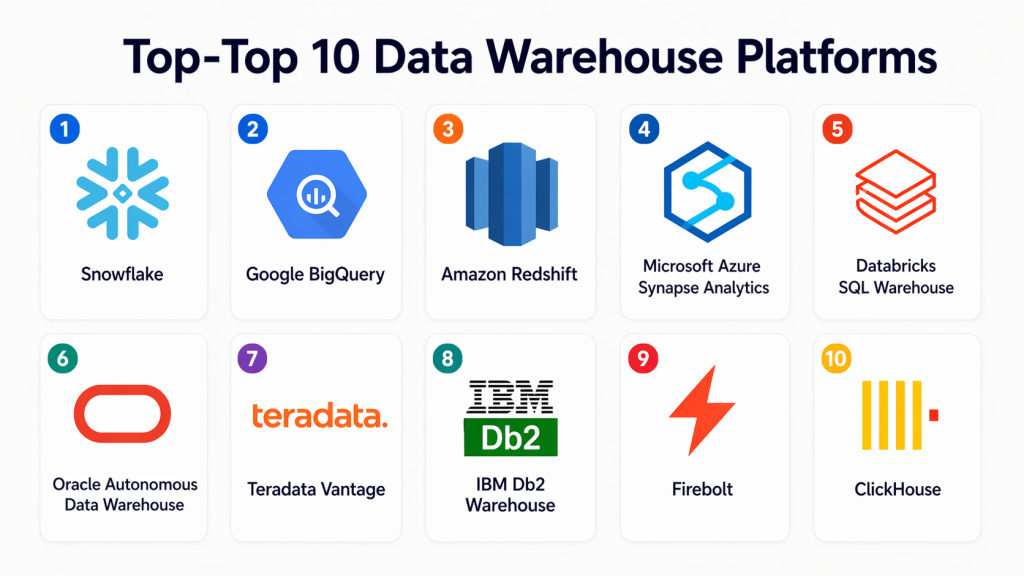
Top 10 Data Warehouse Platforms
1 — Snowflake
Snowflake is a cloud-native data warehouse designed for high scalability with separation of storage and compute.
Key Features
- Storage and compute separation
- Multi-cloud support
- Automatic scaling
- High concurrency performance
- Secure data sharing
- Semi-structured data support
- Time travel and recovery features
Pros
- Highly scalable architecture
- Easy SQL interface
- Strong performance
Cons
- Expensive at large scale
- Cloud dependency
Platforms / Deployment
Cloud (multi-cloud)
Security & Compliance
Encryption, RBAC, enterprise compliance support
Integrations & Ecosystem
BI tools, ETL pipelines, ML platforms, analytics systems
Support & Community
Strong enterprise adoption
2 — Google BigQuery
BigQuery is a serverless data warehouse designed for fast analytics at scale.
Key Features
- Serverless architecture
- Fast SQL querying
- Built-in machine learning support
- Real-time analytics
- Auto scaling
- Columnar storage
- Google Cloud integration
Pros
- No infrastructure management
- Extremely fast queries
- Highly scalable
Cons
- Vendor lock-in
- Cost can increase with usage
Platforms / Deployment
Cloud
Security & Compliance
IAM-based access, encryption, enterprise security
Integrations & Ecosystem
Google Cloud services, BI tools, ML systems, data pipelines
Support & Community
Strong Google support
3 — Amazon Redshift
Redshift is an AWS-based data warehouse optimized for scalable analytics.
Key Features
- Columnar storage
- Massively parallel processing
- Workload management
- Data lake integration
- SQL-based querying
- Automated backups
- Elastic scaling
Pros
- Strong AWS integration
- High performance
- Mature ecosystem
Cons
- Requires optimization
- AWS dependency
Platforms / Deployment
Cloud (AWS)
Security & Compliance
IAM integration, encryption, AWS compliance
Integrations & Ecosystem
AWS tools, BI platforms, ML systems
Support & Community
Enterprise AWS support
4 — Azure Synapse Analytics
Synapse is an integrated analytics platform combining data warehouse and big data analytics.
Key Features
- Unified analytics workspace
- SQL and Spark support
- Data lake integration
- On-demand querying
- Real-time analytics
- Scalable compute
- Azure ecosystem integration
Pros
- Strong hybrid analytics
- Enterprise-ready
- Deep Azure integration
Cons
- Complex setup
- Requires Azure expertise
Platforms / Deployment
Cloud (Azure)
Security & Compliance
Enterprise security, encryption, RBAC
Integrations & Ecosystem
Power BI, Azure Data Factory, ML systems
Support & Community
Strong Microsoft support
5 — Databricks SQL Warehouse
Databricks is built on a lakehouse architecture combining data lakes and warehouses.
Key Features
- Lakehouse architecture
- High-performance SQL engine
- Real-time analytics
- ML integration
- Delta Lake support
- Auto scaling
- Unified data platform
Pros
- Strong AI integration
- Flexible architecture
- High scalability
Cons
- Complex ecosystem
- Learning curve
Platforms / Deployment
Cloud / Hybrid
Security & Compliance
Encryption, RBAC, enterprise security
Integrations & Ecosystem
AI tools, BI systems, data engineering pipelines
Support & Community
Strong enterprise adoption
6 — Oracle Autonomous Data Warehouse
Oracle ADW is a self-driving data warehouse that automates tuning and management.
Key Features
- Autonomous management
- Auto scaling
- Built-in ML support
- High performance SQL
- Self-tuning system
- Automated backups
- Data encryption
Pros
- Minimal manual management
- High reliability
- Strong performance
Cons
- High cost
- Oracle ecosystem dependency
Platforms / Deployment
Cloud / Hybrid
Security & Compliance
Enterprise security, encryption, compliance support
Integrations & Ecosystem
Oracle apps, BI tools, analytics systems
Support & Community
Strong Oracle enterprise support
7 — Teradata Vantage
Teradata is an enterprise-grade analytics platform designed for large-scale workloads.
Key Features
- Massively parallel processing
- Hybrid cloud support
- Advanced analytics engine
- Workload optimization
- SQL + AI support
- Data lake integration
- High concurrency
Pros
- Enterprise scalability
- Strong analytics power
- Reliable performance
Cons
- Expensive
- Complex management
Platforms / Deployment
Cloud / Hybrid / On-premise
Security & Compliance
Enterprise-grade security
Integrations & Ecosystem
BI tools, data lakes, AI systems
Support & Community
Strong enterprise support
8 — IBM Db2 Warehouse
IBM Db2 Warehouse is a cloud data warehouse optimized for enterprise analytics.
Key Features
- In-memory processing
- Columnar storage
- Auto scaling
- AI integration support
- SQL compatibility
- Data compression
- Hybrid deployment
Pros
- Strong enterprise features
- High performance
- Flexible deployment
Cons
- Complex setup
- Higher cost
Platforms / Deployment
Cloud / Hybrid
Security & Compliance
Encryption, enterprise compliance
Integrations & Ecosystem
IBM tools, BI systems, analytics platforms
Support & Community
Strong IBM enterprise support
9 — Firebolt
Firebolt is a high-performance cloud data warehouse designed for fast analytics.
Key Features
- Ultra-fast query engine
- Columnar storage
- Cloud-native design
- High concurrency support
- Cost-efficient compute
- Index optimization
- Real-time analytics
Pros
- Extremely fast
- Efficient cost model
- Scalable architecture
Cons
- Smaller ecosystem
- Limited maturity
Platforms / Deployment
Cloud
Security & Compliance
Encryption, RBAC
Integrations & Ecosystem
BI tools, analytics pipelines
Support & Community
Growing adoption
10 — ClickHouse
ClickHouse is an open-source columnar database optimized for fast analytics.
Key Features
- Columnar storage
- High-speed queries
- Real-time analytics
- Distributed architecture
- Compression optimization
- SQL support
- Scalable performance
Pros
- Extremely fast
- Open-source flexibility
- Strong analytics engine
Cons
- Requires tuning
- Operational complexity
Platforms / Deployment
Self-hosted / Cloud / Hybrid
Security & Compliance
RBAC, encryption support
Integrations & Ecosystem
BI tools, analytics systems, data pipelines
Support & Community
Strong open-source ecosystem
Comparison Table (Top 10)
| Tool | Best For | Platform | Deployment | Standout Feature | Public Rating |
|---|---|---|---|---|---|
| Snowflake | Cloud analytics | Cross-platform | Cloud | Separation model | N/A |
| BigQuery | Serverless analytics | Google Cloud | Cloud | Fast SQL | N/A |
| Redshift | AWS analytics | AWS | Cloud | MPP engine | N/A |
| Synapse | Enterprise analytics | Azure | Cloud | Unified analytics | N/A |
| Databricks | AI + analytics | Cross-platform | Hybrid | Lakehouse model | N/A |
| Oracle ADW | Enterprise DB | Oracle | Cloud | Autonomous tuning | N/A |
| Teradata | Large enterprises | Cross-platform | Hybrid | High concurrency | N/A |
| IBM Db2 | Enterprise analytics | Cross-platform | Hybrid | In-memory engine | N/A |
| Firebolt | Fast analytics | Cloud | Cloud | High-speed queries | N/A |
| ClickHouse | Open-source analytics | Cross-platform | Hybrid | Columnar speed | N/A |
Evaluation & Scoring
| Tool | Core (25%) | Ease (15%) | Integrations (15%) | Security (10%) | Performance (10%) | Support (10%) | Value (15%) | Total |
|---|---|---|---|---|---|---|---|---|
| Snowflake | 9 | 9 | 9 | 9 | 9 | 9 | 8 | 8.9 |
| BigQuery | 9 | 9 | 9 | 9 | 10 | 9 | 8 | 9.0 |
| Redshift | 9 | 8 | 9 | 9 | 9 | 9 | 8 | 8.7 |
| Synapse | 9 | 8 | 9 | 9 | 9 | 9 | 8 | 8.7 |
| Databricks | 9 | 8 | 9 | 9 | 10 | 9 | 8 | 8.9 |
| Oracle ADW | 8 | 8 | 8 | 9 | 9 | 9 | 7 | 8.3 |
| Teradata | 9 | 7 | 8 | 9 | 10 | 9 | 7 | 8.4 |
| IBM Db2 | 8 | 7 | 8 | 9 | 9 | 8 | 7 | 8.1 |
| Firebolt | 8 | 8 | 8 | 8 | 10 | 8 | 8 | 8.4 |
| ClickHouse | 9 | 7 | 8 | 8 | 10 | 8 | 9 | 8.5 |
Which Data Warehouse Platform Should You Choose?
Solo developers and small teams can use ClickHouse or BigQuery for lightweight analytics needs. SMBs typically prefer Snowflake or Firebolt for balanced performance and scalability. Mid-market companies often use Databricks or Redshift for advanced analytics workloads. Enterprises choose Snowflake, Teradata, or Oracle ADW for large-scale systems. Budget users prefer ClickHouse, while premium solutions include Snowflake and BigQuery. Selection depends on workload complexity, scalability needs, and ecosystem compatibility.
Frequently Asked Questions
What is a data warehouse?
It is a centralized system for storing and analyzing large datasets.
Why is it used?
It supports analytics, reporting, and business intelligence.
Is Snowflake a database?
Yes, it is a cloud data warehouse platform.
What is BigQuery used for?
It is used for serverless analytics on large datasets.
Is data warehouse same as database?
No, databases handle transactions, warehouses handle analytics.
Which is fastest data warehouse?
ClickHouse and BigQuery are among the fastest.
Can it handle real-time data?
Yes, modern platforms support near real-time ingestion.
Is SQL used?
Yes, SQL is the primary query language.
What industries use it?
Finance, retail, SaaS, healthcare, and enterprise analytics.
Is cloud mandatory?
Most modern systems are cloud-native but hybrid options exist.
Conclusion
Data Warehouse Platforms are essential for modern analytics-driven organizations that rely on large-scale data processing and insights. They enable centralized data storage, high-performance querying, and business intelligence capabilities. Each platform has unique strengths depending on scalability, performance, and ecosystem integration. Choosing the right solution depends on business requirements and data strategy. A pilot testing approach is recommended before final adoption to ensure performance and cost efficiency.