Introduction
Database Security Tools are specialized platforms designed to protect databases from unauthorized access, data breaches, and internal misuse. These tools provide capabilities such as access control, encryption, activity monitoring, vulnerability assessment, and compliance enforcement to ensure sensitive data remains secure.
As organizations rely heavily on databases for storing critical information—customer records, financial data, and intellectual property—database security has become a top priority. Threats now come from both external attackers and internal users, making it essential to implement multi-layered security strategies that include monitoring, encryption, and policy enforcement.
Common Use Cases
- Database activity monitoring and auditing
- Data encryption and masking
- Privileged access management
- Compliance reporting (PCI DSS, GDPR, HIPAA)
- Threat detection and anomaly identification
What Buyers Should Evaluate
- Real-time monitoring and alerting
- Data encryption and masking capabilities
- Access control and identity management
- Integration with cloud and database platforms
- Compliance and audit support
- Scalability for large datasets
- Performance impact on database operations
- Automation and reporting capabilities
Best for: Enterprises, fintech companies, SaaS platforms, healthcare organizations, and any business managing sensitive or regulated data.
Not ideal for: Small applications with minimal sensitive data or environments relying only on built-in database security features.
Key Trends in Database Security Tools
- Increased adoption of zero trust database access models
- Real-time database activity monitoring (DAM)
- Integration with SIEM and security analytics platforms
- Growth of cloud-native database security solutions
- Automated compliance reporting and auditing
- Data masking and tokenization for privacy protection
- AI-driven anomaly detection
- Centralized security across multi-database environments
- DevSecOps integration for secure database pipelines
- Focus on insider threat detection
How We Selected These Tools (Methodology)
- Strong adoption across enterprise and cloud environments
- Proven database protection and monitoring capabilities
- Feature depth including encryption, monitoring, and compliance
- Integration with major databases and cloud platforms
- Performance and scalability
- Security posture and compliance readiness
- Suitability for SMB, mid-market, and enterprise use
- Product maturity and innovation
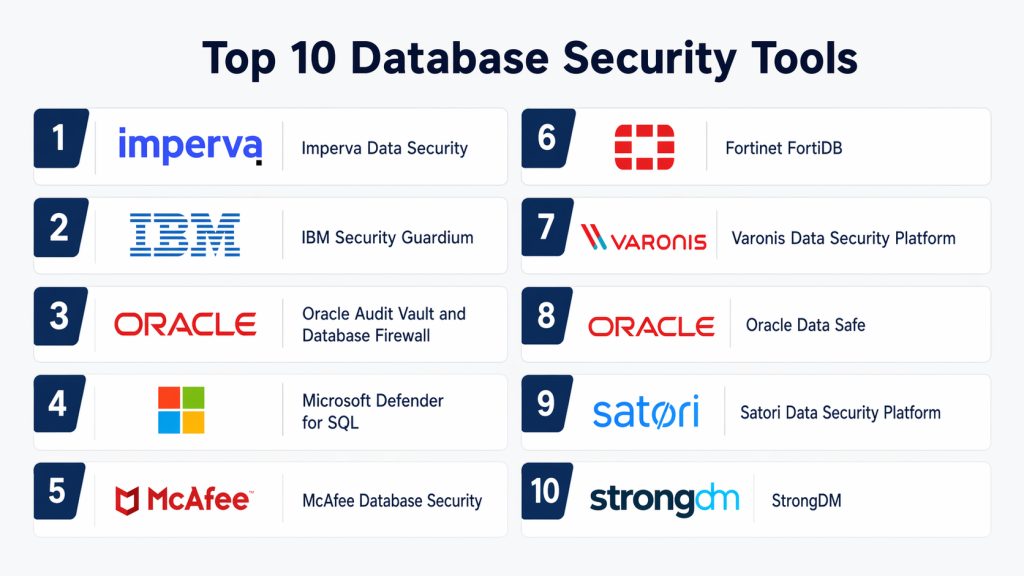
Top 10 Database Security Tools
#1 — Imperva Data Security
Short description: Enterprise-grade platform providing database monitoring, threat detection, and data protection.
Key Features
- Database activity monitoring
- Real-time threat detection
- Data masking and encryption
- Risk analytics
- Compliance reporting
Pros
- Strong analytics and visibility
- Enterprise scalability
Cons
- Complex deployment
- Premium pricing
Platforms / Deployment
Cloud / Hybrid
Security & Compliance
Not publicly stated
Integrations & Ecosystem
- SIEM tools
- Cloud platforms
- APIs
Support & Community
Enterprise support available.
#2 — IBM Security Guardium
Short description: Comprehensive database security solution focused on monitoring, encryption, and compliance.
Key Features
- Database activity monitoring
- Data encryption
- Vulnerability assessment
- Compliance reporting
- Risk analytics
Pros
- Strong compliance features
- Enterprise-grade solution
Cons
- Complex setup
- High cost
Platforms / Deployment
Cloud / Hybrid
Security & Compliance
Not publicly stated
Integrations & Ecosystem
- IBM ecosystem
- Databases
- APIs
Support & Community
Enterprise support.
#3 — Oracle Audit Vault and Database Firewall
Short description: Oracle-native solution for monitoring and protecting database environments.
Key Features
- Database firewall
- SQL traffic monitoring
- Audit reporting
- Threat detection
- Policy enforcement
Pros
- Strong Oracle integration
- Good auditing capabilities
Cons
- Limited outside Oracle
- Complex configuration
Platforms / Deployment
Cloud / On-premises
Security & Compliance
Not publicly stated
Integrations & Ecosystem
- Oracle databases
- Enterprise systems
- APIs
Support & Community
Enterprise support.
#4 — Microsoft Defender for SQL
Short description: Cloud-based database security tool integrated with Azure for threat detection and protection.
Key Features
- Threat detection
- Vulnerability assessment
- Security alerts
- Data classification
- Integration with Azure
Pros
- Strong cloud integration
- Easy deployment
Cons
- Azure dependency
- Limited customization
Platforms / Deployment
Cloud
Security & Compliance
Not publicly stated
Integrations & Ecosystem
- Azure services
- APIs
- Security tools
Support & Community
Microsoft support.
#5 — McAfee Database Security
Short description: Database monitoring and protection solution focusing on real-time security and compliance.
Key Features
- Real-time monitoring
- Data protection
- Access control
- Threat detection
- Compliance support
Pros
- Strong monitoring capabilities
- Enterprise-ready
Cons
- Complex deployment
- Expensive
Platforms / Deployment
Cloud / Hybrid
Security & Compliance
Not publicly stated
Integrations & Ecosystem
- Security platforms
- APIs
- Enterprise tools
Support & Community
Enterprise support.
#6 — Fortinet FortiDB
Short description: Database security platform offering vulnerability scanning and monitoring.
Key Features
- Vulnerability assessment
- Activity monitoring
- Risk analysis
- Policy enforcement
- Compliance tools
Pros
- Strong vulnerability detection
- Centralized control
Cons
- Requires expertise
- Setup complexity
Platforms / Deployment
Cloud / Hybrid
Security & Compliance
Not publicly stated
Integrations & Ecosystem
- Fortinet ecosystem
- APIs
- Security tools
Support & Community
Enterprise support.
#7 — Varonis Data Security Platform
Short description: Data-centric security platform focusing on user behavior analytics and data protection.
Key Features
- User behavior analytics
- Data access monitoring
- Risk detection
- Data classification
- Threat response
Pros
- Strong insider threat detection
- Good analytics
Cons
- Resource-intensive
- Premium pricing
Platforms / Deployment
Cloud / Hybrid
Security & Compliance
Not publicly stated
Integrations & Ecosystem
- Security tools
- APIs
- Enterprise systems
Support & Community
Enterprise support.
#8 — Oracle Data Safe
Short description: Cloud-based database security service for monitoring and protecting Oracle databases.
Key Features
- Activity auditing
- Data masking
- Risk assessment
- Security monitoring
- Compliance tools
Pros
- Native Oracle integration
- Easy to use
Cons
- Limited to Oracle
- Feature limitations
Platforms / Deployment
Cloud
Security & Compliance
Not publicly stated
Integrations & Ecosystem
- Oracle Cloud
- APIs
- Database systems
Support & Community
Enterprise support.
#9 — StrongDM
Short description: Access management platform providing secure and controlled database access.
Key Features
- Privileged access management
- Role-based access control
- Audit logging
- Zero trust access
- Centralized control
Pros
- Strong access control
- Easy management
Cons
- Limited encryption features
- Requires integration
Platforms / Deployment
Cloud
Security & Compliance
Not publicly stated
Integrations & Ecosystem
- Databases
- DevOps tools
- APIs
Support & Community
Strong support and documentation.
#10 — DbVisualizer
Short description: Database management tool with secure access and encrypted connections.
Key Features
- Secure database access
- Encrypted connections
- Multi-database support
- Query tools
- Visualization
Pros
- Easy to use
- Multi-database compatibility
Cons
- Limited advanced security features
- Not enterprise-focused
Platforms / Deployment
Windows / macOS / Linux
Security & Compliance
Not publicly stated
Integrations & Ecosystem
- Database systems
- APIs
- Developer tools
Support & Community
Active user community.
Comparison Table (Top 10)
| Tool Name | Best For | Platform(s) Supported | Deployment | Standout Feature | Public Rating |
|---|---|---|---|---|---|
| Imperva | Enterprise security | Web | Cloud/Hybrid | Threat analytics | N/A |
| IBM Guardium | Compliance | Web | Cloud/Hybrid | Audit automation | N/A |
| Oracle Audit Vault | Oracle DB | Web | Cloud/On-prem | Database firewall | N/A |
| Microsoft Defender for SQL | Azure users | Web | Cloud | Native integration | N/A |
| McAfee DB Security | Monitoring | Web | Cloud/Hybrid | Real-time monitoring | N/A |
| Fortinet FortiDB | Vulnerability scanning | Web | Cloud/Hybrid | Risk analysis | N/A |
| Varonis | Insider threats | Web | Cloud/Hybrid | Behavior analytics | N/A |
| Oracle Data Safe | Oracle Cloud | Web | Cloud | Data masking | N/A |
| StrongDM | Access control | Web | Cloud | Zero trust access | N/A |
| DbVisualizer | Developers | Multi | Local | Secure access | N/A |
Evaluation & Scoring of Database Security Tools
| Tool Name | Core (25%) | Ease (15%) | Integrations (15%) | Security (10%) | Performance (10%) | Support (10%) | Value (15%) | Weighted Total |
|---|---|---|---|---|---|---|---|---|
| Imperva | 9 | 7 | 8 | 9 | 9 | 8 | 7 | 8.4 |
| IBM Guardium | 9 | 6 | 8 | 9 | 9 | 9 | 7 | 8.3 |
| Oracle Audit Vault | 8 | 6 | 7 | 8 | 8 | 8 | 7 | 7.6 |
| Microsoft Defender | 8 | 8 | 8 | 8 | 8 | 8 | 8 | 8.0 |
| McAfee | 8 | 6 | 7 | 8 | 8 | 8 | 7 | 7.5 |
| Fortinet | 8 | 6 | 7 | 8 | 8 | 7 | 7 | 7.4 |
| Varonis | 8 | 7 | 8 | 8 | 8 | 8 | 6 | 7.7 |
| Oracle Data Safe | 7 | 8 | 7 | 7 | 7 | 7 | 7 | 7.2 |
| StrongDM | 8 | 8 | 9 | 8 | 8 | 8 | 8 | 8.2 |
| DbVisualizer | 6 | 9 | 7 | 6 | 7 | 7 | 8 | 7.2 |
How to interpret scores:
These scores provide a comparative benchmark across core features, usability, and value. A higher score indicates a more balanced solution, but the best choice depends on your infrastructure, compliance needs, and security priorities.
Which Database Security Tool Is Right for You?
Solo / Freelancer
DbVisualizer is sufficient for secure access and lightweight usage.
SMB
StrongDM and Microsoft Defender provide good balance of usability and security.
Mid-Market
Fortinet and Varonis offer scalable protection with manageable complexity.
Enterprise
Imperva, IBM Guardium, and Oracle solutions provide advanced security and compliance.
Budget vs Premium
- Budget: DbVisualizer
- Premium: Imperva, IBM
Feature Depth vs Ease of Use
- Easy: Microsoft Defender, DbVisualizer
- Advanced: Imperva, IBM Guardium
Integrations & Scalability
Choose API-first and cloud-native tools for growth.
Security & Compliance Needs
Enterprise tools provide stronger compliance and governance.
Frequently Asked Questions (FAQs)
What is database security?
It refers to protecting databases from unauthorized access and threats.
Why are database security tools important?
They prevent data breaches and ensure compliance.
Can these tools detect threats?
Yes, most provide real-time monitoring and alerts.
Are these tools scalable?
Yes, enterprise tools are designed for scalability.
Do they support cloud environments?
Many modern tools support cloud and hybrid environments.
What integrations are common?
APIs, SIEM tools, and database systems.
Can small businesses use these tools?
Yes, some tools are designed for SMBs.
Do they impact performance?
Some tools may slightly impact performance depending on configuration.
Are they required for compliance?
Yes, in many regulated industries.
What are common mistakes?
Ignoring monitoring, access control, and encryption.
Conclusion
Database Security Tools are critical for protecting sensitive data and maintaining trust in modern digital systems. As threats evolve, organizations must adopt multi-layered security approaches that include monitoring, access control, encryption, and compliance management. The right tool depends on your database environment, scale, and regulatory requirements, with some platforms offering simplicity while others deliver advanced enterprise capabilities. Instead of choosing a single “best” solution, focus on aligning the tool with your operational needs and security priorities. Start by evaluating a few options, testing their performance and integrations, and ensuring they fit seamlessly into your infrastructure before making a final decision.