Introduction
Public Key Infrastructure (PKI) Tools are systems that manage digital certificates, encryption keys, and identity trust frameworks used to secure communication, authenticate users, and protect sensitive data. PKI enables secure interactions across networks by using public and private key cryptography, ensuring that only trusted entities can access or exchange information.
In today’s distributed and cloud-driven environments, PKI has become a foundational security layer for SSL/TLS encryption, secure email, code signing, VPN access, and device authentication. As organizations scale, managing certificates manually becomes risky and inefficient, making PKI tools essential for automation, governance, and compliance.
Common Use Cases
- SSL/TLS certificate management for websites and APIs
- Secure email encryption and signing
- Device and IoT authentication
- Code signing for software integrity
- VPN and network access authentication
What Buyers Should Evaluate
- Certificate lifecycle management capabilities
- Automation and renewal features
- Integration with cloud and enterprise systems
- Scalability for large environments
- Compliance and audit support
- Ease of deployment and management
- Support for hybrid and multi-cloud environments
- Security controls and access management
Best for: Enterprises, security teams, IT administrators, DevOps teams, and organizations managing certificates at scale.
Not ideal for: Small businesses with minimal certificate requirements or those relying on basic hosting provider SSL solutions.
Key Trends in PKI Tools
- Automation of certificate lifecycle management
- Integration with DevOps and CI/CD pipelines
- Growth of machine identity management
- Increased adoption of cloud-native PKI solutions
- API-first architectures for automation
- Centralized visibility of certificates across environments
- Integration with Zero Trust security models
- Expansion of PKI into IoT and device ecosystems
- Compliance-driven certificate governance
- Shorter certificate lifecycles requiring automation
How We Selected These Tools (Methodology)
- Strong adoption across enterprise and cloud environments
- Proven certificate management and PKI capabilities
- Feature depth including automation and policy enforcement
- Integration with cloud, DevOps, and enterprise systems
- Performance and scalability for large infrastructures
- Security posture and compliance readiness
- Suitability for SMB, mid-market, and enterprise use cases
- Product maturity and innovation
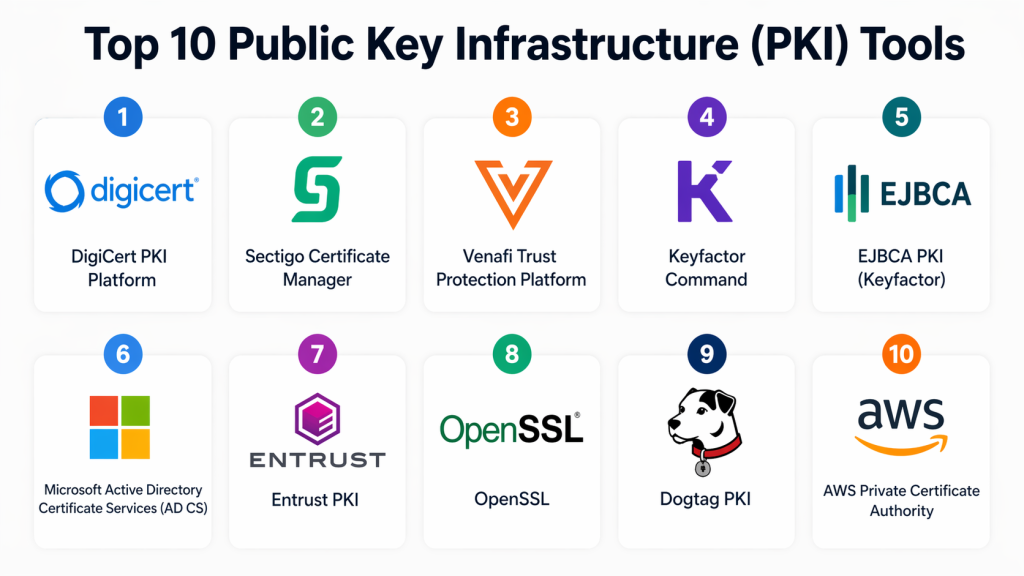
Top 10 Public Key Infrastructure (PKI) Tools
#1 — DigiCert PKI Platform
Short description: Enterprise-grade PKI platform offering certificate lifecycle management and digital trust solutions.
Key Features
- Certificate lifecycle management
- Automated certificate issuance
- Centralized management
- API integration
- Compliance tools
Pros
- Strong enterprise capabilities
- High scalability
Cons
- Premium pricing
- Complex setup
Platforms / Deployment
Cloud / Hybrid
Security & Compliance
Not publicly stated
Integrations & Ecosystem
- Enterprise systems
- APIs
- DevOps tools
Support & Community
Enterprise-level support and services.
#2 — Sectigo Certificate Manager
Short description: PKI solution focused on certificate lifecycle automation and management.
Key Features
- Certificate discovery
- Automated renewal
- Centralized dashboard
- API support
- Compliance tracking
Pros
- Easy certificate management
- Strong automation
Cons
- Limited advanced customization
- Pricing varies
Platforms / Deployment
Cloud
Security & Compliance
Not publicly stated
Integrations & Ecosystem
- Web servers
- APIs
- Enterprise systems
Support & Community
Commercial support available.
#3 — Venafi Trust Protection Platform
Short description: Platform designed to manage machine identities and certificates across enterprises.
Key Features
- Machine identity management
- Certificate lifecycle automation
- Risk monitoring
- Policy enforcement
- DevOps integration
Pros
- Strong enterprise focus
- Excellent visibility
Cons
- Complex implementation
- Higher cost
Platforms / Deployment
Cloud / Hybrid
Security & Compliance
Not publicly stated
Integrations & Ecosystem
- DevOps tools
- Cloud platforms
- APIs
Support & Community
Enterprise support and consulting.
#4 — Keyfactor Command
Short description: PKI platform focused on certificate lifecycle management and automation.
Key Features
- Certificate lifecycle automation
- Centralized management
- Reporting and analytics
- Integration with PKI systems
- API support
Pros
- Strong automation
- Good reporting
Cons
- Requires configuration
- Enterprise-focused
Platforms / Deployment
Cloud / Hybrid
Security & Compliance
Not publicly stated
Integrations & Ecosystem
- PKI systems
- APIs
- DevOps tools
Support & Community
Enterprise support.
#5 — EJBCA PKI (Keyfactor)
Short description: Open-source PKI platform designed for large-scale certificate management.
Key Features
- Certificate authority management
- High scalability
- Open-source flexibility
- Automation capabilities
- API support
Pros
- Flexible and customizable
- Strong community
Cons
- Requires expertise
- Complex setup
Platforms / Deployment
Cloud / Self-hosted
Security & Compliance
Not publicly stated
Integrations & Ecosystem
- Enterprise systems
- APIs
- Security tools
Support & Community
Active open-source and enterprise support.
#6 — Microsoft Active Directory Certificate Services (AD CS)
Short description: PKI solution integrated with Windows environments for managing certificates and identities.
Key Features
- Certificate authority services
- Integration with Active Directory
- Policy enforcement
- Certificate templates
- Automation capabilities
Pros
- Deep Windows integration
- Widely used
Cons
- Windows-dependent
- Complex configuration
Platforms / Deployment
Windows / On-premises
Security & Compliance
Not publicly stated
Integrations & Ecosystem
- Active Directory
- Enterprise systems
- Microsoft ecosystem
Support & Community
Strong enterprise and community support.
#7 — Entrust PKI
Short description: Enterprise PKI solution offering secure certificate and identity management.
Key Features
- Certificate lifecycle management
- Identity-based security
- Automation tools
- Compliance features
- Multi-environment support
Pros
- Strong enterprise security
- Flexible deployment
Cons
- Expensive
- Complex setup
Platforms / Deployment
Cloud / Hybrid
Security & Compliance
Not publicly stated
Integrations & Ecosystem
- Enterprise systems
- APIs
- Cloud platforms
Support & Community
Enterprise support.
#8 — OpenSSL
Short description: Open-source cryptographic toolkit widely used for SSL/TLS and certificate management.
Key Features
- SSL/TLS support
- Certificate generation
- Cryptographic functions
- Open-source flexibility
- Cross-platform support
Pros
- Free and widely used
- Highly flexible
Cons
- Requires technical expertise
- No centralized management
Platforms / Deployment
Windows / macOS / Linux
Security & Compliance
Not publicly stated
Integrations & Ecosystem
- Web servers
- Applications
- Security tools
Support & Community
Large global open-source community.
#9 — Dogtag PKI
Short description: Open-source PKI solution designed for enterprise-grade certificate management.
Key Features
- Certificate authority services
- Identity management
- Automation
- Scalability
- Open-source platform
Pros
- Flexible and scalable
- Open-source
Cons
- Requires expertise
- Limited UI
Platforms / Deployment
Linux / Self-hosted
Security & Compliance
Not publicly stated
Integrations & Ecosystem
- Enterprise systems
- APIs
- Security tools
Support & Community
Open-source community support.
#10 — AWS Private Certificate Authority
Short description: Managed PKI service for creating and managing private certificates within AWS.
Key Features
- Private certificate authority
- Automated certificate issuance
- Integration with AWS services
- Scalability
- Policy management
Pros
- Seamless AWS integration
- Fully managed service
Cons
- AWS dependency
- Usage-based pricing
Platforms / Deployment
Cloud
Security & Compliance
Not publicly stated
Integrations & Ecosystem
- AWS services
- APIs
- Cloud systems
Support & Community
Strong AWS support.
Comparison Table (Top 10)
| Tool Name | Best For | Platform(s) Supported | Deployment | Standout Feature | Public Rating |
|---|---|---|---|---|---|
| DigiCert | Enterprise PKI | Web | Cloud/Hybrid | Full lifecycle mgmt | N/A |
| Sectigo | Automation | Web | Cloud | Auto renewal | N/A |
| Venafi | Machine identity | Web | Cloud/Hybrid | Identity management | N/A |
| Keyfactor Command | PKI automation | Web | Cloud/Hybrid | Reporting | N/A |
| EJBCA | Open-source PKI | Multi | Cloud/Self-hosted | Customization | N/A |
| AD CS | Windows PKI | Windows | On-prem | AD integration | N/A |
| Entrust PKI | Enterprise | Web | Cloud/Hybrid | Identity security | N/A |
| OpenSSL | Developers | Multi | Local | Cryptography toolkit | N/A |
| Dogtag PKI | Open-source | Linux | Self-hosted | Scalability | N/A |
| AWS PCA | Cloud PKI | Web | Cloud | Managed PKI | N/A |
Evaluation & Scoring of PKI Tools
| Tool Name | Core (25%) | Ease (15%) | Integrations (15%) | Security (10%) | Performance (10%) | Support (10%) | Value (15%) | Weighted Total |
|---|---|---|---|---|---|---|---|---|
| DigiCert | 9 | 7 | 9 | 9 | 9 | 9 | 7 | 8.6 |
| Sectigo | 8 | 8 | 8 | 8 | 8 | 8 | 8 | 8.0 |
| Venafi | 9 | 6 | 9 | 9 | 9 | 9 | 7 | 8.5 |
| Keyfactor | 9 | 7 | 9 | 9 | 9 | 8 | 7 | 8.4 |
| EJBCA | 8 | 6 | 8 | 8 | 8 | 7 | 9 | 8.0 |
| AD CS | 8 | 7 | 8 | 8 | 8 | 8 | 8 | 7.9 |
| Entrust | 9 | 6 | 8 | 9 | 9 | 8 | 7 | 8.3 |
| OpenSSL | 7 | 6 | 7 | 8 | 8 | 7 | 10 | 7.8 |
| Dogtag | 7 | 6 | 7 | 8 | 8 | 7 | 9 | 7.7 |
| AWS PCA | 8 | 8 | 9 | 9 | 9 | 8 | 7 | 8.3 |
How to interpret scores:
These scores provide a comparative view of each tool’s capabilities across critical areas. A higher score reflects better balance, but the right choice depends on your infrastructure, scale, and compliance requirements.
Which PKI Tool Is Right for You?
Solo / Freelancer
OpenSSL is sufficient for basic certificate management.
SMB
Sectigo and AWS PCA provide simple and scalable solutions.
Mid-Market
Keyfactor and EJBCA offer flexibility and automation.
Enterprise
DigiCert, Venafi, and Entrust provide advanced features and compliance.
Budget vs Premium
- Budget: OpenSSL, Dogtag
- Premium: DigiCert, Venafi
Feature Depth vs Ease of Use
- Easy: Sectigo, AWS PCA
- Advanced: Venafi, Keyfactor
Integrations & Scalability
Choose API-first tools for scaling environments.
Security & Compliance Needs
Enterprise tools offer stronger governance and audit capabilities.
Frequently Asked Questions (FAQs)
What is PKI?
It is a framework that manages digital certificates and encryption keys.
Why is PKI important?
It ensures secure communication and identity verification.
Can PKI tools automate certificates?
Yes, most modern tools support automation.
Are PKI tools required for enterprises?
Yes, especially for large-scale secure communication.
What is certificate lifecycle management?
It includes issuing, renewing, and revoking certificates.
Can PKI integrate with cloud systems?
Yes, most tools support cloud integration.
Are open-source PKI tools reliable?
Yes, but they require expertise.
What industries use PKI?
Banking, healthcare, IT, and government sectors.
Can PKI scale?
Yes, enterprise tools are highly scalable.
What are common mistakes?
Manual certificate management and lack of automation.
Conclusion
Public Key Infrastructure (PKI) Tools are essential for securing digital communication, managing certificates, and establishing trust across modern IT environments. As organizations scale and adopt cloud and distributed systems, automated certificate lifecycle management becomes critical to avoid outages and security risks. The right PKI solution depends on your infrastructure, whether you need a simple certificate authority or a full enterprise trust platform with governance and compliance features. Instead of selecting a single “best” tool, focus on aligning the solution with your operational complexity, integration needs, and security requirements. Start by testing a few tools, validating automation capabilities, and ensuring they integrate seamlessly into your existing workflows before making a final decision.