Introduction
Unit Testing Frameworks help developers validate the smallest pieces of code such as functions, methods, classes, or modules in isolation. These frameworks make it easier to write repeatable tests, catch bugs early, refactor confidently, and maintain software quality throughout the development lifecycle.
As Agile, DevOps, and CI/CD practices continue to accelerate release cycles, unit testing has become a foundational engineering practice. Strong unit test coverage reduces regressions, improves code reliability, and enables faster deployments. Modern teams rely on unit testing frameworks to integrate quality directly into development workflows rather than treating testing as a late-stage activity.
Common use cases include:
- Function and method validation
- Regression prevention
- Test-driven development (TDD)
- Refactoring confidence
- CI/CD quality gates
- Library and package testing
- Backend logic verification
- Front-end component logic testing
Buyers should evaluate:
- Language compatibility
- Ease of writing tests
- Assertion quality
- Mocking support
- Parallel execution
- IDE integrations
- CI/CD compatibility
- Community adoption
- Reporting outputs
- Performance speed
Best for: Developers, QA engineers, DevOps teams, startups, enterprises, open-source teams, and product engineering organizations.
Not ideal for: Teams that never change code, no-code products with no engineering layer, or projects without software maintenance needs.
Key Trends in Unit Testing Frameworks
- AI-assisted test generation increasing
- Faster parallel execution becoming common
- Built-in mocking tools improving
- Snapshot testing adoption growing
- Better CI/CD reporting integrations
- Shift-left engineering quality expanding
- Stronger developer experience focus
- Cross-platform testing standardizing
- Coverage analytics becoming smarter
- Lightweight frameworks gaining popularity
How We Selected These Tools (Methodology)
These tools were selected based on:
- Global developer adoption
- Language ecosystem relevance
- Ease of use
- Assertion and mocking capabilities
- Speed and reliability
- CI/CD integrations
- IDE compatibility
- Community and documentation strength
- Scalability for teams
- Long-term relevance
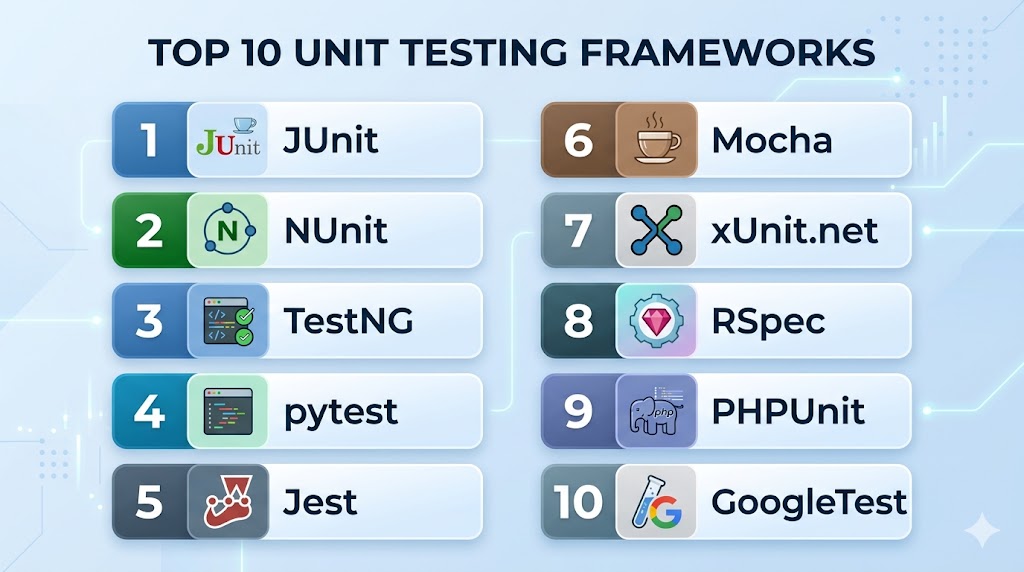
Top 10 Unit Testing Frameworks
#1 — JUnit
Short description:
The most recognized unit testing framework for Java applications, widely used in enterprise and open-source development.
Key Features
- Java-native framework
- Assertions support
- Parameterized tests
- Annotations-based workflows
- IDE integrations
- CI/CD compatibility
- Large ecosystem support
Pros
- Industry standard for Java
- Strong tooling ecosystem
- Excellent documentation
Cons
- Java-specific focus
- Legacy versions still exist in some teams
- Advanced mocking needs separate tools sometimes
Platforms / Deployment
Windows / Linux / macOS
Security & Compliance
Depends on development environment controls.
Integrations & Ecosystem
Strong compatibility with Java build and CI tools.
Support & Community
Massive Java community.
#2 — NUnit
Short description:
Popular unit testing framework for .NET developers focused on flexibility and strong test organization.
Key Features
- .NET compatibility
- Assertions library
- Parameterized tests
- Fixtures support
- Rich attributes
- IDE support
- CI/CD ready
Pros
- Strong .NET relevance
- Mature ecosystem
- Easy onboarding for C# teams
Cons
- .NET-centric scope
- Competes with xUnit.net
- Advanced mocking requires separate tools
Platforms / Deployment
Windows / Linux / macOS
Security & Compliance
Depends on development pipeline controls.
Integrations & Ecosystem
Strong .NET tooling compatibility.
Support & Community
Large developer community.
#3 — TestNG
Short description:
Java testing framework known for flexible configurations, grouping, and enterprise-scale test execution.
Key Features
- Java support
- Parallel execution
- Test grouping
- Dependency handling
- Rich annotations
- Data-driven testing
- Reporting outputs
Pros
- Great for larger Java suites
- Strong execution flexibility
- Good enterprise fit
Cons
- More configuration complexity than some rivals
- Java-only focus
- Smaller mindshare than JUnit
Platforms / Deployment
Windows / Linux / macOS
Security & Compliance
Depends on pipeline controls.
Integrations & Ecosystem
Strong Java automation compatibility.
Support & Community
Established technical community.
#4 — pytest
Short description:
One of the most loved Python testing frameworks known for simplicity, readability, and powerful plugins.
Key Features
- Python-native syntax
- Fixtures system
- Plugin ecosystem
- Parametrized tests
- Easy assertions
- Fast execution
- CI/CD compatibility
Pros
- Excellent developer experience
- Powerful and readable
- Huge Python adoption
Cons
- Python-only scope
- Large plugin choices can vary quality
- Requires discipline in bigger suites
Platforms / Deployment
Windows / Linux / macOS
Security & Compliance
Depends on development environment.
Integrations & Ecosystem
Strong fit with Python ecosystems and CI tools.
Support & Community
Very large global community.
#5 — Jest
Short description:
Widely used JavaScript testing framework popular for frontend and Node.js projects.
Key Features
- JavaScript support
- Snapshot testing
- Mocking built-in
- Parallel execution
- Coverage reports
- Watch mode
- Great DX workflows
Pros
- Excellent frontend relevance
- Strong built-in tooling
- Easy onboarding
Cons
- Primarily JavaScript ecosystem
- Large projects need config discipline
- Snapshot misuse can happen
Platforms / Deployment
Windows / Linux / macOS
Security & Compliance
Depends on project environment.
Integrations & Ecosystem
Strong compatibility with frontend toolchains.
Support & Community
Huge JavaScript community.
#6 — Mocha
Short description:
Flexible JavaScript testing framework known for customization and ecosystem adaptability.
Key Features
- JS/Node.js support
- Async testing
- Flexible setup
- Reporter options
- Broad ecosystem
- CI/CD support
- Extensible workflows
Pros
- Highly flexible
- Strong Node.js relevance
- Great for custom setups
Cons
- Needs extra libraries for full stack needs
- More setup than Jest
- Config choices can slow onboarding
Platforms / Deployment
Windows / Linux / macOS
Security & Compliance
Depends on project environment.
Integrations & Ecosystem
Strong Node.js ecosystem support.
Support & Community
Large developer community.
#7 — xUnit.net
Short description:
Modern .NET testing framework designed for cleaner architecture and strong developer workflows.
Key Features
- .NET support
- Clean conventions
- Parallel execution
- Rich assertions
- Strong IDE support
- CI/CD compatibility
- Modern architecture
Pros
- Popular modern .NET choice
- Fast execution
- Strong developer ergonomics
Cons
- .NET-specific scope
- Preference debates vs NUnit
- External mocking often needed
Platforms / Deployment
Windows / Linux / macOS
Security & Compliance
Depends on development controls.
Integrations & Ecosystem
Strong compatibility with .NET pipelines.
Support & Community
Large modern community.
#8 — RSpec
Short description:
Popular Ruby testing framework known for expressive behavior-driven syntax.
Key Features
- Ruby-native support
- Readable syntax
- Mocks and stubs
- Rich matchers
- BDD style workflows
- CI/CD support
- Strong Rails relevance
Pros
- Highly readable tests
- Strong Ruby ecosystem fit
- Great Rails adoption
Cons
- Ruby-focused scope
- DSL style not loved by all teams
- Performance varies on huge suites
Platforms / Deployment
Windows / Linux / macOS
Security & Compliance
Depends on project controls.
Integrations & Ecosystem
Strong Ruby and Rails compatibility.
Support & Community
Established Ruby community.
#9 — PHPUnit
Short description:
Leading unit testing framework for PHP applications and web platforms.
Key Features
- PHP-native testing
- Assertions support
- Fixtures
- Mocking support
- Coverage reports
- CI/CD integrations
- Framework compatibility
Pros
- Standard PHP choice
- Mature ecosystem
- Strong CMS relevance
Cons
- PHP-only scope
- Legacy project complexity varies
- Larger suites need maintenance discipline
Platforms / Deployment
Windows / Linux / macOS
Security & Compliance
Depends on project controls.
Integrations & Ecosystem
Strong compatibility with PHP ecosystems.
Support & Community
Large PHP community.
#10 — GoogleTest
Short description:
Widely respected C++ testing framework used for performance-critical and systems software projects.
Key Features
- C++ testing support
- Assertions and matchers
- Fixtures
- Parameterized tests
- Fast execution
- Strong tooling support
- Large-scale codebase suitability
Pros
- Excellent for C++ teams
- Mature and reliable
- Great systems relevance
Cons
- C++ learning complexity remains
- Build integration may need setup
- Language-specific scope
Platforms / Deployment
Windows / Linux / macOS
Security & Compliance
Depends on build environment.
Integrations & Ecosystem
Strong compatibility with C++ toolchains.
Support & Community
Strong engineering community.
Comparison Table (Top 10)
| Tool Name | Best For | Platform(s) Supported | Deployment | Standout Feature | Public Rating |
|---|---|---|---|---|---|
| JUnit | Java teams | Multi-platform | Local | Java standard | N/A |
| NUnit | .NET teams | Multi-platform | Local | Mature .NET support | N/A |
| TestNG | Large Java suites | Multi-platform | Local | Parallel grouping | N/A |
| pytest | Python teams | Multi-platform | Local | Simplicity + plugins | N/A |
| Jest | Frontend teams | Multi-platform | Local | Snapshot testing | N/A |
| Mocha | Node.js teams | Multi-platform | Local | Flexibility | N/A |
| xUnit.net | Modern .NET teams | Multi-platform | Local | Clean architecture | N/A |
| RSpec | Ruby teams | Multi-platform | Local | Readable BDD syntax | N/A |
| PHPUnit | PHP teams | Multi-platform | Local | PHP standard | N/A |
| GoogleTest | C++ teams | Multi-platform | Local | Systems testing | N/A |
Evaluation & Scoring of Unit Testing Frameworks
| Tool Name | Core | Ease | Integrations | Security | Performance | Support | Value | Weighted Total |
|---|---|---|---|---|---|---|---|---|
| JUnit | 9 | 8 | 10 | 7 | 9 | 9 | 10 | 8.9 |
| NUnit | 8 | 8 | 9 | 7 | 8 | 8 | 10 | 8.3 |
| TestNG | 8 | 7 | 8 | 7 | 9 | 8 | 9 | 8.0 |
| pytest | 9 | 10 | 9 | 7 | 9 | 9 | 10 | 9.1 |
| Jest | 9 | 9 | 9 | 7 | 9 | 9 | 10 | 9.0 |
| Mocha | 8 | 8 | 8 | 7 | 8 | 8 | 9 | 8.0 |
| xUnit.net | 8 | 8 | 9 | 7 | 9 | 8 | 10 | 8.3 |
| RSpec | 8 | 8 | 8 | 7 | 8 | 8 | 9 | 8.0 |
| PHPUnit | 8 | 8 | 8 | 7 | 8 | 8 | 10 | 8.1 |
| GoogleTest | 9 | 7 | 8 | 7 | 9 | 8 | 9 | 8.2 |
These scores are comparative benchmarks. The best framework depends primarily on programming language, developer workflow, and CI/CD ecosystem.
Which Unit Testing Framework Is Right for You?
Solo / Freelancer
Choose pytest, Jest, JUnit, or PHPUnit based on language.
SMB
Choose pytest, Jest, NUnit, or xUnit.net.
Mid-Market
Choose JUnit, pytest, Jest, or TestNG.
Enterprise
Choose JUnit, xUnit.net, NUnit, GoogleTest, or TestNG.
Budget vs Premium
Most unit testing frameworks are free and open-source.
Feature Depth vs Ease of Use
Depth: JUnit, TestNG, GoogleTest
Ease: pytest, Jest, NUnit
Integrations & Scalability
Strong options: JUnit, pytest, Jest, xUnit.net.
Security & Compliance Needs
Focus more on pipeline security than framework choice.
Frequently Asked Questions (FAQs)
1. What is unit testing?
It tests small pieces of code in isolation.
2. Why is unit testing important?
It catches bugs early and improves maintainability.
3. Which framework is best for Python?
pytest is one of the most popular choices.
4. Which framework is best for Java?
JUnit is widely considered the standard.
5. Is Jest only for frontend projects?
Mostly JavaScript ecosystems, including backend Node.js.
6. Do unit tests run in CI/CD?
Yes, they are commonly run on every commit.
7. Are these tools free?
Most popular unit testing frameworks are free.
8. How much coverage is enough?
Focus on critical logic first rather than chasing numbers.
9. Do I need mocks?
Often yes, when isolating dependencies.
10. What should I test first?
Business logic, validations, calculations, and edge cases.
Conclusion
Unit Testing Frameworks are essential for building reliable software at speed and with confidence. The right choice usually depends first on your programming language, then on team workflow, ecosystem integrations, and developer preferences. Some teams prioritize simplicity, while others need advanced execution control or enterprise-scale pipelines. Fast feedback, maintainability, and CI/CD compatibility should guide your decision. Choose the framework native to your stack, start with critical modules, and grow test coverage strategically over time.