Introduction
Container Orchestration platforms help businesses deploy, manage, scale, and secure containerized applications across clusters of servers. Instead of manually handling individual containers, orchestration tools automate scheduling, networking, scaling, updates, recovery, and lifecycle management. Kubernetes has become the industry standard in this category and powers many modern cloud-native environments.
These platforms are essential because organizations need reliable application delivery, faster releases, resilient infrastructure, hybrid cloud portability, and efficient DevOps workflows. As applications become more distributed, orchestration ensures stability and operational consistency.
Common use cases include:
- Microservices deployment
- Auto-scaling web applications
- CI/CD production delivery
- Multi-cloud workload management
- High-availability systems
- Modern platform engineering
Buyers should evaluate:
- Ease of cluster management
- Security and policy controls
- Multi-cloud support
- Monitoring and observability
- Upgrade simplicity
- Developer experience
- Networking flexibility
- Cost efficiency
- Enterprise support
- Automation depth
Best for: DevOps teams, platform engineers, SaaS companies, enterprises, cloud-native startups, and organizations modernizing application delivery.
Not ideal for: Very small teams with one simple app, businesses without in-house technical operations skills, or static websites with no scaling needs.
Key Trends in Container Orchestration (Kubernetes)
- AI-assisted cluster optimization
- GitOps workflows becoming standard
- Stronger software supply chain security
- Multi-cluster management demand rising
- Platform engineering teams expanding
- Cost governance for clusters increasing
- Serverless Kubernetes adoption growing
- GPU scheduling for AI workloads
- Better developer self-service portals
- Unified VM + Kubernetes operations emerging
How We Selected These Tools (Methodology)
These tools were selected based on:
- Market adoption and trust
- Kubernetes management maturity
- Reliability and scalability
- Security features
- Ecosystem integrations
- Upgrade and lifecycle management
- Multi-cloud relevance
- Developer productivity impact
- Enterprise support options
- Long-term strategic relevance
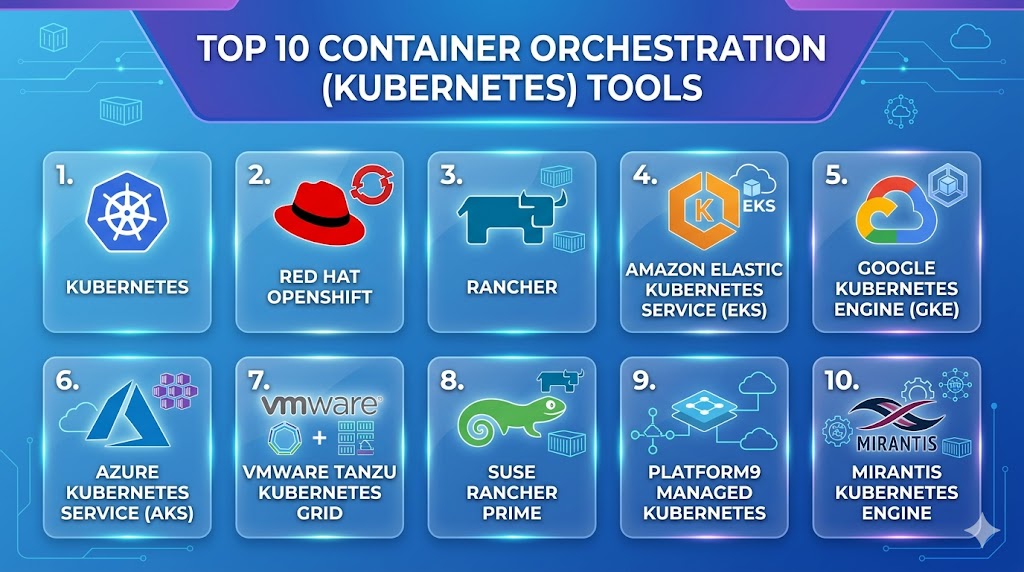
Top 10 Container Orchestration (Kubernetes) Tools
#1 — Kubernetes
Short description:
The core open-source orchestration platform used to automate deployment, scaling, and management of containerized workloads.
Key Features
- Automated scheduling
- Self-healing workloads
- Horizontal scaling
- Rolling updates
- Service discovery
- Massive extension ecosystem
- Multi-cloud portability
Pros
- Industry standard
- Highly flexible
- Huge ecosystem support
Cons
- Steep learning curve
- Operational complexity
- Requires skilled teams
Platforms / Deployment
Cloud / Self-hosted / Hybrid
Security & Compliance
RBAC, network policies, secrets management, audit logging.
Integrations & Ecosystem
Works with nearly all cloud-native tooling.
Support & Community
Massive global open-source community.
#2 — Red Hat OpenShift
Short description:
Enterprise Kubernetes platform focused on governance, security, developer workflows, and hybrid cloud operations.
Key Features
- Managed Kubernetes foundation
- Built-in CI/CD options
- Strong policy controls
- Integrated monitoring
- Developer console
- Hybrid deployment support
- Registry options
Pros
- Strong enterprise controls
- Excellent hybrid flexibility
- Mature support model
Cons
- Premium pricing
- More complex than basic setups
- Best value at scale
Platforms / Deployment
Cloud / Self-hosted / Hybrid
Security & Compliance
RBAC, policy controls, logging, enterprise security features.
Integrations & Ecosystem
Strong compatibility with enterprise stacks.
Support & Community
Excellent enterprise support reputation.
#3 — Rancher
Short description:
A leading platform for managing multiple Kubernetes clusters across clouds and on-prem environments.
Key Features
- Multi-cluster management
- Central dashboards
- Identity integration
- Policy management
- Cluster provisioning
- Monitoring support
- Lifecycle operations
Pros
- Great multi-cluster visibility
- Flexible infrastructure support
- Strong admin experience
Cons
- Depends on Kubernetes maturity
- Less useful for tiny environments
- Advanced ops still need expertise
Platforms / Deployment
Cloud / Self-hosted / Hybrid
Security & Compliance
RBAC, identity controls, policies.
Integrations & Ecosystem
Works across many Kubernetes distributions.
Support & Community
Strong technical community.
#4 — Amazon Elastic Kubernetes Service (EKS)
Short description:
Managed Kubernetes service designed for scalable cloud-native workloads.
Key Features
- Managed control plane
- Auto-scaling
- IAM integration
- Networking controls
- Managed upgrades
- Monitoring integrations
- Cloud-native alignment
Pros
- Reduces infrastructure burden
- Strong scalability
- Good enterprise fit
Cons
- Cloud cost management needed
- Best fit in same ecosystem
- Kubernetes complexity still applies
Platforms / Deployment
Cloud
Security & Compliance
RBAC, IAM controls, logging, encryption options.
Integrations & Ecosystem
Strong compatibility with cloud services.
Support & Community
Strong enterprise support options.
#5 — Google Kubernetes Engine (GKE)
Short description:
Managed Kubernetes platform known for automation, maturity, and strong developer workflows.
Key Features
- Auto-repair nodes
- Auto-scaling
- Managed upgrades
- Security controls
- Monitoring tools
- Release channels
- Developer workflows
Pros
- Strong operational automation
- Great developer experience
- Mature managed service
Cons
- Best fit in same ecosystem
- Cloud spend governance needed
- Kubernetes skills still needed
Platforms / Deployment
Cloud
Security & Compliance
RBAC, logging, identity controls, workload protections.
Integrations & Ecosystem
Strong fit with analytics and AI services.
Support & Community
Strong cloud support presence.
#6 — Azure Kubernetes Service (AKS)
Short description:
Managed Kubernetes platform suited for organizations using productivity and identity ecosystems.
Key Features
- Managed clusters
- Identity integration
- Auto-scaling
- Policy controls
- Monitoring support
- Windows container support
- DevOps alignment
Pros
- Strong enterprise fit
- Identity advantages
- Good hybrid potential
Cons
- Cloud governance needed
- Kubernetes complexity remains
- Best fit in same ecosystem
Platforms / Deployment
Cloud
Security & Compliance
RBAC, policies, logging, identity controls.
Integrations & Ecosystem
Strong alignment with DevOps and productivity environments.
Support & Community
Large enterprise customer base.
#7 — VMware Tanzu Kubernetes Grid
Short description:
Enterprise Kubernetes platform for organizations modernizing private and hybrid infrastructure.
Key Features
- Kubernetes lifecycle management
- Multi-cloud support
- Security tooling
- Enterprise integrations
- Cluster consistency
- Private cloud support
- Application modernization tools
Pros
- Great for infrastructure modernization
- Strong private cloud relevance
- Mature vendor support
Cons
- Premium positioning
- Complex product landscape
- Best for larger organizations
Platforms / Deployment
Cloud / Self-hosted / Hybrid
Security & Compliance
RBAC, policy tools, enterprise controls.
Integrations & Ecosystem
Works well in enterprise infrastructure environments.
Support & Community
Strong enterprise support.
#8 — SUSE Rancher Prime
Short description:
Commercial Kubernetes management offering designed for enterprise governance and production operations.
Key Features
- Enterprise cluster management
- Governance controls
- Security features
- Multi-cluster visibility
- Lifecycle automation
- Policy enforcement
- Commercial support
Pros
- Enterprise-ready governance
- Strong operational controls
- Good support model
Cons
- Better for larger buyers
- Requires Kubernetes maturity
- Commercial cost considerations
Platforms / Deployment
Cloud / Self-hosted / Hybrid
Security & Compliance
RBAC, policies, logging.
Integrations & Ecosystem
Strong alignment with enterprise Kubernetes environments.
Support & Community
Commercial enterprise support.
#9 — Platform9 Managed Kubernetes
Short description:
Managed Kubernetes platform focused on simplifying cluster operations across distributed infrastructure.
Key Features
- Managed operations
- Multi-environment support
- Centralized dashboards
- Lifecycle management
- Monitoring
- Policy controls
- Automation workflows
Pros
- Lower ops burden
- Good hybrid fit
- Simplifies management
Cons
- Smaller market visibility
- Best value for managed needs
- Less ecosystem scale than giants
Platforms / Deployment
Cloud / Hybrid
Security & Compliance
RBAC, policies, access controls.
Integrations & Ecosystem
Useful for hybrid and distributed infrastructure teams.
Support & Community
Commercial support model.
#10 — Mirantis Kubernetes Engine
Short description:
Enterprise Kubernetes platform built for secure and production-grade cluster operations.
Key Features
- Cluster lifecycle tools
- Security controls
- Multi-cluster support
- Automation features
- Registry integrations
- Production operations
- Enterprise support options
Pros
- Production-ready focus
- Good enterprise controls
- Strong modernization use cases
Cons
- Smaller market visibility
- Best for technical buyers
- Premium enterprise orientation
Platforms / Deployment
Cloud / Self-hosted / Hybrid
Security & Compliance
RBAC, logging, policy controls.
Integrations & Ecosystem
Supports enterprise cloud-native operations.
Support & Community
Commercial enterprise support.
Comparison Table (Top 10)
| Tool Name | Best For | Platform(s) Supported | Deployment | Standout Feature | Public Rating |
|---|---|---|---|---|---|
| Kubernetes | Core orchestration | Multi-platform | Hybrid | Industry standard | N/A |
| OpenShift | Enterprise | Multi-platform | Hybrid | Governance | N/A |
| Rancher | Multi-cluster ops | Multi-platform | Hybrid | Cluster control | N/A |
| EKS | Cloud teams | Cloud | Cloud | Managed service | N/A |
| GKE | Dev teams | Cloud | Cloud | Automation | N/A |
| AKS | Enterprise cloud | Cloud | Cloud | Identity alignment | N/A |
| Tanzu Kubernetes Grid | Private cloud | Multi-platform | Hybrid | Modernization | N/A |
| SUSE Rancher Prime | Governance teams | Multi-platform | Hybrid | Enterprise control | N/A |
| Platform9 | Hybrid ops | Multi-platform | Hybrid | Managed simplicity | N/A |
| Mirantis Kubernetes Engine | Production ops | Multi-platform | Hybrid | Enterprise clusters | N/A |
Evaluation & Scoring of Container Orchestration (Kubernetes)
| Tool Name | Core | Ease | Integrations | Security | Performance | Support | Value | Weighted Total |
|---|---|---|---|---|---|---|---|---|
| Kubernetes | 10 | 6 | 10 | 9 | 10 | 9 | 8 | 8.8 |
| OpenShift | 9 | 7 | 9 | 10 | 9 | 9 | 7 | 8.5 |
| Rancher | 8 | 8 | 8 | 8 | 8 | 8 | 8 | 8.0 |
| EKS | 9 | 8 | 9 | 9 | 9 | 8 | 7 | 8.4 |
| GKE | 9 | 8 | 9 | 9 | 9 | 8 | 8 | 8.5 |
| AKS | 9 | 8 | 9 | 9 | 8 | 8 | 8 | 8.4 |
| Tanzu Kubernetes Grid | 8 | 7 | 8 | 9 | 8 | 8 | 7 | 7.8 |
| SUSE Rancher Prime | 8 | 7 | 8 | 9 | 8 | 8 | 7 | 7.9 |
| Platform9 | 8 | 8 | 7 | 8 | 8 | 8 | 8 | 7.9 |
| Mirantis Kubernetes Engine | 8 | 7 | 8 | 8 | 8 | 8 | 7 | 7.7 |
These scores are comparative benchmarks. The right platform depends on team skill, cluster scale, governance needs, and cloud strategy.
Which Container Orchestration (Kubernetes) Tool Is Right for You?
Solo / Freelancer
Choose managed lightweight Kubernetes or simple local Kubernetes environments.
SMB
Choose Rancher, AKS, or managed services.
Mid-Market
Choose GKE, AKS, Rancher, or Platform9.
Enterprise
Choose Kubernetes, OpenShift, EKS, GKE, or Tanzu.
Budget vs Premium
Budget: Kubernetes, Rancher
Premium: OpenShift, Tanzu
Feature Depth vs Ease of Use
Depth: Kubernetes, OpenShift
Ease: GKE, AKS, Platform9
Integrations & Scalability
Strong options: Kubernetes, EKS, GKE, AKS.
Security & Compliance Needs
Strong choices: OpenShift, Kubernetes, SUSE Rancher Prime.
Frequently Asked Questions (FAQs)
1. What is container orchestration?
It automates deployment, scaling, and management of containers.
2. Is Kubernetes the market leader?
Yes, it is widely considered the industry standard.
3. Is Kubernetes hard to learn?
It can be complex, especially for beginners.
4. What is managed Kubernetes?
A provider handles much of the control plane and operations.
5. Which platform is best for enterprises?
OpenShift, Kubernetes, EKS, GKE, and AKS are common choices.
6. Can I run Kubernetes on-premises?
Yes, many platforms support self-hosted deployments.
7. Is Kubernetes secure?
Yes, with proper policies, RBAC, and workload security controls.
8. What is multi-cluster management?
Managing several Kubernetes clusters from one control layer.
9. Can Kubernetes run AI workloads?
Yes, especially with GPU scheduling support.
10. What should I evaluate first?
Ease of operations, scaling, security, and integrations.
Conclusion
Container Orchestration platforms have become essential for running modern applications at scale, with Kubernetes leading the market standard. The best choice depends on your cloud strategy, operational maturity, compliance requirements, and internal engineering skills. Some teams need raw flexibility, while others benefit more from managed or enterprise-ready platforms. Security, automation, and developer productivity should be key evaluation priorities. Shortlist two or three options, test real workloads, and compare operational overhead before making a long-term decision.