Introduction
Cloud File Storage Tools help businesses store, sync, share, organize, and secure files using cloud infrastructure instead of relying only on local devices or on-prem servers. These platforms make files accessible from anywhere while enabling collaboration, version history, permissions management, and backup continuity.
As remote work, distributed teams, hybrid offices, and digital collaboration continue to expand, cloud file storage has become a core productivity layer for organizations of every size. Modern tools now include advanced security controls, AI search, workflow automation, compliance policies, and integrations with productivity suites.
Common use cases include:
- Team file sharing
- Remote access to documents
- Collaborative editing
- Secure client file delivery
- File backup and sync
- Permission-based document access
- Cross-device work continuity
What buyers should evaluate:
- Storage scalability
- Sharing controls
- Security and encryption
- Collaboration features
- Version history
- Admin controls
- Integration ecosystem
- Ease of use
- Compliance readiness
- Pricing model
Best for: SMBs, enterprises, agencies, remote teams, legal firms, finance teams, education, and content-heavy businesses.
Not ideal for: Organizations needing only offline local storage with no collaboration requirements.
Key Trends in Cloud File Storage Tools
- AI-powered file search and summaries expanding
- Zero-trust file sharing controls increasing
- End-to-end encrypted business storage demand rising
- Hybrid cloud + self-hosted models growing
- Real-time co-editing now standard
- Secure external collaboration improving
- Ransomware recovery/version rollback features growing
- Data residency controls becoming more important
- Workflow automation around files expanding
- Lower-cost cold storage tiers increasing
How We Selected These Tools (Methodology)
- Strong market adoption
- Reliable sync and sharing capabilities
- Security maturity
- Collaboration quality
- Admin and governance tools
- Cross-platform support
- Integration ecosystem depth
- SMB to enterprise suitability
- Support reputation
- Overall value for cost
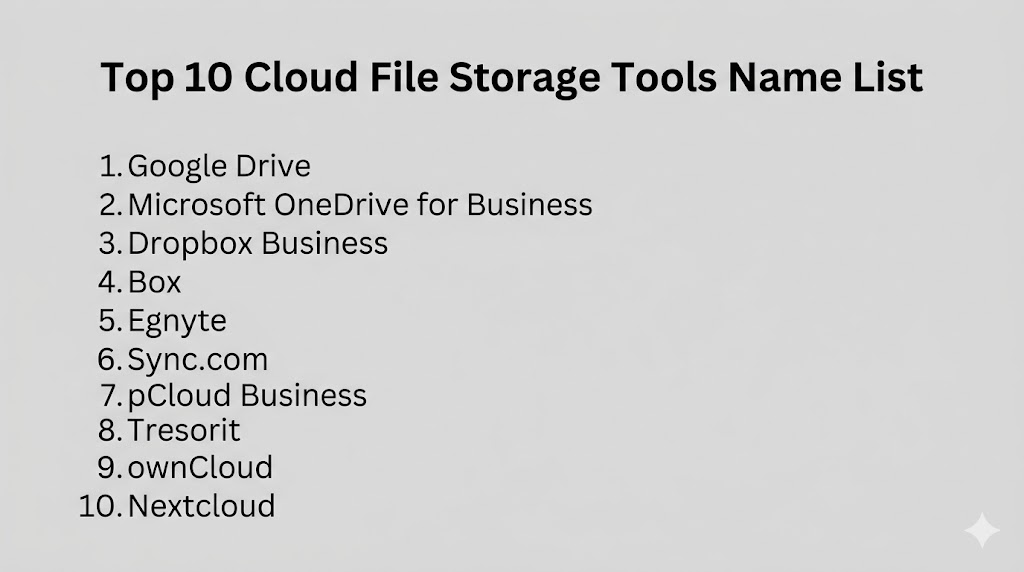
Top 10 Cloud File Storage Tools
#1 — Google Drive
Short description: One of the most widely used cloud file platforms, ideal for collaboration-heavy teams using Google Workspace.
Key Features
- Cloud file storage
- Real-time Docs/Sheets collaboration
- Shared drives
- Permission controls
- AI-assisted search features
- Version history
- Cross-device sync
Pros
- Excellent collaboration experience
- Strong ecosystem integration
- Easy user adoption
Cons
- Best value inside Google ecosystem
- Advanced governance may require higher tiers
Platforms / Deployment
Cloud / Web / Windows / macOS / iOS / Android
Security & Compliance
Encryption, MFA, RBAC, audit tools, admin controls
Integrations & Ecosystem
- Google Workspace
- Third-party SaaS tools
- APIs
- Automation tools
Support & Community
Large global ecosystem.
#2 — Microsoft OneDrive for Business
Short description: Strong choice for businesses using Microsoft 365 needing secure storage and Office collaboration.
Key Features
- File sync
- Office collaboration
- Sharing controls
- Versioning
- Personal vault features
- Admin governance
- Windows integration
Pros
- Excellent Microsoft fit
- Familiar for Office users
- Strong enterprise controls
Cons
- Best inside Microsoft ecosystem
- Sync complexity can vary
Platforms / Deployment
Cloud / Web / Windows / macOS / iOS / Android
Security & Compliance
SSO, MFA, encryption, RBAC
Integrations & Ecosystem
- Microsoft 365
- Teams
- SharePoint
- APIs
Support & Community
Large enterprise ecosystem.
#3 — Dropbox Business
Short description: A leading file sync and sharing platform known for usability and external collaboration.
Key Features
- Fast sync engine
- Team folders
- File transfer tools
- Version recovery
- Sharing permissions
- Admin controls
- E-sign and workflow features
Pros
- Easy to use
- Excellent external sharing
- Strong cross-platform support
Cons
- Premium pricing possible
- Deep governance may vary by plan
Platforms / Deployment
Cloud / Web / Windows / macOS / iOS / Android
Security & Compliance
Encryption, MFA, SSO, admin controls
Integrations & Ecosystem
- Microsoft apps
- Google apps
- Creative tools
- APIs
Support & Community
Large business user base.
#4 — Box
Short description: Enterprise-focused cloud content platform known for governance, workflows, and secure collaboration.
Key Features
- Secure file sharing
- Workflow automation
- Governance controls
- Metadata tools
- Version history
- eSignature options
- Admin analytics
Pros
- Strong enterprise governance
- Good regulated-industry fit
Cons
- Premium tiers for advanced features
- More enterprise-focused than SMB-focused
Platforms / Deployment
Cloud / Web / Windows / macOS / iOS / Android
Security & Compliance
SSO, MFA, encryption, DLP options
Integrations & Ecosystem
- Microsoft 365
- Google Workspace
- Salesforce
- APIs
Support & Community
Strong enterprise support.
#5 — Egnyte
Short description: Popular hybrid file storage platform blending cloud collaboration with on-prem flexibility.
Key Features
- Hybrid storage model
- Secure sharing
- Governance controls
- Ransomware recovery tools
- Sync and mobile access
- External collaboration
- Admin reporting
Pros
- Great hybrid fit
- Strong security controls
Cons
- Premium pricing possible
- Less consumer familiarity
Platforms / Deployment
Cloud / Hybrid / Web / Desktop / Mobile
Security & Compliance
Encryption, MFA, governance controls
Integrations & Ecosystem
- Microsoft 365
- Google Workspace
- Security tools
- APIs
Support & Community
Strong business support reputation.
#6 — Sync.com
Short description: Privacy-focused cloud storage platform emphasizing secure sharing and encrypted storage.
Key Features
- Encrypted storage
- Secure sharing links
- Version history
- Team folders
- File recovery
- Remote access
- Admin tools
Pros
- Strong privacy stance
- Good SMB value
Cons
- Smaller ecosystem than major suites
- Collaboration depth varies
Platforms / Deployment
Cloud / Web / Windows / macOS / iOS / Android
Security & Compliance
Encryption-focused platform
Integrations & Ecosystem
- Productivity workflows
- Basic integrations
- APIs limited by tier
Support & Community
Growing business user base.
#7 — pCloud Business
Short description: Flexible cloud storage option known for straightforward usability and storage-focused plans.
Key Features
- File sync
- Link sharing
- Media previews
- Versioning
- Team management
- File requests
- Offline access
Pros
- Good storage value
- Easy to use
Cons
- Enterprise governance lighter than top suites
- Collaboration depth varies
Platforms / Deployment
Cloud / Web / Desktop / Mobile
Security & Compliance
Encryption options available
Integrations & Ecosystem
- Cross-device apps
- Sharing workflows
Support & Community
Popular global user base.
#8 — Tresorit
Short description: Security-first cloud storage platform ideal for sensitive files and regulated businesses.
Key Features
- End-to-end encryption
- Secure sharing links
- Admin controls
- Activity logs
- File sync
- Compliance tools
- Remote wipe
Pros
- Excellent privacy and security
- Strong for regulated sectors
Cons
- Premium pricing
- Less mainstream collaboration ecosystem
Platforms / Deployment
Cloud / Web / Windows / macOS / iOS / Android
Security & Compliance
End-to-end encryption and admin controls
Integrations & Ecosystem
- Secure workflows
- Business apps
- APIs
Support & Community
Strong security-focused support.
#9 — ownCloud
Short description: Enterprise file sync and share platform with self-hosted and controlled deployment options.
Key Features
- Self-hosted file storage
- Secure sharing
- File sync
- Open integrations
- Admin controls
- Mobile access
- Data sovereignty options
Pros
- Strong control over data
- Good private cloud option
Cons
- Requires administration effort
- Less turnkey than SaaS tools
Platforms / Deployment
Self-hosted / Hybrid / Web / Desktop / Mobile
Security & Compliance
Enterprise-grade access controls
Integrations & Ecosystem
- Enterprise systems
- APIs
- Custom deployments
Support & Community
Strong enterprise/open ecosystem.
#10 — Nextcloud
Short description: Popular open-source collaboration and file platform for organizations wanting control and extensibility.
Key Features
- Self-hosted storage
- Collaboration apps
- File sync
- Sharing permissions
- Video/chat add-ons
- Open integrations
- Data control
Pros
- Highly customizable
- Strong sovereignty benefits
Cons
- Requires technical management
- User experience depends on deployment
Platforms / Deployment
Self-hosted / Hybrid / Web / Desktop / Mobile
Security & Compliance
Access controls, encryption options
Integrations & Ecosystem
- Open-source ecosystem
- Office integrations
- APIs
Support & Community
Very strong open-source community.
Comparison Table (Top 10)
| Tool Name | Best For | Platform(s) Supported | Deployment | Standout Feature | Public Rating |
|---|---|---|---|---|---|
| Google Drive | Collaboration teams | Web/Mobile/Desktop | Cloud | Real-time editing | N/A |
| OneDrive | Microsoft users | Web/Mobile/Desktop | Cloud | Office integration | N/A |
| Dropbox Business | External sharing | Web/Mobile/Desktop | Cloud | Sync simplicity | N/A |
| Box | Enterprise governance | Web/Mobile/Desktop | Cloud | Content controls | N/A |
| Egnyte | Hybrid storage | Web/Mobile/Desktop | Hybrid | Cloud + on-prem | N/A |
| Sync.com | Privacy SMBs | Web/Mobile/Desktop | Cloud | Secure sharing | N/A |
| pCloud | Storage value | Web/Mobile/Desktop | Cloud | Flexible plans | N/A |
| Tresorit | Security-first orgs | Web/Mobile/Desktop | Cloud | End-to-end encryption | N/A |
| ownCloud | Private cloud | Web/Mobile/Desktop | Self-hosted | Data control | N/A |
| Nextcloud | Open-source control | Web/Mobile/Desktop | Self-hosted | Extensibility | N/A |
Evaluation & Scoring of Cloud File Storage Tools
| Tool Name | Core (25%) | Ease (15%) | Integrations (15%) | Security (10%) | Performance (10%) | Support (10%) | Value (15%) | Weighted Total |
|---|---|---|---|---|---|---|---|---|
| Google Drive | 9 | 9 | 9 | 8 | 8 | 8 | 8 | 8.55 |
| OneDrive | 9 | 8 | 9 | 8 | 8 | 8 | 8 | 8.40 |
| Dropbox | 8 | 9 | 8 | 8 | 9 | 8 | 7 | 8.10 |
| Box | 8 | 7 | 9 | 9 | 8 | 8 | 7 | 8.00 |
| Egnyte | 8 | 8 | 8 | 9 | 8 | 8 | 7 | 8.00 |
| Sync.com | 7 | 8 | 6 | 9 | 8 | 7 | 9 | 7.80 |
| pCloud | 7 | 8 | 6 | 8 | 8 | 7 | 9 | 7.65 |
| Tresorit | 8 | 7 | 7 | 10 | 8 | 8 | 6 | 7.80 |
| ownCloud | 8 | 6 | 8 | 8 | 8 | 7 | 8 | 7.65 |
| Nextcloud | 8 | 6 | 8 | 8 | 8 | 8 | 9 | 7.95 |
These scores are comparative benchmarks. Enterprise buyers may prioritize security and governance, while SMB teams often care more about ease of use and value.
Which Cloud File Storage Tool Is Right for You?
Solo / Freelancer
Google Drive, Dropbox, or pCloud are practical and easy to adopt.
SMB
Google Drive, OneDrive, Sync.com, and Dropbox offer strong value.
Mid-Market
Egnyte, Box, and OneDrive balance governance and usability.
Enterprise
Box, Google Drive, Microsoft OneDrive, Egnyte, and Tresorit are strong choices.
Budget vs Premium
- Budget: pCloud, Sync.com, Google Drive
- Premium: Box, Egnyte, Tresorit
Feature Depth vs Ease of Use
- Deep features: Box, Egnyte, Nextcloud
- Easy to use: Google Drive, Dropbox, OneDrive
Integrations & Scalability
- Best integrations: Google Drive, OneDrive, Box
- Best scalability: Box, Egnyte, Google Drive
Security & Compliance Needs
- High-security environments: Tresorit, Box, Egnyte
- General business needs: Google Drive, Dropbox, OneDrive
Frequently Asked Questions (FAQs)
1. What is cloud file storage?
It stores business files online so users can access and share them anywhere.
2. How is it different from backup?
File storage focuses on access and collaboration, while backup focuses on recovery.
3. Is cloud file storage secure?
Leading vendors provide encryption, MFA, permissions, and logging.
4. Can teams collaborate in real time?
Yes, many tools support live editing and comments.
5. Do SMBs need it?
Yes. It simplifies remote work and reduces local storage dependency.
6. What is version history?
It lets users restore earlier file versions after mistakes or unwanted changes.
7. Can external clients access files?
Yes, usually through secure shared links or guest access.
8. Is self-hosted better?
It offers more control but requires technical management.
9. How is pricing structured?
Usually by users, storage amount, or business tier.
10. How should I choose one?
Start with your collaboration tools, security needs, storage size, and budget.
Conclusion
Cloud file storage tools have become a foundation of modern teamwork because businesses need secure access to files from anywhere. The right platform can improve collaboration, simplify sharing, and strengthen governance across distributed teams. Enterprise buyers often prioritize security and policy controls, while SMBs usually focus on usability and value. Ecosystem-native options can deliver smoother workflows, while private-cloud tools offer more control. There is no universal best solution—only the best fit for your workflow and compliance needs. Shortlist a few strong options, test sharing workflows, and validate admin controls before making a final decision.