Introduction
Many beginners enter the stock market with excitement, but they often feel confused when prices move up and down quickly, especially when a company announces a stock split. When a high-performing company’s share price climbs significantly over the years, buying a single share can become expensive for everyday retail investors with limited capital. This creates a psychological barrier and a feeling of exclusion for newcomers who want to own a piece of a growing business. Without a clear understanding of corporate actions, beginners often misinterpret these events as free wealth creation or guaranteed price surges, leading to impulsive buying decisions driven by hype. This blog will explain what stock splits are, why companies implement them, how they affect your portfolio, and what you need to look out for. Beginners, retail investors, and long-term portfolio builders will benefit most from this guide, as it replaces speculative excitement with structural clarity. Practical understanding is always better than chasing short-term market noise, because corporate actions change the nominal share count without altering the underlying fundamental value of the business. By adopting a grounded perspective, you can evaluate these market events calmly and make informed choices that align with your financial goals, ensuring you never fall victim to misleading social media tips.
Understanding Stock Splits and Their Benefits in Simple Words
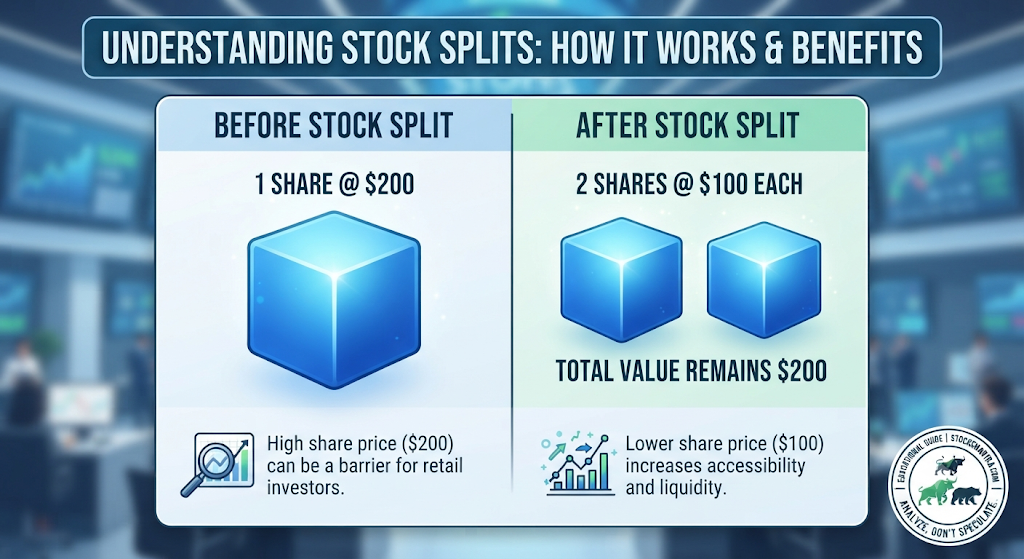
A stock split is a corporate action where a company increases the number of its outstanding shares by issuing more shares to current shareholders. At the same time, the price per share decreases proportionally, meaning the total market capitalization of the company remains exactly the same before and after the split.
For example, in a 2-for-1 forward split, if you own one share worth two hundred dollars, you will suddenly own two shares worth one hundred dollars each. Your total investment value remains unchanged at two hundred dollars. Companies use this mechanism primarily to improve stock liquidity and make individual shares more affordable for retail investors.
In the real world, this connects directly with equity investing, corporate finance, and portfolio management. A common misunderstanding is that a stock split makes a company cheaper or creates instant new value out of thin air. The practical takeaway is that while a split improves accessibility and trading volume, it does not alter the fundamental health, earnings, or intrinsic value of the business.
Why Stock Splits and Their Benefits Is Important
Understanding stock splits affects multiple pillars of personal finance, particularly long-term investing, portfolio diversification, and emotional discipline. When a company splits its stock, it alters the share price entry barrier, which directly impacts how retail investors allocate capital across different assets.
If you are building an investment portfolio, knowing how to interpret these events helps you avoid buying a stock simply because its nominal price dropped. It also guides your approach to trading volatility, tax record-keeping, and broker adjustments.
Consider a practical scenario where an investor sees a major technology stock drop from five hundred dollars to fifty dollars due to a 10-for-1 split and mistakenly believes it is on sale. Recognizing that the underlying valuation metrics remain identical prevents emotional decision-making and protects your long-term capital from panic buying or selling.
The Real Problem Readers Face With Stock Splits and Their Benefits
The core problem beginners face with stock splits is a severe lack of financial awareness compounded by sensationalized media coverage. Online platforms often hype up stock splits as massive catalysts, leading inexperienced traders to believe that a lower share price guarantees rapid future growth.
This creates emotional decision-making, poor portfolio planning, and unrealistic expectations about short-term returns. Many investors fail to look past the nominal price drop, ignoring underlying financial statements, debt levels, and market cycles.
Depending entirely on social media rumors or breaking news headlines without knowing the right analytical next step traps beginners in a cycle of speculative losses. Acknowledging this reality is the first step toward building a disciplined, research-backed investment strategy.
How Stock Splits and Their Benefits Works Step by Step
Step 1: Board Authorization and Announcement The process begins when a company’s board of directors evaluates the share price and approves a resolution to adjust the share structure. This official announcement initiates the legal and operational process of altering share counts across public exchanges, and investors should monitor official investor relations releases rather than relying on unverified forum rumors. A common mistake is assuming the announcement automatically guarantees an immediate spike in business revenue, whereas a better approach is to review the company’s underlying earnings report to understand why the growth occurred.
Step 2: Determining the Record Date and Effective Date Next, the company sets specific calendar milestones to determine which shareholders qualify for the additional shares. Missing these dates can create confusion regarding portfolio holdings and transaction settlements, so you should check your brokerage account or official filings for exact calendar timelines. A common mistake is buying shares on the ex-date expecting to receive split shares intended for earlier holders, which can be avoided by understanding settlement cycles and holding shares continuously through the required dates.
Step 3: Execution of the Split by the Brokerage On the effective date, the clearinghouse and your brokerage automatically adjust your share quantity and price without requiring manual intervention from you. This ensures your account accurately reflects your proportional ownership stake, and you can verify this by logging into your trading platform to check updated balances and transaction history ledgers. A common mistake is panicking when seeing a sudden drop in portfolio value before realizing the share quantity doubled, but checking the transaction ledger immediately resolves this misunderstanding.
Step 4: Market Adjustment and Liquidity Shift Following the execution, trading resumes with the new share count, often bringing increased daily volume and retail participation. Higher liquidity can narrow bid-ask spreads and make execution smoother for active traders, making it important to observe how trading volume reacts in the days following the corporate adjustment. A common mistake is assuming high volume following a split translates to a risk-free upward trend, so the better approach is to evaluate broader market conditions and company fundamentals alongside volume metrics.
Step 5: Post-Split Portfolio Rebalancing Investors must then assess whether their target asset allocation requires adjustment following the share price change. Maintaining a balanced portfolio protects against overexposure to a single equity, which can be done by reviewing your overall sector weights and rebalancing if a split stock dominates your holdings. A common mistake is forgetting to review long-term asset allocation targets amidst the excitement, but sticking to your predetermined portfolio diversification rules keeps your investments secure.
Step 6: Long-Term Performance Tracking Finally, investors should focus on tracking business execution and earnings growth over subsequent quarters and years. Splits do not drive business success; operational execution drives long-term shareholder value, meaning you should track quarterly earnings reports, profit margins, and competitive advantages rather than treating a split as a multi-year catalyst. A better approach is focusing on management quality and cash flow generation over the long run to ensure sustainable financial growth.
Key Factors That Influence Stock Splits and Their Benefits
When evaluating stock splits and their broader market context, several critical factors influence how investors perceive and react to these corporate actions.
- Risk and Return: A stock split does not alter the fundamental risk profile or expected return of an equity asset.
- Time Horizon: Long-term investors view splits as administrative milestones, whereas short-term traders look for temporary volatility spikes.
- Market Volatility: Broad market sentiment heavily dictates whether a split stock experiences post-announcement momentum or correction.
- Research Quality: Deep fundamental analysis prevents investors from misinterpreting nominal price adjustments as fundamental bargains.
- Diversification: Maintaining a balanced mix of assets ensures that single-stock corporate events do not destabilize your entire portfolio.
- Emotional Control: Remaining calm during hype cycles prevents costly impulsive trading mistakes.
- Portfolio Review: Regular audits help you track how share adjustments impact your overall asset allocation percentages.
- Long-Term Discipline: Focusing on business fundamentals rather than corporate cosmetics secures sustainable financial growth.
Detailed Breakdown of Stock Splits and Their Benefits
Stock market mechanics require a solid grasp of how corporate actions operate beneath the surface. When examining stock splits, it is essential to look beyond the basic definition and explore forward splits, reverse splits, psychological pricing effects, and underlying market structures.
A forward stock split increases the share count while reducing the price proportionally. Companies usually execute forward splits when their share price has appreciated significantly, pricing out retail investors who prefer buying whole shares rather than fractional units. By lowering the entry price per share, the company broadens its potential investor base, which can improve overall market liquidity.
Conversely, a reverse stock split consolidates shares, reducing the total count while increasing the price per share proportionally. Companies often resort to reverse splits to meet minimum exchange listing requirements, such as maintaining a stock price above a specific dollar threshold, or to attract institutional investors who avoid low-priced speculative equities.
Understanding the difference between these two actions is vital because a reverse split is frequently associated with underlying financial distress or declining business performance, whereas a forward split is typically a sign of corporate growth and past success. Beginners must avoid treating all splits identically, as market perception and underlying business health vary dramatically between the two scenarios.
Common Mistakes Beginners Make With Stock Splits and Their Benefits
- Following random social media advice regarding upcoming splits without performing independent research.
- Ignoring the fundamental financial health and debt levels of a company executing a split.
- Assuming that a lower post-split price automatically makes an overvalued stock a bargain.
- Confusing forward splits with company earnings growth or free dividend distributions.
- Failing to recognize the warning signs associated with reverse stock splits.
- Making emotional trading decisions driven by sudden media hype and short-term volatility.
- Neglecting portfolio diversification by concentrating too much capital in a single split stock.
- Ignoring transaction fees, tax reporting responsibilities, and brokerage account adjustments.
Don’t Do This Checklist:
- Do not buy a stock solely because its share price dropped after a split announcement.
- Do not ignore company balance sheets and cash flow statements.
- Do not use emergency savings to trade volatile post-split price swings.
- Do not rely on unverified online forums for financial decision-making.
Practical Real-Life Examples of Stock Splits and Their Benefits
A salaried retail investor notices a prominent technology stock announcing a 4-for-1 split and feels tempted to invest their entire monthly savings, mistakenly believing the stock is suddenly on sale; recognizing that the underlying valuation remains unchanged, they decide to allocate only a disciplined portion according to their pre-planned budget, avoiding unnecessary concentration risk.
A beginner trader sees headlines about an upcoming stock split and plans to buy shares on margin for a quick profit, but remembers the risk of short-term volatility and chooses to use cash only, protecting themselves from sudden market corrections and potential margin calls.
An individual reviewing their retirement portfolio notices a company executed a reverse stock split to avoid exchange delisting; instead of holding onto the declining asset out of emotional attachment, they analyze the weak fundamentals and reallocate their capital into a diversified index fund.
A finance student studying corporate actions assumes that stock splits generate free profit for shareholders, but after reviewing accounting balance sheets, they realize that total equity value remains constant, correcting their understanding of corporate mechanics.
A long-term investor tracking a retail giant’s stock split ignores the daily price noise and focuses entirely on quarterly revenue growth and customer retention metrics, successfully maintaining a disciplined, long-term wealth accumulation strategy.
Table 1: Forward Stock Split vs. Reverse Stock Split Comparison
| Feature | Forward Stock Split | Reverse Stock Split |
| Primary Goal | Improve liquidity and retail accessibility | Meet exchange listing rules and raise share price |
| Share Count | Increases | Decreases |
| Price per Share | Decreases proportionally | Increases proportionally |
| Total Market Cap | Remains unchanged | Remains unchanged |
| Market Perception | Usually signals strong past growth and success | Often signals past decline or financial distress |
Table 2: Beginner Mistake vs. Correct Approach
| Situation | Beginner Mistake | Correct Approach |
| Post-Split Price | Assuming the lower price makes the stock cheap | Analyzing valuation metrics like P/E ratio |
| Announcement Hype | Buying immediately based on social media trends | Researching company fundamentals and earnings |
| Portfolio Impact | Overconcentrating capital in a single split stock | Maintaining diversified asset allocation rules |
| Holding Strategy | Expecting guaranteed short-term price surges | Focusing on long-term business execution |
Tools, Methods, and Frameworks Readers Can Use
Utilizing structured tools and analytical frameworks helps beginners navigate corporate actions with confidence.
- Stock Watchlist: A curated list of companies you monitor to track historical price movements and upcoming corporate announcements. It helps you stay organized and prevents reactive decision-making.
- Fundamental Analysis Checklist: A structured review system covering earnings growth, debt levels, and profit margins to ensure you invest in strong businesses regardless of corporate splits.
- Portfolio Review Method: A periodic audit framework that helps you evaluate your asset allocation percentages, ensuring a single stock split does not disrupt your diversification balance.
- Risk Allocation Method: A personal rulebook that limits how much capital you can allocate to volatile equities, protecting your core savings from speculative market movements.
Expert Tips to Make Better Decisions
- Learn the mechanics of corporate actions before deploying real capital into the market.
- Compare multiple valuation metrics rather than focusing solely on nominal share prices.
- Check the underlying business fundamentals and risk factors before expected return.
- Keep written records of all portfolio transactions for clear financial tracking.
- Avoid emotional decisions triggered by breaking news and social media hype.
- Review your investment plan monthly to maintain long-term financial discipline.
- Start with small allocations to test your understanding of market behavior.
- Protect your personal data and use reputable, regulated brokerage platforms.
- Avoid fake promises of guaranteed returns associated with speculative stock trading.
- Read corporate disclosure documents and terms carefully before making moves.
- Keep emergency cash separate from your active investment capital.
- Take professional advice from qualified financial experts when facing complex decisions.
- Do not blindly copy other traders’ strategies without understanding the underlying rationale.
- Focus on long-term wealth accumulation rather than short-term trading excitement.
- Track your past investment mistakes and use them to refine your future approach.
Case Studies: How Better Understanding Changes Decisions
Case Study 1: The Trap of Nominal Price Illusion
- Profile: A 28-year-old software engineer starting investment activities.
- Situation: A major company announced a forward stock split, dropping its share price from six hundred dollars to sixty dollars.
- Problem: The investor believed the stock was ninety percent cheaper and invested their entire emergency fund into the asset.
- Wrong Approach: Buying impulsively based solely on the lower nominal price without checking valuation ratios.
- Better Approach: Realizing that market capitalization remained identical and consulting a fundamental analysis checklist.
- Result or Learning: The investor learned that nominal price adjustments do not alter company valuation, avoiding severe concentration risk.
- Key Takeaway: Always evaluate underlying business value rather than superficial share prices.
Case Study 2: Navigating a Reverse Split
- Profile: A 35-year-old retail investor reviewing a stagnant portfolio holding.
- Situation: A struggling micro-cap stock announced a reverse split to maintain exchange compliance.
- Problem: The investor considered buying more shares, hoping the higher share price would trigger a sudden turnaround.
- Wrong Approach: Treating a reverse split as a bullish catalyst for a fundamentally declining business.
- Better Approach: Analyzing the company’s persistent revenue losses and deciding to cut losses.
- Result or Learning: Reallocating capital into a diversified index fund protected the investor from further portfolio erosion.
- Key Takeaway: Reverse splits often signal underlying structural challenges that require careful risk assessment.
Case Study 3: Disciplined Portfolio Rebalancing
- Profile: A 42-year-old salaried professional building long-term wealth.
- Situation: Several holdings in a retirement portfolio underwent forward splits, increasing share counts significantly.
- Problem: The investor’s portfolio became heavily weighted toward a single industry sector.
- Wrong Approach: Ignoring the portfolio drift and letting single-equity exposure dominate the account.
- Assembling a Better Approach: Conducting a portfolio review and rebalancing asset weights according to a structured plan.
- Result or Learning: Restored healthy diversification without disrupting long-term investment goals.
- Key Takeaway: Regular portfolio audits ensure corporate actions do not compromise your asset allocation strategy.
Risk Awareness: What Readers Must Check First
Navigating the stock market requires a clear understanding of potential financial risks.
- Market Risk: The possibility of overall market downturns affecting your equity investments regardless of corporate actions. You can reduce this risk through rigorous diversification and long-term planning.
- Volatility Risk: Rapid price fluctuations surrounding corporate event announcements that can trigger emotional trading errors. Maintaining strict position sizing helps mitigate this risk.
- Misinformation Risk: Relying on unverified social media tips regarding stock splits and artificial price catalysts. Always verify details through official investor relations portals and regulatory filings.
- Liquidity Risk: The challenge of executing trades efficiently in smaller companies undergoing reverse splits. Stick to well-established, liquid equities to protect your capital.
Readers must verify all financial details and consult a qualified professional before making major investment decisions.
Checklist Before Taking Action
- Clear understanding of the corporate action mechanics established.
- Comprehensive risk review completed for the target asset.
- Valuation metrics and company fundamentals compared properly.
- Brokerage account settings and transaction terms reviewed.
- Emergency funds kept completely separate from investment capital.
- Fake profit claims and guaranteed return hype avoided.
- Personal financial data protected securely.
- Long-term asset allocation and diversification impact reviewed.
- Written investment plan prepared and verified.
- Emotional decision-making eliminated from the process.
- Professional advice considered where complex financial scenarios arise.
Using this checklist before every investment decision ensures disciplined, rational execution and protects your financial well-being against market noise.
Strategic Insights for Better Decision-Making
Developing a sophisticated approach to investing requires mastering core strategic disciplines. Position sizing ensures that no single stock split or market event can disproportionately damage your overall net worth. Regular portfolio reviews help you maintain target asset allocation percentages across different market cycles. Diversification acts as a robust shield against sector-specific downturns, while maintaining a long-term mindset prevents you from reacting to daily price noise. Avoiding herd mentality protects your capital from speculative bubbles driven by social media hype. By grounding your strategy in disciplined research and risk management, you build a resilient financial foundation for the future.
Key Terms Explained for Beginners
- Stock Split: A corporate action where a company increases its share count and reduces the price proportionally without changing total market capitalization.
- Reverse Stock Split: A corporate action that consolidates shares to increase the price per share and meet exchange listing requirements.
- Market Capitalization: The total dollar market value of a company’s outstanding shares, calculated by multiplying share price by total share count.
- Liquidity: The ease with which an asset can be bought or sold in the market without causing drastic price changes.
- Volatility: The statistical measure of price movement over time, indicating how dramatically an asset’s price fluctuates.
- Retail Investor: An individual non-professional investor who trades for their personal account rather than for an institution.
- Fundamental Analysis: The method of evaluating a security by attempting to measure its intrinsic value based on economic and financial data.
- Portfolio Diversification: A risk management strategy that mixes a wide variety of investments within a single portfolio to minimize exposure to any single asset.
- Asset Allocation: An investment strategy that aims to balance risk and reward by dividing a portfolio among different asset categories.
- Ex-Date: The date on or after which a security is traded without a derecho or specific corporate action entitlement.
Who Should Read This Blog
- Beginners: Individuals taking their first steps into the stock market and looking to understand basic corporate actions.
- Students: Learners studying corporate finance, economics, and market mechanics.
- Salaried Employees: People building long-term wealth through personal investing and retirement accounts.
- New Investors: Retail participants seeking clarity on how stock splits impact portfolio value.
- People Improving Money Awareness: Anyone wanting to build financial discipline and avoid common market myths.
- Finance Bloggers & Content Creators: Writers looking for clear, structured explanations of market concepts.
Frequently Asked Questions
What is a stock split?
A stock split is a corporate decision where a company divides its existing shares into multiple new shares to increase liquidity. While the number of shares increases, the overall market value of your investment remains exactly the same.
Why do companies execute stock splits?
Companies primarily use stock splits to make individual shares more affordable for everyday retail investors. Lower nominal share prices can improve trading volume and broaden market participation.
Does a stock split increase my wealth?
No, a stock split does not create new financial value or change the underlying worth of the business. It simply divides your existing equity into a larger number of smaller nominal units.
What is the difference between a forward split and a reverse split?
A forward split increases share count and lowers the price, often signaling strong growth. A reverse split consolidates shares to raise the price, which is frequently associated with struggling companies trying to meet exchange rules.
Is a lower post-split price a sign that a stock is cheap?
No, a lower nominal share price does not make a stock a bargain. You must evaluate fundamental metrics like earnings and valuation ratios rather than looking only at the share price.
How do stock splits affect my brokerage account?
Your brokerage will automatically update your share quantity and adjust the share price on the effective date. No manual action is required on your part, though you should verify your transaction history.
Can beginners trade stock splits safely?
Beginners can navigate stock splits safely by focusing on long-term business fundamentals rather than short-term price hype. Avoiding emotional decisions and maintaining proper portfolio diversification is essential.
Should I buy a stock immediately after a split announcement?
Buying immediately based on announcement hype can expose you to short-term volatility. It is always wiser to review company fundamentals and align purchases with your personal financial plan.
What risks should I know about stock splits?
The main risks involve misinterpreting nominal price drops as bargains and falling for speculative hype. Volatility surrounding announcement dates can also create short-term uncertainty for emotional traders.
Should I take professional advice before investing?
Consulting a qualified financial professional is recommended if you are unsure about complex portfolio decisions. Professional guidance helps align your investments with your long-term financial goals.
How often should I review my investment portfolio?
Conducting a portfolio review periodically helps ensure that corporate actions and market shifts do not disrupt your asset allocation targets. Regular audits maintain healthy financial discipline.
What is the best next step after reading this blog?
The best next step is to review your current portfolio, study company fundamentals, and practice disciplined research before making any major financial decisions.
Conclusion
Stock splits are common corporate actions designed to adjust share accessibility and market liquidity without altering the underlying value of a business. Throughout this blog, we explored the mechanics of forward and reverse splits, examined the real-world impact on portfolio value, and debunked common myths that mislead beginner investors. Financial awareness and disciplined research are your best defenses against market hype and emotional decision-making. As a next step, take time to review your investment strategy, focus on company fundamentals rather than nominal price tags, and maintain a diversified portfolio tailored to your long-term goals. By prioritizing patience, continuous learning, and risk management, you can navigate the stock market with confidence and build a secure financial future.