Introduction
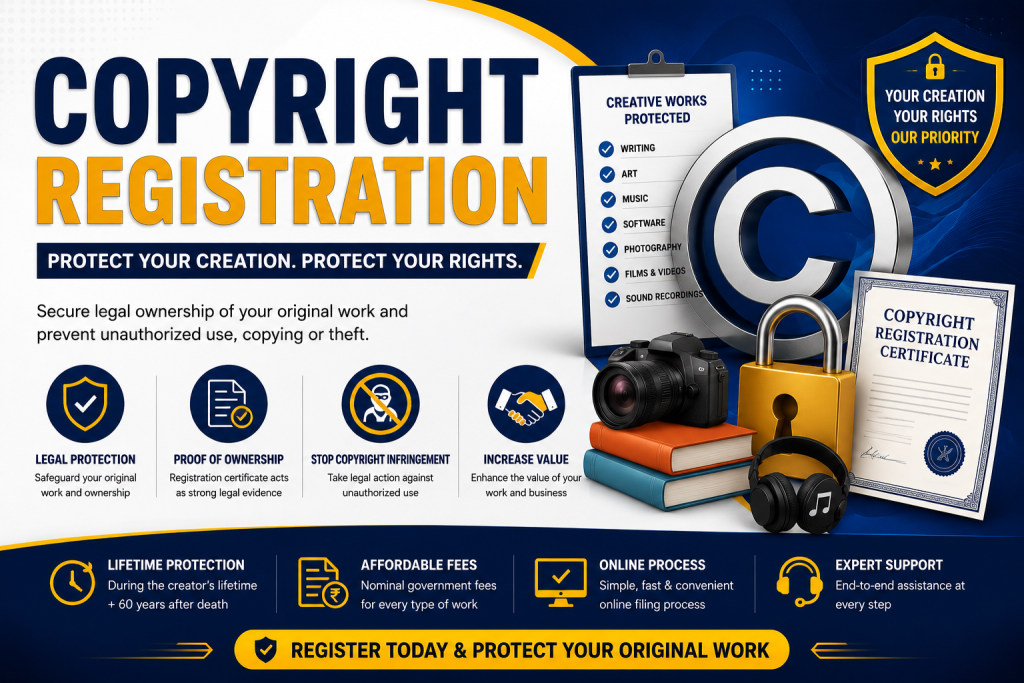
Copyright Registration is an important legal process for protecting original creative work. In today’s digital world, content is created, shared, copied, uploaded, downloaded, and reused very quickly. Writers, artists, designers, software developers, musicians, filmmakers, photographers, businesses, startups, and content creators need proper protection for their original work.
Copyright helps protect creative expression. It gives the creator or owner legal rights over the work and helps prevent unauthorized copying, reproduction, distribution, adaptation, or commercial use.
Many people think copyright is only for books or songs, but it can also protect software, website content, artistic designs, videos, films, sound recordings, music, photographs, drawings, scripts, training material, and many other original works.
This blog explains Copyright Registration in a simple and practical way. It covers meaning, importance, eligible works, documents, fees, process, benefits, common mistakes, and FAQs.
What Is Copyright?
Copyright is a legal right given to the creator or owner of an original creative work. It protects the expression of an idea, not the idea itself.
For example, if you have an idea for a story, the idea alone is not protected. But when you write that story in the form of a book, script, article, or document, the written expression can be protected by copyright.
Copyright protects original work from unauthorized use. It gives the owner the right to control how the work is copied, published, adapted, performed, communicated, or distributed.
In simple words, copyright protects creative work created by human effort, skill, and originality.
What Is Copyright Registration?
Copyright Registration is the process of officially recording ownership of an original creative work with the Copyright Office. After registration, the owner receives a copyright registration certificate.
Copyright protection exists automatically when an original work is created. However, registration gives stronger proof of ownership. It helps in legal disputes, business use, licensing, commercial protection, and enforcement.
A registered copyright certificate can be useful if someone copies your work or claims ownership over it.
Why Copyright Registration Is Important
Copyright Registration is important because creative work can be easily copied. Without proper proof of ownership, it may become difficult to show that you are the original creator or owner.
Key Benefits of Copyright Registration
- Gives legal proof of ownership
- Helps protect original creative work
- Supports legal action against copying
- Builds trust and credibility
- Helps in licensing and commercial use
- Protects digital and offline creative content
- Useful for authors, artists, designers, and businesses
- Helps prevent misuse of original work
- Creates an intellectual property asset
- Supports business valuation and brand protection
Copyright Registration is useful for individuals, companies, startups, publishers, production houses, agencies, software companies, education businesses, and digital creators.
What Can Be Protected Under Copyright?
Copyright can protect different types of original works. The work must be original and must be expressed in a fixed form.
Works That Can Be Copyrighted
| Type of Work | Examples |
|---|---|
| Literary Work | Books, articles, blogs, scripts, manuals, training content |
| Dramatic Work | Plays, drama scripts, stage scripts |
| Musical Work | Music composition, notation, song composition |
| Artistic Work | Paintings, drawings, logos, designs, photographs |
| Cinematograph Film | Movies, short films, documentaries, video content |
| Sound Recording | Audio tracks, voice recordings, music recordings |
| Software | Computer programs, source code, applications |
| Website Content | Text, images, graphics, videos, and other original components |
Each work should be filed according to its category. If one project contains multiple types of content, separate applications may be required for different works.
What Cannot Be Protected by Copyright?
Copyright does not protect everything. It protects original expression, not general ideas or common information.
Copyright Does Not Usually Protect
- Ideas
- Concepts
- Methods
- Systems
- Procedures
- Business plans as ideas
- Titles only
- Names only
- Short slogans
- Short phrases
- Facts
- Common information
- Basic layout or format
- Common symbols
- Public domain material
For example, the idea of writing a health blog is not protected. But the actual written blog content can be protected if it is original.
Similarly, a business name is usually protected through trademark registration, not copyright registration.
Who Can Apply for Copyright Registration?
Copyright Registration can be filed by the person or entity that owns the copyright in the work.
Eligible Applicants
- Author
- Artist
- Writer
- Music composer
- Photographer
- Software developer
- Film producer
- Sound recording owner
- Publisher
- Business owner
- Company
- LLP
- Partnership firm
- Startup
- Legal assignee
- Legal heir
- Authorized representative
If the creator has assigned the rights to a company or business, the company may apply as the copyright owner.
Copyright Registration for Businesses
Businesses often create valuable original content. This content should be protected because it can be copied by competitors, agencies, employees, or online users.
Business Works That May Need Copyright Protection
- Website content
- Training material
- Course content
- Software source code
- Product manuals
- Marketing brochures
- Company presentations
- Product photographs
- Videos and advertisements
- Graphic designs
- Creative artworks
- Business reports
- Mobile app content
- Educational modules
For businesses, copyright registration helps protect internal and external creative assets.
Copyright Registration for Software
Software can also be registered under copyright as literary work. This may include source code and object code. Software companies, app developers, SaaS businesses, IT startups, and freelance developers can use copyright registration to protect their original software work.
Software Copyright May Protect
- Source code
- Object code
- Program structure
- Original software documentation
- Technical manuals
- Application content
- Database structure, where applicable
Copyright does not protect the idea of software. It protects the written code and original expression of the program.
Copyright Registration for Website Content
A website as a complete idea or business concept is not usually protected as one copyright. However, original components of a website can be protected separately.
Website Elements That May Be Protected
- Original written content
- Blog articles
- Website images
- Graphics
- Videos
- Software code
- Product descriptions
- Training material
- Downloadable PDFs
- Original illustrations
If a website contains different types of creative work, separate copyright applications may be needed for different content categories.
Documents Required for Copyright Registration
The documents required depend on the type of work and applicant. However, some documents are commonly needed in most cases.
Basic Documents Required
- Name, address, and nationality of applicant
- Name, address, and nationality of author
- Title of the work
- Category of the work
- Description of the work
- Copy of the work
- Date of creation or publication
- Power of Attorney, if filed through an agent
- No Objection Certificate, if required
- Assignment deed, if rights are transferred
- Identity proof of applicant
- Business registration documents, if applicant is a company or firm
For Literary Work
- Copy of manuscript, book, article, content, or document
- Author details
- Publication details, if published
For Artistic Work
- Copy of artwork, logo, design, painting, image, or illustration
- NOC from author, if applicant is different
- Trademark search certificate may be required if the artistic work is used for goods or services
For Software
- Source code document
- Object code details, if applicable
- Software description
- Developer details
- Ownership proof
For Sound Recording
- Audio file
- Details of producer
- Details of performers, if required
- NOC or assignment, if applicable
For Cinematograph Film
- Film copy
- Producer details
- NOC from contributors, if required
- Rights ownership documents
Government Fees for Copyright Registration
Copyright government fees depend on the type of work. The fee is generally charged per work.
Basic Government Fee Structure
| Type of Work | Government Fee |
|---|---|
| Literary, Dramatic, Musical, or Artistic Work | ₹500 per work |
| Literary or Artistic Work Used for Goods or Services | ₹2,000 per work |
| Cinematograph Film | ₹5,000 per work |
| Sound Recording | ₹2,000 per work |
Professional charges, documentation charges, legal drafting charges, objection reply charges, hearing charges, and other service charges may be separate.
Step-by-Step Copyright Registration Process
Copyright Registration should be done carefully because incorrect details can delay the application.
Step 1: Identify the Type of Work
First, identify the correct category of the work. It may be literary, artistic, musical, dramatic, software, cinematograph film, or sound recording.
Choosing the correct category is important because the form, documents, and fee may depend on the type of work.
Step 2: Prepare the Work Copy
Prepare a clear copy of the work that needs protection. The copy should be complete and readable.
For example:
- Book or article should be in document format
- Artistic work should be in image or PDF format
- Software should include source code details
- Sound recording should be in audio format
- Film should be submitted in the required format
Step 3: Collect Applicant and Author Details
Prepare complete details of the applicant and author.
Details may include:
- Full name
- Address
- Nationality
- Email ID
- Mobile number
- Relationship with the work
- Ownership details
If the applicant and author are different, proper authorization or assignment documents may be needed.
Step 4: Prepare Required Documents
Collect all required documents before filing the application. Missing documents can create objections or deficiencies.
Documents should be clear, correct, and properly signed where required.
Step 5: File Form XIV
Copyright Registration application is filed through Form XIV along with Statement of Particulars and Statement of Further Particulars, where applicable.
The form should be filled carefully with correct information about the work, author, owner, publication status, and rights.
Step 6: Pay Government Fee
Pay the applicable government fee according to the type of work. The fee is usually non-refundable, even if the application is rejected.
Step 7: Upload the Work and Documents
Upload the work copy and required supporting documents in the prescribed format. Make sure the files are clear and complete.
Step 8: Submit the Application
After checking all details, submit the application. Once submitted, an application number or diary number is generated for tracking.
Step 9: Waiting Period and Examination
After filing, the application goes through a waiting period and examination. The Copyright Office checks the details, documents, ownership claim, and originality-related information.
If no objection or discrepancy is found, the application moves forward.
Step 10: Reply to Objection or Deficiency, If Any
If the Copyright Office finds any issue, deficiency, or objection, the applicant may need to submit a reply or additional documents.
A proper reply should be submitted within the given time.
Step 11: Hearing, If Required
In some cases, a hearing may be scheduled. The applicant or authorized representative may need to attend the hearing and explain the claim.
Step 12: Copyright Registration Certificate
If the application is accepted, the copyright is entered in the Register of Copyrights, and the registration certificate is issued.
Copyright Registration Status
After filing, the applicant should regularly check the application status. Status tracking helps avoid missed deadlines.
Common Status Terms
- Application Submitted
- Work Awaited
- Under Examination
- Deficiency Raised
- Objection Raised
- Hearing Scheduled
- Registered
- Rejected
- Abandoned
If any action is required, the applicant should respond on time.
Copyright Objection
Copyright objection means the Copyright Office has raised an issue in the application. This does not always mean the application is rejected.
Common Reasons for Objection
- Incorrect applicant details
- Incomplete author details
- Missing NOC
- Missing Power of Attorney
- Ownership mismatch
- Wrong work category
- Incomplete work copy
- Similar claim by another person
- Missing assignment document
- Incorrect publication details
A proper reply with supporting documents can help resolve the objection.
Copyright Registration Validity
Copyright protection period depends on the type of work. For many literary, dramatic, musical, and artistic works, copyright generally continues during the lifetime of the author and for 60 years after the author’s death.
For some works such as cinematograph films and sound recordings, the period is generally counted from publication as per copyright law.
Copyright validity should be checked according to the type of work because different categories may have different rules.
Difference Between Copyright, Trademark, and Patent
Many people confuse copyright, trademark, and patent. These three protect different types of intellectual property.
| Type | Protects |
|---|---|
| Copyright | Creative work such as books, content, software, music, film, art |
| Trademark | Brand name, logo, tagline, business identity |
| Patent | New invention, technical process, machine, product innovation |
For example, a company logo may need trademark registration for brand protection and copyright registration for artistic protection, depending on its use.
Benefits of Copyright Registration
Copyright Registration gives several benefits to creators and businesses.
1. Legal Proof of Ownership
The registration certificate helps prove ownership of the work.
2. Protection Against Copying
It helps prevent unauthorized copying and misuse.
3. Supports Legal Action
If someone copies the work, registration can support legal action.
4. Commercial Value
Copyrighted work can be licensed, sold, assigned, or monetized.
5. Business Asset
Registered copyright becomes an intellectual property asset for the business.
6. Better Credibility
Registration improves trust for authors, creators, companies, and publishers.
7. Useful for Digital Content
It helps protect online content, videos, graphics, software, and documents.
8. Helps in Licensing
The owner can license the work to others and earn revenue.
Common Mistakes to Avoid
Many copyright applications face delay because of simple mistakes.
Avoid These Mistakes
- Filing under the wrong work category
- Not submitting a complete copy of the work
- Giving incorrect author details
- Filing without ownership proof
- Missing NOC from author
- Missing assignment deed
- Not replying to deficiency on time
- Confusing copyright with trademark
- Trying to copyright an idea only
- Using unclear documents
- Not checking whether separate applications are required
- Submitting copied or non-original work
A carefully prepared application has better chances of smooth processing.
Copyright Registration Service Includes
A professional Copyright Registration service may include:
- Basic consultation
- Work category identification
- Document checklist
- Application preparation
- Form XIV filing support
- Work upload guidance
- Government fee guidance
- Status tracking
- Deficiency reply guidance
- Certificate download support
Objection reply, hearing, legal notice, infringement action, assignment, licensing, and dispute handling may require separate professional support.
Who Should Apply for Copyright Registration?
Copyright Registration is useful for anyone who creates or owns original creative work.
Suitable For
- Authors
- Writers
- Bloggers
- Designers
- Artists
- Photographers
- Musicians
- Composers
- Filmmakers
- YouTubers
- Content creators
- Software developers
- Training institutes
- Publishers
- Startups
- Companies
- Marketing agencies
- Educational businesses
If your work has creative, commercial, educational, artistic, or business value, copyright registration can be useful.
When Should You Apply for Copyright Registration?
It is better to apply for Copyright Registration as early as possible after the work is created or before it is widely published, shared, or commercialized.
You should apply when:
- You have completed an original work
- You are publishing a book or article
- You are launching software
- You are releasing music or audio
- You are publishing videos or films
- You are selling digital content
- You are using creative work commercially
- You want legal proof of ownership
- You want to license or sell the work
- You want to avoid future ownership disputes
Early registration helps create a clear record of ownership.
FAQs
1. What is Copyright Registration?
Copyright Registration is the legal process of recording ownership of an original creative work with the Copyright Office.
2. Is Copyright Registration compulsory?
No, copyright protection exists automatically when original work is created. However, registration gives stronger legal proof of ownership.
3. What can be copyrighted?
Books, articles, software, music, artistic work, photographs, films, sound recordings, scripts, and other original creative works can be copyrighted.
4. Can an idea be copyrighted?
No, copyright does not protect ideas. It protects the original expression of ideas.
5. Can a business name be copyrighted?
Usually, business names are protected through trademark registration, not copyright registration.
6. What is the government fee for Copyright Registration?
The fee depends on the type of work. Literary, dramatic, musical, or artistic work generally has a fee of ₹500 per work, while cinematograph film and sound recording have separate fees.
7. Can software be copyrighted?
Yes, software or computer programs can be registered as literary work.
8. Can website content be copyrighted?
Yes, original website content such as text, graphics, images, videos, and software code may be protected separately.
9. How long does Copyright Registration take?
The timeline may vary depending on objections, deficiencies, examination, and document correctness.
10. What is Form XIV?
Form XIV is the application form used for Copyright Registration.
11. Can I apply for Copyright Registration myself?
Yes, the author, owner, assignee, legal heir, or authorized representative can apply.
12. What happens if someone copies my copyrighted work?
The copyright owner may take legal action against unauthorized copying, use, distribution, or commercial exploitation.
Conclusion
Copyright Registration is an important step for protecting original creative work. Whether the work is a book, article, software, design, music, film, photograph, training material, or digital content, copyright helps protect the creator’s rights and ownership.
Although copyright protection exists automatically, registration provides strong legal proof and helps in disputes, licensing, commercial use, and enforcement. It is especially useful for creators, startups, companies, agencies, software developers, publishers, artists, and digital businesses.
A properly filed Copyright Registration application should include the correct work category, complete author and owner details, required documents, applicable government fee, and a clear copy of the work. By avoiding common mistakes and preparing documents carefully, creators and businesses can protect their original work in a stronger and more professional way.