Introduction
Startup India Certification is an important recognition for startups that want to build trust, apply for government benefits, and become part of India’s official startup ecosystem. Many new business owners, founders, and entrepreneurs start their company or LLP but do not know how to apply for Startup India recognition properly. They also get confused about documents, eligibility, DSC requirements, fees, and the application process.
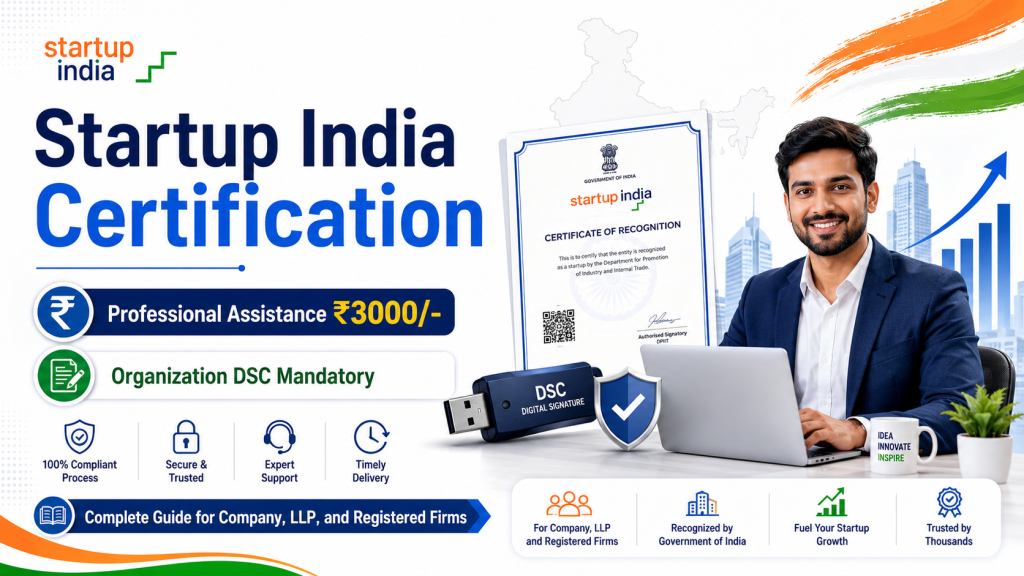
Startup India Certification is commonly known as DPIIT Startup Recognition. It is given to eligible startups by the Department for Promotion of Industry and Internal Trade. After approval, the startup receives a Certificate of Recognition, which helps the business show that it is officially recognized under the Startup India initiative.
For smooth application and verification, an Organization DSC is required because the application is connected with the registered business entity. If the startup is applying as a Private Limited Company, LLP, Partnership Firm, or registered organization, the DSC should represent the organization and authorized signatory.
This blog explains the complete Startup India Certification process, the role of Organization DSC, documents required, eligibility, benefits, fee details, and step-by-step application guidance in a simple and practical way.
What Is Startup India Certification?
Startup India Certification is an official recognition given to eligible startups under the Startup India initiative. It helps a business prove that it is working as a recognized startup and meets the basic conditions defined for startups in India.
This certificate is not the same as company registration. First, the business must be legally registered. After registration, the business can apply for Startup India Certification if it meets the required eligibility conditions.
A startup can use this recognition for credibility, business profile improvement, government scheme access, tax exemption eligibility, public procurement relaxation, and startup ecosystem support.
In simple words, Startup India Certification helps a new business get official startup recognition from the Government of India.
Startup India Certification Rs: 3000/- Fee Explanation
The Startup India Certification service fee of Rs: 3000/- is a professional assistance charge for helping with the application process. This fee may include document checking, DSC guidance, form filling support, application preparation, and submission assistance.
It is important to understand that the government does not charge a fee for DPIIT Startup Recognition. The Rs: 3000/- amount should be treated as a professional service charge, not a government fee.
The service fee may cover:
- Startup eligibility checking
- Document checklist preparation
- Organization DSC guidance
- Application form support
- Business activity content preparation
- Uploading document guidance
- Review before submission
- Application status support
- Certificate download guidance after approval
This helps startups avoid mistakes and complete the process in a proper way.
Why Organization DSC Is Mandatory for Startup India Certification
Organization DSC is mandatory because Startup India Certification is applied in the name of a registered business entity. The application is not only about the founder as an individual. It is about the company, LLP, partnership firm, or registered entity.
DSC stands for Digital Signature Certificate. It is used to digitally verify and sign documents online. When a business applies for Startup India Certification, the portal may require DSC-based verification for the entity and authorized signatory.
An Organization DSC helps verify that the person applying is authorized to act on behalf of the business. It also makes the application more secure and legally valid.
Without a proper Organization DSC, the application process may get delayed or stuck during verification.
What Is Organization DSC?
Organization DSC is a Digital Signature Certificate issued in the name of an organization along with the authorized person’s details. It is used for business-related digital signing and online government filings.
For example, if a Private Limited Company is applying for Startup India Certification, the DSC should be linked with the organization and authorized signatory, such as a director or authorized representative.
Organization DSC is commonly used for:
- Startup India Certification
- MCA filings
- Government portal verification
- Tender applications
- GST-related work
- Income tax and business filings
- Digital document signing
- Company-level online approvals
It proves that the digital signature is being used officially on behalf of the business entity.
Organization DSC vs Individual DSC
Many founders get confused between Organization DSC and Individual DSC. Both are useful, but their purpose is different.
An Individual DSC is issued to a person. It is used for personal digital signing, professional filings, or director-level signing.
An Organization DSC is issued with the organization name. It represents the business entity and is used when the filing or application is related to the organization.
For Startup India Certification, Organization DSC is preferred and required because the certificate is issued to the business entity, not only to the individual founder.
Simple Difference
| Point | Individual DSC | Organization DSC |
|---|---|---|
| Issued To | Individual person | Business organization |
| Used For | Personal or professional signing | Entity-level signing |
| Best For | Directors, professionals, individuals | Companies, LLPs, firms, startups |
| Startup India Use | Not ideal alone | Required for proper entity filing |
| Represents | Person | Business entity |
Who Can Apply for Startup India Certification?
Startup India Certification is available for eligible business entities. The business must be legally registered before applying.
The following entities can apply:
- Private Limited Company
- Limited Liability Partnership
- Registered Partnership Firm
- Cooperative Society
A business idea alone cannot apply for Startup India Certification. The startup must have legal registration documents.
Sole proprietorships are generally not eligible for Startup India recognition because Startup India recognition is meant for registered business entities.
Eligibility Criteria for Startup India Certification
Before applying, the startup should check whether it meets the eligibility criteria. If the business does not meet the conditions, the application may get rejected.
1. Registered Business Entity
The startup must be registered as a Private Limited Company, LLP, Partnership Firm, or eligible registered entity.
2. Business Age Limit
The startup should be within the allowed recognition period from the date of incorporation or registration.
3. Turnover Limit
The startup should be within the prescribed turnover limit as per Startup India rules.
4. Innovation or Improvement
The startup should work on innovation, improvement of products, improvement of services, improvement of processes, or a scalable business model.
5. Not Formed by Splitting Existing Business
The business should not be created by splitting or reconstructing an already existing business.
6. Employment or Wealth Creation Potential
The startup should have potential to create jobs, generate business value, or contribute to economic growth.
Documents Required for Startup India Certification
Proper documents are very important for a successful Startup India Certification application. Incorrect or incomplete documents can delay the process.
Basic Documents Required
- Certificate of Incorporation or Registration Certificate
- PAN of the business entity
- Organization DSC
- Authorization letter
- Details of directors, partners, or authorized representatives
- Registered office address proof
- Email ID and mobile number of authorized person
- Business website, if available
- Pitch deck, if available
- Product or service description
- Details of innovation or business model
- Trademark, patent, or IPR details, if available
- Funding details, if available
Not every startup will have patents, funding, awards, or a website. If these are not available, the startup should provide a clear business description and supporting documents that explain the startup activity properly.
Details Required in Startup India Application
While applying for Startup India Certification, the startup must provide correct business and activity details.
The application may ask for:
- Name of the entity
- Type of entity
- Date of incorporation or registration
- PAN details
- Registered office address
- Authorized representative details
- Director or partner details
- Industry and sector
- Number of employees
- Business stage
- Problem solved by the startup
- Solution offered by the startup
- Uniqueness of the product or service
- Revenue model
- Website or product link
- Awards or recognition, if any
- IPR details, if any
- Funding details, if any
The startup should write these details clearly. The business activity section should not be copied from another website. It should be original and specific to the startup.
How to Write Startup Activity Details Properly
Startup activity details are one of the most important parts of the application. This section explains what the startup does and why it should be recognized.
A weak description may create confusion. A strong description helps the reviewing authority understand the startup properly.
Avoid Generic Lines Like:
“We provide business services to clients.”
“We are working in technology.”
“We provide online solutions.”
These lines are too general and do not explain the startup properly.
Use Clear Details Like:
“Our startup provides a digital platform that helps small businesses manage customer inquiries, sales follow-ups, and service requests from one dashboard. The solution reduces manual tracking, saves time, and improves customer response speed.”
This type of answer is better because it explains the problem, solution, and usefulness of the business.
Step-by-Step Process for Startup India Certification
The Startup India Certification process should be completed carefully. Below is a simple step-by-step process.
Step 1: Check Startup Eligibility
First, check whether the business is eligible for Startup India Certification. Confirm the entity type, registration date, turnover, business activity, and innovation details.
Step 2: Arrange Organization DSC
Before starting the application, arrange a valid Organization DSC. The DSC should be in the name of the business entity and authorized signatory.
Step 3: Prepare Required Documents
Collect all documents such as incorporation certificate, PAN, authorization letter, business details, and supporting documents.
Step 4: Create Account on the Official Portal
Create an account on the official Startup India or NSWS portal as required for application submission.
Step 5: Complete Business Profile
Fill in the business profile with correct details such as entity name, PAN, address, incorporation date, and authorized person details.
Step 6: Select Startup Recognition Application
Choose the Startup India Recognition or Registration as a Startup option from the portal.
Step 7: Fill the Application Form
Enter all required details carefully. Make sure the spelling, PAN, entity name, registration number, and address match the official documents.
Step 8: Add Startup Activity Information
Write the startup activity clearly. Explain the problem, solution, uniqueness, business model, and growth potential.
Step 9: Upload Documents
Upload required documents in the correct format. Make sure all files are clear, readable, and updated.
Step 10: Verify With Organization DSC
Use the Organization DSC for verification and signing wherever required.
Step 11: Review the Application
Before final submission, review every detail carefully. Incorrect information can lead to rejection or delay.
Step 12: Submit the Application
After verification, submit the application and track the status.
Step 13: Download Certificate After Approval
Once approved, download the Startup India Certificate of Recognition from the portal.
Benefits of Startup India Certification
Startup India Certification can help a business in many ways. It improves trust and gives access to startup-related benefits.
1. Official Startup Recognition
The startup gets officially recognized under the Startup India initiative.
2. Better Business Credibility
A recognized startup looks more trustworthy in front of clients, investors, partners, and institutions.
3. Access to Government Startup Benefits
Recognized startups may become eligible for different government schemes, programs, and startup support initiatives.
4. Tax Exemption Eligibility
Startup India recognition can help eligible startups apply for certain tax benefits, subject to separate approval and conditions.
5. Easier Public Procurement Participation
Recognized startups may get relaxation in certain government tender and procurement requirements.
6. IPR Support
Startups may get support for intellectual property-related benefits such as patents, trademarks, and designs, based on eligibility.
7. Better Investor Confidence
Investors may prefer startups that have proper registration, documentation, and official recognition.
8. Compliance Support
Startup recognition may help reduce some compliance burden for eligible startups under specific schemes.
Common Mistakes to Avoid
Many Startup India applications face delay because of small mistakes. Avoid these common errors:
- Applying without checking eligibility
- Using incorrect entity details
- Uploading unclear documents
- Not arranging Organization DSC
- Using weak startup activity descriptions
- Copying content from another startup
- Giving incomplete founder or director details
- Using mismatched PAN or registration details
- Not preparing authorization letter
- Treating professional fee as government fee
- Submitting the application without review
A properly prepared application has a better chance of smooth processing.
Why Professional Assistance Helps
Startup India Certification may look simple, but many startups make mistakes while filling the form. Professional assistance helps in preparing the application properly.
Professional support can help with:
- Checking eligibility
- Understanding DSC requirement
- Preparing document list
- Drafting business activity details
- Reviewing the application
- Avoiding common mistakes
- Saving time for founders
- Improving application quality
This is why many startups choose professional assistance for Startup India Certification at Rs: 3000/-.
Startup India Certification Service Includes
The Startup India Certification assistance service may include:
- Basic consultation
- Eligibility review
- Document checklist
- Organization DSC guidance
- Startup activity drafting support
- Application form filling assistance
- Authorization letter format support
- Document upload guidance
- Application review
- Submission support
- Certificate download guidance
This makes the process easier for startups that are applying for the first time.
Important Points Before Applying
Before applying for Startup India Certification, keep these points in mind:
- The business must be legally registered.
- Organization DSC should be ready.
- Business PAN details should be correct.
- The startup activity should be original and clear.
- The application should not contain false information.
- Supporting documents should be readable.
- The government does not charge a fee for DPIIT recognition.
- Rs: 3000/- is a professional assistance charge.
- Recognition does not automatically guarantee all benefits.
- Some benefits require separate approval.
Who Should Apply for Startup India Certification?
Startup India Certification is useful for:
- New startup founders
- Private Limited Companies
- LLPs
- Registered partnership firms
- Technology startups
- Service-based startups
- Product-based startups
- Innovation-based businesses
- Scalable business models
- Startups looking for government recognition
- Startups planning to apply for tax benefits
- Startups looking for investor trust
If your business is legally registered and has an innovative or scalable model, Startup India Certification can be useful.
FAQs
1. What is Startup India Certification?
Startup India Certification is official DPIIT recognition given to eligible startups under the Startup India initiative.
2. Is Organization DSC mandatory for Startup India Certification?
Yes, Organization DSC is required for proper entity-level verification and application support because the certificate is issued to the registered business entity.
3. What is the fee for Startup India Certification assistance?
The professional assistance fee is Rs: 3000/-. This is a service charge for application support and documentation help.
4. Is Rs: 3000/- a government fee?
No. The government does not charge a fee for DPIIT Startup Recognition. Rs: 3000/- is a professional service fee.
5. Can an individual apply for Startup India Certification?
Startup India Certification is for eligible registered business entities, not for an individual business idea without registration.
6. Can a sole proprietorship apply?
Sole proprietorship is generally not eligible for Startup India recognition. The business should be registered as an eligible entity.
7. Which entities can apply?
Private Limited Companies, LLPs, registered Partnership Firms, and eligible registered entities can apply if they meet the conditions.
8. What documents are required?
Basic documents include incorporation certificate, PAN, Organization DSC, authorization letter, business details, and startup activity information.
9. Does Startup India Certification give automatic tax exemption?
No. Startup India recognition may make the startup eligible to apply for certain tax benefits, but separate approval may be required.
10. How long does Startup India Certification take?
The timeline may vary depending on application quality, document correctness, and portal processing.
Conclusion
Startup India Certification is a useful recognition for eligible startups that want to build credibility, access startup benefits, and become part of India’s official startup ecosystem. The process requires proper documents, correct business details, clear startup activity information, and a valid Organization DSC.
For registered entities, Organization DSC is an important requirement because the application is connected with the business entity and authorized signatory. Without proper DSC and documentation, the application may face delays.
Startup India Certification assistance at Rs: 3000/- can help founders complete the process smoothly by providing document guidance, DSC support, form filling help, and application review. However, it should be clearly understood that this amount is a professional service charge, not a government fee.
If the startup is eligible and documents are prepared correctly, Startup India Certification can help the business improve trust, apply for benefits, and move forward with better recognition.
A practical issue that often gets overlooked is how DSC ownership is managed across founders and team members over time. Since digital signatures are directly tied to legal approvals and filings, startups need clear internal controls for who can use the certificate, how access is transferred, and what happens when founders or authorized signatories change. Weak control here can create compliance and operational risks later.