Introduction
Mental Health Therapy Apps are digital platforms designed to provide psychological support, therapy sessions, mindfulness exercises, and emotional well-being tools directly through smartphones. These apps range from licensed therapist-led platforms to AI-powered self-help tools, making mental health care more accessible and flexible than traditional in-person therapy.
In today’s fast-paced world, mental health apps play a crucial role in bridging gaps in access, cost, and stigma. Many platforms now offer 24/7 therapy access, cognitive behavioral therapy techniques, AI chatbots, telehealth sessions, and secure communication tools, enabling users to manage stress, anxiety, depression, and other conditions more effectively.
Common use cases include:
- Online therapy sessions with licensed professionals
- Stress, anxiety, and depression management
- Mindfulness, meditation, and sleep improvement
- Mood tracking and journaling
- Crisis support and self-help tools
Key evaluation criteria:
- Access to licensed therapists vs self-guided tools
- Therapy modalities (CBT, mindfulness, coaching)
- Ease of use and engagement
- Privacy and data security
- Telehealth and real-time communication
- Cost and subscription flexibility
- Integration with health apps/devices
- Personalization and AI features
Best for: Individuals seeking therapy, stress relief, emotional support, or mental wellness tools—especially those preferring remote or flexible care.
Not ideal for: Severe psychiatric conditions requiring in-person clinical intervention or emergency care.
Key Trends in Mental Health Therapy Apps
- AI therapy chatbots: 24/7 emotional support and CBT-based conversations
- Hybrid therapy models: Combination of human therapists and AI tools
- Teletherapy growth: Video, chat, and voice sessions replacing in-person visits
- Gamification & engagement: Rewards and progress tracking to improve consistency
- Personalized mental health journeys: AI-driven recommendations
- Integration with wearables: Sleep, stress, and activity tracking
- Privacy-first design: Encryption and secure data storage
- Subscription-based therapy: Affordable alternatives to traditional therapy
- Crisis support features: Immediate help resources and escalation options
- Global accessibility: Breaking geographic barriers to mental health care
How We Evaluated Mental Health Therapy Apps (Methodology)
- Assessed market adoption and user popularity
- Evaluated therapy quality (licensed vs self-guided)
- Reviewed features like CBT tools, journaling, and telehealth
- Analyzed security and privacy practices
- Measured performance and user experience
- Compared AI and personalization capabilities
- Evaluated ease of use for diverse users
- Considered pricing and accessibility
- Reviewed support, credibility, and ecosystem strength
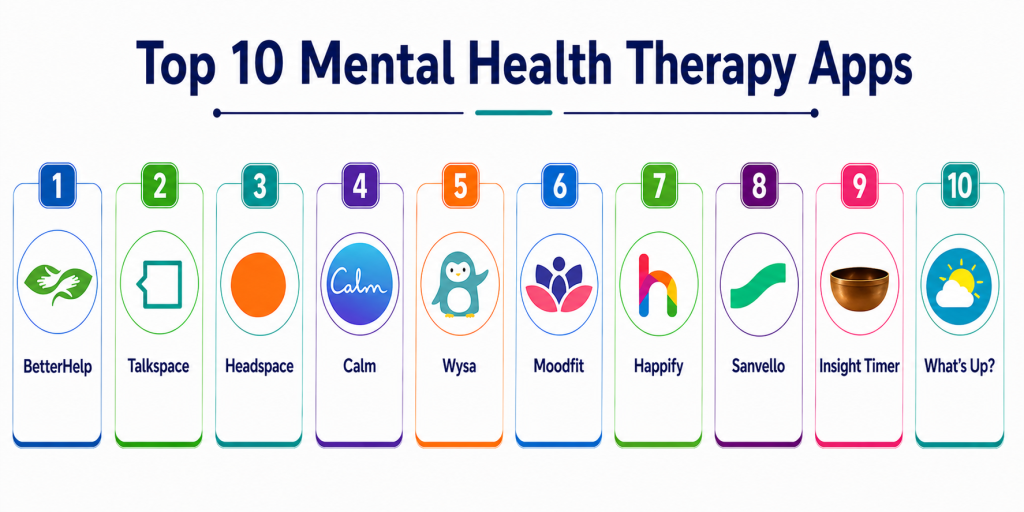
Top 10 Mental Health Therapy Apps
#1 — BetterHelp
Short description: BetterHelp is one of the largest online therapy platforms, connecting users with licensed therapists via chat, video, and phone sessions. It offers flexible scheduling and continuous messaging support. Known for accessibility and global reach. Suitable for individuals seeking consistent therapy support. It provides a wide range of therapist specializations. Ideal for long-term therapy needs.
Key Features
- Licensed therapist access
- Video, chat, and phone sessions
- Messaging between sessions
- Personalized therapist matching
- Flexible scheduling
- Mental health resources
Pros
- Wide therapist network
- Flexible communication options
Cons
- Subscription cost
- Not ideal for crisis situations
Platforms / Deployment
iOS / Android / Web
Cloud
Security & Compliance
Encryption, secure messaging
HIPAA compliance varies by provider
Integrations & Ecosystem
Integrates with digital health tools and communication platforms.
- Mobile apps
- Messaging tools
- APIs
Support & Community
Strong global presence and support network.
#2 — Talkspace
Short description: Talkspace provides licensed therapy via messaging, video, and audio sessions. It focuses on accessibility and affordability. Known for structured therapy programs. Suitable for individuals and couples.
Key Features
- Licensed therapists
- Messaging and video sessions
- Psychiatry services
- Therapy plans
- Secure communication
Pros
- Structured therapy plans
- Flexible communication
Cons
- Subscription-based
- Therapist availability varies
Platforms / Deployment
iOS / Android / Web
Cloud
Security & Compliance
Encryption, secure platform
Supports compliance frameworks
Integrations & Ecosystem
Integrates with healthcare systems and mobile apps.
Support & Community
Strong support and onboarding.
#3 — Headspace
Short description: Headspace is a mindfulness and meditation app designed to reduce stress and improve mental well-being. It offers guided meditations, breathing exercises, and sleep content. Suitable for beginners and daily mindfulness.
Key Features
- Guided meditations
- Sleep stories
- Breathing exercises
- Mindfulness courses
- AI-based recommendations
Pros
- Beginner-friendly
- High-quality content
Cons
- Limited therapy features
- Subscription required
Platforms / Deployment
iOS / Android
Cloud
Security & Compliance
Encryption
Not publicly stated certifications
Integrations & Ecosystem
Integrates with wellness and fitness apps.
Support & Community
Large global user base.
#4 — Calm
Short description: Calm focuses on relaxation, sleep improvement, and stress reduction. It offers meditation sessions, music, and sleep stories. Known for its soothing user experience.
Key Features
- Guided meditation
- Sleep stories
- Relaxation music
- Stress management tools
- Daily mindfulness sessions
Pros
- Excellent sleep features
- Easy to use
Cons
- Not therapy-focused
- Limited clinical tools
Platforms / Deployment
iOS / Android
Cloud
Security & Compliance
Encryption
Not publicly stated certifications
Integrations & Ecosystem
Supports integration with wellness tools.
Support & Community
Strong user adoption.
#5 — Wysa
Short description: Wysa is an AI-powered mental health chatbot offering anonymous support. It uses CBT and mindfulness techniques. Suitable for users seeking private, self-guided therapy.
Key Features
- AI chatbot therapy
- CBT techniques
- Mood tracking
- Self-help exercises
- Optional human coaching
Pros
- Anonymous support
- 24/7 availability
Cons
- Limited human interaction
- Not suitable for severe cases
Platforms / Deployment
iOS / Android
Cloud
Security & Compliance
Encryption
Not publicly stated certifications
Integrations & Ecosystem
Supports integration with health tools.
Support & Community
Growing adoption.
#6 — Moodfit
Short description: Moodfit is a self-care and mood tracking app designed to improve mental wellness. It offers journaling, exercises, and insights.
Key Features
- Mood tracking
- Journaling
- Breathing exercises
- Mental health assessments
- Analytics
Pros
- Strong tracking tools
- Free features available
Cons
- Limited therapy access
- Basic interface
Platforms / Deployment
iOS / Android
Cloud
Security & Compliance
Encryption
Not publicly stated certifications
Integrations & Ecosystem
Supports integration with health apps.
Support & Community
Moderate support.
#7 — Happify
Short description: Happify uses science-based activities and games to improve emotional well-being. It focuses on positive psychology and stress reduction.
Key Features
- CBT-based activities
- Games and exercises
- Mood tracking
- Progress insights
- Personalization
Pros
- Engaging content
- Science-based approach
Cons
- Limited therapy features
- Requires consistency
Platforms / Deployment
iOS / Android / Web
Cloud
Security & Compliance
Encryption
Not publicly stated certifications
Integrations & Ecosystem
Limited integrations.
Support & Community
Moderate support.
#8 — Sanvello
Short description: Sanvello combines therapy, coaching, and self-care tools in one platform. It includes CBT techniques, mood tracking, and peer support.
Key Features
- Guided therapy tools
- Mood tracking
- Peer support
- Coaching
- Meditation
Pros
- All-in-one platform
- Community support
Cons
- Subscription required
- UI complexity
Platforms / Deployment
iOS / Android
Cloud
Security & Compliance
Encryption
Supports compliance frameworks
Integrations & Ecosystem
Supports integration with health apps.
Support & Community
Strong community features.
#9 — Insight Timer
Short description: Insight Timer is a meditation app with a large library of free content. It focuses on mindfulness and stress reduction.
Key Features
- Guided meditations
- Music and soundtracks
- Courses
- Timer tools
- Community features
Pros
- Large free library
- Community-driven
Cons
- Limited therapy features
- Content quality varies
Platforms / Deployment
iOS / Android
Cloud
Security & Compliance
Varies / N/A
Integrations & Ecosystem
Limited integrations.
Support & Community
Strong global community.
#10 — What’s Up?
Short description: What’s Up? is a free mental health app based on CBT and ACT techniques. It helps users manage anxiety, stress, and depression.
Key Features
- CBT tools
- Mood tracking
- Habit tracking
- Coping strategies
- Exercises
Pros
- Free to use
- Evidence-based techniques
Cons
- Basic UI
- Limited advanced features
Platforms / Deployment
iOS / Android
Cloud
Security & Compliance
Varies / N/A
Integrations & Ecosystem
Limited integrations.
Support & Community
Moderate support.
Comparison Table
| Tool Name | Best For | Platform(s) Supported | Deployment | Standout Feature | Public Rating |
|---|---|---|---|---|---|
| BetterHelp | Online therapy | Web, Mobile | Cloud | Licensed therapists | N/A |
| Talkspace | Structured therapy | Web, Mobile | Cloud | Messaging therapy | N/A |
| Headspace | Mindfulness | Mobile | Cloud | Guided meditation | N/A |
| Calm | Sleep & relaxation | Mobile | Cloud | Sleep stories | N/A |
| Wysa | AI therapy | Mobile | Cloud | Chatbot support | N/A |
| Moodfit | Self-tracking | Mobile | Cloud | Mood analytics | N/A |
| Happify | Positive psychology | Web, Mobile | Cloud | Gamified therapy | N/A |
| Sanvello | All-in-one | Mobile | Cloud | Community support | N/A |
| Insight Timer | Meditation | Mobile | Cloud | Free content | N/A |
| What’s Up? | CBT tools | Mobile | Cloud | Free CBT exercises | N/A |
Evaluation & Scoring of Mental Health Therapy Apps
| Tool Name | Core | Ease | Integrations | Security | Performance | Support | Value | Weighted Total |
|---|---|---|---|---|---|---|---|---|
| BetterHelp | 10 | 8 | 9 | 9 | 9 | 9 | 7 | 8.9 |
| Talkspace | 9 | 8 | 9 | 9 | 8 | 8 | 7 | 8.5 |
| Headspace | 8 | 9 | 8 | 8 | 8 | 8 | 8 | 8.3 |
| Calm | 8 | 9 | 7 | 8 | 8 | 8 | 8 | 8.2 |
| Wysa | 8 | 8 | 7 | 8 | 8 | 7 | 9 | 8.1 |
| Moodfit | 7 | 9 | 7 | 7 | 7 | 7 | 9 | 7.8 |
| Happify | 7 | 8 | 6 | 7 | 7 | 7 | 8 | 7.5 |
| Sanvello | 8 | 8 | 7 | 8 | 8 | 7 | 8 | 7.9 |
| Insight Timer | 7 | 9 | 6 | 7 | 7 | 7 | 9 | 7.7 |
| What’s Up? | 7 | 8 | 5 | 7 | 7 | 6 | 9 | 7.4 |
How to interpret scores:
- Therapy platforms rank higher in core features
- Meditation apps excel in usability and engagement
- AI apps provide high value and accessibility
- Choose based on your mental health needs
Which Mental Health Therapy App Is Right for You?
Solo / Self-help Users
Headspace, Calm, or Moodfit for daily mental wellness
Therapy Seekers
BetterHelp or Talkspace for licensed therapist support
Budget Users
Wysa or What’s Up? for free and accessible tools
Advanced Users
Sanvello or CareClinic-style apps for tracking and therapy
Budget vs Premium
Budget: Wysa, Moodfit
Premium: BetterHelp, Talkspace
Feature Depth vs Ease of Use
Feature-rich: BetterHelp, Sanvello
User-friendly: Calm, Headspace
Integrations & Scalability
Best: BetterHelp
Moderate: Moodfit, Wysa
Security & Compliance Needs
High: Therapy platforms
Moderate: Self-help apps
Frequently Asked Questions (FAQs)
1. What are mental health therapy apps?
They are mobile applications that provide therapy, self-help tools, and emotional support. They help users manage stress and mental health. They improve accessibility. They support well-being. They complement traditional therapy.
2. Are these apps effective?
Many apps use evidence-based methods like CBT and mindfulness. They can improve mental well-being. Effectiveness depends on usage. They are best as supplements to therapy. They are not replacements for clinical care.
3. Are therapy apps safe to use?
Most apps include encryption and privacy features. However, not all are clinically validated. Always choose trusted apps. Check privacy policies. Data security is important.
4. Do these apps replace therapists?
No, they complement therapy but do not replace professionals. Severe conditions require clinical care. Apps are useful for support. Hybrid models work best.
5. Are mental health apps free?
Many apps offer free versions. Premium features require subscriptions. Costs vary widely. Free apps provide basic support. Paid plans offer advanced features.
6. Can these apps help with anxiety and depression?
Yes, many apps target anxiety and depression. They offer CBT tools and mindfulness exercises. They help manage symptoms. They improve coping skills.
7. Do they support telehealth?
Yes, many apps include video and chat therapy. Telehealth is a key feature. It improves accessibility. It allows remote care.
8. What features should you look for?
Look for reminders, tracking, therapy access, and security. Integration with devices helps. Ease of use is important. Choose based on your needs.
9. Can caregivers use these apps?
Some apps allow caregiver access. They provide updates and support. This is useful for elderly users. It improves monitoring.
10. Are AI therapy apps reliable?
AI apps can help with basic support. They use CBT techniques. However, they lack human empathy. Use them as supplements, not replacements.
Conclusion
Mental Health Therapy Apps have transformed how individuals access and manage mental health care. By combining therapy, mindfulness, AI-driven support, and real-time communication, these tools provide flexible and scalable solutions for modern mental wellness challenges. Platforms like BetterHelp and Talkspace deliver professional therapy access, while apps like Headspace and Calm focus on mindfulness and stress reduction, and tools like Wysa bring AI-driven support into everyday life. There is no single “best” app for everyone. The right choice depends on whether you need professional therapy, self-guided support, or daily wellness tools. The most effective approach is to shortlist a few apps, try them for a few weeks, and evaluate how well they fit your routine, comfort level, and goals. A thoughtful selection can significantly improve mental well-being, consistency, and long-term emotional health.
I appreciate the balanced comparison because it highlights both benefits and limitations of popular mental wellness applications effectively.
Very informative comparison showing how therapy apps improve access to mental wellness support and guided self care resources.