Introduction
Business Phone Systems (VoIP) are cloud-based communication solutions that allow organizations to make and receive calls over the internet instead of traditional phone lines. These systems combine voice calling with advanced features like call routing, voicemail, messaging, video conferencing, and integrations—making them a central part of modern business communication.
With remote work, global teams, and customer expectations rising, VoIP systems have become essential for maintaining seamless communication. They help businesses reduce costs, improve flexibility, and scale operations without the limitations of traditional telephony systems.
Common use cases include:
- Customer support and call centers
- Sales outreach and lead management
- Internal team communication
- Remote and hybrid workforce connectivity
- Multi-location business operations
Key evaluation criteria:
- Call quality and reliability
- Ease of setup and user experience
- Advanced call management features
- Integration with CRM and business tools
- Scalability and global coverage
- Security and compliance
- Pricing and cost efficiency
- Mobile and desktop accessibility
Best for: SMBs, enterprises, call centers, remote teams, and customer-facing organizations that rely heavily on voice communication.
Not ideal for: Very small teams with minimal calling needs or businesses that rely primarily on messaging-based communication.
Key Trends in Business Phone Systems (VoIP)
- AI-powered call transcription and analytics
- Intelligent call routing and automation
- Integration with CRM and helpdesk platforms
- Increased adoption of cloud-native communication systems
- Unified communications combining voice, video, and messaging
- Enhanced mobile-first communication capabilities
- Focus on global scalability and multi-region support
- Stronger security measures and compliance features
- Real-time call insights and reporting dashboards
- Flexible pricing models based on usage and features
How We Selected These Tools (Methodology)
- Evaluated market presence and adoption
- Assessed feature depth and innovation
- Reviewed call quality and performance reliability
- Analyzed security capabilities and controls
- Checked integration ecosystem strength
- Considered usability across business sizes
- Evaluated scalability and deployment flexibility
- Reviewed support quality and onboarding experience
- Considered value for pricing
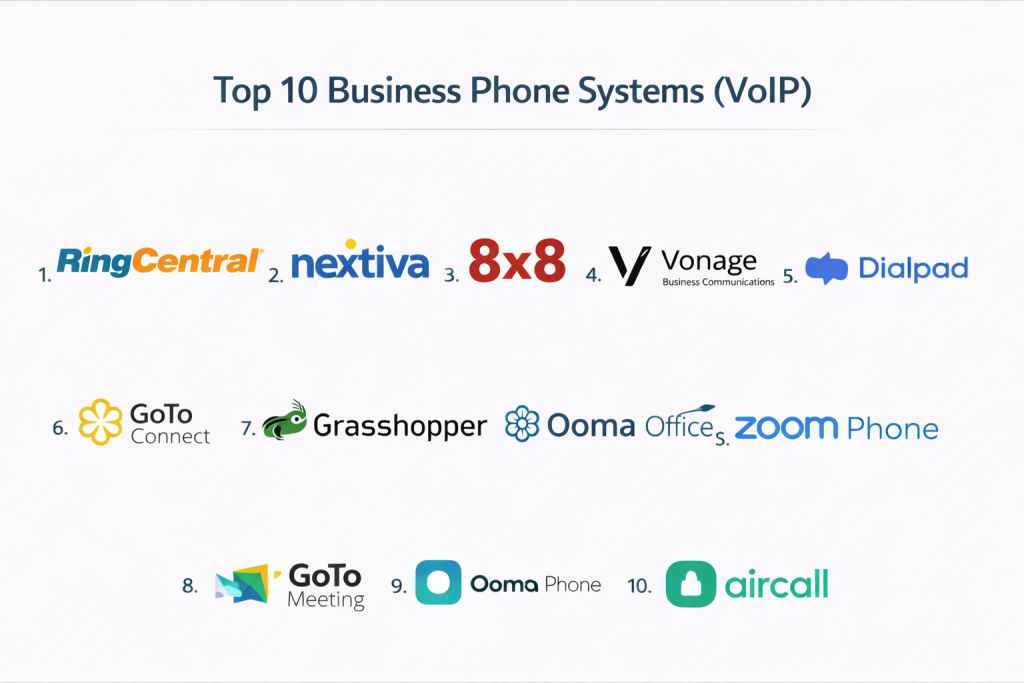
Top 10 Business Phone Systems (VoIP)
#1 — RingCentral
Short description: A leading cloud-based VoIP solution offering unified communication features for businesses of all sizes.
Key Features
- HD voice calling
- Call routing and IVR
- Voicemail-to-text
- Team messaging and video meetings
- Analytics and reporting
- Mobile and desktop apps
Pros
- Comprehensive feature set
- Scalable for growing businesses
Cons
- Pricing can be higher
- Interface may feel complex
Platforms / Deployment
Web / Windows / macOS / iOS / Android
Cloud
Security & Compliance
Encryption, SSO, MFA
Integrations & Ecosystem
RingCentral integrates with a wide range of business tools, enabling seamless workflows.
- CRM platforms
- Helpdesk systems
- Productivity tools
Support & Community
Strong enterprise support and documentation.
#2 — Nextiva
Short description: A reliable VoIP platform focused on customer communication and business productivity.
Key Features
- Voice and video calling
- Call analytics
- Voicemail transcription
- Team collaboration tools
- CRM integrations
Pros
- Easy to use
- Strong customer support
Cons
- Limited advanced customization
- Pricing varies
Platforms / Deployment
Web / Windows / macOS / iOS / Android
Cloud
Security & Compliance
Not publicly stated
Integrations & Ecosystem
- CRM systems
- Business tools
Support & Community
Highly rated support experience.
#3 — 8×8
Short description: A global VoIP and unified communications platform designed for businesses with international operations.
Key Features
- Unlimited calling in supported regions
- Call analytics
- Contact center features
- Video meetings
- Team messaging
Pros
- Strong global coverage
- Good analytics
Cons
- Interface complexity
- Setup may require time
Platforms / Deployment
Web / Windows / macOS / iOS / Android
Cloud
Security & Compliance
Encryption, enterprise controls
Integrations & Ecosystem
- CRM tools
- APIs
- Business integrations
Support & Community
Enterprise-level support.
#4 — Vonage Business Communications
Short description: A flexible VoIP platform offering customizable communication solutions.
Key Features
- Voice calling
- Call routing
- Virtual receptionist
- Mobile apps
- API integrations
Pros
- Flexible customization
- Developer-friendly APIs
Cons
- Add-ons can increase cost
- Interface varies
Platforms / Deployment
Web / Windows / macOS / iOS / Android
Cloud
Security & Compliance
Not publicly stated
Integrations & Ecosystem
- CRM platforms
- APIs for custom apps
Support & Community
Good support with documentation.
#5 — Dialpad
Short description: An AI-powered VoIP system designed for modern business communication.
Key Features
- AI call transcription
- Voice intelligence insights
- Call routing
- Messaging and meetings
- Real-time analytics
Pros
- Strong AI capabilities
- Clean interface
Cons
- Limited advanced telephony features
- Pricing tiers vary
Platforms / Deployment
Web / Windows / macOS / iOS / Android
Cloud
Security & Compliance
Encryption, SSO
Integrations & Ecosystem
- CRM tools
- Productivity apps
Support & Community
Modern platform with growing support ecosystem.
#6 — GoTo Connect
Short description: A VoIP system combining voice, video, and messaging for business communication.
Key Features
- Voice and video calling
- Call routing
- Messaging
- Meeting features
- Mobile support
Pros
- All-in-one solution
- Reliable performance
Cons
- Limited advanced features
- Interface can be basic
Platforms / Deployment
Web / Windows / macOS / iOS / Android
Cloud
Security & Compliance
Not publicly stated
Integrations & Ecosystem
- Business tools
- Calendar integrations
Support & Community
Standard support and onboarding.
#7 — Grasshopper
Short description: A simple virtual phone system designed for small businesses and entrepreneurs.
Key Features
- Call forwarding
- Voicemail
- Business numbers
- Mobile apps
- Extensions
Pros
- Easy setup
- Affordable
Cons
- Limited advanced features
- Not suitable for large teams
Platforms / Deployment
iOS / Android
Cloud
Security & Compliance
Not publicly stated
Integrations & Ecosystem
Limited integrations.
Support & Community
Basic support resources.
#8 — Ooma Office
Short description: A VoIP solution designed for small businesses with essential communication needs.
Key Features
- Voice calling
- Virtual receptionist
- Call forwarding
- Voicemail
- Mobile access
Pros
- Cost-effective
- Easy to deploy
Cons
- Limited scalability
- Basic features
Platforms / Deployment
Web / iOS / Android
Cloud
Security & Compliance
Not publicly stated
Integrations & Ecosystem
Basic integrations.
Support & Community
Standard support.
#9 — Zoom Phone
Short description: A cloud-based phone system integrated with video conferencing capabilities.
Key Features
- Voice calling
- Call routing
- Voicemail transcription
- Integration with Zoom meetings
- Mobile apps
Pros
- Seamless with Zoom ecosystem
- Easy to use
Cons
- Best suited for existing Zoom users
- Limited standalone features
Platforms / Deployment
Web / Windows / macOS / iOS / Android
Cloud
Security & Compliance
Encryption, SSO
Integrations & Ecosystem
- Zoom ecosystem
- Business tools
Support & Community
Strong support infrastructure.
#10 — Aircall
Short description: A cloud-based phone system designed for sales and support teams.
Key Features
- Call center features
- CRM integrations
- Call analytics
- IVR
- Call recording
Pros
- Strong CRM integrations
- Ideal for support teams
Cons
- Pricing can be high
- Limited general business features
Platforms / Deployment
Web / Windows / macOS / iOS / Android
Cloud
Security & Compliance
Not publicly stated
Integrations & Ecosystem
- CRM platforms
- Helpdesk tools
Support & Community
Good support and onboarding.
Comparison Table (Top 10)
| Tool Name | Best For | Platform(s) Supported | Deployment | Standout Feature | Public Rating |
|---|---|---|---|---|---|
| RingCentral | Enterprises | Multi-platform | Cloud | Unified communication | N/A |
| Nextiva | SMBs | Multi-platform | Cloud | Customer communication | N/A |
| 8×8 | Global businesses | Multi-platform | Cloud | International calling | N/A |
| Vonage | Custom setups | Multi-platform | Cloud | API flexibility | N/A |
| Dialpad | AI-driven teams | Multi-platform | Cloud | Voice AI | N/A |
| GoTo Connect | SMBs | Multi-platform | Cloud | All-in-one platform | N/A |
| Grasshopper | Small teams | Mobile | Cloud | Simplicity | N/A |
| Ooma Office | SMBs | Web/mobile | Cloud | Cost efficiency | N/A |
| Zoom Phone | Zoom users | Multi-platform | Cloud | Video + voice | N/A |
| Aircall | Sales teams | Multi-platform | Cloud | CRM integration | N/A |
Evaluation & Scoring of Business Phone Systems (VoIP)
| Tool Name | Core (25%) | Ease (15%) | Integrations (15%) | Security (10%) | Performance (10%) | Support (10%) | Value (15%) | Weighted Total (0–10) |
|---|---|---|---|---|---|---|---|---|
| RingCentral | 9 | 8 | 9 | 8 | 9 | 8 | 7 | 8.4 |
| Nextiva | 8 | 9 | 7 | 7 | 8 | 9 | 8 | 8.1 |
| 8×8 | 9 | 7 | 8 | 8 | 8 | 8 | 7 | 8.0 |
| Vonage | 8 | 7 | 9 | 7 | 8 | 7 | 7 | 7.8 |
| Dialpad | 8 | 9 | 8 | 7 | 8 | 7 | 8 | 8.1 |
| GoTo Connect | 7 | 8 | 7 | 7 | 8 | 7 | 7 | 7.5 |
| Grasshopper | 6 | 9 | 5 | 6 | 7 | 6 | 8 | 7.0 |
| Ooma Office | 6 | 8 | 5 | 6 | 7 | 6 | 8 | 6.9 |
| Zoom Phone | 8 | 9 | 8 | 7 | 8 | 8 | 7 | 8.1 |
| Aircall | 8 | 8 | 9 | 7 | 8 | 8 | 7 | 8.2 |
How to interpret these scores:
These scores provide a relative comparison across tools. Higher scores indicate a balanced combination of features, usability, and value. Enterprise tools tend to score higher in integrations and scalability, while simpler tools perform better in ease of use.
Which Business Phone System (VoIP) Is Right for You?
Solo / Freelancer
Grasshopper or Ooma Office for simple and affordable setups.
SMB
Nextiva or GoTo Connect for ease and reliability.
Mid-Market
RingCentral or Dialpad for scalability and features.
Enterprise
8×8 or RingCentral for global communication and integrations.
Budget vs Premium
Ooma Office for budget; RingCentral for premium capabilities.
Feature Depth vs Ease of Use
Dialpad offers modern features, while Grasshopper focuses on simplicity.
Integrations & Scalability
Aircall and RingCentral lead in integrations.
Security & Compliance Needs
Enterprise tools like 8×8 and RingCentral are better suited.
Frequently Asked Questions (FAQs)
What is a VoIP business phone system?
It is a system that allows voice communication over the internet instead of traditional phone lines.
Is VoIP better than traditional phone systems?
VoIP is more flexible, scalable, and cost-effective for most businesses.
Do VoIP systems support mobile devices?
Yes, most offer apps for smartphones and desktops.
What features are essential?
Call routing, voicemail, integrations, and analytics are key.
Can VoIP systems scale with business growth?
Yes, cloud-based systems are designed to scale easily.
Are VoIP systems secure?
Security varies; look for encryption and access controls.
Do these systems integrate with CRM tools?
Many VoIP systems offer CRM integrations.
What internet speed is required?
A stable internet connection is essential for good call quality.
Can I keep my existing phone number?
Yes, most providers support number porting.
Is setup complicated?
Most modern VoIP systems are easy to set up with minimal technical knowledge.
Conclusion
Business Phone Systems based on VoIP have transformed how organizations communicate, offering flexibility, scalability, and advanced features that traditional systems cannot match. From small businesses to large enterprises, these tools enable efficient communication across teams, customers, and global operations. The right solution depends on your specific needs, including team size, integration requirements, and budget. Rather than choosing based on popularity alone, it is important to evaluate real use cases and test how well a platform fits into your workflow. Shortlisting a few options and running a pilot can help ensure the best long-term decision for your business communication strategy.