Introduction
Payroll Software is designed to automate employee salary processing, tax calculations, compliance filings, and payment distribution. It eliminates manual payroll errors, reduces administrative workload, and ensures businesses remain compliant with labor laws and tax regulations.
In today’s business environment, payroll systems are no longer standalone tools—they are integrated platforms connected with HR, attendance, and accounting systems. This allows organizations to streamline operations, improve accuracy, and scale efficiently. Modern payroll software also includes automation, real-time reporting, and employee self-service portals to enhance transparency and productivity.
Common use cases include:
- Salary and wage processing
- Tax calculations and compliance filings
- Employee benefits and deductions management
- Payroll reporting and analytics
- Integration with HR and accounting systems
What buyers should evaluate:
- Payroll automation and accuracy
- Tax and compliance support
- Integration with HR and accounting tools
- Employee self-service features
- Reporting and analytics
- Scalability
- Security and data protection
- Ease of use and onboarding
Best for: HR teams, finance departments, SMBs, enterprises, and startups managing employee compensation and compliance.
Not ideal for: Freelancers or very small teams without payroll complexity.
Key Trends in Payroll Software
- Fully automated payroll processing and tax filing
- AI-driven error detection and compliance alerts
- Integration with HRMS, ERP, and accounting systems
- Real-time payroll analytics and reporting
- Cloud-based payroll platforms replacing legacy systems
- Employee self-service portals for payslips and tax data
- Multi-country payroll support for global teams
- Mobile payroll management and approvals
- Increased focus on compliance with changing labor laws
- Hybrid payroll + workforce management platforms
How We Selected These Tools (Methodology)
- Strong adoption across SMBs and enterprises
- Comprehensive payroll and compliance features
- Proven reliability and accuracy in calculations
- Integration with HR, accounting, and finance tools
- Security features like encryption and access control
- Ease of use and onboarding
- Scalability for growing teams
- Reporting and analytics capabilities
- Vendor reputation and product innovation
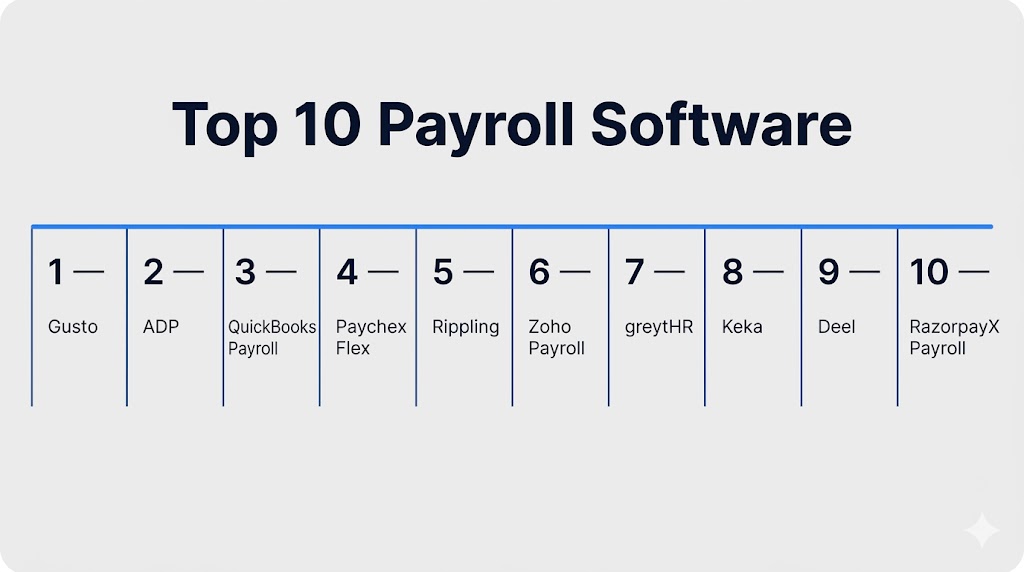
Top 10 Payroll Software
#1 — Gusto
Short description: A popular payroll platform for small businesses with strong automation and HR features.
Key Features
- Automated payroll processing
- Tax filing and compliance
- Employee benefits management
- Reporting and analytics
- Employee self-service
Pros
- Easy to use
- Strong automation
Cons
- Limited global payroll
- Pricing increases with features
Platforms / Deployment
Web / Cloud
Security & Compliance
SSO, MFA, encryption
Integrations & Ecosystem
- Accounting tools
- HR platforms
- APIs
Support & Community
Strong SMB support.
#2 — ADP
Short description: A leading enterprise payroll solution with global capabilities.
Key Features
- Payroll automation
- Tax compliance
- Workforce management
- Reporting tools
- Global payroll
Pros
- Highly scalable
- Strong compliance
Cons
- Expensive
- Complex setup
Platforms / Deployment
Web / Mobile / Cloud
Security & Compliance
SSO, MFA, audit logs, encryption
Integrations & Ecosystem
- ERP systems
- HR tools
- Accounting platforms
Support & Community
Enterprise-grade support.
#3 — QuickBooks Payroll
Short description: A payroll tool integrated with accounting for small and mid-sized businesses.
Key Features
- Payroll automation
- Tax filing
- Direct deposit
- Reporting
- Accounting integration
Pros
- Strong accounting integration
- Easy to use
Cons
- Limited enterprise features
- Pricing tiers
Platforms / Deployment
Web / Mobile / Cloud
Security & Compliance
Encryption, access control
Integrations & Ecosystem
- QuickBooks ecosystem
- Accounting tools
Support & Community
Strong support resources.
#4 — Paychex Flex
Short description: A payroll and HR solution designed for growing businesses.
Key Features
- Payroll processing
- Tax compliance
- Benefits management
- Reporting
- Scheduling
Pros
- Comprehensive features
- Strong HR integration
Cons
- Pricing complexity
- Learning curve
Platforms / Deployment
Web / Mobile / Cloud
Security & Compliance
SSO, MFA, encryption
Integrations & Ecosystem
- HR tools
- Accounting systems
Support & Community
Strong enterprise support.
#5 — Rippling
Short description: An all-in-one HR, IT, and payroll platform with automation capabilities.
Key Features
- Payroll automation
- Benefits management
- Employee management
- Reporting
- Compliance tracking
Pros
- All-in-one solution
- Strong automation
Cons
- Setup required
- Pricing complexity
Platforms / Deployment
Web / Cloud
Security & Compliance
SSO, MFA, encryption
Integrations & Ecosystem
- HR tools
- IT systems
Support & Community
Strong support ecosystem.
#6 — Zoho Payroll
Short description: A cloud-based payroll solution for small businesses.
Key Features
- Automated payroll
- Tax compliance
- Employee self-service
- Reporting
- Integration with Zoho apps
Pros
- Affordable
- Easy to use
Cons
- Limited global support
- Smaller ecosystem
Platforms / Deployment
Web / Cloud
Security & Compliance
Encryption, access control
Integrations & Ecosystem
- Zoho ecosystem
- APIs
Support & Community
Strong SMB support.
#7 — greytHR
Short description: A popular payroll and HRMS solution for small and mid-sized businesses.
Key Features
- Payroll processing
- Compliance management
- Employee self-service
- Reporting
- Leave management
Pros
- Strong compliance features
- Widely used in SMBs
Cons
- Limited customization
- UI improvements needed
Platforms / Deployment
Web / Cloud
Security & Compliance
Not publicly stated
Integrations & Ecosystem
- HR tools
- APIs
Support & Community
Strong regional support.
#8 — Keka
Short description: An HR and payroll platform with strong automation and employee experience features.
Key Features
- Payroll automation
- Attendance integration
- Reporting
- Employee self-service
- Performance management
Pros
- Modern interface
- Strong automation
Cons
- Pricing
- Learning curve
Platforms / Deployment
Web / Mobile / Cloud
Security & Compliance
Not publicly stated
Integrations & Ecosystem
- HR tools
- APIs
Support & Community
Growing support ecosystem.
#9 — Deel
Short description: A global payroll platform designed for remote and international teams.
Key Features
- Global payroll
- Compliance management
- Contractor payments
- Reporting
- Automation
Pros
- Strong global support
- Ideal for remote teams
Cons
- Expensive
- Complex compliance setup
Platforms / Deployment
Web / Cloud
Security & Compliance
SSO, MFA, encryption
Integrations & Ecosystem
- HR tools
- Finance systems
Support & Community
Strong global support.
#10 — RazorpayX Payroll
Short description: A payroll solution tailored for startups and SMBs with compliance automation.
Key Features
- Automated payroll
- Tax compliance
- Employee self-service
- Reporting
- Integration with finance tools
Pros
- Startup-friendly
- Easy compliance
Cons
- Limited enterprise features
- Region-specific
Platforms / Deployment
Web / Cloud
Security & Compliance
Encryption, access control
Integrations & Ecosystem
- Accounting tools
- APIs
Support & Community
Strong SMB support.
Comparison Table (Top 10)
| Tool Name | Best For | Platform(s) Supported | Deployment | Standout Feature | Public Rating |
|---|---|---|---|---|---|
| Gusto | SMB payroll | Web | Cloud | Ease of use | N/A |
| ADP | Enterprise payroll | Web, Mobile | Cloud | Global payroll | N/A |
| QuickBooks Payroll | Accounting users | Web, Mobile | Cloud | Accounting integration | N/A |
| Paychex Flex | Growing businesses | Web, Mobile | Cloud | HR + payroll | N/A |
| Rippling | All-in-one HR | Web | Cloud | Automation | N/A |
| Zoho Payroll | SMBs | Web | Cloud | Affordability | N/A |
| greytHR | SMB HRMS | Web | Cloud | Compliance | N/A |
| Keka | Modern HR teams | Web, Mobile | Cloud | Employee experience | N/A |
| Deel | Global teams | Web | Cloud | Global payroll | N/A |
| RazorpayX Payroll | Startups | Web | Cloud | Compliance automation | N/A |
Evaluation & Scoring of Payroll Software
| Tool Name | Core | Ease | Integrations | Security | Performance | Support | Value | Weighted Total |
|---|---|---|---|---|---|---|---|---|
| Gusto | 9 | 9 | 8 | 8 | 8 | 8 | 8 | 8.4 |
| ADP | 10 | 6 | 9 | 9 | 9 | 9 | 6 | 8.5 |
| QuickBooks Payroll | 8 | 8 | 9 | 8 | 8 | 8 | 7 | 8.0 |
| Paychex Flex | 9 | 7 | 8 | 8 | 8 | 8 | 7 | 8.0 |
| Rippling | 9 | 8 | 9 | 8 | 8 | 8 | 7 | 8.2 |
| Zoho Payroll | 8 | 9 | 7 | 7 | 8 | 8 | 9 | 8.2 |
| greytHR | 8 | 8 | 7 | 7 | 8 | 8 | 9 | 8.1 |
| Keka | 9 | 8 | 8 | 7 | 8 | 8 | 7 | 8.0 |
| Deel | 9 | 7 | 9 | 8 | 8 | 8 | 6 | 8.0 |
| RazorpayX Payroll | 8 | 9 | 7 | 7 | 8 | 8 | 9 | 8.1 |
How to interpret:
These scores are comparative across tools in this list. Higher scores indicate better balance across features, usability, and scalability. Enterprise tools excel in capability, while SMB tools offer better ease of use and value.
Which Payroll Software Is Right for You?
Solo / Freelancer
Not required; simple invoicing tools are sufficient.
SMB
Gusto, Zoho Payroll, and greytHR are ideal due to affordability and ease of use.
Mid-Market
QuickBooks Payroll, Rippling, and Keka offer strong integrations and scalability.
Enterprise
ADP and Paychex Flex are best for compliance and global payroll needs.
Budget vs Premium
Zoho Payroll and RazorpayX Payroll are budget-friendly, while ADP and Deel are premium.
Feature Depth vs Ease of Use
Zoho Payroll = easiest, ADP = most advanced.
Integrations & Scalability
Rippling and QuickBooks Payroll excel.
Security & Compliance Needs
ADP and Deel are best suited for strict compliance.
Frequently Asked Questions (FAQs)
What is payroll software?
It automates salary processing, tax calculations, and employee payments.
Who should use payroll software?
Businesses with employees and payroll requirements.
Does payroll software handle taxes?
Yes, most tools automate tax calculations and filings.
Can it integrate with accounting tools?
Yes, most tools support accounting integrations.
Is payroll software secure?
Most tools include encryption and access control.
Can small businesses use payroll software?
Yes, many tools are designed for SMBs.
What is direct deposit?
It allows salaries to be transferred directly to bank accounts.
Does payroll software support compliance?
Yes, it helps ensure legal and tax compliance.
Can it handle global payroll?
Some tools like Deel and ADP support global payroll.
What mistakes should be avoided?
Choosing tools without compliance support or integration.
Conclusion
Payroll software has become an essential tool for businesses looking to streamline salary processing, ensure compliance, and reduce administrative workload. These platforms automate complex payroll tasks, integrate with HR and accounting systems, and provide real-time insights into workforce costs. While tools like Zoho Payroll and greytHR are ideal for small and mid-sized businesses, platforms like ADP and Deel offer advanced capabilities for enterprise and global operations. The best choice depends on your organization’s size, compliance needs, and integration requirements. Instead of selecting a single solution immediately, shortlist a few tools, run pilot tests, and evaluate how effectively they align with your business workflows and long-term goals.