Introduction
Payment Fraud Scoring APIs help businesses detect, assess, and prevent fraudulent payment activity by analyzing transactions in real time using risk models, behavioral analytics, device intelligence, identity verification, machine learning, and transaction scoring systems. These APIs assign fraud risk scores to payment attempts, helping merchants, fintech companies, banks, and marketplaces make automated approval, review, or rejection decisions.
As digital payments continue growing across ecommerce, banking, subscription services, and embedded finance ecosystems, fraud attacks have become more sophisticated. Modern fraud scoring APIs now combine AI-driven transaction analysis, device fingerprinting, identity intelligence, network behavior analytics, and adaptive risk models to reduce chargebacks and improve transaction trust.
Real-world use cases include:
- Ecommerce fraud prevention
- Account takeover protection
- Card-not-present transaction scoring
- Marketplace risk management
- Real-time payment risk analysis
Evaluation Criteria for Buyers
Organizations evaluating Payment Fraud Scoring APIs should consider:
- Fraud detection accuracy
- Real-time transaction scoring
- Device fingerprinting capabilities
- Identity verification support
- Machine learning adaptability
- API speed and scalability
- Chargeback reduction effectiveness
- Integration flexibility
- Reporting and analytics
- Compliance and security support
Best for: Ecommerce businesses, fintech companies, payment gateways, subscription platforms, marketplaces, digital banks, and enterprises handling large payment volumes.
Not ideal for: Businesses with extremely low transaction volumes or organizations that only require simple manual fraud review processes.
Key Trends in Payment Fraud Scoring APIs
- AI-driven behavioral analytics are improving fraud detection accuracy.
- Real-time risk scoring is becoming a mandatory capability for digital commerce.
- Device fingerprinting and identity intelligence are becoming more advanced.
- Fraud prevention APIs are integrating directly into embedded finance ecosystems.
- Adaptive machine learning models are reducing false positives.
- Cross-border transaction fraud monitoring is becoming increasingly important.
- Payment fraud systems are using network-level intelligence for better scoring.
- Biometric and behavioral authentication signals are expanding.
- Fraud orchestration platforms are combining scoring, identity, and compliance workflows.
- Real-time transaction monitoring is becoming more scalable for high-volume platforms.
How We Selected These Tools
The following Payment Fraud Scoring APIs were selected based on fraud detection capabilities, ecosystem adoption, scalability, and integration flexibility.
- Fraud detection effectiveness
- Real-time scoring capabilities
- Developer API maturity
- Identity and device intelligence support
- Ecommerce and fintech adoption
- Reporting and analytics quality
- Machine learning sophistication
- Scalability and uptime reliability
- Security and governance controls
- Long-term ecosystem strength
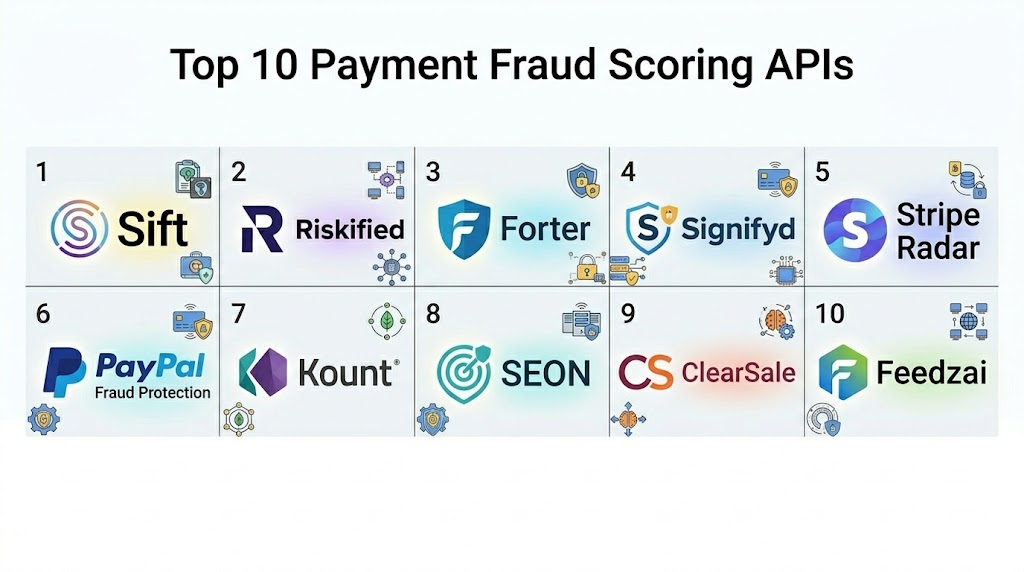
Top 10 Payment Fraud Scoring APIs
1- Stripe Radar
Short description: Stripe Radar is a fraud prevention and risk scoring system integrated into Stripe’s payment ecosystem. It helps businesses detect fraudulent transactions using machine learning, transaction analysis, and adaptive risk models.
Key Features
- AI-driven fraud scoring
- Real-time transaction monitoring
- Adaptive machine learning
- Chargeback protection workflows
- Rule-based fraud controls
- Risk insights and analytics
- Payment ecosystem integration
Pros
- Strong integration with Stripe ecosystem
- Easy merchant onboarding
- Good machine learning accuracy
Cons
- Primarily optimized for Stripe payments
- Limited flexibility outside Stripe ecosystem
- Advanced customization may require expertise
Platforms / Deployment
- Cloud / API
Security & Compliance
Supports transaction encryption, fraud analytics, authentication workflows, and secure payment monitoring.
Integrations & Ecosystem
Stripe Radar integrates with ecommerce, payment, and fintech ecosystems.
- Stripe Payments
- Ecommerce platforms
- Subscription systems
- SaaS billing tools
- Marketplace applications
Support & Community
Large developer ecosystem with extensive fraud prevention documentation.
2- Sift
Short description: Sift provides AI-powered fraud prevention and risk scoring APIs for ecommerce, fintech, travel, gaming, and digital marketplaces.
Key Features
- Payment fraud scoring
- Account takeover detection
- Device fingerprinting
- Behavioral analytics
- Machine learning fraud detection
- Chargeback prevention
- Identity intelligence
Pros
- Strong behavioral analytics
- Broad fraud prevention coverage
- Good enterprise scalability
Cons
- Enterprise pricing structure
- Advanced workflows require tuning
- Integration planning needed for complex ecosystems
Platforms / Deployment
- Cloud / API
Security & Compliance
Supports encrypted data handling, fraud intelligence workflows, and operational transaction protections.
Integrations & Ecosystem
Sift integrates with ecommerce, fintech, and marketplace ecosystems.
- Ecommerce platforms
- Payment gateways
- Marketplaces
- Digital banking systems
- Subscription services
Support & Community
Strong enterprise fraud prevention ecosystem with dedicated onboarding support.
3- Riskified
Short description: Riskified provides ecommerce-focused fraud scoring and chargeback prevention infrastructure using machine learning and transaction intelligence.
Key Features
- Ecommerce fraud scoring
- Chargeback protection
- Behavioral transaction analysis
- Machine learning risk models
- Automated decisioning
- Identity intelligence
- Merchant analytics
Pros
- Strong ecommerce specialization
- Good chargeback reduction support
- Useful merchant analytics
Cons
- Primarily ecommerce-focused
- Enterprise pricing may vary
- Advanced custom workflows may require support
Platforms / Deployment
- Cloud / API
Security & Compliance
Supports transaction protection, fraud analytics, and operational security workflows.
Integrations & Ecosystem
Riskified integrates with ecommerce and retail ecosystems.
- Shopify
- Magento
- Ecommerce systems
- Payment providers
- Retail platforms
Support & Community
Strong ecommerce fraud ecosystem with enterprise merchant support.
4- Forter
Short description: Forter provides identity-based fraud prevention and payment scoring APIs designed for ecommerce, retail, and digital commerce ecosystems.
Key Features
- Identity-based fraud analysis
- Payment risk scoring
- Account takeover protection
- Behavioral intelligence
- Real-time fraud detection
- Chargeback prevention
- Adaptive risk models
Pros
- Strong identity intelligence
- Good transaction accuracy
- Enterprise ecommerce focus
Cons
- Enterprise onboarding complexity
- Premium pricing positioning
- Advanced workflows require operational planning
Platforms / Deployment
- Cloud / API
Security & Compliance
Supports fraud monitoring, identity analytics, and secure operational transaction protections.
Integrations & Ecosystem
Forter integrates with digital commerce and payment ecosystems.
- Ecommerce platforms
- Payment gateways
- Retail systems
- Digital marketplaces
- Customer analytics tools
Support & Community
Strong enterprise commerce ecosystem with implementation support resources.
5- Signifyd
Short description: Signifyd provides payment fraud scoring and commerce protection infrastructure focused on ecommerce and retail fraud prevention.
Key Features
- Fraud risk scoring
- Chargeback guarantees
- Transaction monitoring
- Identity verification
- Behavioral analytics
- Automated fraud decisions
- Ecommerce integrations
Pros
- Strong ecommerce compatibility
- Useful chargeback protection workflows
- Good merchant usability
Cons
- Primarily retail-focused
- Enterprise scaling costs vary
- Limited non-commerce specialization
Platforms / Deployment
- Cloud / API
Security & Compliance
Supports secure payment monitoring and fraud prevention workflows.
Integrations & Ecosystem
Signifyd integrates with ecommerce and commerce ecosystems.
- Shopify
- BigCommerce
- Payment systems
- Retail applications
- Marketplace platforms
Support & Community
Strong ecommerce ecosystem with merchant onboarding resources.
6- SEON
Short description: SEON provides fraud scoring APIs using device intelligence, behavioral analytics, and digital footprint analysis for fintech and ecommerce businesses.
Key Features
- Fraud scoring APIs
- Device fingerprinting
- Email and phone intelligence
- Behavioral analytics
- Digital footprint analysis
- Real-time transaction scoring
- Machine learning detection
Pros
- Strong device intelligence capabilities
- Good fintech compatibility
- Flexible fraud scoring workflows
Cons
- Advanced configuration may require expertise
- Enterprise fraud workflows need tuning
- Smaller ecosystem than larger providers
Platforms / Deployment
- Cloud / API
Security & Compliance
Supports authentication workflows, fraud analytics, and secure transaction protections.
Integrations & Ecosystem
SEON integrates with fintech and digital commerce ecosystems.
- Payment gateways
- Ecommerce systems
- Fintech platforms
- Identity verification tools
- Marketplace applications
Support & Community
Growing fraud prevention ecosystem with developer-friendly onboarding.
7- Kount
Short description: Kount provides AI-driven payment fraud scoring and digital identity trust infrastructure for ecommerce, payments, and enterprise fraud prevention.
Key Features
- AI-powered fraud scoring
- Device intelligence
- Payment risk analysis
- Identity trust analytics
- Account protection
- Real-time monitoring
- Chargeback reduction support
Pros
- Strong identity trust capabilities
- Enterprise-grade fraud workflows
- Good transaction scalability
Cons
- Enterprise implementation complexity
- Premium fraud infrastructure pricing
- Advanced optimization may require tuning
Platforms / Deployment
- Cloud / API
Security & Compliance
Supports fraud intelligence workflows, transaction protection, and operational monitoring controls.
Integrations & Ecosystem
Kount integrates with payment and ecommerce ecosystems.
- Payment systems
- Ecommerce platforms
- Banking systems
- Subscription services
- Marketplace applications
Support & Community
Strong enterprise fraud prevention ecosystem with implementation support.
8- Feedzai
Short description: Feedzai provides AI-powered fraud detection and payment risk scoring infrastructure for banks, fintech companies, and payment providers.
Key Features
- AI fraud scoring
- Transaction monitoring
- Behavioral analytics
- Real-time payment analysis
- Financial crime detection
- Machine learning workflows
- Risk orchestration support
Pros
- Strong banking and fintech focus
- Good machine learning capabilities
- Enterprise transaction scalability
Cons
- Enterprise deployment complexity
- Premium infrastructure positioning
- Requires operational fraud expertise
Platforms / Deployment
- Cloud / Hybrid / API
Security & Compliance
Supports fraud analytics, transaction security, and operational governance protections.
Integrations & Ecosystem
Feedzai integrates with financial infrastructure ecosystems.
- Banking systems
- Payment gateways
- Fintech platforms
- Fraud orchestration systems
- Financial analytics tools
Support & Community
Strong banking fraud ecosystem with enterprise implementation support.
9- Sardine
Short description: Sardine provides fraud prevention and payment risk APIs designed for fintech, crypto, banking, and digital commerce ecosystems.
Key Features
- Fraud risk scoring
- Behavioral analytics
- Device intelligence
- Payment monitoring
- Identity verification support
- Real-time transaction analysis
- Risk orchestration workflows
Pros
- Strong fintech compatibility
- Modern API architecture
- Good transaction intelligence
Cons
- Smaller ecosystem maturity
- Advanced enterprise workflows require tuning
- Scaling costs may vary by usage
Platforms / Deployment
- Cloud / API
Security & Compliance
Supports secure fraud monitoring, authentication workflows, and operational transaction protections.
Integrations & Ecosystem
Sardine integrates with fintech and payment ecosystems.
- Payment gateways
- Banking systems
- Ecommerce platforms
- Crypto infrastructure
- Identity verification tools
Support & Community
Growing fintech fraud ecosystem with developer-focused onboarding support.
10- Fraud.net
Short description: Fraud.net provides AI-driven fraud prevention and payment scoring APIs for ecommerce, banking, insurance, and enterprise transaction ecosystems.
Key Features
- Fraud scoring APIs
- AI transaction analytics
- Payment monitoring
- Identity intelligence
- Risk orchestration
- Behavioral analysis
- Enterprise fraud workflows
Pros
- Broad industry fraud coverage
- Good AI analytics capabilities
- Enterprise risk flexibility
Cons
- Enterprise onboarding complexity
- Premium implementation positioning
- Workflow optimization requires planning
Platforms / Deployment
- Cloud / Hybrid / API
Security & Compliance
Supports fraud monitoring, secure transaction workflows, and operational governance protections.
Integrations & Ecosystem
Fraud.net integrates with financial and enterprise ecosystems.
- Banking systems
- Ecommerce platforms
- Insurance systems
- Payment gateways
- Enterprise applications
Support & Community
Strong enterprise fraud analytics ecosystem with implementation support resources.
Comparison Table
| Tool Name | Best For | Platform(s) Supported | Deployment | Standout Feature | Public Rating |
|---|---|---|---|---|---|
| Stripe Radar | Stripe ecosystem fraud prevention | Cloud / API | Cloud | Adaptive machine learning | N/A |
| Sift | Behavioral fraud analytics | Cloud / API | Cloud | Device and behavior intelligence | N/A |
| Riskified | Ecommerce fraud prevention | Cloud / API | Cloud | Chargeback protection | N/A |
| Forter | Identity-based fraud analysis | Cloud / API | Cloud | Identity intelligence | N/A |
| Signifyd | Commerce fraud protection | Cloud / API | Cloud | Merchant chargeback workflows | N/A |
| SEON | Device fingerprinting | Cloud / API | Cloud | Digital footprint analytics | N/A |
| Kount | Identity trust scoring | Cloud / API | Cloud | Enterprise fraud workflows | N/A |
| Feedzai | Banking fraud detection | Cloud / Hybrid | Hybrid | AI-powered transaction monitoring | N/A |
| Sardine | Fintech fraud prevention | Cloud / API | Cloud | Modern fintech APIs | N/A |
| Fraud.net | Enterprise fraud orchestration | Cloud / Hybrid | Hybrid | AI-driven fraud analytics | N/A |
Evaluation & Scoring of Payment Fraud Scoring APIs
| Tool Name | Core 25% | Ease 15% | Integrations 15% | Security 10% | Performance 10% | Support 10% | Value 15% | Weighted Total |
|---|---|---|---|---|---|---|---|---|
| Stripe Radar | 9 | 9 | 9 | 9 | 9 | 9 | 8 | 8.9 |
| Sift | 9 | 8 | 8 | 9 | 9 | 8 | 7 | 8.3 |
| Riskified | 9 | 8 | 8 | 8 | 8 | 8 | 8 | 8.2 |
| Forter | 9 | 7 | 8 | 9 | 8 | 8 | 7 | 8.0 |
| Signifyd | 8 | 8 | 8 | 8 | 8 | 8 | 8 | 8.0 |
| SEON | 8 | 8 | 8 | 8 | 8 | 7 | 8 | 7.9 |
| Kount | 9 | 7 | 8 | 9 | 8 | 8 | 7 | 8.0 |
| Feedzai | 9 | 7 | 8 | 9 | 9 | 8 | 7 | 8.1 |
| Sardine | 8 | 8 | 8 | 8 | 8 | 7 | 8 | 7.9 |
| Fraud.net | 8 | 7 | 8 | 8 | 8 | 8 | 7 | 7.8 |
These scores are comparative evaluations designed to help businesses understand differences across fraud scoring ecosystems. Some platforms focus more heavily on ecommerce fraud prevention, while others specialize in banking, fintech, identity intelligence, or enterprise fraud orchestration.
Which Payment Fraud Scoring API Is Right for You?
Solo / Freelancer
Small ecommerce sellers and independent developers may benefit most from Stripe Radar or Signifyd because of easier onboarding and simpler integration workflows.
SMB
Small and medium-sized businesses should evaluate Riskified, Sift, or SEON for scalable fraud prevention and ecommerce transaction protection.
Mid-Market
Mid-market fintech and commerce platforms should prioritize Forter, Kount, or Sardine depending on identity intelligence and transaction monitoring needs.
Enterprise
Large financial institutions, payment providers, and enterprise marketplaces should evaluate Feedzai, Fraud.net, Sift, or Kount for scalability and advanced fraud orchestration.
Budget vs Premium
Developer-friendly fraud APIs simplify onboarding and reduce operational overhead, while enterprise fraud systems provide stronger analytics and orchestration at higher infrastructure cost.
Feature Depth vs Ease of Use
Simple fraud APIs focus on quick integration and transaction scoring, while enterprise fraud platforms offer deeper analytics, behavioral intelligence, and workflow customization.
Integrations & Scalability
Businesses with high transaction volumes and global payment infrastructure should prioritize APIs with strong monitoring, real-time analytics, and scalable fraud orchestration.
Security & Compliance Needs
Organizations should prioritize transaction encryption, authentication controls, identity verification, fraud analytics, and operational governance before selecting a fraud scoring platform.
Frequently Asked Questions FAQs
1- What are Payment Fraud Scoring APIs?
Payment Fraud Scoring APIs analyze transactions and assign risk scores to help businesses identify and prevent fraudulent activity.
2- Why are fraud scoring APIs important?
They help reduce chargebacks, prevent account takeover attacks, improve payment trust, and automate transaction risk decisions.
3- Which industries use fraud scoring APIs most?
Ecommerce, fintech, banking, subscription services, travel, marketplaces, and gaming platforms are major users.
4- What is device fingerprinting?
Device fingerprinting identifies devices using browser, hardware, and behavioral data to detect suspicious transaction patterns.
5- Can fraud scoring APIs use AI and machine learning?
Yes. Many modern fraud scoring systems use machine learning to detect suspicious behavior and improve risk accuracy over time.
6- Are fraud scoring APIs real-time?
Most leading platforms analyze transactions in real time to support instant approval or rejection decisions.
7- What should businesses evaluate before choosing a fraud scoring API?
Businesses should evaluate fraud accuracy, false-positive rates, API performance, integrations, reporting, scalability, and operational costs.
8- Can fraud scoring APIs integrate with payment gateways?
Yes. Most providers integrate directly with payment gateways, ecommerce systems, and fintech infrastructure.
9- Are fraud scoring APIs secure?
Leading providers support encryption, authentication controls, transaction monitoring, and operational security protections for payment workflows.
10- Which fraud scoring API is best for ecommerce?
Stripe Radar, Riskified, Forter, Signifyd, and Sift are commonly evaluated for ecommerce fraud prevention because of their merchant ecosystem support and transaction intelligence capabilities.
Conclusion
Payment Fraud Scoring APIs are becoming essential infrastructure for secure digital commerce, fintech operations, and real-time transaction risk management. As payment ecosystems continue expanding across ecommerce, subscriptions, embedded finance, and marketplaces, fraud prevention systems must operate faster, smarter, and with greater accuracy. Platforms such as Stripe Radar, Sift, Riskified, and Forter provide advanced fraud scoring capabilities using machine learning, behavioral analytics, and identity intelligence, while enterprise-focused systems like Feedzai and Fraud.net deliver broader fraud orchestration and financial crime monitoring workflows. The ideal platform depends heavily on transaction volume, industry focus, payment complexity, and operational scale. Smaller businesses may prioritize ease of integration and chargeback reduction, while enterprises often focus more on advanced analytics, governance, scalability, and real-time orchestration. Before selecting a payment fraud scoring API, organizations should benchmark fraud accuracy, validate transaction performance, review reporting capabilities, and carefully assess long-term scalability and security requirements for digital payment operations.
This blog gives simple and practical information about payment fraud scoring APIs and their importance in modern digital payment systems.