Introduction
Digital Wallet SDKs help developers and businesses add wallet features directly into mobile apps, web apps, fintech platforms, ecommerce systems, banking apps, loyalty programs, and Web3 products. These SDKs provide ready-made tools for payments, token storage, card provisioning, identity verification, rewards, crypto wallets, pass management, and secure transaction workflows.
Digital Wallet SDKs are useful because customers now expect fast, secure, and mobile-first payment experiences. Instead of building wallet infrastructure from scratch, companies can use SDKs to reduce development effort, improve security, support multiple payment methods, and launch wallet-enabled products faster.
Real-world use cases include:
- Mobile payment wallets
- Crypto wallet applications
- Loyalty and rewards wallets
- Banking and fintech wallets
- Digital passes and ticketing wallets
Evaluation Criteria for Buyers
Organizations evaluating Digital Wallet SDKs should consider:
- Payment method support
- Mobile and web compatibility
- Security and encryption controls
- Tokenization capabilities
- Developer documentation
- API and SDK flexibility
- Card and bank integration support
- Crypto and Web3 wallet support
- Compliance readiness
- Scalability and transaction reliability
Best for: Fintech companies, banks, ecommerce platforms, SaaS providers, crypto apps, loyalty platforms, travel companies, and enterprises building secure wallet experiences.
Not ideal for: Businesses that only need basic checkout pages or companies without mobile payment, identity, pass, loyalty, or digital asset wallet requirements.
Key Trends in Digital Wallet SDKs
- Mobile-first wallet experiences are becoming standard across fintech and ecommerce apps.
- Tokenized payments are improving transaction security and reducing card exposure.
- Web3 wallets are expanding beyond crypto into identity, loyalty, and digital ownership.
- Embedded finance platforms are adding wallet SDK capabilities for banking and payments.
- Biometric authentication is becoming a common wallet security layer.
- Digital identity and verifiable credentials are increasingly connected with wallet ecosystems.
- Loyalty, rewards, coupons, and passes are being combined into unified wallet experiences.
- Cross-border wallets are improving support for global payments and multi-currency use cases.
- API-first wallet SDKs are helping developers launch faster with less custom infrastructure.
- Fraud monitoring and real-time transaction risk controls are becoming more important.
How We Selected These Tools
The following Digital Wallet SDKs were selected based on adoption, developer ecosystem strength, security capabilities, payment infrastructure, and practical integration value.
- Strong developer adoption and ecosystem maturity
- Secure wallet and payment capabilities
- Mobile and web SDK availability
- API reliability and integration flexibility
- Tokenization and authentication support
- Fintech and ecommerce compatibility
- Web3 and digital asset readiness where relevant
- Documentation and onboarding quality
- Enterprise scalability
- Long-term ecosystem strength
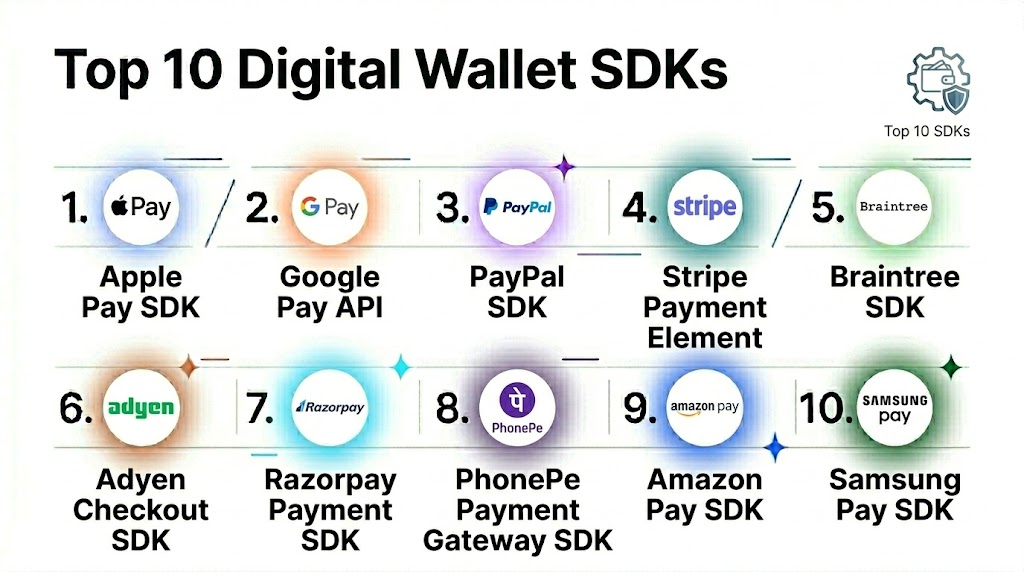
Top 10 Digital Wallet SDKs
1- Apple Wallet
Short description: Apple Wallet provides digital wallet capabilities for iOS users, including payment cards, boarding passes, tickets, loyalty cards, keys, and identity-related wallet experiences. It is widely used by banks, retailers, travel companies, and app developers targeting Apple users.
Key Features
- Payment card provisioning
- Digital pass support
- Loyalty card integration
- Ticket and boarding pass support
- Apple Pay compatibility
- Secure device-based wallet storage
- Biometric authentication support
Pros
- Strong iOS ecosystem adoption
- Excellent user experience
- Strong device-level security
Cons
- Limited to Apple ecosystem
- Requires platform-specific implementation
- Approval and integration requirements can be strict
Platforms / Deployment
- iOS / Web / Cloud
Security & Compliance
Supports tokenized payments, biometric authentication, device-level security, encryption, and secure transaction authorization.
Integrations & Ecosystem
Apple Wallet integrates with payment, travel, retail, loyalty, and ticketing ecosystems.
- Apple Pay
- Banking systems
- Retail applications
- Airline and travel systems
- Loyalty programs
Support & Community
Strong developer documentation and large global ecosystem support for iOS wallet experiences.
2- Google Wallet
Short description: Google Wallet helps businesses add digital passes, payment experiences, loyalty cards, tickets, transit cards, and identity-related wallet features for Android users. It is suitable for brands building mobile-first wallet experiences across Android devices.
Key Features
- Digital pass support
- Payment card compatibility
- Loyalty card integration
- Ticketing and transit support
- Android ecosystem integration
- Secure wallet storage
- API-based wallet object management
Pros
- Strong Android ecosystem reach
- Good pass and loyalty support
- Flexible developer tools
Cons
- Primarily Android-focused
- Feature availability varies by region
- Requires wallet object setup and approval workflows
Platforms / Deployment
- Android / Web / Cloud
Security & Compliance
Supports secure wallet storage, tokenized payment workflows, authentication controls, and encrypted data handling.
Integrations & Ecosystem
Google Wallet integrates with Android apps, payment systems, loyalty tools, and ticketing platforms.
- Android applications
- Ecommerce systems
- Loyalty programs
- Travel and ticketing systems
- Payment gateways
Support & Community
Strong Android developer ecosystem with broad documentation and implementation resources.
3- Stripe Issuing
Short description: Stripe Issuing provides APIs and infrastructure for creating, managing, and embedding card-based wallet and spending experiences into fintech and business applications. It is useful for companies building corporate cards, expense wallets, and embedded payment products.
Key Features
- Virtual and physical card issuing
- Card wallet provisioning
- Spending controls
- Real-time authorization
- Transaction management
- API-first infrastructure
- Embedded finance support
Pros
- Strong developer experience
- Good fintech infrastructure
- Flexible issuing workflows
Cons
- Regional availability varies
- Primarily payment and card focused
- Advanced financial workflows require compliance planning
Platforms / Deployment
- Web / Cloud / Mobile
Security & Compliance
Supports encryption, authentication, transaction monitoring, fraud controls, and secure API workflows.
Integrations & Ecosystem
Stripe Issuing integrates with fintech, payment, ecommerce, and business finance systems.
- Stripe Payments
- Banking infrastructure
- Expense management apps
- SaaS platforms
- Marketplace systems
Support & Community
Large developer ecosystem with extensive documentation and strong fintech adoption.
4- Marqeta
Short description: Marqeta provides modern card issuing and payment infrastructure that helps businesses build wallet-based financial products, virtual cards, and real-time transaction experiences. It is suitable for fintech companies, marketplaces, and embedded finance platforms.
Key Features
- Card issuing APIs
- Virtual card support
- Real-time transaction controls
- Digital wallet tokenization
- Spend management workflows
- Payment authorization controls
- Embedded finance infrastructure
Pros
- Strong card issuing capabilities
- Good real-time controls
- Enterprise-ready fintech infrastructure
Cons
- Card-focused use cases
- Integration complexity for new teams
- Requires compliance and operations planning
Platforms / Deployment
- Cloud / Mobile / Web
Security & Compliance
Supports tokenization, transaction controls, fraud monitoring, authentication, and secure card issuing workflows.
Integrations & Ecosystem
Marqeta integrates with fintech apps, digital banks, wallets, and payment ecosystems.
- Digital banking apps
- Payment gateways
- Card networks
- Marketplace platforms
- Expense management systems
Support & Community
Strong enterprise support and fintech-focused onboarding ecosystem.
5- Thales Digital Wallet SDK
Short description: Thales Digital Wallet SDK supports secure mobile wallet and payment experiences for banks, fintechs, and financial service providers. It focuses on payment security, tokenization, authentication, and digital banking wallet enablement.
Key Features
- Mobile wallet enablement
- Tokenized payment support
- Secure authentication
- Card digitization
- Banking wallet infrastructure
- Mobile payment protection
- Enterprise security controls
Pros
- Strong security focus
- Good banking and fintech fit
- Enterprise-grade wallet protection
Cons
- Enterprise-oriented deployment
- Requires financial integration expertise
- Less suited for lightweight consumer apps
Platforms / Deployment
- iOS / Android / Cloud / Hybrid
Security & Compliance
Supports tokenization, encryption, authentication controls, and secure financial transaction workflows.
Integrations & Ecosystem
Thales integrates with banking systems, payment networks, and mobile financial applications.
- Digital banking platforms
- Card issuing systems
- Payment networks
- Authentication systems
- Enterprise security tools
Support & Community
Strong enterprise support ecosystem with security-focused implementation guidance.
6- Giesecke Devrient Digital Wallet Solutions
Short description: Giesecke Devrient provides digital wallet and payment enablement solutions for banks, fintechs, and enterprises needing secure card, payment, and identity wallet capabilities. It is commonly used in financial-grade wallet environments.
Key Features
- Digital payment wallet support
- Card digitization
- Tokenization services
- Secure mobile payment workflows
- Identity and authentication support
- Banking integration capabilities
- Enterprise wallet infrastructure
Pros
- Strong banking ecosystem experience
- Good security and tokenization focus
- Enterprise wallet readiness
Cons
- Enterprise implementation complexity
- Less developer-first than newer API platforms
- Pricing and packaging vary by deployment
Platforms / Deployment
- iOS / Android / Cloud / Hybrid
Security & Compliance
Supports encryption, tokenization, authentication controls, and secure wallet provisioning workflows.
Integrations & Ecosystem
Giesecke Devrient integrates with banks, card issuers, payment systems, and identity platforms.
- Banking platforms
- Card networks
- Mobile payment apps
- Identity systems
- Payment processors
Support & Community
Strong enterprise support model focused on banking, payments, and secure identity infrastructure.
7- Coinbase Wallet SDK
Short description: Coinbase Wallet SDK helps developers connect decentralized applications with wallet functionality for crypto assets, Web3 authentication, and blockchain interactions. It is suitable for Web3 apps, NFT platforms, and decentralized finance products.
Key Features
- Web3 wallet connection
- Crypto asset support
- Decentralized application integration
- Blockchain transaction signing
- Wallet authentication
- NFT compatibility
- Developer-friendly APIs
Pros
- Strong Web3 ecosystem adoption
- Good developer usability
- Useful for crypto and NFT apps
Cons
- Crypto-focused use cases
- Requires blockchain knowledge
- Not designed for traditional banking wallets
Platforms / Deployment
- Web / iOS / Android / Cloud
Security & Compliance
Supports wallet-based transaction signing, cryptographic authentication, and secure blockchain interaction workflows.
Integrations & Ecosystem
Coinbase Wallet SDK integrates with Web3 applications and blockchain ecosystems.
- Decentralized applications
- NFT marketplaces
- DeFi platforms
- Blockchain networks
- Web3 authentication tools
Support & Community
Large Web3 developer ecosystem with strong community adoption and documentation.
8- MetaMask SDK
Short description: MetaMask SDK helps developers connect applications to MetaMask wallets for Web3 transactions, wallet authentication, and decentralized application workflows. It is widely used across blockchain, NFT, and decentralized finance ecosystems.
Key Features
- Wallet connection support
- Web3 authentication
- Blockchain transaction signing
- Decentralized application integration
- Mobile and browser wallet support
- NFT and token compatibility
- Developer SDKs
Pros
- Very strong Web3 ecosystem presence
- Broad decentralized app compatibility
- Large developer community
Cons
- Web3-focused only
- User onboarding can be complex for non-crypto audiences
- Blockchain transaction fees vary by network
Platforms / Deployment
- Web / iOS / Android / Browser Extension
Security & Compliance
Supports cryptographic wallet signing, user-controlled keys, and secure decentralized transaction workflows.
Integrations & Ecosystem
MetaMask SDK integrates with blockchain and decentralized application ecosystems.
- Ethereum applications
- NFT platforms
- DeFi protocols
- Web3 games
- Blockchain developer tools
Support & Community
Large global Web3 community with extensive developer resources and ecosystem support.
9- WalletConnect
Short description: WalletConnect is an open wallet connection protocol and SDK ecosystem that enables decentralized applications to connect securely with multiple Web3 wallets. It is useful for developers who want broad wallet compatibility rather than support for only one wallet provider.
Key Features
- Multi-wallet connection protocol
- Web3 authentication support
- Decentralized transaction signing
- Cross-platform wallet connectivity
- QR code and mobile linking
- Blockchain ecosystem support
- Developer SDKs
Pros
- Broad wallet compatibility
- Strong Web3 interoperability
- Useful for multi-wallet applications
Cons
- Web3-specific use cases
- Requires decentralized app expertise
- User experience varies by wallet
Platforms / Deployment
- Web / iOS / Android / Cloud
Security & Compliance
Supports cryptographic wallet connections, user-approved signing, and secure decentralized session workflows.
Integrations & Ecosystem
WalletConnect integrates with many Web3 wallets and decentralized applications.
- Crypto wallets
- DeFi platforms
- NFT marketplaces
- Web3 games
- Decentralized applications
Support & Community
Strong open Web3 ecosystem with broad community and developer adoption.
10- Magic
Short description: Magic provides wallet and authentication infrastructure that helps developers build embedded Web3 wallet experiences with simplified user onboarding. It is useful for apps that want wallet functionality without forcing users to manage complex crypto setup from the beginning.
Key Features
- Embedded wallet infrastructure
- Passwordless authentication
- Web3 wallet support
- User onboarding tools
- Developer APIs
- Multi-chain compatibility
- App-based wallet experiences
Pros
- Easier Web3 onboarding
- Good developer experience
- Useful for consumer-friendly wallet apps
Cons
- Web3-focused functionality
- Advanced custody model review required
- Enterprise compliance needs careful evaluation
Platforms / Deployment
- Web / iOS / Android / Cloud
Security & Compliance
Supports authentication controls, wallet infrastructure, and secure access workflows. Specific certifications are not publicly stated.
Integrations & Ecosystem
Magic integrates with Web3 applications and authentication workflows.
- Decentralized applications
- Web3 platforms
- NFT apps
- Consumer apps
- Developer APIs
Support & Community
Growing developer ecosystem focused on simplified wallet onboarding and Web3 user experience.
Comparison Table
| Tool Name | Best For | Platform Supported | Deployment | Standout Feature | Public Rating |
|---|---|---|---|---|---|
| Apple Wallet | iOS payment and pass wallets | iOS / Web | Cloud | Secure Apple ecosystem wallet | N/A |
| Google Wallet | Android wallet experiences | Android / Web | Cloud | Android pass and payment support | N/A |
| Stripe Issuing | Card-based wallet products | Web / Mobile | Cloud | Developer-first card issuing | N/A |
| Marqeta | Fintech card wallets | Web / Mobile | Cloud | Real-time card controls | N/A |
| Thales Digital Wallet SDK | Secure banking wallets | iOS / Android | Hybrid | Enterprise payment security | N/A |
| Giesecke Devrient Digital Wallet Solutions | Banking wallet infrastructure | iOS / Android | Hybrid | Tokenization and card digitization | N/A |
| Coinbase Wallet SDK | Crypto wallet apps | Web / iOS / Android | Cloud | Web3 wallet connection | N/A |
| MetaMask SDK | Decentralized applications | Web / iOS / Android | Cloud | Web3 transaction signing | N/A |
| WalletConnect | Multi-wallet Web3 support | Web / iOS / Android | Cloud | Broad wallet interoperability | N/A |
| Magic | Embedded Web3 wallets | Web / iOS / Android | Cloud | Simplified wallet onboarding | N/A |
Evaluation & Scoring of Digital Wallet SDKs
| Tool Name | Core 25% | Ease 15% | Integrations 15% | Security 10% | Performance 10% | Support 10% | Value 15% | Weighted Total |
|---|---|---|---|---|---|---|---|---|
| Apple Wallet | 9 | 8 | 8 | 10 | 9 | 9 | 8 | 8.7 |
| Google Wallet | 9 | 8 | 8 | 9 | 9 | 9 | 8 | 8.5 |
| Stripe Issuing | 9 | 9 | 9 | 9 | 9 | 9 | 7 | 8.8 |
| Marqeta | 9 | 7 | 8 | 9 | 9 | 8 | 7 | 8.2 |
| Thales Digital Wallet SDK | 8 | 6 | 8 | 10 | 8 | 8 | 7 | 7.9 |
| Giesecke Devrient Digital Wallet Solutions | 8 | 6 | 8 | 10 | 8 | 8 | 7 | 7.9 |
| Coinbase Wallet SDK | 8 | 8 | 8 | 8 | 8 | 8 | 8 | 8.0 |
| MetaMask SDK | 9 | 8 | 9 | 8 | 8 | 9 | 8 | 8.5 |
| WalletConnect | 8 | 8 | 9 | 8 | 8 | 8 | 9 | 8.3 |
| Magic | 8 | 9 | 8 | 8 | 8 | 8 | 8 | 8.2 |
These scores are comparative and should be used as selection guidance rather than fixed rankings. Traditional payment wallet SDKs usually perform better for banking, cards, and pass management, while Web3 wallet SDKs are stronger for crypto, token ownership, decentralized apps, and wallet-based authentication.
Which Digital Wallet SDK Is Right for You?
Solo / Freelancer
Solo developers building Web3 apps may prefer MetaMask SDK, WalletConnect, Coinbase Wallet SDK, or Magic. Developers building simple pass-based wallet experiences may prefer Apple Wallet and Google Wallet.
SMB
Small and medium businesses building loyalty, passes, ecommerce payments, or app-based wallet features should evaluate Apple Wallet, Google Wallet, Stripe Issuing, and Magic depending on the use case.
Mid-Market
Mid-market fintech and commerce platforms should evaluate Stripe Issuing, Marqeta, Thales, or Giesecke Devrient for secure payment, card, and wallet workflows.
Enterprise
Large banks, payment providers, and fintech enterprises should prioritize Thales, Giesecke Devrient, Marqeta, Stripe Issuing, Apple Wallet, and Google Wallet depending on ecosystem and compliance needs.
Budget vs Premium
Web3 wallet SDKs and pass-based wallet integrations can be faster to start with, while banking-grade wallet infrastructure usually requires deeper implementation, stronger compliance planning, and higher operational investment.
Feature Depth vs Ease of Use
Apple Wallet, Google Wallet, Magic, and Stripe Issuing are generally easier for developers to start with. Banking-grade SDKs offer deeper financial security but require more technical and compliance planning.
Integrations & Scalability
Organizations should choose wallet SDKs based on ecosystem needs. Consumer mobile apps need Apple and Google wallet support, fintech products need card and banking APIs, and Web3 apps need wallet connection and signing capabilities.
Security & Compliance Needs
Financial wallet products should prioritize tokenization, device security, authentication, encryption, fraud monitoring, and auditability. Web3 wallets should prioritize secure signing, session management, user key control, and transaction transparency.
Frequently Asked Questions FAQs
1- What is a Digital Wallet SDK?
A Digital Wallet SDK is a developer toolkit that helps apps add wallet features such as payments, cards, passes, crypto assets, identity, loyalty, or transaction signing.
2- Why do businesses use Digital Wallet SDKs?
Businesses use wallet SDKs to reduce development effort, improve security, support mobile payments, and create smoother customer experiences inside their own apps.
3- What is the difference between a payment wallet and a crypto wallet?
A payment wallet stores cards, passes, and payment credentials, while a crypto wallet stores blockchain keys and enables token transactions or decentralized app access.
4- Can Digital Wallet SDKs support loyalty programs?
Yes. Apple Wallet, Google Wallet, and several wallet infrastructure providers support loyalty cards, rewards, coupons, tickets, and membership passes.
5- Are Digital Wallet SDKs secure?
Leading SDKs use encryption, tokenization, authentication, secure signing, device protection, and transaction controls to protect wallet workflows.
6- Can wallet SDKs support both mobile and web apps?
Yes. Many wallet SDKs support mobile and web environments, though feature availability depends on the platform and wallet provider.
7- What should fintech companies evaluate before choosing a wallet SDK?
Fintech companies should evaluate tokenization, card support, banking integrations, compliance requirements, API reliability, fraud controls, and scalability.
8- What should Web3 companies evaluate before choosing a wallet SDK?
Web3 companies should evaluate wallet compatibility, blockchain support, signing workflows, user onboarding, session security, and decentralized application integration.
9- Do Digital Wallet SDKs require compliance review?
Yes, especially for financial wallets, card issuing, banking workflows, identity credentials, or regulated payment activity. Compliance requirements vary by product and region.
10- Which Digital Wallet SDK is best for startups?
Startups building payment wallets may evaluate Stripe Issuing, Apple Wallet, or Google Wallet. Web3 startups may evaluate MetaMask SDK, WalletConnect, Coinbase Wallet SDK, or Magic.
Conclusion
Digital Wallet SDKs are becoming essential infrastructure for mobile payments, fintech applications, loyalty programs, digital passes, crypto wallets, identity experiences, and embedded finance products. The right SDK depends heavily on whether the business is building a traditional payment wallet, banking-grade wallet, loyalty wallet, pass wallet, or Web3 wallet. Apple Wallet and Google Wallet are strong choices for consumer mobile wallet experiences, while Stripe Issuing and Marqeta work well for fintech card and payment workflows. Thales and Giesecke Devrient are better suited for security-focused banking wallet infrastructure, while MetaMask SDK, Coinbase Wallet SDK, WalletConnect, and Magic are strong options for Web3 wallet connectivity and decentralized application onboarding. Before choosing a wallet SDK, organizations should validate platform compatibility, security requirements, integration effort, compliance needs, and long-term scalability. A smart next step is to shortlist two or three SDKs, test a real wallet workflow, review security controls, and confirm that the SDK fits both the technical roadmap and customer experience goals.
Nice article showing how digital wallet SDKs simplify payment integration and improve transaction management for modern digital businesses effectively.