Introduction
Decentralized Identity DID Platforms help individuals and organizations create, manage, verify, and share digital identity credentials without relying fully on a central identity provider. Instead of storing identity data in one central database, DID platforms use decentralized identifiers, verifiable credentials, wallets, cryptographic proofs, and trust registries to give users and organizations more control over identity verification.
These platforms matter because digital identity is now central to online banking, healthcare access, education records, workforce verification, customer onboarding, Web3 applications, and government services. DID platforms can reduce identity fraud, improve privacy, simplify credential verification, and support secure cross-organization trust.
Real-world use cases include:
- Digital employee credentials
- Customer identity verification
- Education certificates and professional licenses
- Healthcare identity and consent management
- Web3 wallets and decentralized application access
Evaluation Criteria for Buyers
Organizations evaluating DID platforms should consider:
- Verifiable credential support
- Wallet compatibility
- Standards alignment
- Enterprise identity integration
- Developer APIs and SDKs
- Privacy and consent controls
- Governance and trust registry support
- Scalability and reliability
- Deployment flexibility
- Support and documentation quality
Best for: Enterprises, governments, universities, financial institutions, healthcare organizations, Web3 companies, and identity teams building privacy-first digital credential systems.
Not ideal for: Small teams that only need basic login, passwordless authentication, or standard SSO without verifiable credentials or decentralized identity requirements.
Key Trends in Decentralized Identity DID Platforms
- Verifiable credentials are becoming more common for education, employment, and compliance verification.
- Enterprises are combining DID systems with existing IAM, SSO, and customer identity platforms.
- Digital wallets are becoming central to user-controlled identity experiences.
- Privacy-preserving identity verification is gaining importance across regulated industries.
- Governments and public-sector programs are exploring reusable digital credentials.
- Web3 ecosystems are using DID platforms for wallet-based identity and reputation.
- Trust registries are becoming important for verifying issuer credibility.
- Zero-knowledge proof capabilities are improving selective disclosure.
- DID platforms are becoming more API-friendly for developers.
- Cross-border identity interoperability remains a key buyer concern.
How We Selected These Tools
The following DID platforms were selected based on recognition, ecosystem maturity, standards alignment, enterprise relevance, and practical deployment capabilities.
- Strong market visibility and adoption
- Support for decentralized identifiers and verifiable credentials
- Wallet and credential management capabilities
- Enterprise identity integration potential
- Developer tooling and API maturity
- Privacy and consent management features
- Scalability for production identity workflows
- Ecosystem partnerships and standards participation
- Governance and trust framework support
- Fit across enterprise, public sector, and Web3 use cases
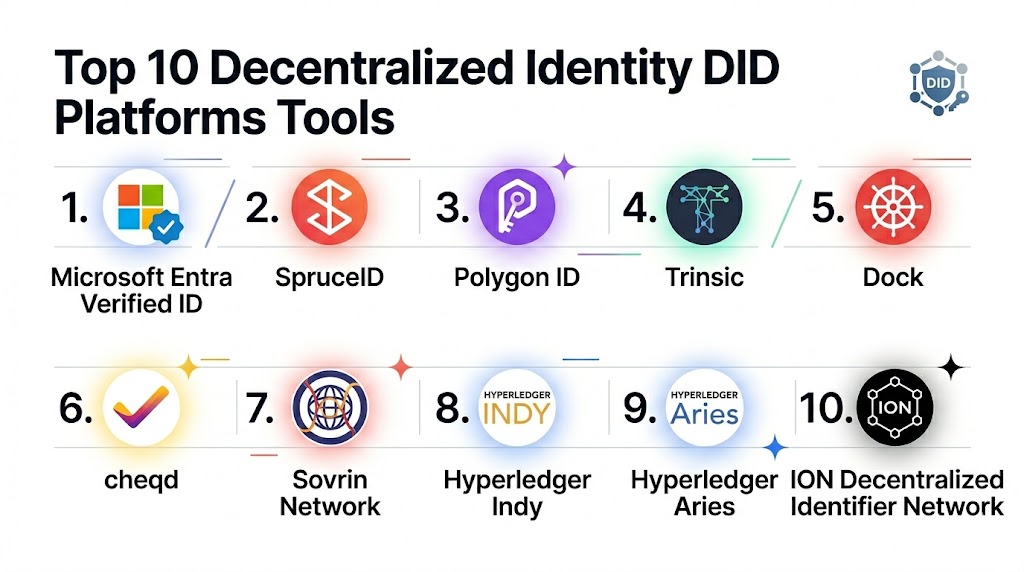
Top 10 Decentralized Identity DID Platforms Tools
1- Microsoft Entra Verified ID
Short description: Microsoft Entra Verified ID helps organizations issue and verify decentralized identity credentials across enterprise and workforce use cases. It is suitable for companies already using Microsoft identity infrastructure and looking to extend identity workflows into verifiable credentials.
Key Features
- Verifiable credential issuance
- Credential verification workflows
- Integration with Microsoft Entra ecosystem
- Digital wallet support
- Enterprise identity governance alignment
- API-based credential management
- User-controlled identity sharing
Pros
- Strong fit for Microsoft enterprise environments
- Good identity governance ecosystem
- Useful for workforce and partner credential workflows
Cons
- Best suited for Microsoft-centric organizations
- Requires planning around wallet adoption
- DID concepts may require user education
Platforms / Deployment
- Cloud / Hybrid
Security & Compliance
Supports enterprise identity controls, encryption, access management, and Microsoft security ecosystem integration. Specific compliance applicability varies by deployment.
Integrations & Ecosystem
Microsoft Entra Verified ID integrates well with enterprise identity and access management workflows.
- Microsoft Entra ID
- Microsoft security tools
- Enterprise applications
- HR and workforce systems
- Custom identity applications
Support & Community
Microsoft provides strong enterprise documentation, support channels, and partner ecosystem resources.
2- SpruceID
Short description: SpruceID provides decentralized identity infrastructure for verifiable credentials, digital wallets, and privacy-focused identity workflows. It is used by organizations building flexible DID and credential systems across enterprise, public sector, and Web3 environments.
Key Features
- Verifiable credential infrastructure
- DID-based identity workflows
- Wallet and credential tooling
- Standards-focused implementation
- API and developer tools
- Privacy-focused identity exchange
- Web3 identity support
Pros
- Strong decentralized identity specialization
- Developer-friendly architecture
- Good fit for standards-based DID projects
Cons
- Requires technical implementation expertise
- Smaller enterprise ecosystem than hyperscalers
- Best results require clear governance design
Platforms / Deployment
- Cloud / Hybrid / Self-hosted
Security & Compliance
Supports cryptographic credential verification and privacy-focused identity workflows. Specific certifications are not publicly stated.
Integrations & Ecosystem
SpruceID fits well into custom identity, wallet, and credential ecosystems.
- Digital wallets
- Web3 applications
- Enterprise identity systems
- Verifiable credential platforms
- Developer APIs
Support & Community
Strong DID-focused technical community and developer documentation, with support options varying by deployment.
3- Trinsic
Short description: Trinsic is a decentralized identity platform focused on verifiable credential issuance, verification, and wallet-based identity experiences. It is designed for organizations that want to build credential applications without managing every low-level DID component themselves.
Key Features
- Credential issuance APIs
- Credential verification workflows
- Wallet support
- DID infrastructure
- Developer SDKs
- Trust ecosystem support
- Identity application building blocks
Pros
- Good developer experience
- Useful for credential-based applications
- Simplifies DID implementation complexity
Cons
- Advanced governance may require additional design
- Enterprise controls vary by plan
- Requires buyer clarity on credential workflows
Platforms / Deployment
- Cloud / Hybrid
Security & Compliance
Supports cryptographic verification and secure credential exchange. Specific compliance certifications are not publicly stated.
Integrations & Ecosystem
Trinsic integrates with identity applications and credential ecosystems.
- Wallet applications
- Custom business applications
- Developer APIs
- Credential verification systems
- Partner identity workflows
Support & Community
Provides developer documentation and platform support, with community strength centered around credential application builders.
4- Dock
Short description: Dock provides decentralized identity and verifiable credential infrastructure for organizations that need secure credential issuance, verification, and management. It is suitable for education, workforce, compliance, and Web3 identity use cases.
Key Features
- Verifiable credential issuance
- Credential verification tools
- DID management
- Digital identity wallet support
- API-driven workflows
- Blockchain-backed trust infrastructure
- Credential revocation support
Pros
- Strong verifiable credential focus
- Useful for credential-heavy workflows
- Flexible API-based implementation
Cons
- Requires identity architecture planning
- Blockchain-based models may not fit every buyer
- Smaller enterprise ecosystem than major IAM vendors
Platforms / Deployment
- Cloud / Hybrid
Security & Compliance
Supports cryptographic credential verification, credential revocation, and decentralized identity protections. Specific certifications are not publicly stated.
Integrations & Ecosystem
Dock integrates with credential systems and custom enterprise identity applications.
- Digital wallets
- Credential verification portals
- Education systems
- Workforce systems
- Developer APIs
Support & Community
Provides documentation and platform guidance for organizations implementing verifiable credential workflows.
5- Polygon ID
Short description: Polygon ID is a decentralized identity platform focused on zero-knowledge proofs, privacy-preserving verification, and Web3 identity use cases. It is suitable for organizations that need selective disclosure and blockchain-compatible identity workflows.
Key Features
- Zero-knowledge identity verification
- Verifiable credential support
- Wallet-based identity
- Privacy-preserving proofs
- Web3 ecosystem compatibility
- Developer tooling
- On-chain and off-chain identity use cases
Pros
- Strong privacy-preserving verification
- Good fit for Web3 applications
- Supports selective disclosure workflows
Cons
- More Web3-oriented than traditional enterprise IAM
- Requires blockchain and cryptography expertise
- Enterprise governance may require custom design
Platforms / Deployment
- Cloud / Hybrid
Security & Compliance
Supports cryptographic proof-based identity verification and privacy-preserving credential exchange. Specific compliance certifications are not publicly stated.
Integrations & Ecosystem
Polygon ID integrates with Web3, wallet, and decentralized application ecosystems.
- Web3 wallets
- Decentralized applications
- Smart contract systems
- Credential issuers
- Developer SDKs
Support & Community
Strong Web3 developer community with growing identity-focused ecosystem support.
6- cheqd
Short description: cheqd provides decentralized identity infrastructure focused on verifiable credentials, trust registries, and commercial credential ecosystems. It is built for organizations that want to issue, verify, and monetize trusted digital credentials.
Key Features
- DID infrastructure
- Verifiable credential support
- Trust registry capabilities
- Credential payment models
- Decentralized network architecture
- Issuer and verifier workflows
- Identity ecosystem governance support
Pros
- Strong trust ecosystem focus
- Useful for commercial credential networks
- Designed for issuer-verifier collaboration
Cons
- Requires ecosystem participation
- More complex than simple identity tools
- Adoption depends on network and governance design
Platforms / Deployment
- Cloud / Hybrid
Security & Compliance
Supports cryptographic credential verification and decentralized identity trust mechanisms. Specific compliance certifications are not publicly stated.
Integrations & Ecosystem
cheqd integrates with identity networks and credential-based business workflows.
- Verifiable credential systems
- Digital wallets
- Trust registries
- Partner ecosystems
- Developer APIs
Support & Community
Growing decentralized identity community with support focused on credential ecosystems and trust networks.
7- Evernym
Short description: Evernym is a decentralized identity platform known for verifiable credential and self-sovereign identity capabilities. It is suited for organizations building trust-based credential networks across industries and public-sector identity programs.
Key Features
- Self-sovereign identity infrastructure
- Verifiable credential support
- DID-based identity
- Digital wallet workflows
- Trust framework support
- Credential issuance and verification
- Enterprise identity collaboration
Pros
- Strong SSI background
- Good fit for trust framework projects
- Useful for public-sector and enterprise identity networks
Cons
- Implementation can be complex
- Requires governance model planning
- Ecosystem details may vary by offering
Platforms / Deployment
- Cloud / Hybrid
Security & Compliance
Supports cryptographic identity verification and privacy-focused credential exchange. Specific certifications are not publicly stated.
Integrations & Ecosystem
Evernym integrates with credential networks and enterprise identity workflows.
- Digital wallets
- Credential issuers
- Trust frameworks
- Enterprise identity systems
- Public-sector identity programs
Support & Community
Support and community strength vary by deployment and partner ecosystem.
8- Sovrin Network
Short description: Sovrin Network is a decentralized identity network designed to support self-sovereign identity and verifiable credentials. It is suitable for organizations exploring decentralized trust frameworks and identity networks.
Key Features
- Decentralized identity network
- DID support
- Verifiable credential ecosystem
- Trust framework orientation
- Public utility-style identity infrastructure
- Privacy-focused design
- Credential verification support
Pros
- Strong self-sovereign identity positioning
- Useful for decentralized trust models
- Recognized in DID ecosystem discussions
Cons
- Requires ecosystem-level adoption
- Not a simple plug-and-play IAM tool
- Enterprise implementation may need partners
Platforms / Deployment
- Cloud / Hybrid
Security & Compliance
Supports decentralized identity verification and cryptographic trust mechanisms. Specific compliance certifications are not publicly stated.
Integrations & Ecosystem
Sovrin fits into decentralized identity and verifiable credential ecosystems.
- DID wallets
- Credential issuers
- Trust frameworks
- Verification systems
- Identity governance networks
Support & Community
Community strength is tied to decentralized identity ecosystem participation and implementation partners.
9- Hyperledger Indy
Short description: Hyperledger Indy is an open-source identity framework designed for decentralized identifiers, verifiable credentials, and self-sovereign identity networks. It is a strong fit for teams building custom DID infrastructure.
Key Features
- DID infrastructure
- Verifiable credential support
- Self-sovereign identity architecture
- Open-source framework
- Credential exchange protocols
- Privacy-focused identity design
- Trust network foundation
Pros
- Strong open-source credibility
- Good for custom DID infrastructure
- Flexible identity network foundation
Cons
- Requires significant technical expertise
- Not a managed product by itself
- Operational complexity can be high
Platforms / Deployment
- Linux / Cloud / Self-hosted / Hybrid
Security & Compliance
Supports cryptographic identity verification and privacy-focused credential exchange. Compliance depends on implementation.
Integrations & Ecosystem
Hyperledger Indy integrates with open-source identity systems and custom credential networks.
- Digital wallets
- Verifiable credential frameworks
- Trust networks
- Enterprise identity applications
- Developer tools
Support & Community
Strong open-source identity community, though production support depends on implementers and vendors.
10- Ceramic Network
Short description: Ceramic Network provides decentralized data and identity infrastructure for Web3 applications, user-owned profiles, and composable identity data. It is useful for developers building decentralized identity and reputation systems.
Key Features
- Decentralized data infrastructure
- User-owned identity profiles
- Web3 identity support
- Composable data streams
- Application identity models
- Wallet-based user control
- Developer APIs
Pros
- Strong fit for Web3 identity data
- Developer-friendly decentralized data model
- Useful for reputation and profile systems
Cons
- Less focused on enterprise IAM
- Requires Web3 architecture knowledge
- Not ideal for traditional compliance credential workflows
Platforms / Deployment
- Cloud / Hybrid
Security & Compliance
Supports decentralized data control and wallet-based identity workflows. Specific compliance certifications are not publicly stated.
Integrations & Ecosystem
Ceramic integrates with Web3 applications and decentralized data systems.
- Web3 wallets
- Decentralized applications
- Identity profiles
- Developer APIs
- Reputation systems
Support & Community
Active Web3 developer community with documentation and ecosystem resources for decentralized application builders.
Comparison Table
| Tool Name | Best For | Platform(s) Supported | Deployment | Standout Feature | Public Rating |
|---|---|---|---|---|---|
| Microsoft Entra Verified ID | Enterprise credential workflows | Cloud / Hybrid | Cloud | Microsoft identity integration | N/A |
| SpruceID | Standards-based DID projects | Cloud / Hybrid | Hybrid | Developer-friendly DID tooling | N/A |
| Trinsic | Credential application builders | Cloud / Hybrid | Cloud | Credential APIs | N/A |
| Dock | Credential issuance and verification | Cloud / Hybrid | Hybrid | Blockchain-backed credentials | N/A |
| Polygon ID | Web3 privacy identity | Cloud / Hybrid | Hybrid | Zero-knowledge verification | N/A |
| cheqd | Trust registry ecosystems | Cloud / Hybrid | Hybrid | Commercial credential networks | N/A |
| Evernym | Self-sovereign identity networks | Cloud / Hybrid | Hybrid | SSI credential workflows | N/A |
| Sovrin Network | Decentralized trust frameworks | Cloud / Hybrid | Hybrid | Public identity network model | N/A |
| Hyperledger Indy | Custom DID infrastructure | Linux / Cloud | Self-hosted / Hybrid | Open-source SSI framework | N/A |
| Ceramic Network | Web3 identity data | Cloud / Hybrid | Hybrid | User-owned data streams | N/A |
Evaluation & Scoring of Decentralized Identity DID Platforms
| Tool Name | Core 25% | Ease 15% | Integrations 15% | Security 10% | Performance 10% | Support 10% | Value 15% | Weighted Total |
|---|---|---|---|---|---|---|---|---|
| Microsoft Entra Verified ID | 9 | 8 | 9 | 9 | 8 | 9 | 7 | 8.5 |
| SpruceID | 8 | 7 | 8 | 8 | 8 | 7 | 8 | 7.8 |
| Trinsic | 8 | 8 | 8 | 8 | 8 | 8 | 8 | 8.0 |
| Dock | 8 | 7 | 7 | 8 | 8 | 7 | 8 | 7.6 |
| Polygon ID | 8 | 7 | 8 | 9 | 8 | 7 | 8 | 7.8 |
| cheqd | 8 | 7 | 7 | 8 | 7 | 7 | 8 | 7.5 |
| Evernym | 8 | 7 | 7 | 8 | 7 | 7 | 7 | 7.4 |
| Sovrin Network | 7 | 6 | 7 | 8 | 7 | 7 | 7 | 7.0 |
| Hyperledger Indy | 8 | 5 | 7 | 8 | 7 | 7 | 8 | 7.1 |
| Ceramic Network | 7 | 7 | 8 | 7 | 8 | 7 | 8 | 7.4 |
These scores are comparative and should not be treated as universal rankings. Enterprise buyers may score Microsoft Entra Verified ID higher because of existing identity integrations, while Web3 teams may prefer Polygon ID or Ceramic Network. Open-source teams may value Hyperledger Indy more despite its operational complexity.
Which Decentralized Identity DID Platform Is Right for You?
Solo / Freelancer
Solo developers building experimental DID applications may prefer SpruceID, Trinsic, Polygon ID, or Ceramic Network because they provide developer-friendly tools and flexible identity building blocks.
SMB
Small and medium-sized businesses that need credential issuance or verification should evaluate Trinsic, Dock, or Microsoft Entra Verified ID depending on existing identity infrastructure and technical resources.
Mid-Market
Mid-market organizations should prioritize platforms that balance usability, governance, and integration flexibility. Trinsic, SpruceID, Dock, and cheqd are strong options for credential-driven workflows.
Enterprise
Large enterprises should evaluate Microsoft Entra Verified ID, Evernym, Hyperledger Indy-based implementations, or cheqd depending on governance needs, compliance expectations, and trust ecosystem design.
Budget vs Premium
Open-source and developer-first platforms can reduce licensing costs but may require more engineering effort. Enterprise platforms usually offer stronger onboarding, identity integrations, and support.
Feature Depth vs Ease of Use
Hyperledger Indy and Sovrin-style architectures offer strong foundational DID capabilities but require deeper technical knowledge. Managed platforms such as Microsoft Entra Verified ID and Trinsic are easier to operationalize.
Integrations & Scalability
Organizations using Microsoft identity infrastructure may benefit from Entra Verified ID. Web3 teams may prefer Polygon ID or Ceramic Network. Credential-heavy industries should evaluate Dock, Trinsic, and cheqd.
Security & Compliance Needs
Regulated organizations should focus on credential governance, issuer verification, wallet security, consent workflows, auditability, and integration with existing IAM and compliance systems.
Frequently Asked Questions FAQs
1- What is a Decentralized Identity DID Platform?
A DID platform helps create, manage, issue, and verify digital identities using decentralized identifiers and verifiable credentials. It gives users and organizations more control over identity data.
2- How is DID different from traditional identity management?
Traditional identity depends on centralized databases and identity providers. DID uses cryptographic identifiers, credentials, wallets, and decentralized trust models to reduce central dependency.
3- What are verifiable credentials?
Verifiable credentials are digital claims issued by trusted organizations and cryptographically verified by another party. Examples include certificates, licenses, employee IDs, and membership proofs.
4- Are DID platforms only for Web3?
No. DID platforms are used in enterprise identity, education, healthcare, government services, workforce verification, and customer onboarding, not only Web3 applications.
5- Do DID platforms replace SSO?
Not always. DID platforms often complement SSO by adding credential verification and user-controlled identity sharing. Many organizations use both together.
6- What is a digital identity wallet?
A digital identity wallet stores credentials and allows users to share verified identity information when needed. Wallets help users control what data they disclose.
7- Are DID platforms secure?
DID platforms use cryptographic verification and decentralized trust models, but security depends on implementation quality, wallet protection, governance, and credential lifecycle management.
8- What industries use DID platforms?
Government, education, healthcare, financial services, workforce management, supply chain, and Web3 organizations are common adopters of decentralized identity platforms.
9- What should buyers evaluate before choosing a DID platform?
Buyers should evaluate credential standards, wallet support, API maturity, enterprise integration, governance features, privacy controls, scalability, and support quality.
10- Are DID platforms difficult to implement?
Implementation complexity depends on the use case. Simple credential issuance can be manageable, but large trust networks require governance planning, issuer onboarding, and technical integration.
Conclusion
Decentralized Identity DID Platforms are becoming important building blocks for privacy-first identity, verifiable credentials, secure onboarding, and user-controlled digital trust. As organizations move beyond simple usernames and passwords, DID platforms offer a stronger way to verify people, organizations, devices, credentials, and permissions across digital ecosystems. Microsoft Entra Verified ID is a strong fit for enterprise Microsoft environments, while SpruceID, Trinsic, Dock, and cheqd provide flexible credential infrastructure for custom use cases. Polygon ID and Ceramic Network are better suited for Web3 identity, privacy proofs, and decentralized application ecosystems, while Hyperledger Indy and Sovrin Network remain relevant for teams building deeper self-sovereign identity infrastructure. The best platform depends on whether the organization needs enterprise IAM integration, credential issuance, wallet-based identity, Web3 reputation, or large trust-network governance. Buyers should shortlist a few platforms, test credential workflows, validate wallet compatibility, review governance requirements, and confirm integration fit before scaling DID adoption.