Introduction
Federated Learning Platforms are specialized AI and machine learning frameworks that allow organizations to train models across distributed devices, systems, or organizations without moving sensitive data into a centralized environment. Instead of sharing raw datasets, federated learning enables local systems to train models independently while only exchanging model updates or parameters.
This approach has become increasingly important for organizations handling highly sensitive information such as healthcare records, financial transactions, mobile user data, industrial telemetry, and regulated enterprise analytics. Federated learning helps organizations improve AI capabilities while reducing privacy, compliance, and data residency risks.
Real-world use cases include:
- Healthcare AI collaboration between hospitals
- Fraud detection across financial institutions
- Mobile device AI personalization
- Industrial IoT predictive analytics
- Privacy-preserving enterprise AI training
Evaluation Criteria for Buyers
Organizations evaluating Federated Learning Platforms should consider:
- AI framework compatibility
- Privacy-preserving architecture
- Scalability across distributed environments
- Security and encryption capabilities
- Deployment flexibility
- Model orchestration and monitoring
- Edge and mobile device support
- Integration ecosystem
- Governance and compliance features
- Developer tooling and APIs
Best for: Healthcare providers, financial institutions, telecommunications companies, AI research organizations, edge computing teams, and enterprises with distributed sensitive datasets.
Not ideal for: Small organizations with centralized datasets or businesses without advanced AI and machine learning requirements.
Key Trends in Federated Learning Platforms
- Privacy-preserving AI adoption is accelerating across regulated industries.
- Federated learning is increasingly combined with differential privacy and confidential computing.
- Edge AI deployments are driving distributed model training demand.
- Mobile and IoT federated learning ecosystems are expanding rapidly.
- AI governance and compliance requirements are influencing platform design.
- GPU-accelerated federated training is improving model performance.
- Cross-organization AI collaboration is becoming more common.
- Federated analytics and decentralized AI workflows are gaining traction.
- MLOps platforms are adding federated orchestration capabilities.
- Enterprises are focusing on secure model aggregation and encryption.
How We Selected These Tools
The following platforms were selected based on technical maturity, AI ecosystem relevance, enterprise adoption, and privacy-preserving machine learning capabilities.
- Industry recognition and enterprise adoption
- Federated learning orchestration capabilities
- AI framework compatibility
- Security and privacy controls
- Scalability across distributed environments
- Cloud and edge deployment readiness
- Integration ecosystem maturity
- Developer tooling and APIs
- Governance and operational visibility
- Community momentum and ecosystem growth
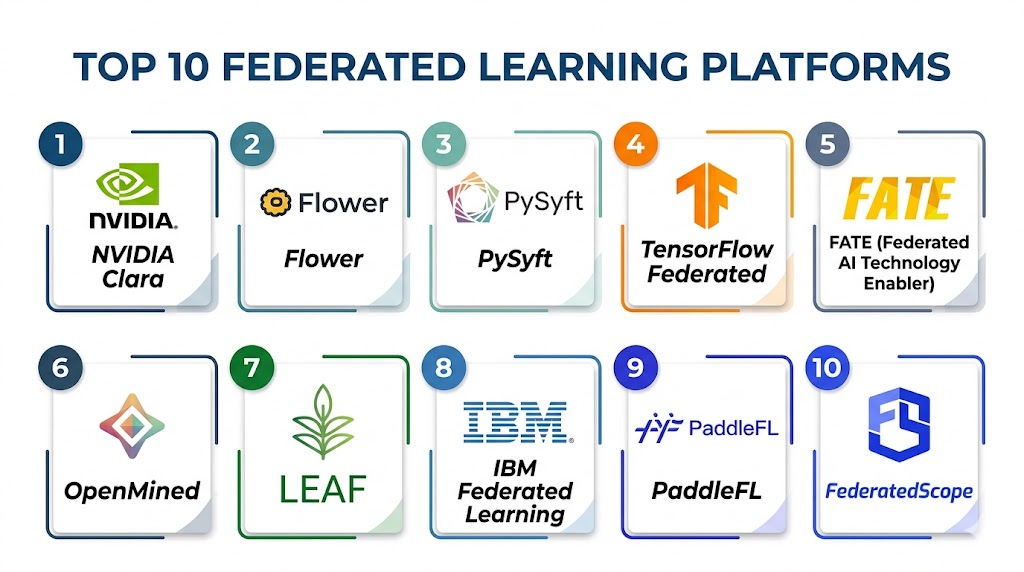
Top 10 Federated Learning Platforms
1- TensorFlow Federated
Short description: TensorFlow Federated is one of the most recognized open-source frameworks for privacy-preserving federated machine learning and distributed AI experimentation.
Key Features
- Federated machine learning workflows
- TensorFlow integration
- Privacy-preserving model training
- Distributed model orchestration
- Federated analytics support
- Secure aggregation capabilities
- Research and experimentation tools
Pros
- Strong TensorFlow ecosystem support
- Large AI research community
- Flexible experimentation environment
Cons
- Requires machine learning expertise
- Complex enterprise deployments
- Limited enterprise governance tooling
Platforms / Deployment
- Linux / Windows / Cloud
Security & Compliance
Supports privacy-preserving AI workflows and secure distributed training environments.
Integrations & Ecosystem
TensorFlow Federated integrates strongly with machine learning and MLOps ecosystems.
- TensorFlow
- Kubernetes
- AI pipelines
- Cloud AI platforms
- Federated analytics systems
Support & Community
Large AI and machine learning community with extensive research adoption.
2- NVIDIA FLARE
Short description: NVIDIA FLARE is a federated learning SDK designed for scalable enterprise AI collaboration across distributed environments and edge systems.
Key Features
- Federated AI orchestration
- GPU acceleration support
- Enterprise AI workflows
- Secure model aggregation
- Distributed training management
- Edge AI support
- Privacy-preserving collaboration
Pros
- Strong GPU optimization
- Enterprise AI scalability
- Good edge computing support
Cons
- NVIDIA ecosystem dependency
- Requires advanced AI expertise
- Complex infrastructure setup
Platforms / Deployment
- Linux / Cloud / Hybrid
Security & Compliance
Supports encrypted model exchange, secure aggregation, and privacy-preserving AI workflows.
Integrations & Ecosystem
NVIDIA FLARE integrates with enterprise AI and accelerated computing environments.
- NVIDIA AI Enterprise
- Kubernetes
- PyTorch
- TensorFlow
- Edge AI infrastructure
Support & Community
Strong enterprise support and active AI ecosystem participation.
3- OpenFL
Short description: OpenFL is an open-source federated learning framework originally developed for secure collaborative AI and privacy-preserving analytics environments.
Key Features
- Secure federated AI training
- Distributed model orchestration
- Privacy-preserving workflows
- Flexible deployment support
- Multi-party collaboration
- Open-source framework
- Secure aggregation support
Pros
- Open ecosystem flexibility
- Strong collaborative AI support
- Multi-environment deployment compatibility
Cons
- Requires infrastructure expertise
- Smaller enterprise ecosystem
- Advanced deployment complexity
Platforms / Deployment
- Linux / Cloud / Hybrid
Security & Compliance
Supports encrypted communication, secure aggregation, and privacy-preserving AI protections.
Integrations & Ecosystem
OpenFL integrates with enterprise AI and distributed analytics systems.
- Kubernetes
- AI pipelines
- Cloud infrastructure
- Secure analytics systems
- Research environments
Support & Community
Growing open-source community focused on collaborative AI systems.
4- Flower
Short description: Flower is a flexible federated learning framework designed for scalable AI experimentation and distributed machine learning across multiple environments.
Key Features
- Framework-agnostic architecture
- Distributed model orchestration
- Federated analytics support
- Edge and mobile compatibility
- Scalable AI collaboration
- Flexible API ecosystem
- Cloud-native deployment support
Pros
- Strong framework flexibility
- Good developer usability
- Broad AI compatibility
Cons
- Smaller enterprise governance tooling
- Requires distributed AI expertise
- Advanced orchestration may be complex
Platforms / Deployment
- Windows / Linux / macOS / Cloud
Security & Compliance
Supports secure federated communication and distributed AI privacy protections.
Integrations & Ecosystem
Flower integrates with modern AI development ecosystems.
- PyTorch
- TensorFlow
- Kubernetes
- Cloud infrastructure
- Mobile AI environments
Support & Community
Rapidly growing open-source AI and federated learning community.
5- IBM Federated Learning
Short description: IBM Federated Learning provides enterprise-grade federated AI capabilities focused on regulated industries and privacy-sensitive machine learning workflows.
Key Features
- Enterprise federated AI orchestration
- Privacy-preserving machine learning
- Secure model aggregation
- Governance and monitoring tools
- Multi-party AI collaboration
- Compliance-focused architecture
- Hybrid cloud deployment support
Pros
- Strong enterprise governance capabilities
- Regulated industry focus
- Good hybrid deployment flexibility
Cons
- Enterprise-oriented complexity
- Higher implementation costs
- Smaller open-source ecosystem
Platforms / Deployment
- Cloud / Hybrid
Security & Compliance
Supports governance controls, encrypted communication, secure aggregation, and enterprise AI protections.
Integrations & Ecosystem
IBM Federated Learning integrates with enterprise analytics and AI environments.
- IBM Watson
- Red Hat OpenShift
- Kubernetes
- Enterprise AI pipelines
- Hybrid cloud systems
Support & Community
Strong enterprise onboarding and implementation support.
6- FedML
Short description: FedML is an open federated learning platform focused on scalable distributed machine learning and collaborative AI infrastructure.
Key Features
- Distributed AI orchestration
- Federated analytics support
- Edge AI compatibility
- Multi-cloud deployment support
- AI experimentation tools
- MLOps integration
- Privacy-preserving AI workflows
Pros
- Strong research ecosystem
- Flexible deployment architecture
- Good edge AI compatibility
Cons
- Requires AI engineering expertise
- Limited enterprise abstraction layers
- Smaller governance ecosystem
Platforms / Deployment
- Linux / Cloud / Hybrid
Security & Compliance
Supports secure distributed AI communication and federated privacy protections.
Integrations & Ecosystem
FedML integrates with cloud-native AI and edge computing systems.
- Kubernetes
- PyTorch
- TensorFlow
- Cloud AI platforms
- Edge AI infrastructure
Support & Community
Growing federated AI and distributed machine learning community.
7- Clara Train
Short description: Clara Train is NVIDIA’s healthcare-focused federated learning platform designed for medical imaging and collaborative healthcare AI.
Key Features
- Healthcare federated learning
- Medical imaging AI workflows
- GPU-accelerated AI training
- Privacy-preserving healthcare collaboration
- Secure model aggregation
- Enterprise healthcare integration
- Distributed clinical AI support
Pros
- Strong healthcare specialization
- GPU optimization
- Good medical imaging support
Cons
- Healthcare-focused deployment scope
- NVIDIA ecosystem dependency
- Specialized implementation requirements
Platforms / Deployment
- Linux / Cloud / Hybrid
Security & Compliance
Supports secure healthcare AI collaboration and privacy-preserving clinical analytics.
Integrations & Ecosystem
Clara Train integrates with healthcare AI and imaging ecosystems.
- NVIDIA AI systems
- Medical imaging platforms
- Kubernetes
- AI healthcare pipelines
- Enterprise healthcare infrastructure
Support & Community
Strong healthcare AI support ecosystem and enterprise onboarding.
8- FATE
Short description: FATE is an open-source federated AI framework designed for secure multi-party machine learning and industrial-scale collaborative AI environments.
Key Features
- Secure multi-party learning
- Federated AI workflows
- Privacy-preserving analytics
- Distributed AI orchestration
- Cross-party collaboration
- Enterprise deployment flexibility
- Federated model lifecycle management
Pros
- Strong industrial AI capabilities
- Good collaborative learning support
- Broad federated AI features
Cons
- Complex deployment architecture
- Requires engineering expertise
- Limited beginner accessibility
Platforms / Deployment
- Linux / Cloud / Hybrid
Security & Compliance
Supports encrypted communication, federated privacy protections, and secure AI collaboration.
Integrations & Ecosystem
FATE integrates with enterprise AI and distributed analytics systems.
- Kubernetes
- AI platforms
- Big data infrastructure
- Cloud environments
- Secure analytics systems
Support & Community
Strong open-source ecosystem with enterprise AI collaboration focus.
9- Substra
Short description: Substra is a federated learning platform focused on collaborative machine learning and secure AI experimentation across distributed organizations.
Key Features
- Federated machine learning orchestration
- Collaborative AI experimentation
- Secure distributed workflows
- Privacy-preserving analytics
- Enterprise AI governance
- Flexible deployment architecture
- Secure model lifecycle controls
Pros
- Strong collaboration capabilities
- Good enterprise flexibility
- Privacy-focused architecture
Cons
- Smaller ecosystem adoption
- Requires distributed AI expertise
- Limited mainstream visibility
Platforms / Deployment
- Cloud / Hybrid
Security & Compliance
Supports secure distributed AI collaboration and privacy-focused machine learning protections.
Integrations & Ecosystem
Substra integrates with AI research and enterprise analytics systems.
- Kubernetes
- AI frameworks
- Cloud infrastructure
- Research environments
- Enterprise analytics systems
Support & Community
Growing community focused on collaborative privacy-preserving AI.
10- Owkin Connect
Short description: Owkin Connect is a federated learning platform focused on healthcare AI collaboration and privacy-preserving medical research.
Key Features
- Healthcare federated AI
- Secure clinical collaboration
- Distributed model training
- Privacy-preserving medical analytics
- Research-oriented AI workflows
- Federated healthcare infrastructure
- Secure data collaboration
Pros
- Strong healthcare AI specialization
- Good clinical collaboration capabilities
- Privacy-focused architecture
Cons
- Healthcare-specific orientation
- Smaller general-purpose ecosystem
- Specialized deployment requirements
Platforms / Deployment
- Cloud / Hybrid
Security & Compliance
Supports secure healthcare AI collaboration and privacy-preserving analytics protections.
Integrations & Ecosystem
Owkin Connect integrates with healthcare AI and clinical analytics systems.
- Healthcare AI pipelines
- Research infrastructure
- Cloud analytics systems
- Clinical collaboration environments
- Secure medical analytics platforms
Support & Community
Strong healthcare research ecosystem and collaborative AI support capabilities.
Comparison Table
| Tool Name | Best For | Platform(s) Supported | Deployment | Standout Feature | Public Rating |
|---|---|---|---|---|---|
| TensorFlow Federated | Research AI workflows | Windows / Linux | Hybrid | TensorFlow federated training | N/A |
| NVIDIA FLARE | Enterprise GPU AI | Linux / Cloud | Hybrid | GPU-accelerated federated AI | N/A |
| OpenFL | Collaborative AI | Linux / Cloud | Hybrid | Open federated ecosystem | N/A |
| Flower | Flexible AI experimentation | Windows / Linux / macOS | Hybrid | Framework-agnostic AI support | N/A |
| IBM Federated Learning | Regulated enterprise AI | Cloud / Hybrid | Hybrid | Enterprise governance | N/A |
| FedML | Distributed AI orchestration | Linux / Cloud | Hybrid | Edge AI compatibility | N/A |
| Clara Train | Healthcare AI | Linux / Cloud | Hybrid | Medical imaging federated learning | N/A |
| FATE | Industrial AI collaboration | Linux / Cloud | Hybrid | Multi-party machine learning | N/A |
| Substra | Secure collaborative AI | Cloud / Hybrid | Hybrid | Distributed AI governance | N/A |
| Owkin Connect | Clinical AI research | Cloud / Hybrid | Hybrid | Healthcare collaboration AI | N/A |
Evaluation & Scoring of Federated Learning Platforms
| Tool Name | Core 25% | Ease 15% | Integrations 15% | Security 10% | Performance 10% | Support 10% | Value 15% | Weighted Total |
|---|---|---|---|---|---|---|---|---|
| TensorFlow Federated | 9 | 7 | 9 | 8 | 8 | 8 | 8 | 8.2 |
| NVIDIA FLARE | 9 | 7 | 8 | 9 | 9 | 8 | 7 | 8.3 |
| OpenFL | 8 | 7 | 7 | 8 | 7 | 7 | 8 | 7.6 |
| Flower | 8 | 8 | 8 | 8 | 7 | 8 | 8 | 7.9 |
| IBM Federated Learning | 9 | 7 | 8 | 9 | 8 | 8 | 7 | 8.1 |
| FedML | 8 | 7 | 8 | 8 | 8 | 7 | 8 | 7.8 |
| Clara Train | 8 | 7 | 7 | 9 | 8 | 8 | 7 | 7.8 |
| FATE | 9 | 6 | 8 | 9 | 8 | 7 | 7 | 7.9 |
| Substra | 8 | 7 | 7 | 8 | 7 | 7 | 7 | 7.4 |
| Owkin Connect | 8 | 7 | 7 | 9 | 7 | 8 | 7 | 7.6 |
These scores are comparative evaluations designed to help organizations understand relative strengths across federated learning ecosystems. Some platforms focus heavily on healthcare and regulated industries, while others prioritize open experimentation or scalable enterprise AI collaboration. Organizations should align platform selection with AI maturity, privacy requirements, and operational complexity needs.
Which Federated Learning Platform Is Right for You?
Solo / Freelancer
Independent AI researchers and developers may benefit from Flower or TensorFlow Federated because of their strong open-source ecosystems and flexible experimentation environments.
SMB
Small and medium-sized organizations exploring privacy-preserving AI may find Flower or FedML easier to adopt for distributed machine learning experimentation.
Mid-Market
Mid-market organizations requiring stronger governance and scalable orchestration should evaluate OpenFL, IBM Federated Learning, or FATE.
Enterprise
Large enterprises handling regulated AI workloads should prioritize NVIDIA FLARE, IBM Federated Learning, Clara Train, or FATE depending on industry requirements and infrastructure investments.
Budget vs Premium
Open-source federated learning frameworks reduce licensing costs but often require advanced engineering expertise. Enterprise-oriented platforms generally simplify governance and orchestration.
Feature Depth vs Ease of Use
Research-oriented platforms provide extensive customization flexibility, while enterprise AI solutions focus more on operational scalability and governance automation.
Integrations & Scalability
Organizations with large AI infrastructure, Kubernetes deployments, or distributed edge environments should prioritize platforms with mature orchestration ecosystems and cloud-native integrations.
Security & Compliance Needs
Highly regulated industries should focus on secure aggregation, encrypted communication, auditability, and governance capabilities before selecting a federated learning platform.
Frequently Asked Questions FAQs
1- What is federated learning?
Federated learning is a machine learning approach where models are trained across distributed systems without transferring raw data to a centralized environment.
2- Why is federated learning important?
Federated learning helps organizations improve AI capabilities while reducing privacy, compliance, and data residency risks.
3- Which industries use federated learning the most?
Healthcare, financial services, telecommunications, manufacturing, and AI research organizations are among the largest adopters.
4- Does federated learning improve data privacy?
Yes. Since raw data remains local, federated learning reduces exposure risks associated with centralized data collection.
5- Can federated learning work with edge devices?
Yes. Many federated learning platforms support mobile devices, IoT systems, and edge computing environments.
6- What is secure aggregation?
Secure aggregation protects model updates during federated training so that participating systems cannot view each other’s sensitive information.
7- Is federated learning difficult to implement?
Implementation complexity depends on infrastructure scale, AI maturity, and governance requirements. Distributed orchestration can require advanced engineering expertise.
8- Can federated learning work with confidential computing and differential privacy?
Yes. Many organizations combine federated learning with differential privacy and confidential computing for stronger privacy protections.
9- Are federated learning platforms open source?
Several leading frameworks including TensorFlow Federated, Flower, OpenFL, FedML, and FATE are open source.
10- What should organizations evaluate before choosing a platform?
Organizations should evaluate scalability, AI framework compatibility, orchestration capabilities, governance controls, deployment flexibility, and security architecture.
Conclusion
Federated Learning Platforms are becoming critical technologies for organizations pursuing privacy-preserving AI, distributed analytics, and collaborative machine learning strategies. As enterprises increasingly process sensitive healthcare, financial, operational, and edge-generated data, centralized AI training approaches often create unnecessary privacy and compliance risks. Platforms such as TensorFlow Federated, NVIDIA FLARE, IBM Federated Learning, and FATE provide strong foundations for scalable distributed AI orchestration, while solutions like Clara Train and Owkin Connect specialize in healthcare-focused collaborative machine learning environments. The ideal platform depends heavily on organizational AI maturity, privacy requirements, infrastructure strategy, and governance needs. Research-oriented teams may prioritize flexibility and experimentation capabilities, while enterprises often focus more on scalability, orchestration automation, and operational visibility. Before selecting a platform, organizations should benchmark distributed training performance, validate integrations, assess governance requirements, and carefully evaluate long-term scalability and operational complexity for privacy-preserving AI deployments.