Introduction
PII Detection and Redaction Tools help organizations identify, classify, mask, remove, tokenize, or anonymize personally identifiable information across documents, databases, logs, emails, images, forms, support tickets, chat transcripts, AI prompts, and business workflows. PII may include names, email addresses, phone numbers, government IDs, financial details, health identifiers, addresses, account numbers, and other sensitive personal data.
These tools matter because organizations are handling more sensitive data across cloud apps, AI systems, customer platforms, analytics pipelines, and internal collaboration tools. A single exposed file, prompt, log entry, or support ticket can create privacy, compliance, legal, and reputational risk. PII detection and redaction tools help teams reduce exposure, enforce data minimization, protect users, and prepare data safely for analytics, AI training, support operations, and compliance review.
Real-world use cases include:
- Redacting PII from legal and compliance documents
- Detecting personal data inside logs and application telemetry
- Removing sensitive information before AI model training
- Masking customer data in support tickets and chat transcripts
- Scanning cloud storage, SaaS apps, and databases for exposed PII
Buyers evaluating PII Detection and Redaction Tools should consider:
- PII detection accuracy
- Redaction, masking, tokenization, and anonymization options
- Support for structured and unstructured data
- Document, image, audio, and database coverage
- Data loss prevention integrations
- AI and LLM prompt protection
- Security and access controls
- Compliance reporting and audit logs
- API and workflow automation
- Deployment flexibility and scalability
Best for: Security teams, privacy teams, compliance teams, legal teams, data governance teams, AI engineering teams, DevOps teams, healthcare organizations, financial services firms, SaaS companies, and enterprises handling sensitive customer or employee data.
Not ideal for: Very small teams with minimal sensitive data, organizations that only need basic manual document editing, or teams without formal privacy, compliance, data governance, or security workflows.
Key Trends in PII Detection and Redaction Tools
- AI usage is increasing demand for real-time PII detection before prompts, files, or logs are sent to AI systems.
- Data loss prevention and PII redaction are becoming more connected across SaaS, cloud, endpoint, and browser workflows.
- Unstructured data redaction is becoming more important as organizations process PDFs, images, scans, emails, tickets, and transcripts.
- Developer teams are using PII detection APIs inside applications, data pipelines, and observability systems.
- Privacy teams are prioritizing automated discovery of sensitive data across cloud storage and databases.
- Redaction tools are expanding beyond text to support images, screenshots, forms, audio transcripts, and scanned documents.
- Synthetic data and anonymized datasets are becoming more important for analytics and AI development.
- Policy-based redaction is replacing one-size-fits-all masking because different roles need different data visibility.
- Audit trails and evidence collection are becoming essential for privacy and compliance programs.
- Enterprises are combining PII detection with data classification, DSPM, DLP, SIEM, and AI governance tools.
How We Selected These Tools
The tools in this list were selected based on PII detection depth, redaction flexibility, enterprise adoption, security controls, integration ecosystem, and practical fit across privacy, compliance, AI, and data protection workflows.
Selection criteria included:
- PII and sensitive data detection accuracy
- Structured and unstructured data coverage
- Redaction, masking, anonymization, and tokenization support
- API, SDK, and automation flexibility
- Cloud, SaaS, database, document, and log integrations
- Security and access control features
- Compliance reporting and audit workflows
- AI and LLM data protection support
- Scalability for enterprise environments
- Practical usability for security, privacy, legal, and engineering teams
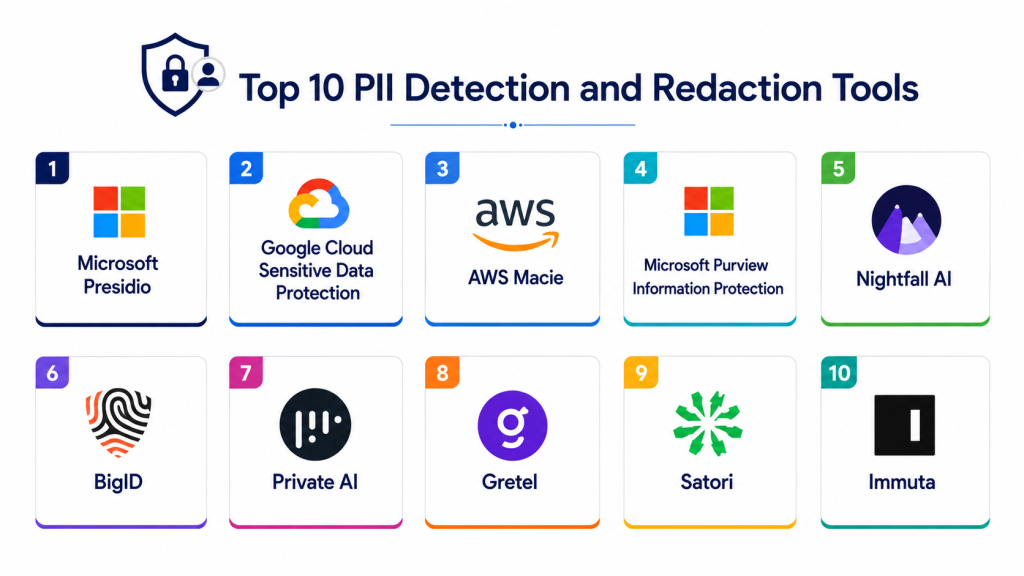
Top 10 PII Detection and Redaction Tools
1- Microsoft Purview
Short description: Microsoft Purview is a data governance, compliance, information protection, and data loss prevention platform that helps organizations discover, classify, label, protect, and manage sensitive data. It is especially useful for Microsoft-centric enterprises that need PII detection across productivity, cloud, data, and compliance workflows.
Key Features
- Sensitive data discovery
- Data classification and labeling
- Data loss prevention policies
- Compliance and audit workflows
- Information protection controls
- Insider risk and data governance support
- Microsoft ecosystem integration
Pros
- Strong fit for Microsoft-based enterprises
- Good compliance and governance capabilities
- Useful for detecting and protecting PII across business workflows
Cons
- Best value comes in Microsoft-centric environments
- Advanced configuration can require expertise
- Complex organizations need careful policy tuning
Platforms / Deployment
- Web / Microsoft Cloud / Enterprise environments
- Cloud / Hybrid options vary
Security & Compliance
- RBAC
- Microsoft Entra ID integration
- Encryption
- Audit logging
- Data loss prevention
- Compliance controls
Integrations & Ecosystem
Microsoft Purview integrates deeply with Microsoft security, compliance, productivity, and data platforms. It is practical for organizations that want PII discovery and redaction-style controls as part of a broader governance program.
- Microsoft 365
- Microsoft Defender
- Microsoft Entra ID
- Microsoft Fabric
- Data governance workflows
- Compliance reporting systems
Support & Community
Microsoft provides enterprise support, documentation, partner services, training resources, and a large ecosystem of security and compliance professionals.
2- Google Cloud Sensitive Data Protection
Short description: Google Cloud Sensitive Data Protection helps organizations discover, classify, inspect, de-identify, tokenize, and protect sensitive data across cloud storage, databases, data warehouses, and application workflows. It is strong for teams building privacy-aware cloud and AI pipelines.
Key Features
- PII inspection
- Data de-identification
- Tokenization and masking
- Structured and unstructured data scanning
- Cloud storage inspection
- API-based sensitive data detection
- Risk analysis workflows
Pros
- Strong cloud-native PII detection
- Good de-identification and tokenization support
- Useful for data engineering and AI pipelines
Cons
- Best suited for Google Cloud environments
- Requires technical setup for complex workflows
- Broader enterprise governance may need additional tools
Platforms / Deployment
- Google Cloud / APIs / Data pipelines
- Cloud
Security & Compliance
- IAM integration
- Encryption
- Audit logging
- Access controls
- Cloud governance controls
- Compliance support depends on configuration
Integrations & Ecosystem
Google Cloud Sensitive Data Protection integrates with cloud data, analytics, AI, and application workflows.
- Cloud Storage
- BigQuery
- Pub/Sub
- Dataflow
- Vertex AI workflows
- Custom applications
Support & Community
Google Cloud provides documentation, enterprise support, technical resources, and cloud security guidance for privacy and data protection teams.
3- AWS Macie
Short description: AWS Macie is a cloud-native data security service that uses machine learning and pattern matching to discover and classify sensitive data such as PII in Amazon S3. It is useful for AWS teams that need automated sensitive data discovery and exposure monitoring.
Key Features
- Sensitive data discovery
- PII classification
- S3 bucket scanning
- Data exposure alerts
- Security findings
- Automated discovery workflows
- AWS security integration
Pros
- Strong AWS-native sensitive data discovery
- Useful for cloud storage privacy monitoring
- Good integration with AWS security workflows
Cons
- Primarily focused on Amazon S3 data
- Less suitable for multi-cloud use by itself
- Redaction workflows require additional services or architecture
Platforms / Deployment
- AWS Cloud / Amazon S3 environments
- Cloud
Security & Compliance
- IAM integration
- Encryption
- Audit logging through AWS services
- Security findings
- Access controls
- Compliance support depends on AWS configuration
Integrations & Ecosystem
AWS Macie integrates with AWS security, storage, and monitoring workflows.
- Amazon S3
- AWS Security Hub
- AWS IAM
- CloudWatch
- EventBridge
- Security operations workflows
Support & Community
AWS provides documentation, enterprise support plans, cloud training resources, and a large security and cloud operations ecosystem.
4- Nightfall AI
Short description: Nightfall AI is a data loss prevention platform focused on discovering and protecting sensitive data across SaaS apps, cloud workflows, developer environments, and AI-related usage. It helps teams detect PII, secrets, credentials, financial data, and regulated information.
Key Features
- PII detection
- Data loss prevention
- SaaS data protection
- Secrets detection
- API-based scanning
- Policy-based alerts and actions
- Developer workflow protection
Pros
- Strong sensitive data detection capabilities
- Useful for SaaS and developer workflows
- Good fit for security and compliance teams
Cons
- Not solely focused on document redaction
- Advanced AI workflow protection may require configuration
- Best value comes with broader DLP needs
Platforms / Deployment
- Web / APIs / SaaS apps / Developer workflows
- Cloud
Security & Compliance
- RBAC
- Encryption
- Audit logging
- DLP controls
- Access controls
- Compliance support varies by configuration
Integrations & Ecosystem
Nightfall integrates with SaaS apps, developer tools, and security workflows where sensitive data must be detected and controlled.
- Slack
- GitHub
- Jira
- APIs
- Cloud workflows
- Security operations processes
Support & Community
Nightfall provides product documentation, support resources, security guidance, and customer success options for data protection teams.
5- BigID
Short description: BigID is a data discovery, privacy, security, and governance platform that helps organizations find, classify, map, and manage sensitive data across cloud, on-premises, structured, and unstructured environments. It is strong for enterprise privacy and data governance programs.
Key Features
- Sensitive data discovery
- PII classification
- Data mapping
- Privacy workflow automation
- Risk scoring
- Data inventory and cataloging
- Policy and compliance support
Pros
- Strong enterprise data discovery coverage
- Good privacy and governance workflows
- Useful for large distributed data environments
Cons
- Enterprise deployment requires planning
- May be more than small teams need
- Redaction workflows may depend on integrations
Platforms / Deployment
- Web / Enterprise data environments
- Cloud / Self-hosted / Hybrid options vary
Security & Compliance
- RBAC
- Encryption
- Audit logging
- Identity integration
- Governance controls
- Compliance workflow support
Integrations & Ecosystem
BigID integrates with enterprise data sources, privacy workflows, security tools, and governance programs.
- Databases
- Cloud storage
- SaaS platforms
- Data lakes
- Data warehouses
- Governance and privacy systems
Support & Community
BigID provides enterprise support, implementation guidance, documentation, and privacy and data governance expertise.
6- OneTrust
Short description: OneTrust provides privacy, data governance, consent, risk, and compliance tools that help organizations manage personal data, privacy requests, data inventories, and regulatory workflows. For PII detection and redaction, it is useful as part of a broader privacy operations program.
Key Features
- Privacy management workflows
- Data discovery and mapping
- PII classification support
- Consent and preference management
- Data subject request workflows
- Risk and compliance reporting
- Governance dashboards
Pros
- Strong privacy operations platform
- Useful for compliance and legal teams
- Good fit for enterprise privacy programs
Cons
- Less developer-focused than API-first tools
- Redaction may require workflow integration
- Enterprise setup can be complex
Platforms / Deployment
- Web / Enterprise governance environments
- Cloud
Security & Compliance
- RBAC
- Encryption
- Audit logging
- Identity integration
- Governance controls
- Compliance workflow support
Integrations & Ecosystem
OneTrust integrates with privacy, compliance, data governance, and enterprise systems.
- Data inventories
- SaaS applications
- Consent systems
- Privacy request workflows
- Governance tools
- Compliance reporting systems
Support & Community
OneTrust provides enterprise support, implementation services, documentation, training, and privacy program guidance.
7- Private AI
Short description: Private AI provides PII detection, redaction, anonymization, and de-identification tools for text, documents, and AI workflows. It is especially useful for teams that need to remove sensitive data before sending content to AI models, analytics systems, or third-party processors.
Key Features
- PII detection
- Text redaction
- Data anonymization
- De-identification workflows
- API-based integration
- Multilingual sensitive data detection
- AI prompt protection patterns
Pros
- Strong focus on AI and privacy workflows
- Useful for redacting data before LLM processing
- Developer-friendly API patterns
Cons
- Broader governance may require additional tools
- Enterprise controls vary by deployment
- Complex document workflows may require integration planning
Platforms / Deployment
- APIs / Developer environments / Enterprise workflows
- Cloud / Self-hosted / Hybrid options vary
Security & Compliance
- Access controls
- Encryption support
- Deployment options vary
- Audit and governance features vary by plan
Integrations & Ecosystem
Private AI integrates with applications, AI systems, and data workflows that need privacy-preserving processing.
- LLM applications
- Chatbots
- Data pipelines
- APIs
- Document workflows
- Customer support systems
Support & Community
Private AI provides documentation, developer resources, enterprise support options, and guidance for privacy-preserving AI workflows.
8- Gretel
Short description: Gretel provides synthetic data, data anonymization, transformation, and privacy engineering tools. It helps teams detect sensitive data, create privacy-preserving datasets, and prepare safer data for analytics, testing, and AI development.
Key Features
- PII detection
- Data anonymization
- Synthetic data generation
- Data transformation
- Privacy-preserving workflows
- API and SDK support
- Developer-friendly data pipelines
Pros
- Strong synthetic data and anonymization capabilities
- Useful for AI and testing data workflows
- Good developer experience
Cons
- Not primarily a document redaction tool
- Requires technical setup for advanced pipelines
- Governance workflows may need additional systems
Platforms / Deployment
- APIs / Developer environments / Data pipelines
- Cloud / Hybrid options vary
Security & Compliance
- Access controls
- Encryption support
- Deployment controls vary
- Audit and enterprise governance features vary by plan
Integrations & Ecosystem
Gretel integrates with data engineering, AI, analytics, and testing workflows.
- Databases
- Data warehouses
- Python workflows
- APIs
- AI pipelines
- Synthetic data workflows
Support & Community
Gretel provides developer documentation, support resources, technical examples, and guidance for privacy-preserving data engineering.
9- Everlaw
Short description: Everlaw is a legal technology platform used for eDiscovery, document review, investigations, and litigation workflows. It includes capabilities that help legal teams review, search, organize, and redact sensitive information from large document collections.
Key Features
- Legal document review
- Redaction workflows
- Search and filtering
- Collaboration tools
- Document production support
- Review management
- Audit and case workflows
Pros
- Strong fit for legal redaction workflows
- Useful for large document review projects
- Good collaboration for legal teams
Cons
- More focused on legal and eDiscovery than general PII automation
- Not ideal for developer API-first workflows
- Best value comes in legal operations and investigations
Platforms / Deployment
- Web / Legal operations environments
- Cloud
Security & Compliance
- RBAC
- Encryption
- Audit logging
- Access controls
- Legal workflow security features
- Compliance details vary by plan
Integrations & Ecosystem
Everlaw integrates with legal review, eDiscovery, and investigation workflows.
- Document repositories
- Legal review workflows
- Case management processes
- Investigation teams
- Production workflows
- Collaboration systems
Support & Community
Everlaw provides legal technology support, onboarding, documentation, customer success, and litigation workflow expertise.
10- Adobe Acrobat Pro
Short description: Adobe Acrobat Pro is widely used for PDF editing, document management, and manual redaction workflows. It is useful for teams that need to redact PII from PDFs, forms, legal documents, contracts, reports, and records before sharing or publishing.
Key Features
- PDF redaction
- Search and remove text
- Document editing
- OCR support
- Form handling
- Comment and review workflows
- PDF security controls
Pros
- Familiar document redaction interface
- Strong PDF workflow support
- Useful for legal, HR, finance, and compliance teams
Cons
- Not designed for large automated data discovery
- Manual workflows can be slow at scale
- Enterprise-wide PII detection requires additional tools
Platforms / Deployment
- Windows / macOS / Web
- Cloud / Desktop
Security & Compliance
- Password protection
- PDF permissions
- Encryption options
- Access controls vary by plan
- Enterprise security depends on Adobe environment configuration
Integrations & Ecosystem
Adobe Acrobat Pro fits into document-heavy workflows where teams need direct PDF redaction and secure document sharing.
- PDF workflows
- Document management systems
- Legal review processes
- Cloud storage
- Collaboration workflows
- Forms and records management
Support & Community
Adobe provides documentation, enterprise support options, training resources, and a large user community across business and legal teams.
Comparison Table
| Tool Name | Best For | Platforms Supported | Deployment | Standout Feature | Public Rating |
|---|---|---|---|---|---|
| Microsoft Purview | Enterprise Microsoft data protection | Microsoft Cloud / Web | Cloud / Hybrid options vary | Data governance and DLP controls | N/A |
| Google Cloud Sensitive Data Protection | Cloud-native PII inspection and de-identification | Google Cloud / APIs | Cloud | Tokenization and de-identification | N/A |
| AWS Macie | AWS S3 sensitive data discovery | AWS Cloud / S3 | Cloud | Automated S3 PII discovery | N/A |
| Nightfall AI | SaaS and developer DLP | Web / APIs / SaaS apps | Cloud | Sensitive data detection across workflows | N/A |
| BigID | Enterprise privacy data discovery | Web / Enterprise data environments | Cloud / Self-hosted / Hybrid options vary | Data discovery and privacy intelligence | N/A |
| OneTrust | Privacy operations and compliance | Web / Governance environments | Cloud | Privacy workflow automation | N/A |
| Private AI | AI-ready PII redaction | APIs / Developer environments | Cloud / Self-hosted / Hybrid options vary | PII redaction for AI workflows | N/A |
| Gretel | Synthetic data and anonymization | APIs / Data pipelines | Cloud / Hybrid options vary | Privacy-preserving synthetic data | N/A |
| Everlaw | Legal document redaction | Web / Legal workflows | Cloud | eDiscovery redaction workflows | N/A |
| Adobe Acrobat Pro | PDF redaction | Windows / macOS / Web | Cloud / Desktop | Manual PDF redaction | N/A |
Evaluation & Scoring of PII Detection and Redaction Tools
| Tool Name | Core 25% | Ease 15% | Integrations 15% | Security 10% | Performance 10% | Support 10% | Value 15% | Weighted Total |
|---|---|---|---|---|---|---|---|---|
| Microsoft Purview | 9.0 | 8.0 | 9.2 | 9.3 | 8.7 | 8.9 | 8.2 | 8.78 |
| Google Cloud Sensitive Data Protection | 9.1 | 8.1 | 9.0 | 9.1 | 8.9 | 8.7 | 8.3 | 8.80 |
| AWS Macie | 8.5 | 8.4 | 8.8 | 9.1 | 8.7 | 8.8 | 8.2 | 8.63 |
| Nightfall AI | 8.8 | 8.3 | 8.7 | 9.0 | 8.6 | 8.5 | 8.1 | 8.59 |
| BigID | 9.2 | 7.7 | 9.0 | 9.1 | 8.7 | 8.7 | 7.8 | 8.63 |
| OneTrust | 8.6 | 8.0 | 8.6 | 8.9 | 8.4 | 8.7 | 7.9 | 8.42 |
| Private AI | 8.9 | 8.5 | 8.6 | 8.7 | 8.7 | 8.4 | 8.4 | 8.66 |
| Gretel | 8.7 | 8.2 | 8.8 | 8.7 | 8.7 | 8.4 | 8.6 | 8.60 |
| Everlaw | 8.1 | 8.4 | 8.0 | 8.8 | 8.3 | 8.7 | 7.8 | 8.26 |
| Adobe Acrobat Pro | 7.7 | 9.0 | 7.8 | 8.2 | 8.0 | 8.5 | 8.5 | 8.19 |
These scores are comparative and intended to help buyers evaluate practical fit rather than identify one universal winner. Cloud-native tools are strong for automated inspection and de-identification, while enterprise governance platforms are better for data discovery and compliance workflows. Document-focused tools are useful for legal and manual redaction, while API-first tools are stronger for AI, application, and data pipeline integration.
Which PII Detection and Redaction Tool Is Right for You?
Solo / Freelancer
Solo consultants, small legal teams, and independent professionals usually need simple document-level redaction rather than enterprise-wide data discovery. Adobe Acrobat Pro is practical for PDF redaction, while developer-focused users may prefer API-first tools like Private AI for application workflows.
SMB
SMBs often need sensitive data detection across SaaS tools, cloud storage, documents, and support workflows without building a complex governance program. Nightfall AI, Private AI, Google Cloud Sensitive Data Protection, and AWS Macie are strong choices depending on cloud and application architecture.
Mid-Market
Mid-sized organizations usually need broader visibility across cloud storage, databases, SaaS apps, and AI workflows. Microsoft Purview, BigID, Nightfall AI, Google Cloud Sensitive Data Protection, and Gretel are strong options for scaling privacy and data protection programs.
Enterprise
Large enterprises typically need data discovery, classification, DLP, privacy workflows, audit trails, governance reporting, and integration with identity and security systems. Microsoft Purview, BigID, OneTrust, Google Cloud Sensitive Data Protection, AWS Macie, and Nightfall AI are strong enterprise-focused options.
Budget vs Premium
Manual tools like Adobe Acrobat Pro are cost-effective for small document workflows but do not scale well for automated enterprise detection. Cloud-native and API-first tools offer scalable automation, while enterprise governance platforms provide deeper reporting, workflow controls, and compliance support.
Feature Depth vs Ease of Use
Adobe Acrobat Pro and Everlaw are easier for document-focused teams. Google Cloud Sensitive Data Protection and Private AI are stronger for technical redaction workflows. BigID and OneTrust provide deeper privacy governance, while Microsoft Purview is strong for Microsoft-based data protection.
Integrations & Scalability
Teams should prioritize integrations with cloud storage, data warehouses, databases, SaaS apps, support platforms, AI gateways, LLM applications, SIEM tools, DLP platforms, and identity providers. PII redaction works best when embedded into daily workflows rather than handled only manually.
Security & Compliance Needs
Security-focused teams should prioritize RBAC, SSO, encryption, audit logs, access controls, data retention settings, policy enforcement, redaction evidence, and repeatable compliance reporting. For AI workflows, teams should also validate that PII is removed before prompts, embeddings, logs, or training data are processed.
Frequently Asked Questions
1. What is a PII Detection and Redaction Tool?
A PII Detection and Redaction Tool identifies personal information and removes, masks, tokenizes, anonymizes, or blocks it from being exposed. It helps protect sensitive data across documents, applications, databases, cloud storage, and AI workflows.
2. What counts as PII?
PII may include names, phone numbers, email addresses, home addresses, government IDs, financial records, health identifiers, account numbers, employee IDs, IP addresses, and other information that can identify a person.
3. Why is PII redaction important?
PII redaction helps reduce privacy risk, prevent accidental disclosure, support compliance, protect customers, and make data safer for sharing, analytics, testing, and AI processing.
4. What is the difference between masking and redaction?
Masking hides part or all of sensitive data, while redaction removes or permanently obscures it from a document or dataset. Tokenization replaces sensitive values with controlled substitutes.
5. Can PII detection tools work with AI applications?
Yes. Many tools can detect or redact PII before prompts, documents, transcripts, logs, or datasets are sent to AI models. This is important for privacy-preserving AI and responsible data use.
6. What are common implementation mistakes?
Common mistakes include relying only on manual redaction, ignoring logs and support tickets, scanning only structured databases, failing to test accuracy, skipping audit trails, and not validating redaction before external sharing.
7. Can these tools redact scanned PDFs and images?
Some tools support OCR-based extraction and redaction, while others focus only on text or structured data. Buyers should test scanned documents, handwriting, image quality, and complex layouts before choosing.
8. What integrations are most important?
Important integrations include cloud storage, databases, SaaS applications, DLP tools, SIEM platforms, document management systems, AI gateways, support tools, and data pipelines.
9. Should teams choose cloud-native or enterprise governance tools?
Cloud-native tools are strong for automated inspection inside a specific cloud. Enterprise governance tools are better when data spans many systems, departments, compliance workflows, and business units.
10. What should buyers evaluate before choosing a tool?
Buyers should evaluate detection accuracy, false positives, redaction quality, supported file types, APIs, automation, audit logs, security controls, compliance workflows, scalability, and fit with existing data governance architecture.
Conclusion
PII Detection and Redaction Tools are essential for organizations that want to protect personal data across documents, cloud storage, SaaS apps, databases, logs, AI workflows, and business operations. The right tool can reduce privacy risk, prevent sensitive data leakage, support compliance, enable safer analytics, and make AI workflows more secure by removing personal information before processing. Microsoft Purview is strong for Microsoft-centered governance and DLP, while Google Cloud Sensitive Data Protection and AWS Macie are strong cloud-native options. Nightfall AI is useful for SaaS and developer data protection, while BigID and OneTrust support broader privacy governance programs. Private AI and Gretel are strong for AI-ready redaction, anonymization, and privacy-preserving data workflows. Everlaw and Adobe Acrobat Pro are practical for legal and document-level redaction. The best choice depends on data sources, file types, automation needs, AI usage, compliance requirements, security architecture, and team maturity. Shortlist two or three tools, test them with real sensitive data samples, measure detection accuracy and false positives, validate redaction quality, review audit logs, and ensure the selected platform fits your long-term privacy and data protection strategy.