Introduction
Prompt Security and Guardrail Tools help organizations protect AI applications, copilots, chatbots, agents, and retrieval systems from unsafe prompts, prompt injection, jailbreaks, sensitive data leakage, toxic outputs, hallucination risks, and policy violations. These tools act as a control layer around large language model applications by checking user inputs, retrieved content, tool calls, model responses, and business rules before AI systems interact with users or enterprise systems.
As organizations deploy AI across customer support, software development, HR, finance, legal, sales, cybersecurity, and internal knowledge workflows, prompt-level security has become essential. A single unsafe prompt or hidden instruction inside a document can cause an AI system to reveal sensitive data, ignore policies, misuse tools, or produce harmful responses.
Real-world use cases include:
- Blocking prompt injection in RAG applications
- Preventing users from entering sensitive data into AI tools
- Detecting jailbreak attempts in chatbots
- Validating AI outputs before showing them to users
- Enforcing topic, safety, and compliance policies in AI agents
Buyers evaluating Prompt Security and Guardrail Tools should consider:
- Prompt injection detection
- Jailbreak protection
- Input and output moderation
- Sensitive data detection and redaction
- RAG and agent guardrails
- Tool call and execution controls
- Policy configuration flexibility
- API and framework integrations
- Logging, monitoring, and audit trails
- Latency, scalability, and deployment options
Best for: AI security teams, LLMOps teams, application security teams, developers, platform engineers, compliance teams, AI governance teams, customer support AI teams, and enterprises deploying AI assistants or agents in production.
Not ideal for: Small experiments with no sensitive data, internal prototypes without user exposure, or teams that have not yet defined AI usage policies, data handling rules, and security review processes.
Key Trends in Prompt Security and Guardrail Tools
- Prompt injection protection is becoming a standard requirement for enterprise AI applications.
- RAG security is growing because retrieved documents can contain hidden malicious instructions.
- AI agents need stronger runtime controls because they can call APIs, tools, databases, and business systems.
- Input and output guardrails are increasingly combined with policy engines and audit logs.
- Sensitive data detection is becoming critical for preventing personal data, secrets, and confidential business information from entering AI prompts.
- AI gateways are emerging as a central layer for controlling model traffic, costs, logs, and policies.
- Developers are adopting guardrails directly inside CI/CD and application testing workflows.
- Runtime enforcement is becoming more important than only static prompt filtering.
- Enterprises are combining prompt security with DLP, CASB, SSE, IAM, and AI governance platforms.
- Multimodal guardrails are becoming more relevant as AI systems process text, images, audio, files, and code.
How We Selected These Tools
The tools in this list were selected based on prompt security depth, guardrail flexibility, enterprise readiness, developer adoption, integration options, AI safety coverage, and practical fit for production AI systems.
Selection criteria included:
- Prompt injection and jailbreak protection
- Input and output scanning capabilities
- Sensitive data detection and redaction
- RAG, chatbot, and AI agent security support
- Policy customization and workflow controls
- Developer API and framework compatibility
- Deployment flexibility across cloud and self-hosted environments
- Logging, monitoring, and audit support
- Enterprise security and governance readiness
- Practical value for LLM applications, copilots, and AI assistants
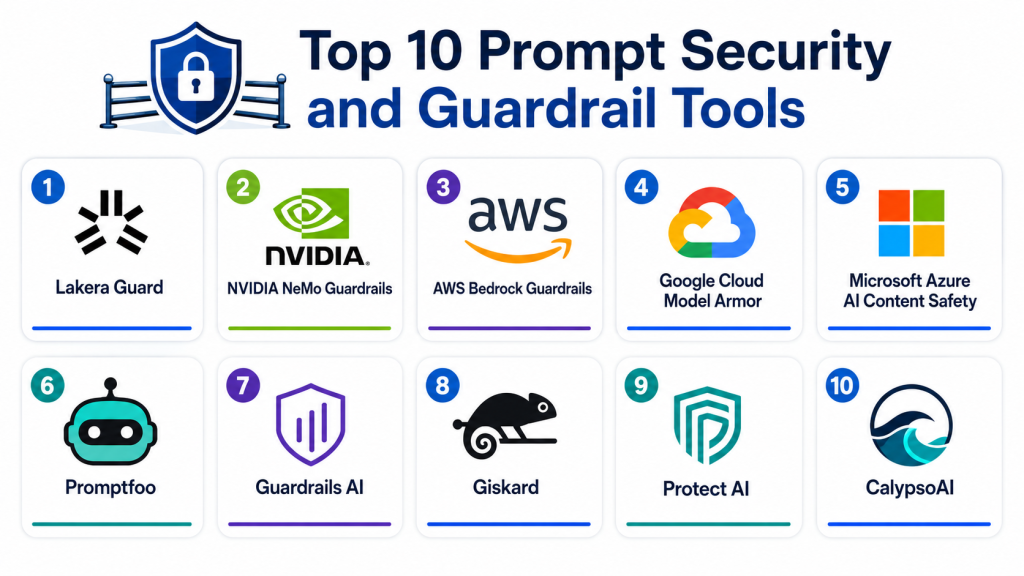
Top 10 Prompt Security and Guardrail Tools
1- Lakera Guard
Short description: Lakera Guard is an AI security platform focused on protecting LLM applications from prompt injection, jailbreaks, sensitive data leakage, malicious inputs, and unsafe outputs. It is designed for organizations deploying customer-facing or internal AI systems that need real-time prompt and response protection.
Key Features
- Prompt injection detection
- Jailbreak protection
- Input and output scanning
- Sensitive data leakage detection
- Policy enforcement
- AI application security controls
- API-based deployment
Pros
- Strong focus on LLM application security
- Useful for production AI apps
- Good fit for prompt injection and jailbreak defense
Cons
- Primarily focused on LLM security use cases
- Enterprise pricing and controls vary by plan
- Complex AI agent workflows may need additional architecture
Platforms / Deployment
- APIs / Web / AI application environments
- Cloud / Hybrid options vary
Security & Compliance
- Access controls
- Encryption support
- Policy controls
- Enterprise security features vary by plan
- Compliance details vary by deployment
Integrations & Ecosystem
Lakera Guard integrates with AI applications, chatbots, RAG systems, and LLM workflows where real-time security checks are needed.
- LLM applications
- Chatbots
- AI agents
- RAG workflows
- APIs
- Enterprise AI systems
Support & Community
Lakera provides documentation, implementation guidance, support options, and AI security expertise for organizations deploying LLM applications.
2- NVIDIA NeMo Guardrails
Short description: NVIDIA NeMo Guardrails is an open-source guardrail framework for building safer and more controllable LLM applications. It helps teams define rules for conversation flow, topic control, input checks, output checks, retrieval grounding, and AI assistant behavior.
Key Features
- Conversational guardrails
- Input and output rails
- Topic control
- RAG grounding support
- Jailbreak prevention patterns
- Custom rule definition
- Integration with AI application frameworks
Pros
- Strong framework for controllable AI assistants
- Useful for RAG and conversational AI workflows
- Open-source flexibility for developers
Cons
- Requires engineering setup
- Not a complete enterprise governance platform by itself
- Policy design and testing require expertise
Platforms / Deployment
- Python / AI application environments
- Self-hosted / Hybrid
Security & Compliance
- Not publicly stated
- Security depends on deployment, model provider, and application architecture
- Policy enforcement requires careful implementation
Integrations & Ecosystem
NeMo Guardrails integrates with modern LLM application frameworks and custom AI systems.
- LangChain
- LangGraph
- LlamaIndex
- RAG systems
- Chatbot frameworks
- Enterprise copilots
Support & Community
NVIDIA provides developer resources, documentation, ecosystem support, and open-source community adoption around guardrail-based AI application development.
3- Guardrails AI
Short description: Guardrails AI is a developer-focused framework for validating, correcting, and controlling LLM outputs. It helps teams enforce schemas, detect unsafe responses, validate content quality, and apply custom rules to AI-generated outputs.
Key Features
- Output validation
- Custom validators
- Schema enforcement
- Safety checks
- Response correction workflows
- RAG validation support
- Developer-friendly integration
Pros
- Good for structured output control
- Flexible validator-based design
- Useful for AI applications that require predictable responses
Cons
- Not a complete prompt security suite by itself
- Requires validator and policy design
- Broader AI security testing may need additional tools
Platforms / Deployment
- Python / Developer environments
- Self-hosted / Hybrid
Security & Compliance
- Not publicly stated
- Security depends on deployment, validator design, and AI application architecture
Integrations & Ecosystem
Guardrails AI integrates with LLM applications that need output safety, formatting, validation, and policy enforcement.
- LLM providers
- Python applications
- RAG systems
- Structured output workflows
- AI assistants
- Custom validation pipelines
Support & Community
Guardrails AI has developer documentation, open-source adoption, and a growing ecosystem around AI output validation and safe application design.
4- Protect AI LLM Guard
Short description: Protect AI LLM Guard is an open-source toolkit for scanning and protecting LLM application inputs and outputs. It helps developers detect prompt injection, secrets, sensitive data, toxic content, unsafe prompts, and risky AI interactions.
Key Features
- Prompt injection scanning
- Sensitive data detection
- Secrets detection
- Toxicity detection
- Input and output scanners
- Modular scanner architecture
- Developer-friendly integration
Pros
- Open-source and flexible
- Practical for developer-led AI security
- Useful for both testing and runtime validation
Cons
- Requires engineering integration
- Not a full enterprise governance platform
- Advanced reporting may need customization
Platforms / Deployment
- Python / Developer environments
- Self-hosted / Hybrid
Security & Compliance
- Not publicly stated
- Security depends on deployment, integration design, and data handling practices
Integrations & Ecosystem
LLM Guard can be integrated into AI apps, RAG systems, chatbots, and testing pipelines to scan content and detect unsafe patterns.
- LLM applications
- RAG workflows
- Python APIs
- Chatbot systems
- AI agents
- Security validation pipelines
Support & Community
Protect AI LLM Guard has open-source community support, developer documentation, and practical adoption among AI security builders.
5- AWS Bedrock Guardrails
Short description: AWS Bedrock Guardrails helps organizations apply safety, privacy, and policy controls to generative AI applications built on Amazon Bedrock. It is useful for AWS-based teams that want managed guardrails for model responses, denied topics, sensitive information, and content filtering.
Key Features
- Content filtering
- Denied topic controls
- Sensitive information handling
- Model response policy controls
- Amazon Bedrock integration
- Application-level guardrails
- Managed cloud deployment
Pros
- Strong AWS ecosystem integration
- Useful for teams building on Amazon Bedrock
- Managed guardrail configuration reduces operational burden
Cons
- Best suited for AWS environments
- Less flexible outside Bedrock workflows
- Complex use cases may require additional controls
Platforms / Deployment
- AWS Cloud / Bedrock environments
- Cloud
Security & Compliance
- IAM integration
- Encryption
- Audit logging through AWS services
- Access controls
- Compliance support depends on AWS configuration
Integrations & Ecosystem
AWS Bedrock Guardrails integrates with AWS generative AI and application development workflows.
- Amazon Bedrock
- AWS IAM
- CloudWatch
- AWS application services
- RAG workflows
- Enterprise AI apps
Support & Community
AWS provides documentation, enterprise support plans, cloud training resources, and a large AI developer ecosystem.
6- Azure AI Content Safety
Short description: Azure AI Content Safety helps teams detect harmful, unsafe, or policy-violating content in user inputs and AI outputs. It is useful for organizations building AI applications in Microsoft environments that need moderation, safety controls, and responsible AI checks.
Key Features
- Text content safety detection
- Image content safety support
- Prompt and response moderation
- Harm category classification
- API-based safety workflows
- Azure AI integration
- Enterprise policy alignment
Pros
- Strong Microsoft ecosystem integration
- Useful for moderation and content safety
- Good fit for Azure AI applications
Cons
- Best suited for Microsoft environments
- Not a complete AI agent security solution
- Broader prompt injection protection may require additional tools
Platforms / Deployment
- Azure Cloud / APIs
- Cloud
Security & Compliance
- Microsoft Entra ID integration
- RBAC
- Encryption
- Audit logging
- Cloud governance controls
- Compliance support depends on Azure configuration
Integrations & Ecosystem
Azure AI Content Safety integrates with Microsoft AI, cloud, and application development workflows.
- Azure AI services
- Azure OpenAI workflows
- Microsoft security tools
- Web applications
- Chatbots
- Enterprise content moderation systems
Support & Community
Microsoft provides enterprise support, documentation, partner resources, training, and responsible AI guidance.
7- Google Cloud Model Armor
Short description: Google Cloud Model Armor is designed to help protect generative AI applications from unsafe prompts, malicious inputs, and risky outputs. It is useful for teams building AI systems on Google Cloud that need policy-based protection around prompts and responses.
Key Features
- Prompt safety controls
- Response safety checks
- Prompt injection risk mitigation
- Sensitive data protection patterns
- Google Cloud integration
- API-based enforcement
- AI application security support
Pros
- Strong Google Cloud integration
- Useful for AI applications needing prompt and response protection
- Good fit for managed cloud AI workflows
Cons
- Best suited for Google Cloud environments
- May require additional governance tools
- Advanced AI agent risks need broader architecture controls
Platforms / Deployment
- Google Cloud / APIs
- Cloud
Security & Compliance
- IAM integration
- Encryption
- Audit logging
- Access controls
- Compliance support depends on Google Cloud configuration
Integrations & Ecosystem
Google Cloud Model Armor integrates with Google Cloud AI and application security workflows.
- Vertex AI workflows
- Google Cloud applications
- API-based AI systems
- RAG workflows
- Enterprise cloud systems
- Security operations
Support & Community
Google Cloud provides documentation, enterprise support, technical resources, and security guidance for cloud AI teams.
8- Prompt Security
Short description: Prompt Security focuses on protecting enterprise generative AI usage by helping organizations monitor prompts, detect shadow AI, prevent sensitive data exposure, and enforce AI security policies. It is useful for organizations that need controls across employee and application-level AI usage.
Key Features
- Generative AI usage visibility
- Shadow AI discovery
- Prompt monitoring
- Sensitive data protection
- Policy enforcement
- AI app risk controls
- Security reporting
Pros
- Purpose-built for generative AI security
- Useful for controlling AI tool usage
- Good fit for prompt and sensitive data visibility
Cons
- Newer category compared to traditional security platforms
- May need integration with broader security stack
- Enterprise capabilities vary by deployment
Platforms / Deployment
- Web / Browser / Enterprise AI environments
- Cloud / Hybrid options vary
Security & Compliance
- Access controls
- Encryption support
- Audit logging
- Policy controls
- Enterprise security details vary by plan
Integrations & Ecosystem
Prompt Security integrates with enterprise environments where organizations need visibility and control over generative AI usage.
- Browser workflows
- AI applications
- Security platforms
- DLP processes
- Compliance workflows
- Enterprise identity systems
Support & Community
Prompt Security provides documentation, enterprise support options, and guidance for AI security and governance teams.
9- Cloudflare AI Gateway
Short description: Cloudflare AI Gateway helps developers control, monitor, and govern traffic between AI applications and model providers. It supports logging, analytics, rate limits, caching, and central visibility for AI API usage.
Key Features
- AI API gateway
- Request and response logging
- Rate limiting
- Usage analytics
- Model provider routing
- Caching support
- Central AI traffic visibility
Pros
- Good for developer-built AI applications
- Useful for AI API control and observability
- Helps standardize model traffic management
Cons
- More focused on AI traffic control than full content safety
- Requires developer integration
- Guardrail logic may require additional tools
Platforms / Deployment
- APIs / Web / Developer environments
- Cloud
Security & Compliance
- API controls
- Access policies
- Logging
- Rate limiting
- Security features vary by configuration
Integrations & Ecosystem
Cloudflare AI Gateway integrates with AI applications that call external model providers or internal AI services.
- LLM providers
- AI applications
- Serverless workflows
- Developer platforms
- Observability systems
- API security workflows
Support & Community
Cloudflare provides documentation, developer resources, enterprise support options, and a large cloud security ecosystem.
10- OpenAI Moderation and Safety APIs
Short description: OpenAI Moderation and Safety APIs help developers detect potentially unsafe text or image content in AI applications. They are useful for teams building applications that need moderation checks, safety filtering, and policy-based content handling around model inputs and outputs.
Key Features
- Text moderation
- Image moderation support
- Safety classification
- Input and output checks
- API-based integration
- Policy-aligned detection
- Developer-friendly workflows
Pros
- Easy to integrate into AI applications
- Useful for moderation and safety filtering
- Good fit for developers using OpenAI-compatible workflows
Cons
- Not a complete enterprise guardrail platform
- Advanced prompt injection defense may require additional controls
- Best results require careful policy and workflow design
Platforms / Deployment
- APIs / Developer environments
- Cloud
Security & Compliance
- API authentication
- Security controls vary by implementation
- Data handling depends on provider configuration and application design
Integrations & Ecosystem
OpenAI Moderation and Safety APIs integrate with AI applications that need content classification and safety checks.
- Chatbots
- AI assistants
- Content platforms
- RAG workflows
- Developer applications
- Moderation pipelines
Support & Community
OpenAI provides developer documentation, API resources, and ecosystem support for teams building AI applications.
Comparison Table
| Tool Name | Best For | Platforms Supported | Deployment | Standout Feature | Public Rating |
|---|---|---|---|---|---|
| Lakera Guard | LLM app security | APIs / AI applications | Cloud / Hybrid options vary | Prompt injection and jailbreak protection | N/A |
| NVIDIA NeMo Guardrails | Conversational AI guardrails | Python / AI app environments | Self-hosted / Hybrid | Programmable rails and topic control | N/A |
| Guardrails AI | Output validation | Python / Developer environments | Self-hosted / Hybrid | Custom validators and schema enforcement | N/A |
| Protect AI LLM Guard | Open-source LLM scanning | Python environments | Self-hosted / Hybrid | Modular input and output scanners | N/A |
| AWS Bedrock Guardrails | AWS generative AI apps | AWS Cloud / Bedrock | Cloud | Managed Bedrock policy controls | N/A |
| Azure AI Content Safety | Content moderation and safety | Azure Cloud / APIs | Cloud | Harm category detection | N/A |
| Google Cloud Model Armor | Google Cloud AI protection | Google Cloud / APIs | Cloud | Prompt and response protection | N/A |
| Prompt Security | Enterprise AI usage control | Web / Browser / AI environments | Cloud / Hybrid options vary | Shadow AI and prompt visibility | N/A |
| Cloudflare AI Gateway | AI API governance | APIs / Developer environments | Cloud | AI traffic logging and control | N/A |
| OpenAI Moderation and Safety APIs | AI content moderation | APIs / Developer environments | Cloud | Safety classification APIs | N/A |
Evaluation & Scoring of Prompt Security and Guardrail Tools
| Tool Name | Core 25% | Ease 15% | Integrations 15% | Security 10% | Performance 10% | Support 10% | Value 15% | Weighted Total |
|---|---|---|---|---|---|---|---|---|
| Lakera Guard | 9.1 | 8.4 | 8.6 | 9.0 | 8.8 | 8.5 | 8.0 | 8.67 |
| NVIDIA NeMo Guardrails | 8.9 | 7.6 | 8.8 | 8.0 | 8.6 | 8.5 | 9.2 | 8.57 |
| Guardrails AI | 8.4 | 8.2 | 8.5 | 7.8 | 8.3 | 8.2 | 9.0 | 8.40 |
| Protect AI LLM Guard | 8.5 | 7.9 | 8.4 | 8.0 | 8.3 | 8.1 | 9.2 | 8.39 |
| AWS Bedrock Guardrails | 8.8 | 8.5 | 9.0 | 9.1 | 8.8 | 8.8 | 8.1 | 8.76 |
| Azure AI Content Safety | 8.6 | 8.6 | 9.0 | 9.0 | 8.7 | 8.8 | 8.2 | 8.70 |
| Google Cloud Model Armor | 8.7 | 8.3 | 8.8 | 9.0 | 8.7 | 8.7 | 8.1 | 8.64 |
| Prompt Security | 8.8 | 8.2 | 8.4 | 8.9 | 8.5 | 8.4 | 8.1 | 8.47 |
| Cloudflare AI Gateway | 8.3 | 8.7 | 8.9 | 8.6 | 9.0 | 8.5 | 8.7 | 8.66 |
| OpenAI Moderation and Safety APIs | 8.2 | 8.8 | 8.7 | 8.4 | 8.7 | 8.5 | 8.6 | 8.54 |
These scores are comparative and intended to help buyers evaluate practical fit rather than identify one universal winner. Cloud-native guardrails are strong for teams already using AWS, Azure, or Google Cloud, while open-source frameworks provide better customization and cost flexibility. Dedicated LLM security platforms are stronger for prompt injection, jailbreak protection, and enterprise AI usage control.
Which Prompt Security and Guardrail Tool Is Right for You?
Solo / Freelancer
Solo developers and independent AI builders usually need simple, low-cost, flexible guardrail options. Guardrails AI, Protect AI LLM Guard, OpenAI Moderation and Safety APIs, and Cloudflare AI Gateway are practical choices for small AI apps and prototypes.
SMB
SMBs usually need easy integration, prompt protection, content filtering, and sensitive data controls without heavy enterprise overhead. Lakera Guard, Cloudflare AI Gateway, Guardrails AI, and OpenAI Moderation and Safety APIs are strong options depending on application architecture.
Mid-Market
Mid-sized organizations often need stronger guardrails, monitoring, data protection, and integration with cloud or internal AI systems. AWS Bedrock Guardrails, Azure AI Content Safety, Google Cloud Model Armor, Lakera Guard, Prompt Security, and NeMo Guardrails are strong choices.
Enterprise
Large enterprises usually require AI governance, audit logs, sensitive data protection, prompt visibility, policy enforcement, runtime controls, and integration with security operations. Prompt Security, Lakera Guard, AWS Bedrock Guardrails, Azure AI Content Safety, Google Cloud Model Armor, NeMo Guardrails, and Cloudflare AI Gateway are strong enterprise-focused options.
Budget vs Premium
Open-source options like NeMo Guardrails, Guardrails AI, and Protect AI LLM Guard reduce licensing costs but require engineering effort. Premium platforms and cloud-native guardrails reduce operational burden and provide stronger support, but they need budget planning.
Feature Depth vs Ease of Use
Guardrails AI is easier for output validation, while NeMo Guardrails is stronger for conversational flow control. Lakera Guard and Prompt Security are stronger for dedicated LLM security. Cloud-native guardrails are easier if the team is already committed to AWS, Azure, or Google Cloud.
Integrations & Scalability
Teams building RAG systems should prioritize prompt injection detection, retrieved-content scanning, output grounding, and sensitive data controls. Teams building AI agents should prioritize runtime tool-call controls, execution boundaries, API policies, and multi-turn attack testing.
Security & Compliance Needs
Security-focused teams should prioritize RBAC, SSO, encryption, audit logs, prompt and response logging, sensitive data redaction, policy versioning, private deployment options, and integration with existing DLP and SIEM tools.
Frequently Asked Questions
1. What is a Prompt Security and Guardrail Tool?
A Prompt Security and Guardrail Tool helps protect AI applications by checking user prompts, retrieved content, model responses, and tool actions against security, safety, privacy, and business rules.
2. Why are prompt guardrails important?
Prompt guardrails help reduce risks such as prompt injection, jailbreaks, sensitive data leakage, unsafe outputs, hallucinations, and policy violations. They make AI applications safer and more predictable.
3. What is prompt injection?
Prompt injection is an attack where a user or external content tries to override the AI system’s original instructions. It can happen directly through user input or indirectly through documents, web pages, files, or retrieved content.
4. What is a jailbreak in AI?
A jailbreak is an attempt to bypass an AI model’s safety rules or guardrails so it produces restricted, unsafe, harmful, or policy-breaking responses.
5. What is the difference between moderation and guardrails?
Moderation usually classifies or blocks unsafe content, while guardrails can also enforce business rules, validate outputs, control conversation flow, redact sensitive data, and restrict tool actions.
6. Can guardrails fully stop prompt injection?
No tool can guarantee complete protection. Guardrails reduce risk, but they should be combined with secure architecture, least-privilege tool access, human review, testing, monitoring, and governance workflows.
7. Are guardrails useful for RAG systems?
Yes. RAG systems need guardrails because retrieved documents can contain hidden instructions, sensitive data, outdated content, or unsafe text that may influence the model’s response.
8. What integrations are most important?
Important integrations include LLM providers, AI gateways, RAG frameworks, vector databases, application APIs, DLP tools, SIEM systems, identity providers, and monitoring platforms.
9. Should teams choose open-source or managed guardrails?
Open-source guardrails are useful for customization and cost control. Managed guardrails are better when teams need easier deployment, enterprise support, cloud integration, and operational reliability.
10. What should buyers evaluate before choosing a tool?
Buyers should evaluate prompt injection coverage, jailbreak detection, sensitive data handling, output validation, policy controls, latency, deployment model, integrations, audit logging, and support for RAG and AI agents.
Conclusion
Prompt Security and Guardrail Tools are essential for organizations building AI applications that need safety, trust, privacy, and operational control. The right tool can help detect prompt injection, block jailbreak attempts, prevent sensitive data leakage, enforce business policies, validate AI outputs, and reduce risk in RAG systems, chatbots, copilots, and AI agents. Lakera Guard and Prompt Security are strong dedicated AI security options, while NVIDIA NeMo Guardrails and Guardrails AI provide flexible developer frameworks for controllable AI behavior. Protect AI LLM Guard is useful for open-source input and output scanning, while AWS Bedrock Guardrails, Azure AI Content Safety, and Google Cloud Model Armor fit teams building inside major cloud ecosystems. Cloudflare AI Gateway helps control AI API usage, and OpenAI Moderation and Safety APIs are practical for content safety workflows. The best choice depends on application architecture, cloud strategy, security maturity, data sensitivity, guardrail depth, and integration needs. Shortlist two or three tools, test them against real prompt injection and jailbreak scenarios, validate sensitive data handling, measure latency, review audit logging, and make prompt security a continuous part of the AI development lifecycle.