Introduction
AI Usage Control Tools help organizations monitor, govern, restrict, approve, and secure how employees, developers, applications, and business teams use artificial intelligence systems. These tools are especially important for managing generative AI apps, copilots, AI agents, LLM APIs, internal chatbots, RAG systems, and third-party AI tools that may process sensitive data.
As AI adoption spreads across marketing, HR, finance, legal, engineering, customer support, sales, operations, and cybersecurity teams, organizations need clear control over what data enters AI systems, which users can access AI tools, what prompts are allowed, what outputs are generated, and whether AI usage aligns with security and compliance policies.
Real-world use cases include:
- Detecting shadow AI usage across the organization
- Blocking sensitive data from being pasted into public AI tools
- Monitoring employee use of generative AI applications
- Enforcing AI access policies by role, department, or risk level
- Logging prompts and outputs for audit, compliance, and governance
Buyers evaluating AI Usage Control Tools should consider:
- Shadow AI discovery
- AI app access control
- Prompt and output monitoring
- Data loss prevention for AI usage
- Policy-based blocking and warnings
- User and department-level controls
- Logging, reporting, and audit trails
- LLM gateway and API control
- Integration with identity and security tools
- Support for SaaS, browser, endpoint, and network environments
Best for: Security teams, IT teams, compliance teams, AI governance teams, data protection teams, legal teams, risk teams, DevOps teams, and enterprises adopting generative AI across multiple departments.
Not ideal for: Very small teams using only a few approved AI tools with no sensitive data, organizations without formal AI policies, or teams that do not need auditability, access control, or data protection around AI usage.
Key Trends in AI Usage Control Tools
- Shadow AI discovery is becoming a major requirement as employees use unapproved AI apps.
- AI data loss prevention is becoming critical because users may paste sensitive data into public tools.
- Browser-based AI controls are growing as many generative AI tools are accessed through web apps.
- LLM gateway controls are becoming important for developers building AI applications.
- AI governance is shifting from policy documents to enforceable technical controls.
- Prompt and output logging is becoming important for audit, compliance, and incident review.
- AI access policies are becoming more role-based, department-based, and risk-based.
- Security teams are combining AI usage control with CASB, SSE, DLP, IAM, and endpoint controls.
- Enterprises are building approved AI catalogs to guide safe tool adoption.
- AI usage monitoring is increasingly connected with responsible AI, model risk, and data governance programs.
How We Selected These Tools
The tools in this list were selected based on AI usage visibility, access control depth, data protection capabilities, enterprise security fit, governance workflows, and integration maturity.
Selection criteria included:
- Ability to discover and monitor AI tool usage
- Data loss prevention and sensitive data controls
- Prompt and output inspection capabilities
- User, role, and policy-based access controls
- Support for SaaS, browser, endpoint, and network activity
- Integration with identity, security, and compliance systems
- AI application gateway and API governance capabilities
- Reporting, audit trails, and governance dashboards
- Enterprise readiness and scalability
- Practical fit for AI governance, security, and compliance teams
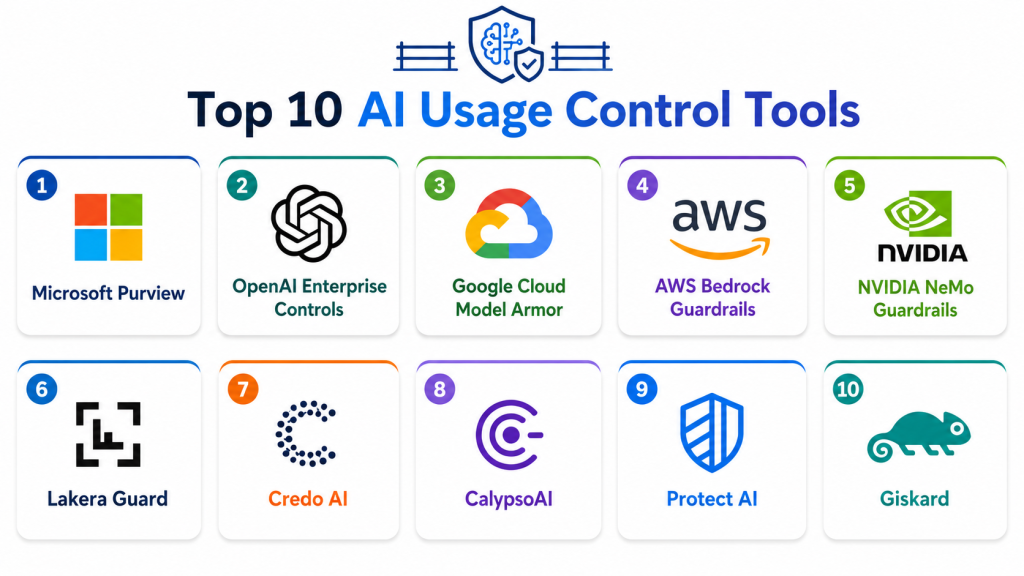
Top 10 AI Usage Control Tools
1- Microsoft Purview
Short description: Microsoft Purview helps organizations govern, protect, and monitor sensitive data across Microsoft environments and connected enterprise systems. For AI usage control, it is useful for organizations that need data security, compliance visibility, and governance around AI-assisted work, especially in Microsoft-centric environments.
Key Features
- Data governance and classification
- Sensitive data discovery
- Data loss prevention workflows
- Compliance and audit support
- Insider risk signals
- Microsoft ecosystem integration
- AI-related data security controls
Pros
- Strong fit for Microsoft-based enterprises
- Good compliance and data governance capabilities
- Useful for protecting sensitive data in AI-enabled workflows
Cons
- Best suited for Microsoft-centric organizations
- Advanced setup can require planning
- AI-specific controls may depend on broader Microsoft configuration
Platforms / Deployment
- Web / Microsoft Cloud / Enterprise environments
- Cloud / Hybrid options vary
Security & Compliance
- RBAC
- Microsoft Entra ID integration
- Encryption
- Audit logging
- Data loss prevention
- Compliance controls
Integrations & Ecosystem
Microsoft Purview integrates deeply with Microsoft security, productivity, and compliance environments. It is useful when AI usage control is part of a larger data governance and information protection strategy.
- Microsoft 365
- Microsoft Entra ID
- Microsoft Defender
- Microsoft Copilot environments
- Data governance workflows
- Compliance reporting systems
Support & Community
Microsoft provides enterprise support, documentation, partner services, security guidance, and a large ecosystem of compliance and governance resources.
2- Netskope One
Short description: Netskope One is a security service edge platform that helps organizations manage cloud, SaaS, web, data, and AI application usage. It is useful for discovering shadow AI, controlling access to AI tools, and applying data protection policies across web and cloud activity.
Key Features
- Shadow AI discovery
- SaaS and web app control
- Data loss prevention
- User and activity monitoring
- Risk-based policy enforcement
- Cloud access security broker capabilities
- Security service edge architecture
Pros
- Strong visibility into cloud and SaaS usage
- Good data protection and policy controls
- Useful for organizations managing broad AI app adoption
Cons
- Enterprise deployment requires planning
- Policy tuning can take time
- Best value comes with mature security operations
Platforms / Deployment
- Web / Cloud / Enterprise network environments
- Cloud / Hybrid
Security & Compliance
- RBAC
- SSO integration
- Encryption
- Audit logging
- Data loss prevention
- Access policy controls
Integrations & Ecosystem
Netskope integrates with identity, endpoint, SIEM, data protection, and cloud security workflows. It is especially useful when AI usage control is part of broader SaaS and web governance.
- Identity providers
- SIEM platforms
- Endpoint security tools
- Cloud applications
- DLP workflows
- Security operations systems
Support & Community
Netskope provides enterprise support, deployment guidance, security documentation, and customer success resources for large organizations.
3- Zscaler
Short description: Zscaler provides cloud security, secure web gateway, data protection, and AI visibility capabilities that help organizations monitor and control employee access to AI applications. It is suitable for enterprises that want AI usage governance at the web, network, and security policy layer.
Key Features
- AI app visibility
- Secure web gateway controls
- Data loss prevention
- SaaS access control
- User activity monitoring
- Risk-based blocking and warnings
- Cloud security policy enforcement
Pros
- Strong network and web security coverage
- Good fit for enterprise AI access control
- Useful for enforcing AI usage policies at scale
Cons
- Requires security architecture planning
- Advanced policies need tuning
- Best suited for larger organizations
Platforms / Deployment
- Web / Cloud / Enterprise network environments
- Cloud / Hybrid
Security & Compliance
- RBAC
- SSO integration
- Encryption
- Audit logging
- DLP controls
- Policy-based access enforcement
Integrations & Ecosystem
Zscaler integrates with enterprise identity, security operations, endpoint, and compliance systems. It is useful for organizations that need centralized control over internet, SaaS, and AI application usage.
- Identity providers
- SIEM systems
- Endpoint security tools
- SaaS platforms
- DLP workflows
- Cloud security operations
Support & Community
Zscaler provides enterprise support, implementation services, documentation, and security architecture guidance.
4- Palo Alto Networks Prisma Access and AI Security Capabilities
Short description: Palo Alto Networks provides cloud-delivered security, secure access, data protection, and AI-related security capabilities for organizations controlling AI application usage. It is useful for enterprises that want to combine AI usage control with broader network security, SaaS security, and data protection programs.
Key Features
- Secure access control
- SaaS and web app visibility
- Data loss prevention
- AI application monitoring
- Risk-based policy enforcement
- Threat prevention workflows
- Centralized security management
Pros
- Strong enterprise security ecosystem
- Good fit for large security teams
- Useful when AI control is part of broader security architecture
Cons
- Enterprise deployment can be complex
- Requires security operations maturity
- AI-specific visibility depends on configured capabilities
Platforms / Deployment
- Web / Cloud / Enterprise security infrastructure
- Cloud / Hybrid
Security & Compliance
- RBAC
- Encryption
- Audit logging
- Identity integration
- DLP controls
- Security policy enforcement
Integrations & Ecosystem
Palo Alto Networks integrates with enterprise security operations, network controls, cloud security, and data protection workflows.
- SIEM systems
- Identity providers
- Endpoint tools
- Cloud security platforms
- SaaS applications
- Security operations workflows
Support & Community
Palo Alto Networks provides enterprise support, security services, technical documentation, and implementation partner resources.
5- Cloudflare AI Gateway
Short description: Cloudflare AI Gateway helps developers and organizations control, monitor, cache, and govern traffic between applications and AI model providers. It is useful for teams building AI applications that need visibility into API usage, latency, costs, logs, and model provider interactions.
Key Features
- AI API gateway control
- Request and response logging
- Rate limiting
- Usage analytics
- Caching support
- Multi-provider AI routing
- Developer-friendly API governance
Pros
- Good fit for developer-led AI applications
- Useful for controlling AI API usage
- Helps centralize AI traffic visibility
Cons
- More focused on AI API traffic than employee SaaS usage
- Requires developer integration
- Broader governance may need additional tools
Platforms / Deployment
- APIs / Web / Developer environments
- Cloud
Security & Compliance
- API controls
- Access policies
- Logging
- Rate limiting
- Security features vary by configuration
Integrations & Ecosystem
Cloudflare AI Gateway integrates with AI applications that call external model providers or internal AI services. It is useful when organizations need to manage usage at the API layer.
- LLM providers
- AI applications
- Developer platforms
- Serverless workflows
- Observability systems
- API security workflows
Support & Community
Cloudflare provides documentation, developer resources, enterprise support options, and a large cloud security ecosystem.
6- Prompt Security
Short description: Prompt Security focuses on protecting enterprise generative AI usage by helping organizations discover AI tools, monitor prompts, prevent sensitive data exposure, and enforce AI security policies. It is useful for security teams that want specialized controls around employee and application-level AI use.
Key Features
- Generative AI usage visibility
- Shadow AI discovery
- Prompt monitoring
- Sensitive data protection
- Policy enforcement
- AI app risk controls
- Security reporting
Pros
- Purpose-built for generative AI security
- Good for controlling AI tool usage
- Useful for prompt and sensitive data visibility
Cons
- Newer category compared to traditional security platforms
- May need integration with broader security stack
- Enterprise capabilities vary by deployment
Platforms / Deployment
- Web / Browser / Enterprise AI environments
- Cloud / Hybrid options vary
Security & Compliance
- Access controls
- Encryption support
- Audit logging
- Policy controls
- Enterprise security details vary by plan
Integrations & Ecosystem
Prompt Security integrates with enterprise environments where organizations need visibility and control over generative AI usage.
- Browser workflows
- AI applications
- Security platforms
- DLP processes
- Compliance workflows
- Enterprise identity systems
Support & Community
Prompt Security provides product documentation, enterprise support options, and guidance for AI security and governance teams.
7- Lakera Guard
Short description: Lakera Guard helps protect LLM applications from prompt injection, jailbreaks, unsafe inputs, data leakage, and risky AI interactions. It is useful for organizations that need runtime controls and policy enforcement for AI applications and user interactions.
Key Features
- Prompt injection detection
- Jailbreak protection
- Sensitive data leakage detection
- Input and output scanning
- Policy enforcement
- AI application security controls
- API-based integration
Pros
- Strong LLM application security focus
- Useful for production AI apps
- Helps control risky AI interactions
Cons
- Primarily focused on LLM app protection
- Not a full SaaS AI usage governance suite
- Integration planning may be needed
Platforms / Deployment
- APIs / Web / AI application environments
- Cloud / Hybrid options vary
Security & Compliance
- Access controls
- Encryption support
- Policy controls
- Enterprise security features vary by plan
- Compliance details vary by deployment
Integrations & Ecosystem
Lakera Guard integrates with AI applications, chatbots, RAG systems, and LLM-based workflows where real-time protection and usage control are needed.
- LLM applications
- Chatbots
- AI agents
- RAG workflows
- APIs
- Enterprise AI systems
Support & Community
Lakera provides documentation, support options, implementation guidance, and AI security expertise for organizations deploying LLM applications.
8- Protect AI LLM Guard
Short description: Protect AI LLM Guard is an open-source toolkit for scanning and controlling LLM application inputs and outputs. It helps teams detect prompt injection, sensitive data exposure, toxic content, secrets, and unsafe patterns in AI workflows.
Key Features
- Prompt injection scanning
- Sensitive data detection
- Toxicity detection
- Input and output scanners
- Modular scanner architecture
- LLM app security controls
- Developer-friendly integration
Pros
- Open-source and flexible
- Useful for LLM application control
- Practical for developer-led security checks
Cons
- Requires engineering integration
- Not a full enterprise governance platform
- Reporting and audit workflows may need customization
Platforms / Deployment
- Python / Developer environments
- Self-hosted / Hybrid
Security & Compliance
- Not publicly stated
- Security depends on deployment, integration design, and data handling practices
Integrations & Ecosystem
LLM Guard can be integrated into AI applications, RAG systems, chatbots, and testing pipelines to control unsafe inputs and outputs.
- LLM applications
- RAG workflows
- Python APIs
- Chatbot systems
- AI agents
- Security validation pipelines
Support & Community
Protect AI LLM Guard has open-source community support, developer documentation, and practical adoption among AI security builders.
9- Nightfall AI
Short description: Nightfall AI is a data loss prevention platform that helps organizations detect and prevent sensitive data exposure across cloud applications, SaaS tools, and developer workflows. For AI usage control, it is useful when teams need to prevent secrets, personal data, or regulated information from entering AI systems.
Key Features
- Sensitive data detection
- Data loss prevention
- SaaS data protection
- Developer workflow protection
- Secrets detection
- Policy-based controls
- Alerting and reporting
Pros
- Strong sensitive data detection focus
- Useful for preventing risky AI prompts
- Good fit for security and compliance teams
Cons
- Not solely focused on AI usage control
- AI-specific workflows may require configuration
- Best value comes with broader data protection needs
Platforms / Deployment
- Web / APIs / Cloud applications / Developer workflows
- Cloud
Security & Compliance
- RBAC
- Encryption
- Audit logging
- DLP controls
- Access controls
- Compliance support varies by configuration
Integrations & Ecosystem
Nightfall integrates with SaaS platforms, developer tools, and security workflows where sensitive data needs to be identified and controlled.
- SaaS applications
- APIs
- Developer tools
- Security workflows
- Compliance systems
- Data protection processes
Support & Community
Nightfall provides product documentation, support resources, security guidance, and customer success options for data protection teams.
10- Cisco AI Defense
Short description: Cisco AI Defense is designed to help organizations secure AI applications, manage AI risks, and improve visibility into AI usage and threats. It is suitable for enterprises that want AI control as part of a broader security architecture.
Key Features
- AI application visibility
- AI security posture support
- Model and application risk controls
- Policy-based protection
- Security monitoring
- Enterprise security integration
- AI risk reporting
Pros
- Strong enterprise security positioning
- Useful for organizations with broad security programs
- Good fit for AI risk and security operations workflows
Cons
- Enterprise deployment may require planning
- Capabilities depend on environment and integration depth
- Best suited for larger organizations
Platforms / Deployment
- Web / Enterprise security environments
- Cloud / Hybrid options vary
Security & Compliance
- Access controls
- Encryption support
- Audit logging
- Policy controls
- Enterprise security features vary by deployment
Integrations & Ecosystem
Cisco AI Defense fits into broader enterprise security workflows where AI application risk needs to be managed alongside network, cloud, and identity security.
- Security operations systems
- Enterprise identity tools
- Cloud security workflows
- AI applications
- Risk reporting systems
- Security governance programs
Support & Community
Cisco provides enterprise support, technical services, documentation, security expertise, and partner resources for large organizations.
Comparison Table
| Tool Name | Best For | Platforms Supported | Deployment | Standout Feature | Public Rating |
|---|---|---|---|---|---|
| Microsoft Purview | Microsoft data governance and AI data protection | Microsoft Cloud / Web | Cloud / Hybrid options vary | Data governance and DLP controls | N/A |
| Netskope One | Shadow AI and SaaS usage control | Web / Cloud / Network environments | Cloud / Hybrid | AI app visibility and DLP | N/A |
| Zscaler | Secure web and AI access control | Web / Cloud / Network environments | Cloud / Hybrid | Web-layer AI policy enforcement | N/A |
| Palo Alto Networks Prisma Access and AI Security Capabilities | Enterprise security-led AI control | Web / Cloud / Security infrastructure | Cloud / Hybrid | AI control within security architecture | N/A |
| Cloudflare AI Gateway | AI API usage governance | APIs / Developer environments | Cloud | LLM API traffic visibility | N/A |
| Prompt Security | Generative AI usage control | Web / Browser / Enterprise AI environments | Cloud / Hybrid options vary | Prompt and shadow AI visibility | N/A |
| Lakera Guard | LLM application protection | APIs / AI applications | Cloud / Hybrid options vary | Prompt injection and leakage controls | N/A |
| Protect AI LLM Guard | Open-source LLM input and output scanning | Python environments | Self-hosted / Hybrid | Modular AI scanners | N/A |
| Nightfall AI | Sensitive data protection for AI workflows | Web / APIs / SaaS apps | Cloud | DLP and secrets detection | N/A |
| Cisco AI Defense | Enterprise AI security posture | Web / Security environments | Cloud / Hybrid options vary | AI risk and security posture controls | N/A |
Evaluation & Scoring of AI Usage Control Tools
| Tool Name | Core 25% | Ease 15% | Integrations 15% | Security 10% | Performance 10% | Support 10% | Value 15% | Weighted Total |
|---|---|---|---|---|---|---|---|---|
| Microsoft Purview | 9.0 | 8.0 | 9.2 | 9.3 | 8.7 | 8.9 | 8.2 | 8.78 |
| Netskope One | 9.2 | 8.0 | 9.0 | 9.2 | 8.8 | 8.8 | 8.0 | 8.77 |
| Zscaler | 9.0 | 7.9 | 8.9 | 9.2 | 8.9 | 8.8 | 8.0 | 8.71 |
| Palo Alto Networks Prisma Access and AI Security Capabilities | 9.0 | 7.7 | 9.0 | 9.3 | 8.9 | 8.9 | 7.8 | 8.70 |
| Cloudflare AI Gateway | 8.4 | 8.6 | 8.8 | 8.6 | 9.0 | 8.5 | 8.7 | 8.66 |
| Prompt Security | 8.8 | 8.2 | 8.4 | 8.8 | 8.5 | 8.4 | 8.1 | 8.47 |
| Lakera Guard | 8.5 | 8.4 | 8.4 | 8.9 | 8.6 | 8.4 | 8.0 | 8.46 |
| Protect AI LLM Guard | 8.1 | 7.9 | 8.3 | 8.0 | 8.2 | 8.0 | 9.2 | 8.25 |
| Nightfall AI | 8.5 | 8.2 | 8.6 | 9.0 | 8.5 | 8.5 | 8.1 | 8.49 |
| Cisco AI Defense | 8.7 | 7.8 | 8.7 | 9.1 | 8.7 | 8.8 | 7.9 | 8.56 |
These scores are comparative and intended to help buyers evaluate practical fit rather than identify one universal winner. SSE and CASB-style platforms are stronger for workforce AI usage visibility and access control, while AI gateways and LLM security tools are better for developer-built AI applications. Data protection platforms are strongest when the main risk is sensitive data exposure through prompts, files, or AI-connected workflows.
Which AI Usage Control Tool Is Right for You?
Solo / Freelancer
Solo developers and small AI builders usually need lightweight controls for API usage, prompt testing, and sensitive data handling. Cloudflare AI Gateway and Protect AI LLM Guard are practical options for developer-led AI applications that need visibility, scanning, and basic usage control.
SMB
SMBs usually need simple AI usage visibility, data protection, and safe AI adoption without building a large governance program. Nightfall AI, Prompt Security, Cloudflare AI Gateway, and Lakera Guard can help teams control sensitive data, LLM usage, and risky AI interactions.
Mid-Market
Mid-sized organizations often need shadow AI discovery, policy enforcement, access control, DLP, and reporting across multiple teams. Netskope One, Zscaler, Microsoft Purview, Prompt Security, and Nightfall AI are strong options depending on security architecture.
Enterprise
Large enterprises usually need AI visibility, access control, audit logs, DLP, identity integration, approved AI app policies, and governance reporting. Microsoft Purview, Netskope One, Zscaler, Palo Alto Networks, Cisco AI Defense, and Prompt Security are strong enterprise-focused options.
Budget vs Premium
Open-source tools like Protect AI LLM Guard can reduce cost for technical teams, but they require engineering integration. Premium enterprise platforms provide stronger visibility, policy enforcement, support, reporting, and security integrations, but require budget and implementation planning.
Feature Depth vs Ease of Use
AI gateways are easier for developer-controlled AI apps, while SSE and CASB platforms provide deeper enterprise visibility across employee usage. DLP platforms are strong for sensitive data protection, while LLM security tools are stronger for prompt injection, jailbreak, and output control.
Integrations & Scalability
Organizations should prioritize integrations with identity providers, SIEM platforms, DLP systems, endpoint tools, cloud platforms, SaaS apps, AI gateways, and model providers. AI usage control works best when connected with existing security and governance systems.
Security & Compliance Needs
Security-focused teams should prioritize RBAC, SSO, audit logs, encryption, sensitive data detection, prompt logging, output monitoring, policy enforcement, approval workflows, and data retention controls. For regulated industries, AI usage logs and DLP evidence are especially important.
Frequently Asked Questions
1. What is an AI Usage Control Tool?
An AI Usage Control Tool helps organizations monitor, restrict, approve, and secure how employees, applications, and teams use AI systems. It can control access, inspect prompts, prevent sensitive data sharing, and create audit trails.
2. Why are AI Usage Control Tools important?
They help reduce risks from shadow AI, sensitive data exposure, unapproved tools, unsafe prompts, insecure AI applications, and weak governance. They also help organizations adopt AI safely instead of blocking it completely.
3. What is shadow AI?
Shadow AI refers to employees or teams using AI tools without formal approval, visibility, security review, or governance. It can create risks if sensitive data is shared with unknown or unmanaged AI services.
4. How do these tools prevent data leakage?
They can detect sensitive data in prompts, files, API calls, or web activity. Some tools can warn users, block actions, mask data, log incidents, or route usage through approved AI services.
5. What is an AI gateway?
An AI gateway sits between an application and AI model providers. It helps control API traffic, monitor usage, apply policies, manage costs, log requests, and standardize access to multiple models.
6. Are AI Usage Control Tools only for generative AI?
No. They are most commonly discussed for generative AI, but they can also support governance for ML models, AI APIs, AI agents, copilots, recommendation systems, and enterprise automation workflows.
7. What are common implementation mistakes?
Common mistakes include blocking all AI usage without alternatives, ignoring employee workflows, failing to classify AI apps by risk, weak DLP policies, no audit logging, and not training users on approved AI practices.
8. What integrations are most important?
Important integrations include identity providers, SIEM tools, DLP systems, endpoint security, browser controls, CASB, SSE, cloud platforms, AI gateways, model providers, and compliance reporting systems.
9. Should organizations use one tool or multiple tools?
Most organizations use a layered approach. A security service edge platform may control employee AI app usage, while an AI gateway controls developer-built apps, and DLP tools protect sensitive data.
10. What should buyers evaluate before choosing a tool?
Buyers should evaluate AI discovery, access control, prompt inspection, output monitoring, DLP, audit logs, identity integration, API governance, reporting, deployment model, scalability, and fit with existing security architecture.
Conclusion
AI Usage Control Tools are becoming essential for organizations that want to adopt AI safely without losing control over data, users, applications, and governance. The right tool can help detect shadow AI, prevent sensitive data leakage, enforce approved usage policies, monitor prompts and outputs, control AI APIs, and create audit-ready visibility across the enterprise. Microsoft Purview is strong for Microsoft data governance and compliance workflows, while Netskope One, Zscaler, Palo Alto Networks, and Cisco AI Defense support broader enterprise security-led AI control. Cloudflare AI Gateway is useful for developer-built AI applications, while Prompt Security, Lakera Guard, and Protect AI LLM Guard focus more directly on generative AI and LLM security controls. Nightfall AI is a strong option when sensitive data protection is the main priority. The best choice depends on whether the organization needs workforce AI visibility, developer API control, data loss prevention, LLM security, governance reporting, or a layered combination of all these controls. Shortlist two or three tools, test them with real AI usage scenarios, validate DLP and access policies, review integration with identity and security systems, and make AI usage control part of a practical enterprise AI governance program.