Introduction
Community Management Platforms are software solutions that enable organizations to build, manage, and engage online communities where users can interact, share content, and collaborate. These platforms act as centralized hubs—similar to social networks—where members can post discussions, attend events, and communicate in real time.
As businesses shift toward community-led growth, these platforms have become essential for customer engagement, brand loyalty, and peer-to-peer support. Instead of relying on fragmented tools like social media or forums, organizations now use dedicated platforms to create structured, branded communities with deeper engagement and data control.
Common use cases include:
- Customer support communities
- Product feedback and idea forums
- Creator and membership communities
- Employee and internal communities
- Learning and cohort-based communities
What buyers should evaluate:
- Discussion forums and communication tools
- Member segmentation and access control
- Analytics and engagement tracking
- Monetization features (subscriptions, paid groups)
- Integrations with CRM, LMS, and tools
- Custom branding and white-labeling
- Scalability and performance
- Security and moderation controls
Best for: SaaS companies, creators, enterprises, education platforms, and community-driven brands.
Not ideal for: Teams relying only on basic social media groups or minimal engagement needs.
Key Trends in Community Management Platforms
- AI-powered moderation and engagement insights
- Shift from social media groups to owned communities
- Monetization through memberships and subscriptions
- Integration with LMS, CRM, and customer success tools
- Real-time chat and live events inside communities
- Mobile-first and app-based community experiences
- Gamification (badges, leaderboards, rewards)
- Community-led product development and feedback loops
- Automation for onboarding and engagement workflows
- Data-driven community analytics and ROI tracking
How We Selected These Tools (Methodology)
- Strong adoption across creators, SaaS, and enterprises
- Feature completeness (forums, chat, analytics, monetization)
- Ease of use and onboarding
- Integration ecosystem (CRM, LMS, APIs)
- Scalability for growing communities
- Security and moderation capabilities
- Vendor reputation and innovation
- Flexibility across different community types
- Engagement and retention capabilities
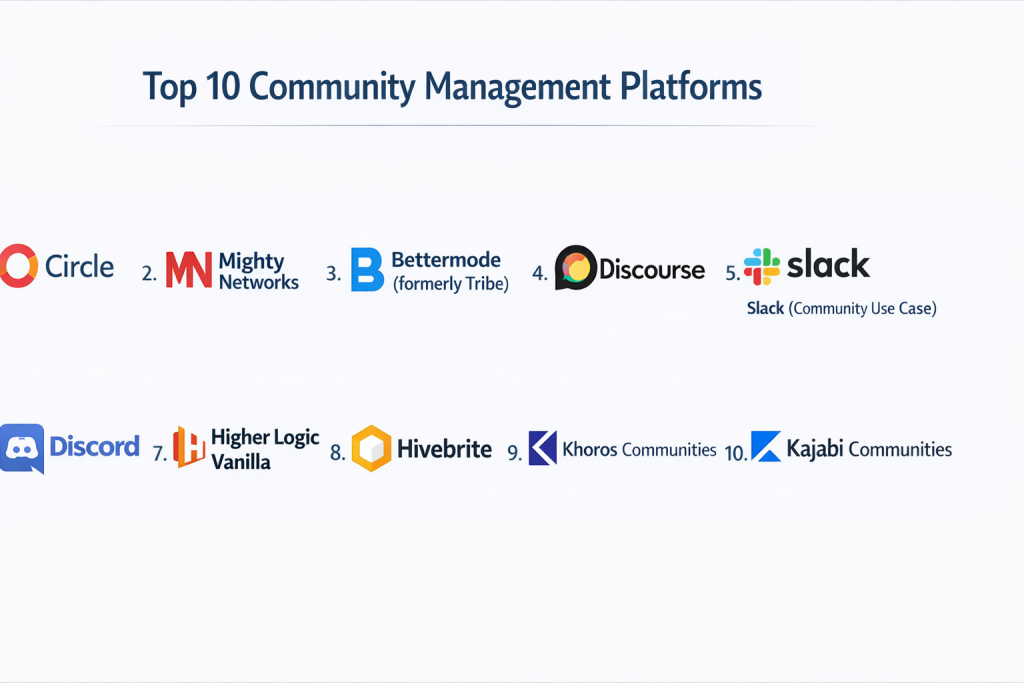
Top 10 Community Management Platforms
#1 — Circle
Short description: A modern community platform designed for creators and businesses to build private, engaging communities.
Key Features
- Discussion forums
- Live events and streaming
- Member segmentation
- Custom branding
- Integrations
Pros
- Clean UI
- Strong engagement tools
Cons
- Pricing
- Limited deep customization
Platforms / Deployment
Web / Cloud
Security & Compliance
SSO, encryption
Integrations & Ecosystem
Supports integrations with content, course, and CRM tools
- Zapier
- APIs
Support & Community
Strong creator ecosystem
#2 — Mighty Networks
Short description: A community platform focused on social-style engagement and monetization.
Key Features
- Community feeds
- Courses and memberships
- Mobile apps
- Live streaming
- Monetization tools
Pros
- Strong engagement
- Built-in monetization
Cons
- Limited enterprise features
- Customization constraints
Platforms / Deployment
Web / Mobile / Cloud
Security & Compliance
Not publicly stated
Integrations & Ecosystem
- Payment tools
- APIs
Support & Community
Strong creator adoption
#3 — Bettermode (formerly Tribe)
Short description: A customizable community platform for SaaS and brands.
Key Features
- Discussion forums
- Widgets and customization
- Analytics
- Gamification
- API integrations
Pros
- Highly customizable
- Developer-friendly
Cons
- Learning curve
- Pricing
Platforms / Deployment
Web / Cloud
Security & Compliance
Not publicly stated
Integrations & Ecosystem
- APIs
- SaaS tools
Support & Community
Growing adoption
#4 — Discourse
Short description: An open-source discussion platform for building community forums.
Key Features
- Threaded discussions
- Moderation tools
- Plugins
- Notifications
- Searchable content
Pros
- Open-source
- Highly customizable
Cons
- Requires setup
- Technical management
Platforms / Deployment
Web / Self-hosted / Cloud
Security & Compliance
RBAC, encryption
Integrations & Ecosystem
- Plugins
- APIs
Support & Community
Strong open-source community
#5 — Slack (Community Use Case)
Short description: A collaboration tool often used for building private communities.
Key Features
- Channels and messaging
- File sharing
- Integrations
- Notifications
- Search
Pros
- Easy communication
- Widely adopted
Cons
- Not built for large communities
- Limited structure
Platforms / Deployment
Web / Mobile / Desktop / Cloud
Security & Compliance
SSO, MFA
Integrations & Ecosystem
- Thousands of integrations
- APIs
Support & Community
Strong global ecosystem
#6 — Discord
Short description: A real-time communication platform widely used for community engagement.
Key Features
- Voice and text channels
- Role-based access
- Bots and automation
- Live streaming
- Community moderation
Pros
- Free and flexible
- Real-time engagement
Cons
- Can become chaotic
- Limited analytics
Platforms / Deployment
Web / Mobile / Desktop
Security & Compliance
Not publicly stated
Integrations & Ecosystem
- Bots
- APIs
Support & Community
Massive global community
#7 — Higher Logic Vanilla
Short description: An enterprise-grade community platform for customer engagement and support.
Key Features
- Discussion forums
- Knowledge base
- Gamification
- Analytics
- Community moderation
Pros
- Enterprise-ready
- Strong support features
Cons
- Expensive
- Complex setup
Platforms / Deployment
Web / Cloud
Security & Compliance
SSO, MFA
Integrations & Ecosystem
- CRM tools
- APIs
Support & Community
Enterprise support
#8 — Hivebrite
Short description: A community platform for organizations, alumni networks, and associations.
Key Features
- Member management
- Events
- Content sharing
- Analytics
- Monetization
Pros
- Strong for associations
- Scalable
Cons
- Pricing
- Learning curve
Platforms / Deployment
Web / Mobile / Cloud
Security & Compliance
Not publicly stated
Integrations & Ecosystem
- CRM tools
- APIs
Support & Community
Strong association support
#9 — Khoros Communities
Short description: A large-scale enterprise platform for customer engagement and support.
Key Features
- Forums
- AI moderation
- Analytics
- Customer support integration
- Knowledge base
Pros
- Enterprise-grade
- Strong analytics
Cons
- Expensive
- Complex
Platforms / Deployment
Web / Cloud
Security & Compliance
SSO, MFA
Integrations & Ecosystem
- CRM systems
- APIs
Support & Community
Enterprise support
#10 — Kajabi Communities
Short description: A community feature within Kajabi for creators and course-based businesses.
Key Features
- Course + community integration
- Member engagement
- Content sharing
- Analytics
- Monetization
Pros
- All-in-one platform
- Great for creators
Cons
- Limited standalone features
- Pricing
Platforms / Deployment
Web / Cloud
Security & Compliance
Not publicly stated
Integrations & Ecosystem
- Payment tools
- APIs
Support & Community
Strong creator ecosystem
Comparison Table (Top 10)
| Tool Name | Best For | Platform(s) Supported | Deployment | Standout Feature | Public Rating |
|---|---|---|---|---|---|
| Circle | Creator communities | Web | Cloud | Clean UX | N/A |
| Mighty Networks | Monetization | Web, Mobile | Cloud | Paid communities | N/A |
| Bettermode | Custom communities | Web | Cloud | Customization | N/A |
| Discourse | Forums | Web | Self-hosted/Cloud | Open-source | N/A |
| Slack | Private communities | Web, Mobile | Cloud | Messaging | N/A |
| Discord | Real-time communities | Web, Mobile | Cloud | Voice + chat | N/A |
| Higher Logic | Enterprise | Web | Cloud | Customer support | N/A |
| Hivebrite | Associations | Web, Mobile | Cloud | Member management | N/A |
| Khoros | Enterprise CX | Web | Cloud | AI moderation | N/A |
| Kajabi | Creator economy | Web | Cloud | Course + community | N/A |
Evaluation & Scoring of Community Management Platforms
| Tool Name | Core | Ease | Integrations | Security | Performance | Support | Value | Weighted Total |
|---|---|---|---|---|---|---|---|---|
| Circle | 9 | 9 | 8 | 7 | 8 | 8 | 8 | 8.3 |
| Mighty Networks | 9 | 8 | 7 | 6 | 8 | 7 | 9 | 8.1 |
| Bettermode | 9 | 7 | 9 | 7 | 8 | 7 | 8 | 8.0 |
| Discourse | 8 | 6 | 8 | 7 | 8 | 8 | 9 | 7.9 |
| Slack | 8 | 10 | 10 | 8 | 9 | 9 | 8 | 8.7 |
| Discord | 8 | 9 | 7 | 6 | 8 | 7 | 9 | 8.0 |
| Higher Logic | 10 | 6 | 9 | 9 | 9 | 9 | 6 | 8.4 |
| Hivebrite | 9 | 7 | 8 | 7 | 8 | 7 | 8 | 8.0 |
| Khoros | 10 | 6 | 9 | 9 | 9 | 9 | 6 | 8.4 |
| Kajabi | 8 | 8 | 7 | 6 | 8 | 7 | 8 | 7.9 |
How to interpret:
Enterprise tools like Khoros and Higher Logic score higher in scalability and analytics, while tools like Circle and Discord excel in usability and engagement. Choose based on your community size and goals.
Which Community Management Platform Is Right for You?
Solo / Freelancer
Circle, Discord, and Kajabi are ideal for creators.
SMB
Mighty Networks, Bettermode, and Discord provide flexibility and affordability.
Mid-Market
Circle, Hivebrite, and Slack offer balance and scalability.
Enterprise
Khoros and Higher Logic are best for large-scale communities.
Budget vs Premium
Discord = budget-friendly, Khoros = premium.
Feature Depth vs Ease of Use
Circle = easiest, Khoros = most advanced.
Integrations & Scalability
Slack and Bettermode excel.
Security & Compliance Needs
Khoros and Higher Logic are best suited.
Frequently Asked Questions (FAQs)
What is a community management platform?
It is software used to create and manage online communities where users interact and share content.
How is it different from social media?
Community platforms offer more control, customization, and deeper engagement than social networks.
Who should use these platforms?
Businesses, creators, educators, and organizations building communities.
What features are essential?
Forums, messaging, analytics, moderation, and access control.
Can these platforms generate revenue?
Yes, many support memberships, subscriptions, and paid content.
Are they suitable for customer support?
Yes, many platforms include forums and knowledge bases.
Do they support integrations?
Yes, integration with CRM, LMS, and APIs is common.
Are they scalable?
Yes, most platforms are designed to scale with growth.
What industries use them?
SaaS, education, creators, enterprises, and nonprofits.
What mistakes should be avoided?
Choosing tools without scalability or ignoring engagement strategies.
Conclusion
Community Management Platforms have become essential for organizations aiming to build meaningful relationships, drive engagement, and create loyal user bases. These platforms centralize communication, enable collaboration, and provide valuable insights into user behavior. While tools like Discord and Circle offer flexibility and ease of use, enterprise platforms like Khoros and Higher Logic deliver advanced analytics and scalability. The right choice depends on your community size, engagement goals, and integration needs. Instead of selecting one immediately, shortlist a few platforms, test engagement workflows, and choose the one that best supports long-term community growth and value creation.