Introduction
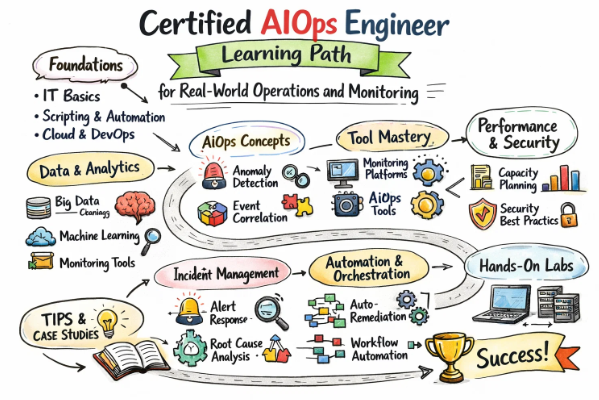
The role of an Certified AIOps Engineer is defined by the integration of artificial intelligence and machine learning into IT operations. Large volumes of data are generated by modern infrastructure, and this data is analyzed by intelligent systems to identify patterns. Traditional methods of manual intervention are being replaced by automated responses.
By achieving this certification, a professional is recognized for their ability to manage complex environments through data-driven insights. It is not merely about using tools; it is about understanding how algorithms are applied to improve system uptime and performance. Efficiency is gained when repetitive tasks are offloaded to intelligent frameworks, allowing engineers to focus on higher-level architectural challenges.
Why it matters today?
In the current era of technology, downtime is considered unacceptable. Massive amounts of telemetry, logs, and traces are produced every second. This scale is too large to be handled by human operators alone. Therefore, the adoption of AIOps is seen as a necessity rather than an option.
Alert fatigue is a common problem faced by engineering teams. Thousands of notifications are often received, making it difficult to find the actual root cause of an issue. Through the use of AIOps, noise is filtered out, and critical incidents are prioritized automatically. This shift ensures that business continuity is maintained even in highly dynamic environments.
The Importance of AIOps Certifications
Validation of skills is required in a competitive job market. A certification serves as a formal proof that a specific standard of knowledge has been met. For engineers in India and across the world, these credentials provide a structured path for career growth.
Professional trust is built when a standardized curriculum is followed. Employers are increasingly looking for candidates who can demonstrate hands-on expertise in machine learning models applied to infrastructure. This certification ensures that the latest industry best practices are understood and implemented correctly.
Why Choose AIOps School?
The selection of a training provider is a critical decision for any professional. AIOps School is chosen because the focus is kept on real-world application rather than just theoretical concepts. The curriculum is designed by industry veterans who understand the challenges faced in production environments.
Comprehensive resources are provided to every learner. Complex topics are broken down into simple, digestible modules. Furthermore, the certification is recognized globally, making it a valuable asset for those seeking roles in top-tier technology firms. Support is offered throughout the learning journey to ensure that every candidate succeeds.
A Detailed Look at the Certified AIOps Engineer Program
What is this certification?
This program is a specialized credential that focuses on the application of AI and ML technologies within IT operations. Practical skills are developed to automate incident management and system monitoring.
Who should take this certification?
The program is designed for Software Engineers, DevOps Professionals, SREs, and Engineering Managers. It is also highly beneficial for those working in Cloud and Platform Engineering who wish to move into intelligent automation.
Certification Overview Table
| Track | Level | Who it’s for | Prerequisites | Skills Covered | Recommended Order |
| AIOps/MLOps | Specialist | DevOps/SRE Engineers | Basic Linux & Python | ML Models, Data Analysis | 1st |
| DevOps | Foundation | Software Developers | SDLC Knowledge | CI/CD, Automation | 2nd |
| DevSecOps | Advanced | Security Analysts | DevOps Basics | Security Scanning | 3rd |
| SRE | Expert | Platform Engineers | Infrastructure Exp | SLOs, Error Budgets | 1st |
| DataOps | Specialist | Data Engineers | SQL & Data Flow | Data Pipelines | 2nd |
| FinOps | Management | Finance/Ops Leads | Cloud Cost Basics | Cost Optimization | 3rd |
Skills You Will Gain
- Data ingestion and normalization techniques are mastered.
- Anomaly detection using machine learning algorithms is implemented.
- Automated root cause analysis is performed on large datasets.
- Predictive maintenance strategies are developed for cloud infrastructure.
- Dashboards for intelligent monitoring are designed and maintained.
Real-world projects you should be able to do after this certification
- A self-healing system is built to restart services based on predictive failure analysis.
- An intelligent alerting pipeline is created to reduce noise by 90%.
- Automated capacity planning models are deployed to optimize cloud resources.
- Log analysis tools are integrated with ML models to detect security threats in real-time.
Strategic Preparation Plans
7–14 Days Plan (The Intensive Path)
This plan is suited for those with significant prior experience.
- Days 1-4: Core AIOps concepts and ML basics are reviewed.
- Days 5-10: Official documentation and hands-on labs are completed.
- Days 11-14: Mock exams are taken and weak areas are addressed.
30 Days Plan (The Standard Path)
This is the most common approach for working professionals.
- Week 1: Theoretical foundations of AI in operations are studied.
- Week 2: Practical implementation of monitoring tools is practiced.
- Week 3: Case studies on incident automation are analyzed.
- Week 4: Final review and certification exam are scheduled.
60 Days Plan (The Comprehensive Path)
This plan is recommended for beginners or those changing domains.
- Month 1: Deep dive into Python, Linux, and basic data science.
- Month 2: The AIOps curriculum is followed step-by-step with all lab exercises.
Common Mistakes to Avoid
- Practical lab exercises are often ignored in favor of reading theory.
- The importance of data quality is frequently underestimated.
- Basic prerequisites like Linux and scripting are sometimes skipped.
- Mock tests are not given enough time before the final attempt.
Best next certification after this
Same-Track Progression
Advanced MLOps certifications are pursued to deepen technical expertise. The focus is shifted toward managing the entire lifecycle of machine learning models in production environments.
Cross-Track Progression
FinOps certification is recommended to understand the financial implications of automated systems. A balance between technical performance and cost-efficiency is achieved through this combination.
Leadership / Management Progression
Engineering Management tracks are explored by those aiming for senior leadership roles. Strategic decision-making and team scaling are the primary focus of this path.
Choosing Your Learning Path
DevOps Path
This path is chosen by those who want to automate the software delivery lifecycle. Focus is placed on CI/CD pipelines and infrastructure as code.
DevSecOps Path
Security is integrated into every stage of the development process. This path is ideal for professionals who prioritize system safety and compliance.
Site Reliability Engineering (SRE) Path
System availability and performance are managed through software engineering principles. This is best for those who enjoy solving complex reliability issues.
AIOps / MLOps Path
Intelligence is added to IT operations and model management. It is best suited for engineers who want to work at the intersection of AI and Infrastructure.
DataOps Path
The focus is placed on the automated, policy-based management of data. This is intended for professionals managing large-scale data warehouses and pipelines.
FinOps Path
Cloud financial management is the core of this track. It is best for those who want to ensure that cloud spending is optimized and aligned with business goals.
Mapping Roles to Recommended Certifications
| Current Role | Primary Certification | Secondary Certification |
| DevOps Engineer | Certified AIOps Engineer | DevSecOps Professional |
| SRE | Certified AIOps Engineer | FinOps Practitioner |
| Platform Engineer | SRE Foundation | Certified AIOps Engineer |
| Cloud Engineer | Certified AIOps Engineer | DataOps Specialist |
| Security Engineer | DevSecOps Expert | Certified AIOps Engineer |
| Data Engineer | DataOps Specialist | Certified AIOps Engineer |
| FinOps Practitioner | FinOps Certified | Certified AIOps Engineer |
| Engineering Manager | Certified AIOps Engineer | Leadership in Tech |
Next Certifications to Take
One Same-Track Certification
A Professional MLOps Engineer credential is often sought after completing the AIOps path. The ability to scale machine learning models across diverse cloud environments is validated by this step. It ensures that the technical depth of the candidate remains at the highest level.
One Cross-Track Certification
The Certified DevSecOps Professional program is recommended to broaden one’s perspective. Security concerns are increasingly becoming part of the operational workflow. By understanding security automation, an AIOps engineer becomes a more versatile asset to any engineering organization.
One Leadership-Focused Certification
Technical Leadership or Engineering Management programs are considered for long-term growth. Skills in project management, team building, and strategic planning are developed. These certifications are essential for moving from an individual contributor role to a leadership position.
Training and Certification Support Bodies
DevOpsSchool
Comprehensive training programs for various IT operations tracks are provided. A strong focus is placed on practical learning and industry-relevant projects.
Cotocus
Specialized consulting and training services are offered to help professionals master modern tech stacks. Advanced curriculum designs are used to ensure high success rates.
ScmGalaxy
A vast repository of resources and community support is maintained for engineers. Knowledge sharing and technical excellence are encouraged through their various initiatives.
BestDevOps
Curated learning paths and expert-led sessions are delivered to aspiring engineers. The goal is to bridge the gap between academic knowledge and industrial requirements.
devsecopsschool.com
Security-focused training is delivered to help engineers integrate safety into their pipelines. Hands-on labs are emphasized for better understanding.
sreschool.com
Reliability engineering concepts are taught with a focus on real-world scalability. Modern SRE practices are covered in detail.
aiopsschool.com
The leading institution for artificial intelligence in operations is represented here. Specialist certifications are offered to help engineers stay ahead in the field.
dataopsschool.com
Data management and pipeline automation are the primary focus of this institution. Modern data engineering practices are taught by experts.
finopsschool.com
Financial transparency and cloud cost optimization are taught to professionals. The intersection of finance and technology is explored.
General Frequently Asked Questions
- What is the difficulty level of the certification?
The level is considered moderate to high, as a good understanding of both operations and basic AI is required. - How much time is required for preparation?
Usually, 30 to 60 days are sufficient for most working professionals to feel confident. - Are there any prerequisites for this program?
A basic understanding of Linux, scripting, and IT operations is generally expected. - In what sequence should these certifications be taken?
It is recommended to start with AIOps or SRE, followed by specialized tracks like DevSecOps or FinOps. - What is the career value of becoming certified?
Higher salary packages and roles in premium organizations are often reported by certified individuals. - Which job roles are most suitable after completion?
Roles such as AIOps Engineer, SRE, and Platform Architect are commonly pursued. - Is the certification recognized globally?
Yes, the credentials from AIOps School are respected by tech companies across various countries. - Can a non-technical person take this course?
A basic technical background is recommended to fully benefit from the advanced technical modules. - Are hands-on labs included in the training?
Yes, practical labs are a major part of the curriculum to ensure real-world readiness. - Is there a renewal requirement for the certification?
Periodic updates or recertification are usually suggested to stay current with evolving technology. - How does this differ from standard DevOps?
Standard DevOps focuses on the pipeline, while AIOps adds an intelligent layer of analysis and automation. - Is support provided for exam preparation?
Study guides, mock tests, and mentor support are typically available to all candidates.
AIOps Specific Frequently Asked Questions
- Why is Python important for AIOps?
Python is used for data manipulation and the implementation of machine learning models within the operational framework. - What role does Big Data play in AIOps?
Large datasets are the foundation upon which AI models are trained to recognize patterns and anomalies. - Can AIOps reduce operational costs?
Yes, costs are reduced by automating incident response and optimizing resource allocation in the cloud. - What is the difference between AIOps and MLOps?
AIOps focuses on applying AI to IT operations, while MLOps focuses on managing the lifecycle of machine learning models. - How does AIOps improve system reliability?
Reliability is improved by predicting failures before they occur and initiating automated recovery processes. - Is deep learning used in the AIOps certification?
Fundamental concepts of neural networks and deep learning are covered as they apply to log analysis and forecasting. - What monitoring tools are integrated with AIOps?
Tools for log management, metrics collection, and distributed tracing are commonly used in the AIOps ecosystem. - Is the certification exam conducted online?
Yes, the exam can be taken from any location through a proctored online platform.
Testimonials
Arun
A significant improvement in technical skills was observed after completing the course. The practical application of ML models to system logs was particularly helpful.
Sita
Great clarity was gained regarding career progression. The move from traditional operations to intelligent automation was made much smoother through this certification.
Vikram
High levels of confidence were built during the training. Complex incident management tasks are now handled with much more ease using automated tools.
Ananya
The curriculum was found to be very easy to follow despite the complexity of the topics. Real-world scenarios were used to explain every major concept.
Rahul
A better understanding of the global market requirements was developed. The certification served as a bridge to a senior engineering role in a top-tier firm.
Conclusion
The importance of the Certified AIOps Engineer certification cannot be overstated in today’s technology-driven world. A strategic advantage is gained by those who choose to invest in their education early. Long-term career benefits include not only increased earning potential but also the ability to lead the next generation of IT operations. Continuous learning and careful planning of certification paths are encouraged for all professionals who wish to remain relevant and successful.