Introduction
Imagine you are trying to buy a popular ticket for a concert. If you try to type your credit card details by hand, the tickets might sell out. But if you write a small script that clicks “buy” the exact second tickets go on sale, you win.
Financial markets work in a very similar way, just on a massive scale. Millions of prices change every second. Humans get tired, stressed, and distracted. They make emotional choices, like panic selling when a stock drops.
Algorithmic trading solves this problem by letting computers do the heavy lifting. While it sounds like something only massive Wall Street banks can do, modern retail traders and investors use simple automated rules every day. This guide breaks down what algo trading is, how it works under the hood, and what you need to watch out for before trying it.
What Is Algo Trading?
Algorithmic trading is the process of executing financial trades using automated instructions. An algorithm is simply a step-by-step set of instructions for a computer.
In trading, these instructions tell the software:
- When to buy: For example, “Buy shares of Company X if the price drops below $50.”
- When to sell: For example, “Sell those shares if the price goes up by 5% or drops by 2%.”
- How much to trade: For example, “Only buy 10 shares at a time.”
Why Does It Matter?
Markets move faster than human eyes can track. Algo trading matters because it cuts down the time between spotting an opportunity and placing a trade to a fraction of a second. It also enforces strict discipline. A computer will never hesitate or let fear change the plan.
How Algo Trading Works
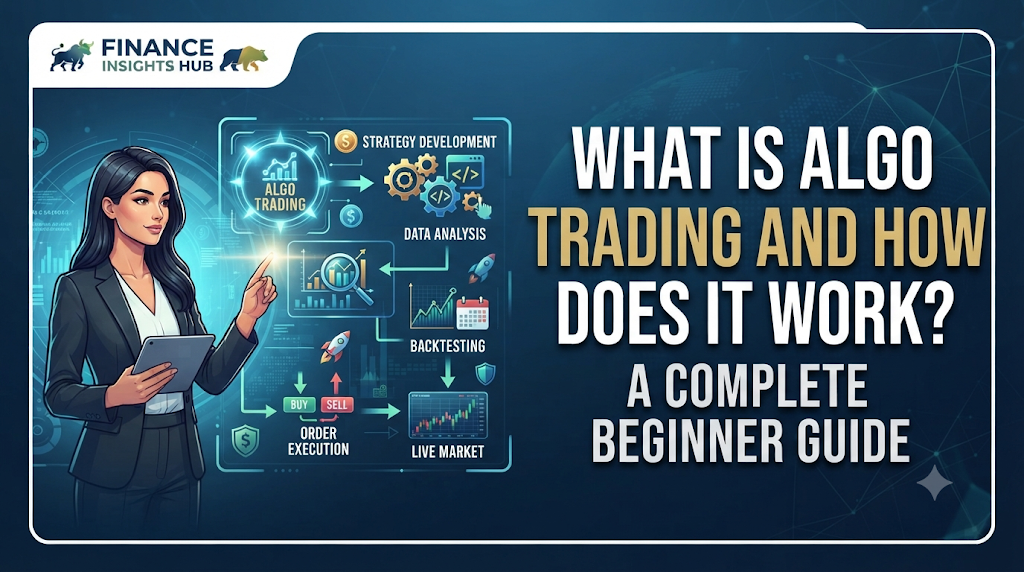
An automated trading system does not guess. It follows a strict workflow from gathering data to final execution. Here is how the process flows step-by-step:
- Market Data Feed: The system connects to a stock exchange or broker feed to get live data on prices, volume, and order books.
- Strategy and Logic: The algorithm runs your programmed rules against the live data. It constantly checks questions like: Is the moving average crossing? Has the price hit our target?
- Order Generation: Once the rule triggers, the algorithm creates a trade order (such as a limit order or market order).
- Execution: The system sends the order electronically to the broker’s server, which routes it to the stock exchange.
A Simple Example
Suppose you want to trade a stock based on price averages. You write a rule:
- If the 10-day average price crosses above the 50-day average price, buy 50 shares.
- If the opposite happens, sell.
The computer watches the prices 24/7. The moment that crossover happens, it places the trade instantly without needing you to log into your brokerage account.
Key Strategies Used in Algo Trading
Traders use different types of algorithms depending on what they want to achieve. Here are the most common strategies:
1. Trend-Following Strategies
These are the simplest and most popular algorithms. They look for stocks that are moving clearly upward or downward and ride the wave. They use technical indicators like moving averages or price channels. If a stock keeps breaking previous highs, the algorithm buys.
2. Arbitrage
Prices for the same asset can sometimes differ slightly across different exchanges for a brief second. Arbitrage algorithms spot this price gap instantly. They buy the asset cheaply on one exchange and sell it for a higher price on another, pocketing the tiny difference.
3. Mean Reversion
This strategy assumes that prices tend to return to their average over time. If a stock price shoots up too fast for no good reason, a mean-reversion algorithm will short-sell it, expecting it to drop back down. If it crashes too hard, the algorithm buys it, expecting a bounce.
4. Execution Algorithms (TWAP / VWAP)
Large institutional investors cannot buy one million shares all at once without crashing or spiking the market price. They use execution algorithms to break large orders into thousands of tiny pieces and spread them out over the day using Time-Weighted Average Price (TWAP) or Volume-Weighted Average Price (VWAP).
Real-World Considerations and Setup
Setting up an algorithmic trading strategy involves more than just writing code. You must think about the infrastructure and real-world costs.
- Broker APIs: To trade automatically, you need a broker that provides an Application Programming Interface (API). An API lets your computer talk directly to your broker’s trading platform.
- Latency: Latency is the delay it takes for your order to reach the exchange. In high-frequency trading, a delay of a few milliseconds means losing a profitable trade. Retail traders usually do not need microsecond speeds, but a stable internet connection is still vital.
- Backtesting: Before risking real money, professional traders test their algorithms on historical market data. This is called backtesting. It shows how the strategy would have performed over the last 5 years.
Common Mistakes Beginners Make
Jumping into automation without experience often leads to quick financial losses. Watch out for these common traps:
- Overfitting Data: A beginner builds a strategy and tweaks the rules until it looks 100% profitable on past data. This is called curve fitting. When the algorithm runs on future live data, it fails completely because it memorized the past instead of learning real market patterns.
- Ignoring Transaction Costs: Every time your algorithm buys and sells, your broker charges a fee or commission. If your algorithm makes 100 trades a day with tiny profits, broker fees can eat up all your gains.
- Leaving Systems Unmonitored: Beginners sometimes write a script, turn it on, and walk away. A sudden internet outage, a broker glitch, or unexpected market news can cause the algorithm to run wild and place bad trades.
Risks and Limitations
| Risk | Why It Matters | Example | How to Reduce It |
| System Glitches | Code bugs can cause infinite loops or unintended duplicate orders. | A typo in your order size turns 1 share into 1,000 shares. | Thorough testing in a simulated “paper trading” environment. |
| Market Volatility | Flash crashes or sudden news can break standard technical rules. | A major economic crisis causes prices to gap down past your stop-loss. | Implement hard daily loss limits that shut down the script automatically. |
| Connectivity Failure | Losing internet or server connection mid-trade leaves open positions unmanaged. | Your internet drops right after a buy order, preventing you from setting a stop-loss. | Host your trading bot on a reliable cloud server (like AWS) rather than a home laptop. |
Decision-Making Framework: Is Algo Trading Right for You?
Before spending time building or buying trading bots, walk through this simple framework:
- Check Your Skills: Do you understand basic programming (like Python) or use a no-code visual strategy builder?
- Define Your Edge: Do you have a clear, rules-based strategy that actually works manually first? (Automation cannot fix a bad strategy).
- Assess Risk Capital: Can you afford to lose the money you allocate to automated testing?
- Choose Your Tool: Decide whether you will code your own script using a broker API or use existing retail platforms with built-in automation.
- Start Small: Run your algorithm with paper trading (fake money) for at least a few months before risking real capital.
Key Terms
- API (Application Programming Interface): A bridge that lets your custom software communicate directly with your stock broker.
- Backtesting: Testing a trading strategy using historical market data to see how it would have performed in the past.
- High-Frequency Trading (HFT): An advanced form of algo trading that uses powerful computers to execute thousands of orders in fractions of a second.
- Latency: The time delay between when a trading signal is generated and when the order is executed on the exchange.
- Paper Trading: Practicing trading with simulated money in real-time market conditions without financial risk.
- Slippage: The difference between the expected price of a trade and the actual price at which the trade executes.
- Stop-Loss Order: An automated instruction to sell a security when it reaches a certain price to limit your losses.
- TWAP (Time-Weighted Average Price): An execution algorithm that divides an order into equal parts over a set time period.
FAQs
Can beginners do algorithmic trading?
Yes. Many modern brokerages offer no-code or visual strategy builders where you can set up simple automated rules without writing complex computer code. However, understanding basic market mechanics is still required.
Do I need to know how to code?
Not necessarily. While Python is the most popular language for custom algo trading, many retail platforms offer drag-and-drop builders or pre-built bots that you can configure with simple settings.
Can algo trading guarantee profits?
No. Algorithms only follow instructions. If a strategy is poorly designed or market conditions change unexpectedly, an algorithm can lose money just as fast as a human trader.
How much money do I need to start?
You can start paper trading for free. For live trading, capital requirements depend entirely on your broker’s minimum deposit and the asset classes you plan to trade.
Is algorithmic trading legal?
Yes, algorithmic trading is completely legal and forms a massive part of daily volume on global stock exchanges. However, malicious practices like “spoofing” (placing fake orders to manipulate prices) are strictly illegal.
What happens if my internet goes down while a bot is running?
If you run a bot from your home computer and your internet drops, your open positions might remain unmanaged. This is why serious traders host their bots on reliable cloud servers that stay online 24/7.
Conclusion
Algorithmic trading turns trading from an emotional guessing game into a systematic process. By replacing human hesitation with pre-set rules, computers can analyze data, spot opportunities, and execute orders in milliseconds.
However, automation is not a magic shortcut to wealth. A bad trading strategy automated by a computer is simply a faster way to lose money. Start small, test your ideas thoroughly with historical data and paper trading, and always keep a close eye on your risk limits.