Introduction
Business Rules & Decision Management Systems (often called BRMS or decision management platforms) are tools that help organizations define, manage, and automate decision logic across applications. These systems separate business rules (like pricing policies, eligibility criteria, or risk rules) from application code, making them easier to update and scale.
Instead of hardcoding logic into systems, BRMS platforms allow businesses to create rules using conditional logic (like IF-THEN statements) and apply them consistently across workflows. This improves agility, reduces errors, and enables real-time decision-making at scale.
Common Use Cases
- Loan approval and credit scoring
- Fraud detection and risk management
- Pricing and discount rules
- Insurance underwriting decisions
- Compliance and policy enforcement
What Buyers Should Evaluate
- Rule authoring (low-code/no-code)
- Decision modeling (DMN support)
- Real-time execution performance
- Integration with APIs and systems
- Versioning and governance
- Testing and simulation tools
- Scalability and rule complexity handling
- Security and compliance
Best for: Enterprises, financial institutions, insurance companies, and organizations managing complex decision logic at scale.
Not ideal for: Small teams with simple workflows or systems that don’t require dynamic decision-making logic.
Key Trends in Business Rules & Decision Management Systems
- Shift toward AI-powered decision intelligence platforms
- Adoption of Decision Model and Notation (DMN) standards
- Integration with machine learning and predictive analytics
- Growth of real-time decision engines
- Expansion of low-code rule authoring tools
- Integration with BPM, RPA, and iPaaS platforms
- Increased focus on governance and auditability
- Support for event-driven decisioning systems
- Rise of cloud-native decision platforms
- Movement toward hyperautomation ecosystems
How We Selected These Tools (Methodology)
- Market adoption and enterprise usage
- Feature completeness (rules + decisioning)
- Performance and scalability signals
- Integration ecosystem and APIs
- Security and governance capabilities
- Ease of use for business and technical users
- Support for standards like DMN
- Community and enterprise support
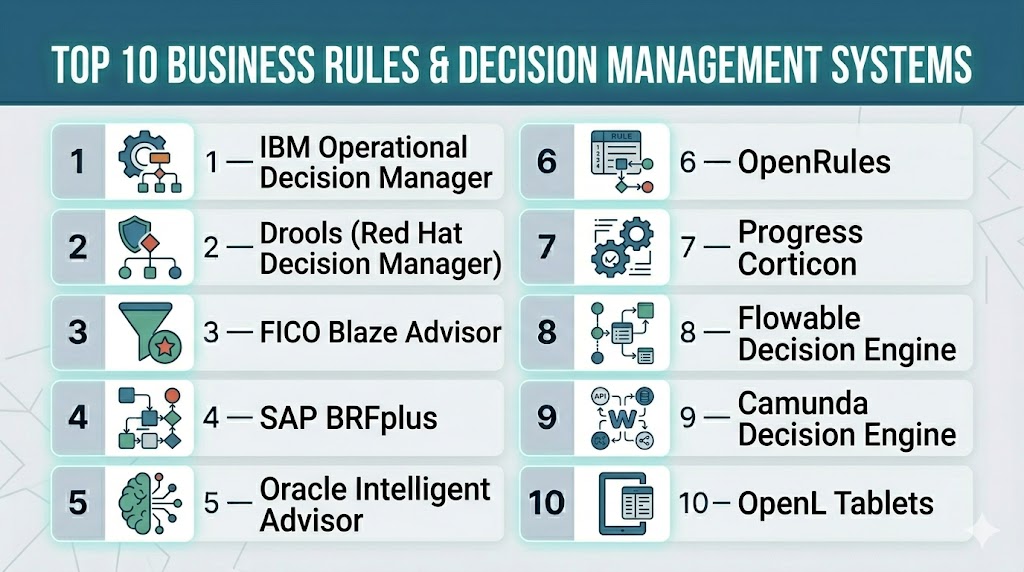
Top 10 Business Rules & Decision Management Systems
#1 — IBM Operational Decision Manager
Short description: A leading enterprise BRMS for managing complex decision logic and automation.
Key Features
- Rule authoring and management
- Decision services
- Real-time rule execution
- Event processing
- Analytics
Pros
- Highly scalable
- Strong enterprise governance
Cons
- Expensive
- Complex setup
Platforms / Deployment
Cloud / On-premise
Security & Compliance
Enterprise-grade security, access control
Integrations & Ecosystem
IBM ODM integrates with enterprise systems and APIs.
- WebSphere
- Enterprise apps
- APIs
Support & Community
Enterprise-level support
#2 — Drools (Red Hat Decision Manager)
Short description: An open-source BRMS with a powerful rule engine and decision management capabilities.
Key Features
- Rule engine (Rete algorithm)
- Decision tables
- Workflow integration
- Rule authoring
- Event processing
Pros
- Open-source flexibility
- Highly customizable
Cons
- Requires technical expertise
- Complex configuration
Platforms / Deployment
Self-hosted / Cloud
Security & Compliance
Not publicly stated
Integrations & Ecosystem
- Java ecosystem
- APIs
Support & Community
Strong open-source community
#3 — FICO Blaze Advisor
Short description: A decision management platform widely used in financial services.
Key Features
- Decision modeling
- Rule management
- Simulation tools
- Analytics
- Real-time execution
Pros
- Strong in financial use cases
- Advanced decisioning
Cons
- Expensive
- Requires expertise
Platforms / Deployment
Cloud / On-premise
Security & Compliance
Enterprise-grade security
Integrations & Ecosystem
- Financial systems
- APIs
Support & Community
Enterprise support
#4 — SAP BRFplus
Short description: A business rules framework integrated into SAP systems for enterprise decision automation.
Key Features
- Rule modeling
- Decision tables
- Integration with SAP data
- Workflow automation
- Rule execution engine
Pros
- Deep SAP integration
- Strong enterprise capabilities
Cons
- Limited outside SAP ecosystem
- Complex setup
Platforms / Deployment
On-premise / Cloud
Security & Compliance
Enterprise-grade security
Integrations & Ecosystem
- SAP ecosystem
- Web services
Support & Community
Enterprise support
#5 — Oracle Intelligent Advisor
Short description: A decision automation platform focused on policy-driven rules and compliance.
Key Features
- Decision modeling
- Rule authoring
- Workflow automation
- Compliance tools
- Analytics
Pros
- Strong compliance features
- Scalable
Cons
- Complex
- Pricing varies
Platforms / Deployment
Cloud / On-premise
Security & Compliance
Enterprise-grade security
Integrations & Ecosystem
- Oracle ecosystem
- APIs
Support & Community
Enterprise support
#6 — OpenRules
Short description: An open-source decision management system using spreadsheet-based rules.
Key Features
- Decision tables
- Rule engine
- Integration with Java
- Rule simulation
- Data-driven rules
Pros
- Flexible
- Cost-effective
Cons
- Requires technical skills
- Limited UI
Platforms / Deployment
Self-hosted
Security & Compliance
Not publicly stated
Integrations & Ecosystem
- Java ecosystem
- APIs
Support & Community
Open-source community
#7 — Progress Corticon
Short description: A rules engine designed for complex decision automation and governance.
Key Features
- Decision modeling
- Rule management
- Simulation tools
- Analytics
- Policy automation
Pros
- Strong rule governance
- High accuracy
Cons
- Expensive
- Learning curve
Platforms / Deployment
Cloud / On-premise
Security & Compliance
Enterprise-grade security
Integrations & Ecosystem
- APIs
- Enterprise systems
Support & Community
Enterprise support
#8 — Flowable Decision Engine
Short description: A lightweight decision engine integrated with BPM and workflow systems.
Key Features
- Decision tables (DMN)
- Workflow integration
- Rule execution
- Analytics
- Event-driven support
Pros
- Flexible
- Developer-friendly
Cons
- Requires setup
- Smaller ecosystem
Platforms / Deployment
Cloud / Self-hosted
Security & Compliance
Not publicly stated
Integrations & Ecosystem
- BPM tools
- APIs
Support & Community
Open-source community
#9 — Camunda Decision Engine
Short description: A decision automation engine integrated with BPM workflows and microservices.
Key Features
- DMN decision tables
- Workflow integration
- Process orchestration
- Monitoring
- API support
Pros
- Strong developer ecosystem
- Scalable
Cons
- Requires technical knowledge
- Limited no-code features
Platforms / Deployment
Cloud / Self-hosted
Security & Compliance
Authentication, access control
Integrations & Ecosystem
- Microservices
- APIs
Support & Community
Strong open-source community
#10 — OpenL Tablets
Short description: A business rule management system using spreadsheet-like decision tables.
Key Features
- Decision tables
- Rule engine
- Spreadsheet-based logic
- Integration capabilities
- Rule execution
Pros
- Easy rule representation
- Open-source
Cons
- Limited enterprise features
- Smaller ecosystem
Platforms / Deployment
Cross-platform / Self-hosted
Security & Compliance
Not publicly stated
Integrations & Ecosystem
- Java ecosystem
- APIs
Support & Community
Open-source support
Comparison Table (Top 10)
| Tool Name | Best For | Platform(s) Supported | Deployment | Standout Feature | Public Rating |
|---|---|---|---|---|---|
| IBM ODM | Enterprise decisioning | Web | Cloud/On-prem | Decision services | N/A |
| Drools | Developers | Web | Cloud/Self-hosted | Rule engine | N/A |
| FICO Blaze | Finance | Web | Cloud/On-prem | Decision modeling | N/A |
| SAP BRFplus | SAP users | Web | Cloud/On-prem | SAP integration | N/A |
| Oracle Advisor | Compliance | Web | Cloud/On-prem | Policy automation | N/A |
| OpenRules | Open-source | CLI/Web | Self-hosted | Spreadsheet rules | N/A |
| Corticon | Governance | Web | Cloud/On-prem | Rule accuracy | N/A |
| Flowable | BPM integration | Web | Cloud/Self-hosted | DMN support | N/A |
| Camunda | Microservices | Web | Cloud/Self-hosted | Workflow + rules | N/A |
| OpenL | Lightweight | CLI/Web | Self-hosted | Decision tables | N/A |
Evaluation & Scoring of Business Rules & Decision Management Systems
| Tool Name | Core (25%) | Ease (15%) | Integrations (15%) | Security (10%) | Performance (10%) | Support (10%) | Value (15%) | Weighted Total |
|---|---|---|---|---|---|---|---|---|
| IBM ODM | 10 | 6 | 9 | 9 | 9 | 9 | 6 | 8.6 |
| Drools | 9 | 6 | 9 | 7 | 9 | 8 | 8 | 8.2 |
| FICO Blaze | 10 | 6 | 9 | 9 | 9 | 9 | 5 | 8.5 |
| SAP BRFplus | 9 | 7 | 8 | 9 | 8 | 8 | 6 | 8.1 |
| Oracle Advisor | 9 | 6 | 9 | 9 | 8 | 8 | 6 | 8.2 |
| OpenRules | 8 | 6 | 8 | 6 | 8 | 7 | 9 | 7.8 |
| Corticon | 9 | 6 | 8 | 9 | 8 | 8 | 6 | 8.0 |
| Flowable | 8 | 7 | 8 | 7 | 8 | 7 | 8 | 7.9 |
| Camunda | 9 | 6 | 9 | 7 | 8 | 8 | 7 | 8.0 |
| OpenL | 7 | 7 | 7 | 6 | 7 | 7 | 9 | 7.5 |
How to interpret scores:
- Enterprise tools score highest in governance and scalability
- Open-source tools offer better flexibility and cost efficiency
- Developer-focused tools require more expertise but offer control
- Scores are comparative, not absolute
Which Business Rules & Decision Management System Is Right for You?
Solo / Freelancer
- Best: OpenRules, OpenL
- Lightweight and cost-effective
SMB
- Best: Flowable, Camunda
- Balanced flexibility and scalability
Mid-Market
- Best: Drools, Corticon
- Need strong rule engines
Enterprise
- Best: IBM ODM, FICO Blaze, Oracle Advisor
- Require governance and real-time decisioning
Budget vs Premium
- Budget: Open-source tools
- Premium: IBM, FICO
Feature Depth vs Ease of Use
- Advanced: IBM ODM, FICO
- Easier: Flowable
Integrations & Scalability
- Strong: IBM, Oracle
- Moderate: Open-source
Security & Compliance Needs
- Enterprise: IBM, Oracle
- Basic: Open-source
Frequently Asked Questions (FAQs)
What is a Business Rules Management System?
A system used to define, manage, and execute business rules for decision-making.
How does it work?
It uses conditional logic (IF-THEN rules) to automate decisions across systems.
What is decision management?
It automates operational decisions using rules, analytics, and models.
Why use a BRMS?
To improve efficiency, reduce errors, and enable faster decision-making.
Is BRMS the same as BPM?
No, BRMS focuses on decision logic, while BPM manages workflows.
Can business users create rules?
Yes, many tools offer low-code interfaces for non-technical users.
Are these systems scalable?
Yes, they can manage thousands of rules across systems.
Do they support AI?
Modern systems integrate AI and analytics for better decision-making.
What industries use BRMS?
Finance, insurance, healthcare, and retail widely use these systems.
What are alternatives?
Custom rule engines or workflow automation tools.
Conclusion
Business Rules & Decision Management Systems are essential for automating complex decision-making and maintaining consistency across enterprise operations. From open-source rule engines to enterprise-grade decision platforms, each tool serves different levels of complexity and scalability. The right choice depends on your need for governance, performance, and integration capabilities. Focus on platforms that allow flexible rule management and real-time decision execution. Start by testing a few tools to identify the best fit for your decision automation strategy.