Introduction
Active Learning Tooling helps machine learning teams choose the most useful data samples for human review, labeling, validation, and model improvement. Instead of labeling every available data point manually, active learning identifies uncertain, difficult, diverse, or high-value examples that are likely to improve model performance the most.
This approach is especially useful when annotation is expensive, data volume is large, or expert review is limited. Active learning is commonly used in computer vision, natural language processing, document AI, healthcare AI, fraud detection, speech recognition, robotics, autonomous systems, and generative AI evaluation workflows.
Real-world use cases include:
- Selecting uncertain images for human annotation
- Prioritizing edge cases for model retraining
- Reducing labeling cost in computer vision projects
- Improving NLP classifiers with targeted review
- Building feedback loops for production AI systems
Buyers evaluating Active Learning Tooling should consider:
- Uncertainty sampling support
- Model-assisted labeling workflows
- Human review and annotation integration
- Dataset curation and versioning
- Support for image, text, video, audio, and document data
- MLOps and model training integrations
- Data quality and bias detection features
- Security and access controls
- Scalability for large datasets
- Reporting and experiment tracking
Best for: AI teams, data scientists, machine learning engineers, computer vision teams, NLP teams, annotation teams, MLOps teams, research teams, and enterprises that want to improve model accuracy while reducing labeling effort.
Not ideal for: Very small datasets, simple rule-based automation projects, or teams without a repeatable model training and labeling workflow.
Key Trends in Active Learning Tooling
- Model-assisted labeling is becoming standard in modern AI data workflows.
- Human-in-the-loop review is increasingly combined with active learning to improve label quality.
- Active learning is being used to reduce annotation cost in large computer vision and NLP projects.
- Dataset curation and data quality tools are becoming tightly connected with active learning.
- Generative AI evaluation workflows are using active review loops to improve answer quality.
- MLOps platforms are adding feedback loops for retraining and monitoring.
- Bias detection and edge-case mining are becoming important active learning use cases.
- Multimodal active learning across images, text, video, and documents is growing.
- Teams are increasingly using active learning to prioritize rare events and failure cases.
- Enterprise AI programs are focusing more on traceability, auditability, and data governance.
How We Selected These Tools
The tools in this list were selected based on their active learning support, annotation integration, AI data workflows, model feedback capabilities, enterprise adoption, and practical fit for machine learning teams.
Selection criteria included:
- Active learning and model-assisted labeling capabilities
- Support for human-in-the-loop review
- Dataset curation and management
- Integration with annotation workflows
- Computer vision, NLP, and document AI support
- MLOps and model training compatibility
- Security and governance controls
- Scalability for large datasets
- Ease of use for AI teams
- Practical value for reducing labeling effort
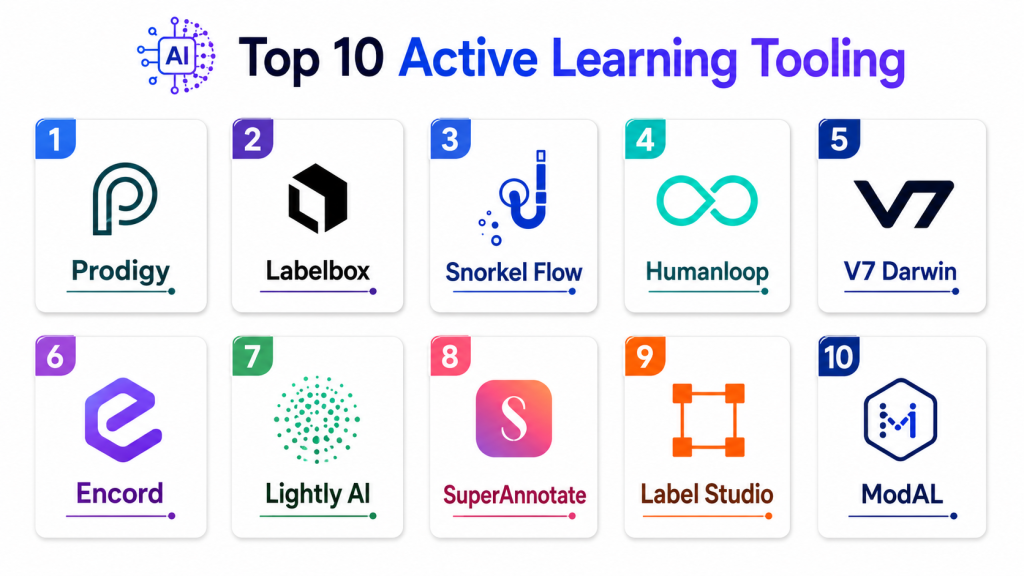
Top 10 Active Learning Tooling
1- Labelbox
Short description: Labelbox is an AI data platform that supports active learning workflows, model-assisted labeling, dataset curation, annotation review, and training data management. It helps teams identify valuable data for labeling and improve models through structured human feedback.
Key Features
- Active learning workflow support
- Model-assisted labeling
- Dataset curation and prioritization
- Human review queues
- Quality assurance workflows
- API and ML pipeline integration
- Data versioning and collaboration
Pros
- Strong enterprise AI data workflow support
- Good balance of automation and human review
- Useful for computer vision, NLP, and document AI projects
Cons
- Pricing may be high for small teams
- Advanced workflows require setup planning
- Best value comes with mature AI data operations
Platforms / Deployment
- Web / APIs
- Cloud / Hybrid options vary
Security & Compliance
- RBAC
- SSO support
- Encryption
- Audit logging
- Enterprise security controls
- Compliance details vary by plan
Integrations & Ecosystem
Labelbox integrates active learning with annotation, model training, and data curation workflows. It is useful for teams that want to connect labeling decisions directly with model improvement.
- Cloud storage platforms
- Python SDKs
- ML pipelines
- Computer vision workflows
- NLP workflows
- MLOps environments
Support & Community
Labelbox provides documentation, onboarding support, customer success resources, and enterprise guidance for production AI data teams.
2- Scale AI
Short description: Scale AI provides data labeling, evaluation, human review, and active learning-style workflows for enterprise AI teams. It is useful when organizations need managed annotation operations and feedback loops for improving complex AI models.
Key Features
- Managed labeling workflows
- Human-in-the-loop review
- Model evaluation support
- Data quality workflows
- Image, video, text, and document labeling
- Workforce operations
- Enterprise project management
Pros
- Strong managed workforce capability
- Good for large-scale enterprise AI projects
- Useful for complex annotation and model evaluation workflows
Cons
- Less suitable for simple self-service labeling needs
- Premium pricing model
- Project setup may require vendor coordination
Platforms / Deployment
- Web / APIs
- Cloud / Managed services
Security & Compliance
- RBAC
- Encryption
- Audit controls
- Enterprise security support
- Compliance details vary by project and contract
Integrations & Ecosystem
Scale AI connects human labeling operations with AI training and evaluation workflows. It is practical when teams need both software and managed human review capacity.
- Cloud storage
- ML pipelines
- Computer vision workflows
- NLP workflows
- AI evaluation workflows
- Custom enterprise pipelines
Support & Community
Scale AI provides enterprise support, project operations, managed workforce coordination, and AI data expertise for large-scale labeling programs.
3- Encord
Short description: Encord is a data annotation and AI data platform focused on visual AI, medical AI, video annotation, data quality, and active learning workflows. It helps teams prioritize high-value data, review model predictions, and improve dataset quality.
Key Features
- Active learning workflow support
- Image and video annotation
- Model-assisted labeling
- Data quality evaluation
- Human review workflows
- Medical imaging support
- Dataset management
Pros
- Strong visual AI and medical AI fit
- Good data quality and model-assisted workflows
- Useful for complex image and video datasets
Cons
- Best suited for visual data projects
- Advanced workflows may require onboarding
- Pricing may not fit small one-time tasks
Platforms / Deployment
- Web / APIs
- Cloud / Hybrid options vary
Security & Compliance
- RBAC
- Encryption
- Audit logging
- SSO support
- Enterprise security controls
- Healthcare-related compliance details vary by plan and deployment
Integrations & Ecosystem
Encord integrates annotation, review, model evaluation, and data quality workflows for visual AI teams.
- Cloud storage
- Python SDKs
- Computer vision pipelines
- Medical imaging workflows
- Model evaluation systems
- APIs
Support & Community
Encord provides documentation, onboarding support, customer success resources, and domain-focused guidance for visual AI teams.
4- Dataloop
Short description: Dataloop is an AI data platform that supports annotation, automation, active learning, model feedback, dataset management, and human review workflows. It is designed for production AI teams managing large data pipelines.
Key Features
- Active learning pipelines
- Model-assisted labeling
- Dataset curation
- Workflow automation
- Human review queues
- Quality assurance tools
- API and MLOps integrations
Pros
- Strong AI data operations capabilities
- Good automation and dataset management
- Useful for production ML teams
Cons
- Requires workflow planning
- Advanced features can have a learning curve
- Pricing varies by project size and scale
Platforms / Deployment
- Web / APIs
- Cloud / Hybrid options vary
Security & Compliance
- RBAC
- SSO support
- Encryption
- Audit logging
- Enterprise security controls
- Compliance details vary by deployment
Integrations & Ecosystem
Dataloop connects labeling, automation, model feedback, and dataset operations into repeatable AI workflows.
- Cloud storage
- Python SDKs
- ML models
- Automation pipelines
- Computer vision workflows
- APIs
Support & Community
Dataloop provides documentation, enterprise support, onboarding, and AI data operations guidance for teams building production pipelines.
5- SuperAnnotate
Short description: SuperAnnotate is an annotation and AI data platform that supports human-in-the-loop labeling, automation, model-assisted workflows, and dataset management. It is especially useful for visual AI and multimodal annotation projects.
Key Features
- Model-assisted annotation
- Human review workflows
- Active learning-style prioritization
- Image and video annotation
- Text and document labeling
- Quality assurance controls
- Dataset management
Pros
- Strong visual annotation experience
- Good QA and review controls
- Useful for enterprise computer vision projects
Cons
- Advanced workflows may require onboarding
- Pricing may not fit very small projects
- Complex projects need careful setup
Platforms / Deployment
- Web / APIs
- Cloud / Hybrid options vary
Security & Compliance
- RBAC
- Encryption
- SSO support
- Audit logging
- Enterprise security options
- Compliance details vary by plan
Integrations & Ecosystem
SuperAnnotate connects annotation operations with AI model development and review workflows.
- Cloud storage
- Python workflows
- ML pipelines
- Computer vision systems
- Review workflows
- APIs
Support & Community
SuperAnnotate provides onboarding, documentation, enterprise support, and workflow guidance for AI data teams.
6- Label Studio
Short description: Label Studio is an open-source data labeling platform that can support active learning workflows through ML-assisted labeling, custom templates, model backends, and human review loops. It is flexible for teams that need self-hosted control and custom data workflows.
Key Features
- ML-assisted labeling
- Custom annotation templates
- Human review workflows
- Text, image, audio, video, and time series labeling
- Model backend integration
- Self-hosted deployment
- API-based workflow customization
Pros
- Flexible and open-source
- Supports many data types
- Good fit for custom active learning pipelines
Cons
- Enterprise governance may require paid features or customization
- Large projects need workflow planning
- Active learning setup often requires engineering work
Platforms / Deployment
- Web / Docker / Python environments
- Cloud / Self-hosted / Hybrid
Security & Compliance
- Authentication support
- Role-based access options
- Deployment-based encryption and security controls
- Enterprise security varies by edition
Integrations & Ecosystem
Label Studio integrates with custom ML backends and data workflows, making it useful for active learning systems built by technical teams.
- Python SDKs
- Cloud storage
- ML backends
- NLP workflows
- Computer vision workflows
- APIs
Support & Community
Label Studio has a strong open-source community, documentation, templates, and commercial support options for production environments.
7- CVAT
Short description: CVAT is an open-source computer vision annotation tool that supports human review, model-assisted labeling, and dataset workflows. It is widely used for image and video annotation projects where teams need flexible self-hosted tooling.
Key Features
- Image annotation
- Video annotation
- Model-assisted labeling options
- Bounding boxes
- Segmentation masks
- Object tracking
- Dataset export formats
Pros
- Strong open-source computer vision support
- Good deployment control
- Useful for visual AI dataset creation
Cons
- Requires technical setup and maintenance
- Enterprise workflow features may need customization
- Less suited for non-visual active learning workflows
Platforms / Deployment
- Web / Docker / Linux
- Self-hosted / Hybrid
Security & Compliance
- Authentication support
- Role-based project access
- Deployment-based security controls
- Compliance depends on hosting environment
Integrations & Ecosystem
CVAT integrates well with computer vision pipelines and custom model feedback workflows.
- OpenCV workflows
- YOLO-style datasets
- COCO formats
- Pascal VOC formats
- Custom ML pipelines
- Self-hosted AI systems
Support & Community
CVAT has a strong open-source community, active developer adoption, documentation, and commercial ecosystem support options.
8- Prodigy
Short description: Prodigy is a scriptable annotation tool designed for active learning workflows, especially in NLP, text classification, named entity recognition, and custom machine learning annotation tasks. It is useful for teams that want programmable annotation loops.
Key Features
- Active learning workflows
- Scriptable annotation interface
- NLP annotation support
- Text classification
- Named entity recognition
- Custom model integration
- Human feedback loops
Pros
- Strong active learning design
- Excellent for NLP annotation workflows
- Highly customizable for technical teams
Cons
- Requires coding knowledge
- Less suitable for large managed workforce programs
- Visual annotation support is more limited than CV-focused tools
Platforms / Deployment
- Python / Local environments / Web interface
- Self-hosted
Security & Compliance
- Security depends on local deployment and infrastructure controls
- Not publicly stated for enterprise compliance details
Integrations & Ecosystem
Prodigy integrates well with NLP and Python machine learning workflows.
- spaCy
- Python ML pipelines
- NLP classifiers
- Custom models
- Annotation scripts
- Data export workflows
Support & Community
Prodigy has strong adoption among NLP developers, practical documentation, and a technically skilled user community.
9- Humanloop
Short description: Humanloop is an AI development and evaluation platform focused on human feedback, prompt evaluation, model comparison, and improvement loops for language model applications. It is useful for teams building generative AI systems that need human review and iterative quality improvement.
Key Features
- Human feedback workflows
- Prompt evaluation
- Model comparison
- LLM output review
- Dataset management
- Experiment tracking
- Evaluation workflows
Pros
- Strong fit for generative AI feedback loops
- Useful for prompt and output evaluation
- Good collaboration for AI product teams
Cons
- More focused on LLM workflows than traditional annotation
- Not a full computer vision labeling platform
- Enterprise setup depends on AI governance needs
Platforms / Deployment
- Web / APIs
- Cloud / Hybrid options vary
Security & Compliance
- Access controls
- Encryption support
- Enterprise controls vary by plan
- Audit and governance details vary by deployment
Integrations & Ecosystem
Humanloop integrates with LLM application development and evaluation workflows.
- LLM providers
- Prompt workflows
- Evaluation datasets
- Custom applications
- APIs
- AI product feedback loops
Support & Community
Humanloop provides documentation, support resources, and practical workflows for teams building and evaluating LLM-based applications.
10- Snorkel AI
Short description: Snorkel AI provides programmatic data labeling and AI data development workflows that help teams generate, improve, and manage training data using labeling functions, weak supervision, and human review patterns.
Key Features
- Programmatic labeling
- Weak supervision workflows
- Training data development
- Labeling functions
- Data quality improvement
- Human review integration
- Model iteration support
Pros
- Strong programmatic labeling approach
- Useful for reducing manual labeling effort
- Good for enterprise training data workflows
Cons
- Requires technical and data science expertise
- Less simple than manual annotation tools
- Best value comes from structured data development programs
Platforms / Deployment
- Web / APIs / Enterprise infrastructure
- Cloud / Hybrid options vary
Security & Compliance
- Enterprise access controls
- Encryption support
- Governance controls vary by deployment
- Compliance details vary by plan and contract
Integrations & Ecosystem
Snorkel AI integrates with machine learning and enterprise data workflows.
- Data warehouses
- ML pipelines
- Python workflows
- Enterprise data systems
- Model training workflows
- Custom AI applications
Support & Community
Snorkel AI provides enterprise support, documentation, and expertise for programmatic labeling and training data development.
Comparison Table
| Tool Name | Best For | Platforms Supported | Deployment | Standout Feature | Public Rating |
|---|---|---|---|---|---|
| Labelbox | Enterprise AI data workflows | Web / APIs | Cloud / Hybrid options vary | Dataset curation and model-assisted labeling | N/A |
| Scale AI | Managed enterprise review | Web / APIs | Cloud / Managed services | Managed human review at scale | N/A |
| Encord | Visual and medical AI | Web / APIs | Cloud / Hybrid options vary | Data quality and active review workflows | N/A |
| Dataloop | Production AI data operations | Web / APIs | Cloud / Hybrid options vary | Automation and dataset feedback loops | N/A |
| SuperAnnotate | Computer vision annotation | Web / APIs | Cloud / Hybrid options vary | Visual annotation and QA workflows | N/A |
| Label Studio | Custom open-source workflows | Web / Docker / Python | Cloud / Self-hosted / Hybrid | Flexible ML-assisted labeling | N/A |
| CVAT | Open-source visual annotation | Web / Docker / Linux | Self-hosted / Hybrid | Computer vision dataset workflows | N/A |
| Prodigy | NLP active learning | Python / Local environments | Self-hosted | Scriptable active learning loops | N/A |
| Humanloop | LLM feedback workflows | Web / APIs | Cloud / Hybrid options vary | Human feedback for generative AI | N/A |
| Snorkel AI | Programmatic labeling | Web / APIs | Cloud / Hybrid options vary | Weak supervision and labeling functions | N/A |
Evaluation & Scoring of Active Learning Tooling
| Tool Name | Core 25% | Ease 15% | Integrations 15% | Security 10% | Performance 10% | Support 10% | Value 15% | Weighted Total |
|---|---|---|---|---|---|---|---|---|
| Labelbox | 9.2 | 8.3 | 9.0 | 9.0 | 8.8 | 8.8 | 8.0 | 8.75 |
| Scale AI | 9.0 | 7.9 | 8.8 | 9.0 | 8.8 | 9.0 | 7.7 | 8.61 |
| Encord | 8.9 | 8.3 | 8.5 | 8.8 | 8.7 | 8.6 | 8.0 | 8.57 |
| Dataloop | 8.9 | 8.0 | 8.8 | 8.8 | 8.7 | 8.6 | 8.1 | 8.58 |
| SuperAnnotate | 8.8 | 8.3 | 8.6 | 8.7 | 8.6 | 8.6 | 8.1 | 8.52 |
| Label Studio | 8.4 | 8.0 | 8.5 | 8.0 | 8.3 | 8.3 | 9.1 | 8.42 |
| CVAT | 8.2 | 7.4 | 8.2 | 7.8 | 8.4 | 8.2 | 9.2 | 8.22 |
| Prodigy | 8.7 | 8.1 | 8.3 | 7.8 | 8.5 | 8.2 | 8.8 | 8.41 |
| Humanloop | 8.4 | 8.4 | 8.5 | 8.3 | 8.4 | 8.4 | 8.0 | 8.40 |
| Snorkel AI | 9.0 | 7.4 | 8.7 | 8.8 | 8.8 | 8.7 | 7.9 | 8.55 |
These scores are comparative and intended to help buyers evaluate practical fit rather than identify one universal winner. Annotation-first platforms are stronger for human review workflows, while programmatic labeling tools are better for reducing manual labeling at scale. LLM-focused feedback platforms are useful for generative AI teams, while open-source tools provide stronger flexibility and value for technical teams.
Which Active Learning Tool Is Right for You?
Solo / Freelancer
Solo AI developers and researchers usually need low-cost, flexible, and scriptable workflows. Label Studio, CVAT, and Prodigy are strong options because they support self-hosting, custom pipelines, and hands-on model feedback loops.
SMB
SMBs usually need active learning capabilities without heavy enterprise complexity. Label Studio, SuperAnnotate, Encord, and Dataloop are practical choices depending on whether the team focuses on NLP, computer vision, or multimodal AI workflows.
Mid-Market
Mid-sized AI teams often require better dataset management, model-assisted labeling, quality review, and integration with ML pipelines. Labelbox, Dataloop, Encord, SuperAnnotate, and Snorkel AI are strong choices for growing production AI programs.
Enterprise
Large enterprises usually need governance, auditability, workforce controls, automation, scalable feedback loops, and secure data handling. Labelbox, Scale AI, Snorkel AI, Dataloop, and Encord are strong enterprise-focused options.
Budget vs Premium
Open-source and scriptable tools like Label Studio, CVAT, and Prodigy are good for budget-conscious technical teams. Premium platforms like Labelbox, Scale AI, Encord, Dataloop, SuperAnnotate, and Snorkel AI provide stronger workflow management, governance, and enterprise support.
Feature Depth vs Ease of Use
Prodigy is excellent for scriptable NLP active learning, while Labelbox and Dataloop provide broader enterprise AI data workflows. Encord and SuperAnnotate are strong for visual data, while Humanloop is better for LLM feedback and generative AI evaluation.
Integrations & Scalability
Teams with custom ML pipelines should prioritize APIs, SDKs, cloud storage support, and model feedback integrations. Teams using managed annotation workforces should prioritize quality review, workforce controls, and audit trails.
Security & Compliance Needs
Security-focused teams should prioritize RBAC, SSO, encryption, audit logs, private deployment options, data retention controls, and restricted reviewer access. Sensitive datasets should be tested in controlled workflows before scaling annotation operations.
Frequently Asked Questions
1. What is Active Learning Tooling?
Active Learning Tooling helps machine learning teams choose the most valuable data samples for labeling, review, and retraining. It reduces unnecessary annotation by focusing human effort on uncertain or high-impact examples.
2. Why is active learning important?
Active learning improves model performance while reducing labeling cost. Instead of labeling every data point, teams label the examples most likely to improve the model.
3. How does active learning work?
A model identifies uncertain, difficult, diverse, or high-value samples. Human reviewers label or correct those samples, and the improved dataset is used to retrain the model.
4. What is uncertainty sampling?
Uncertainty sampling selects data points where the model is least confident. These examples are often useful because correcting them can help the model learn from its weaknesses.
5. What is model-assisted labeling?
Model-assisted labeling uses AI predictions to pre-label data. Human reviewers then approve, correct, or reject those predictions, improving speed while maintaining quality.
6. What are common active learning mistakes?
Common mistakes include selecting only uncertain samples, ignoring data diversity, using weak label guidelines, skipping QA review, retraining too rarely, and failing to track dataset versions.
7. Can active learning help generative AI systems?
Yes. Active learning can support human feedback loops for prompts, outputs, relevance review, safety evaluation, and response quality improvement in generative AI systems.
8. What integrations are most important?
Important integrations include annotation tools, cloud storage, model training systems, MLOps platforms, Python SDKs, APIs, human review workflows, and dataset versioning tools.
9. Is active learning only for computer vision?
No. Active learning is also useful for NLP, speech, document AI, fraud detection, recommendation systems, healthcare AI, and generative AI evaluation workflows.
10. What should buyers evaluate before choosing a tool?
Buyers should evaluate supported data types, model feedback workflows, review features, annotation quality controls, security, integrations, scalability, deployment model, and total labeling cost.
Conclusion
Active Learning Tooling is becoming essential for AI teams that want to improve model quality while reducing unnecessary labeling effort. The right tool can help teams prioritize high-value samples, accelerate annotation, reduce human workload, improve dataset quality, and create continuous feedback loops between models and reviewers. Labelbox, Dataloop, Encord, and SuperAnnotate are strong choices for teams that need structured annotation and active review workflows. Scale AI is useful for managed enterprise labeling operations, while Label Studio, CVAT, and Prodigy provide flexible options for technical teams that want more control. Humanloop is better suited for generative AI feedback workflows, and Snorkel AI is strong for programmatic labeling and weak supervision. The best choice depends on data type, labeling complexity, review workflow, security needs, budget, and ML pipeline maturity. Shortlist two or three tools, test them with real datasets, compare labeling efficiency and model improvement, validate quality review workflows, and confirm that the selected platform can support long-term AI data operations.