Introduction
Clinical Trial Management Systems CTMS are software platforms used to plan, manage, track, and optimize clinical trials across their entire lifecycle, including study setup, site management, patient enrollment, monitoring, and reporting. These systems act as a centralized hub for clinical operations, ensuring efficiency, compliance, and data accuracy.
With increasing regulatory requirements and complex global trials, managing studies manually is no longer feasible. CTMS platforms provide automation, real-time visibility, compliance tracking, and integration with clinical systems, helping organizations reduce delays, improve data quality, and accelerate trial outcomes.
Real-world use cases
- Managing clinical trial planning and execution
- Tracking patient recruitment and enrollment
- Monitoring site performance and compliance
- Managing study budgets and timelines
- Ensuring regulatory and audit readiness
What buyers should evaluate
- Study and site management capabilities
- Patient recruitment and tracking features
- Integration with EDC, eTMF, and lab systems
- Compliance and regulatory support
- Reporting and analytics dashboards
- Scalability for multi-site trials
- Data security and privacy controls
- Deployment flexibility
Best for: Pharma companies, CROs, research organizations, and healthcare institutions conducting clinical trials.
Not ideal for: Small-scale studies with minimal operational complexity.
Key Trends in Clinical Trial Management Systems
- AI-driven patient recruitment and matching
- Integration with EDC, eTMF, and real-world data platforms
- Cloud-based CTMS platforms for global trials
- Automation of compliance and audit workflows
- Real-time analytics and performance dashboards
- Decentralized clinical trial support
- Mobile access for field teams
- Enhanced data privacy and regulatory compliance
- API-driven integration ecosystems
- Increased use of predictive analytics for trial optimization
How We Selected These Tools
- Evaluated adoption across pharma and CRO industries
- Assessed core CTMS capabilities and lifecycle coverage
- Considered integration with clinical systems
- Reviewed scalability for multi-site global trials
- Analyzed usability and onboarding
- Evaluated compliance and regulatory features
- Considered reporting and analytics capabilities
- Assessed overall flexibility and value
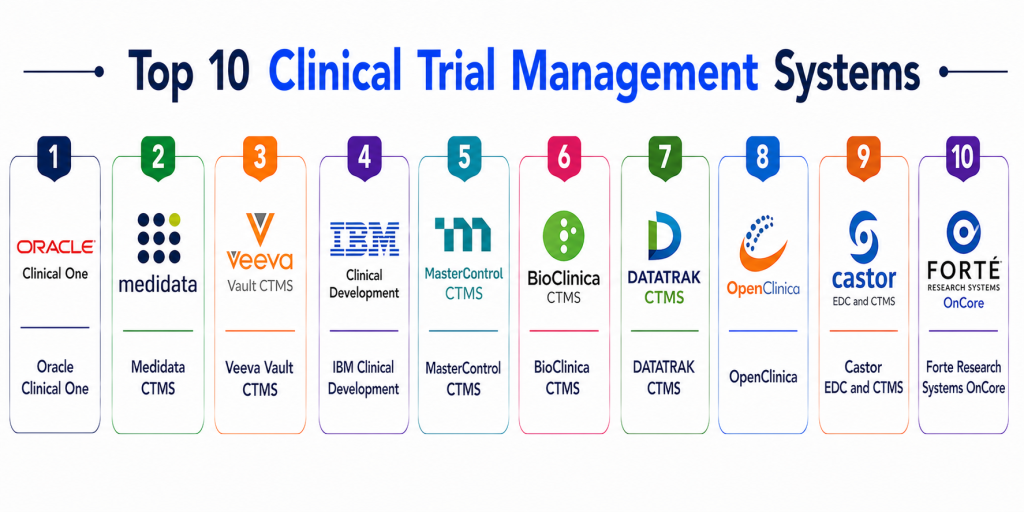
Top 10 Clinical Trial Management Systems
#1 — Oracle Clinical One
Short description: Oracle Clinical One is a unified platform combining CTMS, EDC, and analytics for managing clinical trials at scale.
Key Features
- Study management
- Patient tracking
- Data integration
- Reporting dashboards
- Compliance support
Pros
- Comprehensive platform
- Scalable
- Strong integration
Cons
- Expensive
- Complex setup
- Learning curve
Platforms / Deployment
- Web
- Cloud
Security & Compliance
- Enterprise-level controls
- Not publicly stated
Integrations & Ecosystem
Integrates with clinical systems and data tools.
- APIs
- EDC systems
- Data platforms
Support & Community
Enterprise support
#2 — Medidata CTMS
Short description: Medidata CTMS is a widely used platform for managing clinical operations and improving trial efficiency.
Key Features
- Study planning
- Site management
- Reporting
- Patient tracking
- Analytics
Pros
- Strong analytics
- Scalable
- Reliable
Cons
- Pricing
- Complex
- Requires training
Platforms / Deployment
- Web
- Cloud
Security & Compliance
- Not publicly stated
Integrations & Ecosystem
Supports integration with clinical tools.
- APIs
- Data systems
Support & Community
Enterprise support
#3 — Veeva Vault CTMS
Short description: Veeva Vault CTMS provides unified clinical operations with strong compliance and collaboration features.
Key Features
- Study tracking
- Site management
- Reporting
- Compliance tracking
- Workflow automation
Pros
- Strong compliance features
- Scalable
- Easy collaboration
Cons
- Expensive
- Complex
- Learning curve
Platforms / Deployment
- Web
- Cloud
Security & Compliance
- Compliance-focused controls
- Not publicly stated
Integrations & Ecosystem
Integrates with Veeva ecosystem.
- APIs
- Clinical systems
Support & Community
Enterprise support
#4 — IBM Clinical Development
Short description: IBM Clinical Development provides tools for managing clinical trials and ensuring data quality.
Key Features
- Study management
- Data tracking
- Reporting
- Analytics
- Compliance
Pros
- Reliable
- Scalable
- Good analytics
Cons
- Complex
- Expensive
- Learning curve
Platforms / Deployment
- Web
- Cloud
Security & Compliance
- Not publicly stated
Integrations & Ecosystem
Supports integration with enterprise tools.
- APIs
- Data systems
Support & Community
Enterprise support
#5 — MasterControl CTMS
Short description: MasterControl CTMS focuses on compliance and quality management in clinical trials.
Key Features
- Compliance tracking
- Document management
- Workflow automation
- Reporting
- Risk management
Pros
- Strong compliance
- Scalable
- Reliable
Cons
- Complex
- Pricing
- Learning curve
Platforms / Deployment
- Web
- Cloud
Security & Compliance
- Compliance-focused
- Not publicly stated
Integrations & Ecosystem
Integrates with quality systems.
- APIs
- Enterprise tools
Support & Community
Enterprise support
#6 — BioClinica CTMS
Short description: BioClinica provides clinical trial solutions with strong imaging and data capabilities.
Key Features
- Study tracking
- Data management
- Reporting
- Analytics
- Integration
Pros
- Specialized features
- Scalable
- Reliable
Cons
- Expensive
- Complex
- Limited flexibility
Platforms / Deployment
- Web
- Cloud
Security & Compliance
- Not publicly stated
Integrations & Ecosystem
Supports integration with clinical tools.
- APIs
- Data platforms
Support & Community
Enterprise support
#7 — DATATRAK CTMS
Short description: DATATRAK CTMS offers unified clinical data and trial management capabilities.
Key Features
- Study management
- Patient tracking
- Reporting
- Data integration
- Compliance
Pros
- Integrated platform
- Scalable
- Reliable
Cons
- Pricing
- Learning curve
- Setup effort
Platforms / Deployment
- Web
- Cloud
Security & Compliance
- Not publicly stated
Integrations & Ecosystem
Supports integration with clinical systems.
- APIs
- EDC
Support & Community
Good support
#8 — OpenClinica
Short description: OpenClinica is an open-source clinical trial platform offering data management and tracking capabilities.
Key Features
- Data collection
- Study tracking
- Reporting
- Compliance
- Integration
Pros
- Open-source option
- Flexible
- Affordable
Cons
- Limited advanced features
- Requires setup
- Smaller ecosystem
Platforms / Deployment
- Web
- Cloud Self-hosted
Security & Compliance
- Not publicly stated
Integrations & Ecosystem
Supports APIs and integrations.
- APIs
- Data tools
Support & Community
Open-source community
#9 — Castor EDC and CTMS
Short description: Castor provides clinical data capture and trial management with user-friendly interfaces.
Key Features
- Data capture
- Study tracking
- Reporting
- Collaboration
- Integration
Pros
- Easy to use
- Modern interface
- Affordable
Cons
- Limited enterprise features
- Smaller ecosystem
- Basic analytics
Platforms / Deployment
- Web
- Cloud
Security & Compliance
- Not publicly stated
Integrations & Ecosystem
Supports integrations with clinical tools.
- APIs
- Data systems
Support & Community
Good support
#10 — OnCore
Short description: OnCore is a clinical trial management system designed for research institutions and healthcare organizations.
Key Features
- Study management
- Patient tracking
- Reporting
- Workflow management
- Compliance
Pros
- Research-focused
- Scalable
- Reliable
Cons
- Complex
- Pricing
- Learning curve
Platforms / Deployment
- Web
- Cloud
Security & Compliance
- Not publicly stated
Integrations & Ecosystem
Supports integration with healthcare systems.
- APIs
- Clinical tools
Support & Community
Enterprise support
Comparison Table Top 10
| Tool Name | Best For | Platform Supported | Deployment | Standout Feature | Public Rating |
|---|---|---|---|---|---|
| Oracle Clinical One | Enterprise | Web | Cloud | Unified platform | N/A |
| Medidata CTMS | Global trials | Web | Cloud | Analytics | N/A |
| Veeva Vault CTMS | Compliance | Web | Cloud | Workflow automation | N/A |
| IBM Clinical | Data mgmt | Web | Cloud | Analytics | N/A |
| MasterControl | Compliance | Web | Cloud | Quality focus | N/A |
| BioClinica | Imaging trials | Web | Cloud | Specialized tools | N/A |
| DATATRAK | Integrated | Web | Cloud | Data integration | N/A |
| OpenClinica | Open-source | Web | Cloud Self-hosted | Flexibility | N/A |
| Castor | SMB | Web | Cloud | Ease of use | N/A |
| OnCore | Research | Web | Cloud | Research focus | N/A |
Evaluation & Scoring of Clinical Trial Management Systems
| Tool Name | Core | Ease | Integrations | Security | Performance | Support | Value | Weighted Total |
|---|---|---|---|---|---|---|---|---|
| Oracle Clinical One | 10 | 6 | 9 | 9 | 9 | 9 | 6 | 8.7 |
| Medidata | 9 | 7 | 9 | 9 | 9 | 8 | 6 | 8.4 |
| Veeva Vault | 9 | 7 | 9 | 9 | 9 | 8 | 6 | 8.4 |
| IBM Clinical | 9 | 6 | 8 | 9 | 9 | 8 | 6 | 8.2 |
| MasterControl | 9 | 6 | 8 | 9 | 8 | 8 | 6 | 8.1 |
| BioClinica | 8 | 6 | 8 | 8 | 8 | 8 | 6 | 7.8 |
| DATATRAK | 8 | 7 | 8 | 8 | 8 | 7 | 7 | 7.9 |
| OpenClinica | 7 | 7 | 7 | 7 | 7 | 7 | 9 | 7.6 |
| Castor | 7 | 9 | 7 | 7 | 7 | 7 | 8 | 7.7 |
| OnCore | 8 | 6 | 7 | 8 | 8 | 7 | 7 | 7.6 |
Scores are comparative and reflect scalability, compliance, and usability across CTMS platforms.
Which Clinical Trial Management System Is Right for You
Small Research Teams
OpenClinica or Castor are affordable and flexible.
SMB CROs
DATATRAK and Castor provide strong value.
Mid-Market
Medidata and Veeva Vault offer balanced features.
Enterprise / Pharma
Oracle Clinical One and IBM Clinical Development are ideal.
Budget vs Premium
OpenClinica is budget-friendly, Oracle is premium.
Feature Depth vs Ease of Use
Oracle for depth, Castor for simplicity.
Integrations & Scalability
Medidata and Veeva Vault are strong options.
Security & Compliance Needs
Enterprise tools provide strongest compliance support.
Frequently Asked Questions
1. What is a CTMS
A CTMS is software used to manage clinical trials from planning to execution. It tracks studies, patients, and data. This improves efficiency.
2. Why is CTMS important
It ensures compliance and improves trial management. It helps reduce delays and errors. This enhances trial outcomes.
3. How does CTMS work
It centralizes trial data and workflows. It tracks progress and manages sites. This improves coordination.
4. Is CTMS suitable for small trials
Yes, some tools are designed for smaller studies. However, full CTMS platforms are often used by larger organizations.
5. How much does CTMS cost
Pricing varies widely. Open-source tools are affordable, while enterprise solutions are expensive.
6. Do CTMS integrate with other systems
Yes, most integrate with EDC, eTMF, and lab systems. This improves workflow efficiency.
7. How long does implementation take
Implementation can take weeks depending on complexity. Larger systems require more setup.
8. What are common mistakes
Choosing tools without scalability is common. Poor data integration can also cause issues.
9. Are CTMS secure
Most tools provide strong security features. Compliance varies by provider.
10. Are there alternatives
Manual systems or spreadsheets can be used. However, they lack scalability and automation.
Conclusion
Clinical Trial Management Systems are essential for managing the complexity of modern clinical research, enabling organizations to plan, execute, and monitor trials efficiently while ensuring compliance and data integrity. These platforms provide centralized control, automation, and real-time insights that help reduce risks and accelerate study timelines. From flexible solutions like OpenClinica and Castor to enterprise-grade platforms like Oracle Clinical One and Medidata, each tool offers unique strengths depending on the scale and requirements of the trial. The best choice depends on factors such as regulatory needs, integration capabilities, and scalability rather than a one-size-fits-all solution. Organizations should prioritize compliance, usability, and ecosystem integration when selecting a CTMS. A practical next step is to shortlist a few tools, run pilot studies, and evaluate how well they align with your clinical workflows and long-term research goals.