Introduction
DDoS Protection Tools are specialized cybersecurity solutions designed to detect, mitigate, and prevent Distributed Denial-of-Service (DDoS) attacks. These attacks overwhelm servers, networks, or applications with massive volumes of traffic, making services unavailable to legitimate users.
With the rapid growth of cloud services, APIs, and IoT devices, DDoS attacks have become more frequent, larger, and more complex. Modern attacks often use multi-vector strategies—targeting multiple layers simultaneously—making traditional defenses insufficient.
Today’s DDoS protection tools combine real-time traffic analysis, AI-driven detection, and global scrubbing networks to ensure uptime and reliability even during large-scale attacks.
Real-world use cases include:
- Protecting websites and APIs from downtime
- Securing gaming platforms and streaming services
- Safeguarding financial services and e-commerce systems
- Preventing service disruption in cloud environments
- Ensuring uptime for enterprise applications
What buyers should evaluate:
- Detection speed and accuracy
- Multi-layer (L3/L4/L7) protection
- Global mitigation network capacity
- Integration with cloud providers
- Automation and AI capabilities
- Performance impact and latency
- Reporting and visibility
- Scalability for high traffic
- Cost vs value
Best for: Enterprises, SaaS companies, cloud-native businesses, ISPs, and any organization with public-facing applications.
Not ideal for: Small internal systems without internet exposure or low-risk environments.
Key Trends in DDoS Protection Tools
- AI-driven detection and mitigation of attacks
- Multi-vector attack protection across all network layers
- Cloud-based scrubbing centers for traffic filtering
- Integration with WAF and Zero Trust frameworks
- Real-time threat intelligence and automation
- Edge-based mitigation to reduce latency
- API and application-layer protection
- Subscription and usage-based pricing models
- Increased focus on IoT-driven attack prevention
- Hybrid deployment models combining on-prem and cloud
How We Selected These Tools (Methodology)
- Evaluated industry adoption and credibility
- Assessed multi-layer protection capabilities
- Reviewed performance under large-scale attacks
- Considered automation and AI features
- Analyzed integration with cloud ecosystems
- Included enterprise and SMB-friendly tools
- Compared ease of deployment and usability
- Evaluated global network capacity and resilience
- Focused on real-world scalability and reliability
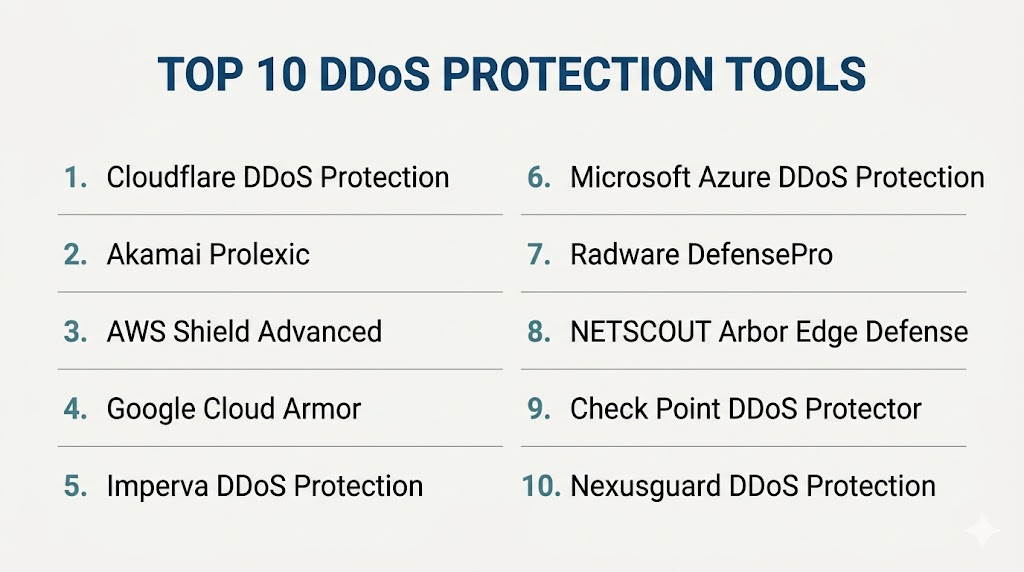
Top 10 DDoS Protection Tools
#1 — Cloudflare DDoS Protection
Short description: A globally distributed cloud-based platform providing automated DDoS mitigation and edge security.
Key Features
- Global Anycast network
- Automatic attack mitigation
- Layer 3–7 protection
- Bot detection
- Real-time analytics
- API and web protection
Pros
- Easy deployment
- Massive global network
Cons
- Limited customization in lower plans
- Usage-based pricing
Platforms / Deployment
Web
Cloud
Security & Compliance
Encryption, RBAC (details not publicly stated)
Integrations & Ecosystem
Cloudflare integrates with modern cloud and DevOps ecosystems.
- CDN
- APIs
- Security tools
Support & Community
Strong documentation and large community.
#2 — Akamai Prolexic
Short description: A premium DDoS mitigation service designed for large-scale enterprise and mission-critical applications.
Key Features
- Global scrubbing centers
- Always-on protection
- Real-time threat intelligence
- Layered defense
- High scalability
Pros
- Excellent performance
- Enterprise-grade reliability
Cons
- Expensive
- Complex onboarding
Platforms / Deployment
Cloud
Managed Service
Security & Compliance
Not publicly stated
Integrations & Ecosystem
Integrated within Akamai ecosystem.
- CDN
- Security tools
Support & Community
Enterprise-level support.
#3 — AWS Shield Advanced
Short description: A cloud-native DDoS protection service integrated into AWS infrastructure.
Key Features
- Automatic attack detection
- Integration with AWS services
- Real-time monitoring
- Custom protections
- Advanced reporting
Pros
- Seamless AWS integration
- Highly scalable
Cons
- Limited outside AWS
- Requires AWS expertise
Platforms / Deployment
Web
Cloud
Security & Compliance
IAM integration, encryption (details not publicly stated)
Integrations & Ecosystem
Deep integration with AWS services.
- CloudFront
- Load balancers
- API Gateway
Support & Community
Strong documentation and community.
#4 — Google Cloud Armor
Short description: A cloud-based security service providing DDoS protection for applications hosted on Google Cloud.
Key Features
- Edge-based protection
- Traffic filtering
- Integration with load balancing
- Threat detection
- Custom rules
Pros
- High performance
- Strong cloud integration
Cons
- Limited outside Google Cloud
- Requires cloud expertise
Platforms / Deployment
Web
Cloud
Security & Compliance
Not publicly stated
Integrations & Ecosystem
Integrated with Google Cloud services.
- Load balancers
- APIs
Support & Community
Strong cloud ecosystem support.
#5 — Imperva DDoS Protection
Short description: A comprehensive solution providing network and application-layer DDoS defense.
Key Features
- Multi-layer protection
- Real-time analytics
- Bot mitigation
- API protection
- Traffic monitoring
Pros
- Strong application-layer security
- Reliable performance
Cons
- Premium pricing
- Complex setup
Platforms / Deployment
Cloud / On-premises
Hybrid
Security & Compliance
Not publicly stated
Integrations & Ecosystem
Integrates with enterprise security platforms.
- SIEM tools
- APIs
Support & Community
Enterprise support available.
#6 — Microsoft Azure DDoS Protection
Short description: A cloud-native service designed to protect Azure-hosted applications from DDoS attacks.
Key Features
- Automatic attack mitigation
- Integration with Azure services
- Real-time telemetry
- Adaptive tuning
- Analytics
Pros
- Seamless Azure integration
- Scalable
Cons
- Limited outside Azure
- Requires Azure knowledge
Platforms / Deployment
Web
Cloud
Security & Compliance
Azure security controls (details not publicly stated)
Integrations & Ecosystem
Deep integration with Azure ecosystem.
- Azure services
- APIs
Support & Community
Strong support and documentation.
#7 — Radware DefensePro
Short description: A hybrid DDoS protection platform combining on-premises appliances with cloud mitigation.
Key Features
- Behavioral analysis
- Real-time mitigation
- Hybrid deployment
- Automated response
- Threat intelligence
Pros
- Flexible deployment
- Strong detection capabilities
Cons
- Complex configuration
- Higher cost
Platforms / Deployment
Appliance / Cloud
Hybrid
Security & Compliance
Not publicly stated
Integrations & Ecosystem
Supports integration with enterprise networks.
- Security tools
- APIs
Support & Community
Enterprise-level support.
#8 — NETSCOUT Arbor Edge Defense
Short description: A network-based DDoS protection solution designed for enterprise and service provider environments.
Key Features
- Network-level protection
- Traffic visibility
- Threat detection
- Automation
- Scalability
Pros
- Strong network visibility
- Enterprise-grade solution
Cons
- Expensive
- Requires expertise
Platforms / Deployment
Appliance
On-premises
Security & Compliance
Not publicly stated
Integrations & Ecosystem
Integrates with enterprise network infrastructure.
- Network tools
- APIs
Support & Community
Strong enterprise support.
#9 — Nexusguard DDoS Protection
Short description: A managed DDoS mitigation platform offering automated detection and real-time protection.
Key Features
- Automated detection
- Traffic analysis
- Global mitigation network
- Real-time monitoring
- Threat intelligence
Pros
- Managed service option
- Good scalability
Cons
- Limited brand recognition
- Pricing varies
Platforms / Deployment
Cloud
Managed Service
Security & Compliance
Not publicly stated
Integrations & Ecosystem
Supports integration with network environments.
- APIs
- Security tools
Support & Community
Managed support with enterprise focus.
#10 — AppTrana
Short description: A cloud-based application security platform with integrated DDoS protection capabilities.
Key Features
- Behavior-based protection
- Continuous monitoring
- Risk detection
- Managed services
- Web application security
Pros
- Easy to deploy
- Managed security support
Cons
- Limited customization
- Smaller ecosystem
Platforms / Deployment
Web
Cloud
Security & Compliance
Not publicly stated
Integrations & Ecosystem
Supports integration with application security tools.
- APIs
- Cloud services
Support & Community
Good support with managed service model.
Comparison Table (Top 10)
| Tool Name | Best For | Platform(s) Supported | Deployment | Standout Feature | Public Rating |
|---|---|---|---|---|---|
| Cloudflare | SMB/Enterprise | Web | Cloud | Global network | N/A |
| Akamai Prolexic | Enterprise | Cloud | Managed | Always-on protection | N/A |
| AWS Shield | Cloud users | Web | Cloud | AWS integration | N/A |
| Google Cloud Armor | Cloud users | Web | Cloud | Edge protection | N/A |
| Imperva | Enterprise | Hybrid | Hybrid | Multi-layer security | N/A |
| Azure DDoS | Cloud users | Web | Cloud | Adaptive protection | N/A |
| Radware DefensePro | Enterprise | Hybrid | Hybrid | Behavioral analysis | N/A |
| Arbor Edge Defense | Enterprise | Appliance | On-prem | Network visibility | N/A |
| Nexusguard | Enterprise | Cloud | Managed | Global mitigation | N/A |
| AppTrana | SMB | Web | Cloud | Managed security | N/A |
Evaluation & Scoring of DDoS Protection Tools
| Tool Name | Core (25%) | Ease (15%) | Integrations (15%) | Security (10%) | Performance (10%) | Support (10%) | Value (15%) | Weighted Total (0–10) |
|---|---|---|---|---|---|---|---|---|
| Cloudflare | 9 | 9 | 8 | 8 | 9 | 8 | 8 | 8.6 |
| Akamai | 9 | 7 | 8 | 9 | 9 | 9 | 6 | 8.3 |
| AWS Shield | 8 | 7 | 9 | 8 | 8 | 8 | 7 | 7.9 |
| Google Armor | 8 | 7 | 9 | 8 | 8 | 8 | 7 | 7.9 |
| Imperva | 9 | 7 | 8 | 9 | 8 | 8 | 6 | 8.0 |
| Azure DDoS | 8 | 7 | 9 | 8 | 8 | 8 | 7 | 7.9 |
| Radware | 9 | 6 | 8 | 8 | 9 | 8 | 6 | 7.9 |
| Arbor | 8 | 6 | 7 | 8 | 8 | 8 | 6 | 7.5 |
| Nexusguard | 8 | 7 | 7 | 8 | 8 | 7 | 7 | 7.6 |
| AppTrana | 7 | 8 | 7 | 7 | 7 | 7 | 8 | 7.4 |
How to interpret these scores:
These scores are comparative and reflect typical use cases across different organizations. Enterprise tools score higher in performance and security, while cloud-native tools excel in ease of use and scalability. Choose based on your infrastructure and risk level.
Which DDoS Protection Tool Is Right for You?
Solo / Freelancer
Basic CDN-based protection tools are usually sufficient.
SMB
Cloudflare and AppTrana offer easy deployment and strong protection.
Mid-Market
AWS Shield and Azure DDoS provide scalable cloud-native solutions.
Enterprise
Akamai, Radware, Imperva, and Arbor offer advanced, high-capacity protection.
Budget vs Premium
Budget tools provide basic protection, while premium tools deliver advanced mitigation and global coverage.
Feature Depth vs Ease of Use
Advanced tools offer deep customization, while simpler tools focus on ease of deployment.
Integrations & Scalability
Choose tools aligned with your cloud ecosystem for better scalability.
Security & Compliance Needs
Highly regulated industries should prioritize enterprise-grade solutions.
Frequently Asked Questions (FAQs)
1. What is DDoS protection?
It protects systems from traffic overload attacks designed to disrupt services.
2. How do DDoS protection tools work?
They detect abnormal traffic and filter malicious requests using scrubbing and rate limiting.
3. Are DDoS attacks still a major threat?
Yes, attacks are increasing in scale and complexity.
4. What is multi-vector DDoS?
An attack targeting multiple layers simultaneously.
5. Do cloud providers offer DDoS protection?
Yes, most major cloud providers include built-in protection.
6. Can DDoS protection affect performance?
Modern tools are optimized for minimal latency.
7. Are these tools necessary for all businesses?
Only for businesses with internet-facing services.
8. What is traffic scrubbing?
Filtering malicious traffic before it reaches servers.
9. Can DDoS tools integrate with WAF?
Yes, many solutions integrate with WAF platforms.
10. How do I choose the right tool?
Evaluate based on scale, infrastructure, and threat level.
Conclusion
DDoS Protection Tools are essential for maintaining uptime, performance, and security in today’s digital landscape. As attacks grow more sophisticated and multi-layered, organizations must adopt advanced solutions that combine automation, AI-driven detection, and global mitigation capabilities. While cloud-native tools provide scalability and ease of use, enterprise-grade platforms deliver deeper control and resilience. The best approach is to shortlist a few tools, test them in your environment, and ensure they align with your infrastructure, traffic patterns, and security requirements before making a final decision.