Introduction
Log Management Tools are platforms that collect, store, analyze, and manage log data generated by applications, servers, networks, and security systems. These logs act as a detailed record of system activity, helping teams understand performance, troubleshoot issues, and detect security threats.
In modern environments driven by microservices, cloud-native infrastructure, and distributed systems, log data volumes have exploded. Without proper tools, analyzing logs becomes inefficient and error-prone. Log management tools transform raw log data into searchable, structured insights, enabling faster debugging, better observability, and improved compliance.
Real-World Use Cases
- Troubleshooting application and infrastructure issues
- Monitoring system performance and uptime
- Detecting security threats and anomalies
- Supporting compliance and audit requirements
- Centralizing logs across multi-cloud environments
What Buyers Should Evaluate
- Log collection and ingestion capabilities
- Search and query performance
- Real-time monitoring and alerting
- Integration with observability and DevOps tools
- Scalability for large log volumes
- Data retention and storage costs
- Visualization and dashboards
- Security and compliance features
Best for: DevOps teams, SREs, security analysts, and enterprises managing large-scale distributed systems.
Not ideal for: Small applications with minimal logging requirements or teams needing only basic monitoring.
Key Trends in Log Management Tools
- AI-driven log analysis and anomaly detection
- Integration with full observability platforms
- Adoption of OpenTelemetry standards
- Real-time log streaming and processing
- Cloud-native and multi-cloud log management
- Cost optimization through log filtering and routing
- Security-focused log analytics (SIEM integration)
- Automation of alerting and incident response
- Unified dashboards combining logs, metrics, and traces
- Developer-first log analysis experiences
How We Selected These Tools (Methodology)
- Strong adoption across DevOps and enterprise environments
- Comprehensive log ingestion and analysis capabilities
- Integration with cloud-native ecosystems
- Proven scalability and performance
- Security and compliance features
- Active community or vendor support
- Flexibility across deployment models
- Balanced mix of open-source and enterprise tools
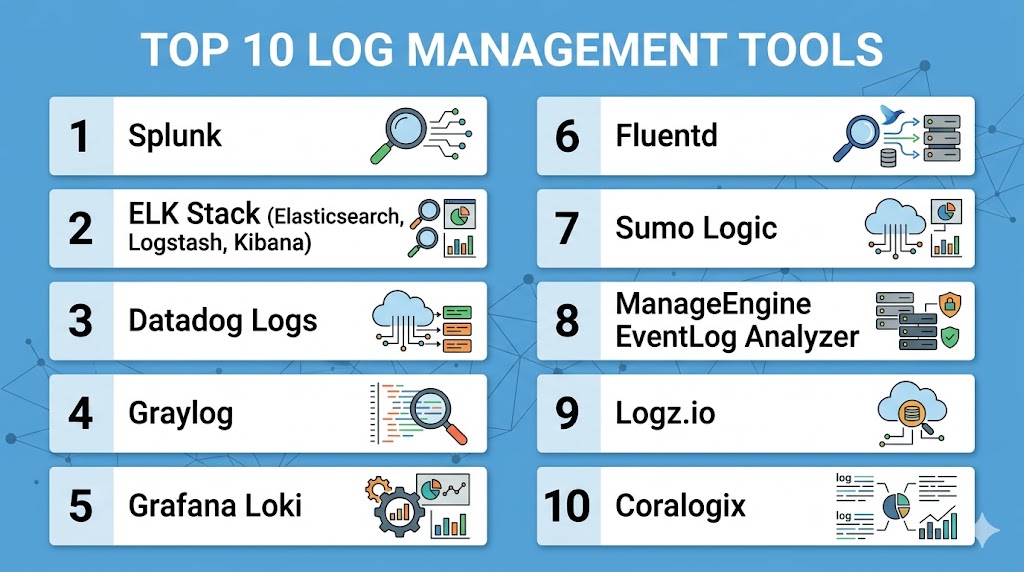
Top 10 Log Management Tools
#1 — Splunk
Short description: An enterprise-grade platform for log aggregation, monitoring, and analytics.
Key Features
- Real-time log indexing and search
- Advanced analytics and dashboards
- Machine learning capabilities
- Alerting and reporting
- Large-scale data processing
Pros
- Powerful analytics engine
- Enterprise scalability
Cons
- Expensive
- Complex setup
Platforms / Deployment
Web
Cloud / Self-hosted
Security & Compliance
RBAC, audit logs
Not publicly stated
Integrations & Ecosystem
- DevOps tools
- Cloud platforms
- Security tools
Support & Community
Strong enterprise support.
#2 — ELK Stack (Elasticsearch, Logstash, Kibana)
Short description: A popular open-source stack for centralized log management and visualization.
Key Features
- Log ingestion and processing
- Real-time search and analytics
- Visualization dashboards
- Scalability
- Open-source flexibility
Pros
- Free and open-source
- Highly customizable
Cons
- Requires setup and maintenance
- Resource-intensive
Platforms / Deployment
Windows / macOS / Linux
Cloud / Self-hosted
Security & Compliance
Not publicly stated
Integrations & Ecosystem
- Beats agents
- Cloud services
- DevOps tools
Support & Community
Large open-source community.
#3 — Datadog Logs
Short description: A cloud-native log management solution integrated with full observability.
Key Features
- Real-time log ingestion
- Correlation with metrics and traces
- AI-powered alerts
- Visualization dashboards
- Cloud integrations
Pros
- Unified observability
- Easy integration
Cons
- Expensive at scale
- Pricing complexity
Platforms / Deployment
Web
Cloud
Security & Compliance
RBAC, encryption
Not publicly stated
Integrations & Ecosystem
- AWS
- Kubernetes
- CI/CD tools
Support & Community
Strong enterprise support.
#4 — Graylog
Short description: An open-source log management platform focused on centralized logging.
Key Features
- Log collection and processing
- Search and analysis
- Alerting system
- Dashboards
- Scalability
Pros
- Open-source option
- Easy to deploy
Cons
- Limited advanced analytics
- UI limitations
Platforms / Deployment
Windows / Linux
Cloud / Self-hosted
Security & Compliance
Not publicly stated
Integrations & Ecosystem
- Syslog sources
- DevOps tools
Support & Community
Active community.
#5 — Grafana Loki
Short description: A lightweight log aggregation system designed for cloud-native environments.
Key Features
- Log aggregation
- Integration with Grafana
- Efficient storage
- Kubernetes support
- Label-based indexing
Pros
- Cost-efficient
- Cloud-native
Cons
- Limited advanced features
- Requires setup
Platforms / Deployment
Linux
Cloud / Self-hosted
Security & Compliance
Not publicly stated
Integrations & Ecosystem
- Grafana
- Prometheus
Support & Community
Strong open-source support.
#6 — Fluentd
Short description: A data collector for unified logging across multiple sources.
Key Features
- Log aggregation
- Data routing
- Plugin ecosystem
- Multi-source support
- Open-source
Pros
- Flexible and extensible
- Lightweight
Cons
- Not a full analysis platform
- Requires additional tools
Platforms / Deployment
Windows / macOS / Linux
Cloud / Self-hosted
Security & Compliance
Not publicly stated
Integrations & Ecosystem
- Cloud platforms
- DevOps tools
Support & Community
Active open-source community.
#7 — Sumo Logic
Short description: A cloud-native log analytics platform for monitoring and security insights.
Key Features
- Log aggregation and analysis
- Real-time monitoring
- Security analytics
- Dashboards
- Alerts
Pros
- Cloud-native
- Strong analytics
Cons
- Pricing
- Learning curve
Platforms / Deployment
Web
Cloud
Security & Compliance
Encryption, RBAC
Not publicly stated
Integrations & Ecosystem
- Cloud platforms
- DevOps tools
Support & Community
Enterprise support.
#8 — ManageEngine EventLog Analyzer
Short description: A log management and SIEM tool focused on compliance and security.
Key Features
- Log collection and analysis
- Security monitoring
- Compliance reporting
- Alerting
- Visualization
Pros
- Strong compliance features
- Easy deployment
Cons
- Limited scalability
- UI complexity
Platforms / Deployment
Windows
Self-hosted
Security & Compliance
Compliance reporting features
Not publicly stated
Integrations & Ecosystem
- Windows/Unix systems
- Security tools
Support & Community
Vendor support.
#9 — Logz.io
Short description: A cloud-based log management platform built on open-source technologies.
Key Features
- Log analytics
- Open-source stack integration
- Real-time monitoring
- Alerts
- Visualization
Pros
- Easy cloud deployment
- Scalable
Cons
- Paid plans
- Limited customization
Platforms / Deployment
Web
Cloud
Security & Compliance
Not publicly stated
Integrations & Ecosystem
- ELK-based tools
- Cloud services
Support & Community
Vendor support.
#10 — Coralogix
Short description: A modern log analytics platform focused on real-time insights and cost optimization.
Key Features
- Real-time log analysis
- Machine learning insights
- Alerting
- Dashboards
- Cost optimization
Pros
- Fast performance
- Cost-efficient
Cons
- Smaller ecosystem
- Learning curve
Platforms / Deployment
Web
Cloud
Security & Compliance
Not publicly stated
Integrations & Ecosystem
- Cloud platforms
- DevOps tools
Support & Community
Growing support.
Comparison Table (Top 10)
| Tool Name | Best For | Platform(s) Supported | Deployment | Standout Feature | Public Rating |
|---|---|---|---|---|---|
| Splunk | Enterprise | Web | Hybrid | Advanced analytics | N/A |
| ELK Stack | Open-source | Multi-OS | Hybrid | Customization | N/A |
| Datadog Logs | Cloud teams | Web | Cloud | Unified observability | N/A |
| Graylog | SMB | Multi-OS | Hybrid | Central logging | N/A |
| Grafana Loki | Cloud-native | Linux | Hybrid | Cost efficiency | N/A |
| Fluentd | Data collection | Multi-OS | Hybrid | Flexibility | N/A |
| Sumo Logic | Cloud analytics | Web | Cloud | Security insights | N/A |
| ManageEngine | Compliance | Windows | Self-hosted | SIEM features | N/A |
| Logz.io | Cloud-native | Web | Cloud | ELK-based | N/A |
| Coralogix | Modern teams | Web | Cloud | Real-time analysis | N/A |
Evaluation & Scoring of Log Management Tools
| Tool Name | Core | Ease | Integrations | Security | Performance | Support | Value | Weighted Total |
|---|---|---|---|---|---|---|---|---|
| Splunk | 10 | 7 | 9 | 10 | 9 | 9 | 6 | 8.9 |
| ELK Stack | 9 | 6 | 9 | 8 | 9 | 8 | 10 | 8.6 |
| Datadog | 9 | 8 | 10 | 9 | 9 | 9 | 7 | 9.0 |
| Graylog | 8 | 8 | 7 | 8 | 8 | 8 | 9 | 8.2 |
| Loki | 8 | 7 | 8 | 7 | 9 | 8 | 10 | 8.3 |
| Fluentd | 7 | 7 | 9 | 7 | 8 | 7 | 10 | 8.0 |
| Sumo Logic | 9 | 8 | 8 | 9 | 9 | 8 | 7 | 8.6 |
| ManageEngine | 8 | 8 | 7 | 9 | 8 | 8 | 8 | 8.2 |
| Logz.io | 8 | 8 | 8 | 8 | 8 | 8 | 8 | 8.1 |
| Coralogix | 8 | 8 | 8 | 8 | 9 | 7 | 8 | 8.2 |
How to interpret scores:
These scores compare tools across features, usability, and value. Enterprise tools excel in analytics and security, while open-source tools provide flexibility and cost efficiency. Choose based on your scale and infrastructure needs.
Which Log Management Tool Is Right for You?
Solo / Freelancer
Grafana Loki and ELK Stack are cost-effective and flexible.
SMB
Graylog and Logz.io offer ease of use and scalability.
Mid-Market
Datadog and Sumo Logic provide strong automation and analytics.
Enterprise
Splunk and Coralogix deliver advanced insights and scalability.
Budget vs Premium
- Budget: ELK Stack, Fluentd
- Premium: Splunk, Datadog
Feature Depth vs Ease of Use
- Feature-rich: Splunk
- Easy-to-use: Datadog
Integrations & Scalability
- Best integrations: Datadog
- Scalable: Splunk
Security & Compliance Needs
- Strong security: Splunk
- Moderate: Graylog
Frequently Asked Questions (FAQs)
What is a log management tool?
It collects, stores, and analyzes log data from systems and applications.
Why is log management important?
It helps troubleshoot issues, monitor performance, and detect security threats.
Do these tools support real-time monitoring?
Yes, most modern tools provide real-time insights.
Are log management tools expensive?
Some enterprise tools are costly; open-source options are cheaper.
Do they integrate with DevOps tools?
Yes, integration is a key feature.
Can small teams use them?
Yes, especially lightweight or open-source tools.
What data do they handle?
Logs from applications, servers, and network devices.
Are they secure?
Most include encryption and access controls.
What is the best log management tool?
Depends on your infrastructure and needs.
Do they support cloud environments?
Yes, many tools are cloud-native.
Conclusion
Log Management Tools are essential for maintaining system reliability, security, and performance in modern IT environments. By transforming raw log data into actionable insights, these tools enable teams to quickly identify issues, optimize operations, and ensure compliance. Whether you choose enterprise platforms like Splunk or flexible open-source solutions like ELK Stack, the right tool depends on your scale, budget, and technical requirements. To make the best choice, shortlist a few tools, integrate them into your workflow, and evaluate their effectiveness in real-world scenarios.