Introduction
Code editors are essential tools that developers use to write, edit, and manage source code efficiently. Unlike full-fledged IDEs, code editors are typically lightweight, fast, and highly customizable, making them ideal for a wide range of programming tasks. From simple scripting to large-scale application development, code editors provide syntax highlighting, extensions, and productivity features that streamline coding workflows.
In today’s development landscape, code editors have evolved significantly. With AI-assisted coding, cloud-based development environments, and integrated DevOps workflows, modern editors are no longer just text editors—they are productivity platforms. Developers now expect intelligent autocomplete, real-time collaboration, and seamless integrations with version control and deployment tools.
Real-World Use Cases
- Writing and editing application code across languages
- Debugging and testing scripts
- Managing frontend, backend, and full-stack projects
- Collaborating with teams through extensions and plugins
- Rapid prototyping and experimentation
What Buyers Should Evaluate
- Performance and responsiveness
- Language support and extensibility
- Built-in vs plugin-based features
- AI-assisted coding capabilities
- Debugging and terminal integration
- Cross-platform support
- Customization options
- Community and extension ecosystem
- Security features and updates
Best for: Developers, software engineers, students, DevOps professionals, and teams needing flexible and efficient coding tools.
Not ideal for: Users requiring heavy enterprise tooling, deep debugging, or complex application lifecycle management—full IDEs may be better suited.
Key Trends in Code Editors for 2026 and Beyond
- AI-powered code completion and generation becoming standard
- Integration with cloud development environments
- Real-time collaboration and pair programming features
- Expansion of plugin marketplaces and ecosystems
- Built-in security scanning and linting tools
- Performance optimization for large codebases
- Cross-platform uniform experiences
- Lightweight editors evolving into IDE-like platforms
- Remote development capabilities via containers and SSH
- Personalization using developer behavior insights
How We Selected These Tools (Methodology)
- High adoption among developers globally
- Strong plugin and extension ecosystems
- Performance and reliability across environments
- Support for multiple programming languages
- Integration with modern development workflows
- Ease of use and onboarding experience
- Community strength and documentation quality
- Balance between lightweight and feature-rich capabilities
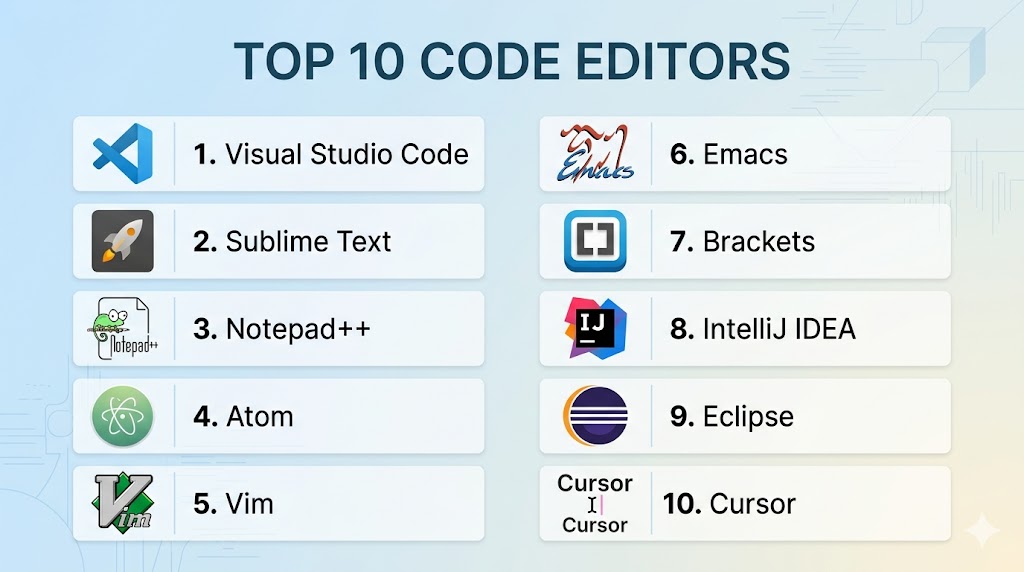
Top 10 Code Editors
#1 — Visual Studio Code
Short description: A highly popular, extensible code editor by Microsoft supporting a wide range of languages and workflows.
Key Features
- Rich extension marketplace
- Built-in Git integration
- IntelliSense (smart autocomplete)
- Debugging tools
- Integrated terminal
- Remote development support
Pros
- Extremely versatile and customizable
- Massive community support
Cons
- Can become heavy with many extensions
- Requires configuration for optimal use
Platforms / Deployment
Windows / macOS / Linux
Desktop / Remote environments
Security & Compliance
MFA via integrations, extension sandboxing
Not publicly stated (full compliance details)
Integrations & Ecosystem
Extensive ecosystem supporting development workflows.
- GitHub
- Docker
- Kubernetes
- Azure
- Third-party plugins
Support & Community
Very strong global community with extensive documentation.
#2 — Sublime Text
Short description: A fast and lightweight code editor known for performance and simplicity.
Key Features
- Fast startup and performance
- Multi-cursor editing
- Command palette
- Plugin support
- Syntax highlighting
Pros
- Extremely fast
- Minimal resource usage
Cons
- Limited built-in features
- Paid license for full usage
Platforms / Deployment
Windows / macOS / Linux
Desktop
Security & Compliance
Not publicly stated
Integrations & Ecosystem
Supports plugins for extended functionality.
Support & Community
Active community and plugin ecosystem.
#3 — Notepad++
Short description: A lightweight text and code editor for Windows users.
Key Features
- Syntax highlighting
- Plugin support
- Lightweight performance
- Multi-tab editing
- Macro recording
Pros
- Free and lightweight
- Easy to use
Cons
- Windows-only
- Limited advanced features
Platforms / Deployment
Windows
Desktop
Security & Compliance
Not publicly stated
Integrations & Ecosystem
Basic plugin support.
Support & Community
Strong community support.
#4 — Atom
Short description: An open-source editor known for customization and community-driven development.
Key Features
- Hackable interface
- Built-in Git integration
- Package ecosystem
- Cross-platform support
- Collaborative features
Pros
- Highly customizable
- Open-source
Cons
- Slower performance
- Development activity reduced
Platforms / Deployment
Windows / macOS / Linux
Desktop
Security & Compliance
Not publicly stated
Integrations & Ecosystem
Large package ecosystem.
Support & Community
Declining community activity.
#5 — Vim
Short description: A powerful, keyboard-driven code editor used by advanced developers.
Key Features
- Modal editing
- High efficiency workflows
- Extensive plugin support
- Terminal-based usage
- Custom scripting
Pros
- Extremely fast
- Highly efficient for power users
Cons
- Steep learning curve
- Not beginner-friendly
Platforms / Deployment
Windows / macOS / Linux
Terminal-based
Security & Compliance
Not publicly stated
Integrations & Ecosystem
Supports plugins and scripting.
Support & Community
Large and dedicated community.
#6 — Emacs
Short description: A highly extensible editor with powerful customization capabilities.
Key Features
- Lisp-based customization
- Built-in tools and extensions
- Multi-language support
- Terminal and GUI modes
- Package manager
Pros
- Extremely flexible
- Strong community
Cons
- Complex setup
- Steep learning curve
Platforms / Deployment
Windows / macOS / Linux
Desktop / Terminal
Security & Compliance
Not publicly stated
Integrations & Ecosystem
Extensive package ecosystem.
Support & Community
Long-standing developer community.
#7 — Brackets
Short description: A web-focused code editor designed for frontend development.
Key Features
- Live preview
- Inline editing
- Preprocessor support
- Lightweight interface
- Extensions
Pros
- Great for web developers
- Easy to use
Cons
- Limited broader language support
- Smaller ecosystem
Platforms / Deployment
Windows / macOS / Linux
Desktop
Security & Compliance
Not publicly stated
Integrations & Ecosystem
Focused on web development tools.
Support & Community
Moderate community support.
#8 — IntelliJ IDEA
Short description: A powerful Java-focused editor with advanced development tools.
Key Features
- Smart code completion
- Advanced debugging
- Refactoring tools
- Plugin ecosystem
- Framework support
Pros
- Excellent for Java development
- Feature-rich
Cons
- Heavy resource usage
- Paid version required for full features
Platforms / Deployment
Windows / macOS / Linux
Desktop
Security & Compliance
Not publicly stated
Integrations & Ecosystem
- Git
- Maven
- Gradle
Support & Community
Strong enterprise and developer support.
#9 — Eclipse
Short description: A long-standing development platform with strong plugin support.
Key Features
- Plugin-based architecture
- Java development tools
- Debugging support
- Code analysis tools
- Large ecosystem
Pros
- Mature platform
- Highly extensible
Cons
- Heavy and complex
- UI can feel outdated
Platforms / Deployment
Windows / macOS / Linux
Desktop
Security & Compliance
Not publicly stated
Integrations & Ecosystem
- Git
- Maven
- Jenkins
Support & Community
Large but aging community.
#10 — Cursor
Short description: A modern AI-powered code editor designed for intelligent development workflows.
Key Features
- AI-assisted coding
- Smart autocomplete
- Code explanation tools
- Chat-based development
- Modern UI
Pros
- AI-first approach
- Improves productivity
Cons
- Newer tool
- Limited ecosystem maturity
Platforms / Deployment
Varies / N/A
Security & Compliance
Not publicly stated
Integrations & Ecosystem
- AI integrations
- Developer tools
Support & Community
Growing community support.
Comparison Table (Top 10)
| Tool Name | Best For | Platform(s) Supported | Deployment | Standout Feature | Public Rating |
|---|---|---|---|---|---|
| VS Code | All developers | Multi-OS | Desktop | Extensions | N/A |
| Sublime Text | Speed | Multi-OS | Desktop | Performance | N/A |
| Notepad++ | Beginners | Windows | Desktop | Lightweight | N/A |
| Atom | Customization | Multi-OS | Desktop | Hackable UI | N/A |
| Vim | Power users | Multi-OS | Terminal | Efficiency | N/A |
| Emacs | Advanced users | Multi-OS | Desktop | Extensibility | N/A |
| Brackets | Web dev | Multi-OS | Desktop | Live preview | N/A |
| IntelliJ | Java dev | Multi-OS | Desktop | Smart coding | N/A |
| Eclipse | Enterprise | Multi-OS | Desktop | Plugins | N/A |
| Cursor | AI dev | N/A | Desktop | AI coding | N/A |
Evaluation & Scoring of Code Editors
| Tool Name | Core | Ease | Integrations | Security | Performance | Support | Value | Weighted Total |
|---|---|---|---|---|---|---|---|---|
| VS Code | 10 | 9 | 10 | 9 | 9 | 10 | 9 | 9.5 |
| Sublime | 8 | 8 | 7 | 7 | 10 | 8 | 8 | 8.2 |
| Notepad++ | 7 | 9 | 6 | 6 | 9 | 8 | 10 | 8.0 |
| Atom | 7 | 7 | 8 | 6 | 6 | 7 | 9 | 7.2 |
| Vim | 9 | 5 | 7 | 7 | 10 | 9 | 9 | 8.3 |
| Emacs | 9 | 5 | 8 | 7 | 9 | 9 | 9 | 8.4 |
| Brackets | 7 | 8 | 6 | 6 | 7 | 7 | 9 | 7.3 |
| IntelliJ | 9 | 7 | 9 | 8 | 8 | 9 | 7 | 8.3 |
| Eclipse | 8 | 6 | 8 | 7 | 7 | 8 | 8 | 7.6 |
| Cursor | 8 | 8 | 7 | 7 | 8 | 7 | 8 | 7.8 |
How to interpret scores:
These scores are comparative and help highlight strengths across tools. Higher totals indicate a better balance across features, usability, and performance. However, tools like Vim and Emacs may score lower in ease but excel for experienced users. Always align your choice with your workflow, skill level, and project requirements.
Which Code Editors Tool Is Right for You?
Solo / Freelancer
VS Code or Sublime Text offer flexibility and speed.
SMB
VS Code and IntelliJ provide balance between features and usability.
Mid-Market
VS Code and Eclipse work well for growing teams.
Enterprise
IntelliJ and Eclipse provide advanced capabilities and scalability.
Budget vs Premium
- Budget: VS Code, Notepad++
- Premium: IntelliJ, Sublime
Feature Depth vs Ease of Use
- Feature-rich: IntelliJ, VS Code
- Easy-to-use: Notepad++
Integrations & Scalability
- Best integrations: VS Code
- Scalable: IntelliJ
Security & Compliance Needs
- Enterprise-ready: IntelliJ
- Basic: Notepad++
Frequently Asked Questions (FAQs)
What is a code editor?
A tool used to write and edit source code with features like syntax highlighting and autocomplete.
How is a code editor different from an IDE?
Editors are lightweight, while IDEs include full development environments.
Which code editor is best for beginners?
VS Code and Notepad++ are great starting points.
Are code editors free?
Many are free, though some offer paid versions.
Do code editors support all programming languages?
Most modern editors support multiple languages via plugins.
Can I use multiple editors?
Yes, developers often switch depending on tasks.
Are code editors secure?
Security depends on extensions and usage practices.
Do code editors support debugging?
Some include debugging tools or plugins.
Can code editors handle large projects?
Yes, especially tools like VS Code and IntelliJ.
What is the best code editor overall?
VS Code is widely considered the most versatile.
Conclusion
Code editors have evolved into powerful development platforms that balance speed, flexibility, and functionality. Whether you prefer the simplicity of Notepad++ or the extensibility of Visual Studio Code, the right editor depends on your workflow and project complexity. Modern editors now integrate AI, DevOps, and cloud capabilities, making them essential tools for developers at every level. To make the best choice, shortlist a few options, test them with your projects, and evaluate how well they fit into your development environment. A well-chosen code editor can significantly boost productivity and improve your overall coding experience.