Introduction
Process Mining Tools are advanced analytics platforms that analyze event logs from enterprise systems (ERP, CRM, ITSM, etc.) to visualize how business processes actually run in reality. Unlike traditional BPM tools that design processes, process mining reveals real execution paths, bottlenecks, and inefficiencies using data.
These tools help organizations move from assumptions to data-driven insights—enabling continuous process improvement, automation opportunities, and performance optimization.
Common Use Cases
- Process discovery and visualization
- Identifying bottlenecks and inefficiencies
- Compliance and conformance checking
- Automation opportunity detection (RPA)
- Performance monitoring and optimization
What Buyers Should Evaluate
- Data integration (ERP, CRM, logs)
- Process discovery accuracy
- Conformance checking capabilities
- Real-time monitoring and analytics
- Automation integration (RPA, BPM)
- Scalability and performance
- Ease of use (low-code vs technical)
- Security and compliance
Best for: Enterprises, operations teams, process analysts, and organizations focused on optimization and digital transformation.
Not ideal for: Small teams without structured system data or simple workflows.
Key Trends in Process Mining Tools
- Growth of AI-powered process intelligence
- Integration with RPA and workflow automation platforms
- Adoption of real-time process monitoring
- Expansion of task mining and desktop analytics
- Rise of cloud-native process mining platforms
- Integration with BPM and decision management systems
- Focus on digital twins of organizations (DTO)
- Increased use of low-code analytics interfaces
- Enhanced process simulation and prediction capabilities
- Movement toward hyperautomation ecosystems
How We Selected These Tools (Methodology)
- Market adoption and industry leadership
- Feature completeness (discovery → optimization → automation)
- Integration ecosystem and scalability
- Performance and analytics capabilities
- Ease of use for business and technical users
- Security and governance readiness
- Innovation in AI and automation
- Community and enterprise support
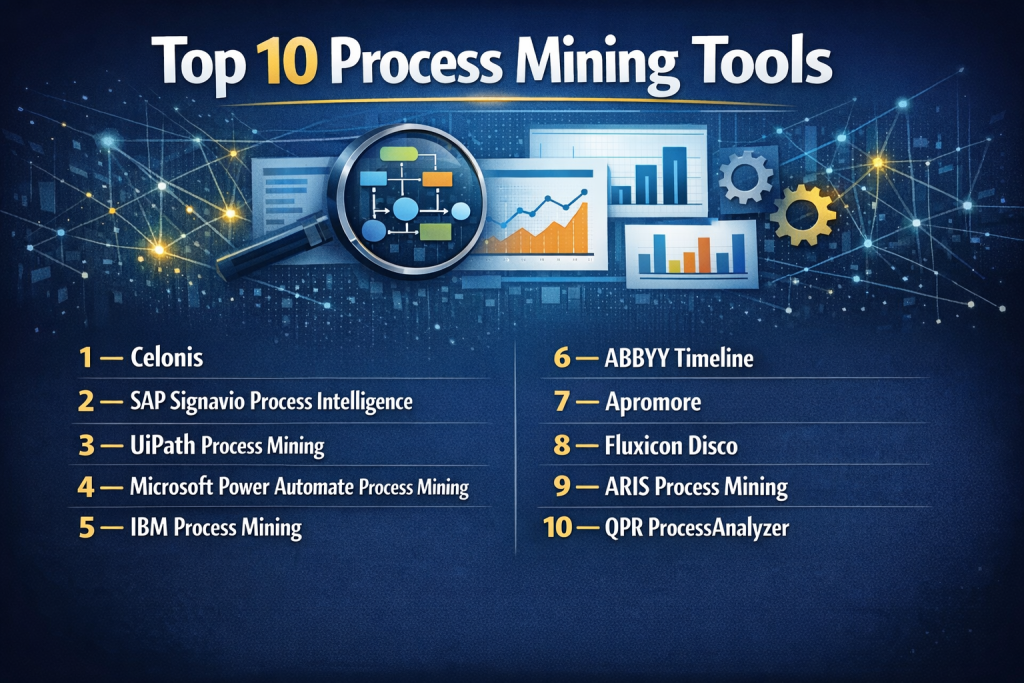
Top 10 Process Mining Tools
#1 — Celonis
Short description: A market-leading process mining platform for enterprise-wide process optimization.
Key Features
- Process discovery and visualization
- Real-time monitoring
- Execution management system (EMS)
- Root cause analysis
- Automation integration
Pros
- Industry leader
- Strong enterprise capabilities
Cons
- Expensive
- Complex implementation
Platforms / Deployment
Cloud / Hybrid
Security & Compliance
Enterprise-grade security
Integrations & Ecosystem
- ERP systems
- CRM platforms
- APIs
Support & Community
Strong enterprise ecosystem
#2 — SAP Signavio Process Intelligence
Short description: A process mining and transformation platform tightly integrated with SAP systems.
Key Features
- Process discovery
- Conformance checking
- Simulation and modeling
- KPI tracking
- Collaboration tools
Pros
- Strong SAP integration
- End-to-end transformation
Cons
- Limited outside SAP ecosystem
- Complex setup
Platforms / Deployment
Cloud
Security & Compliance
Enterprise-grade security
Integrations & Ecosystem
- SAP ecosystem
- Enterprise apps
Support & Community
Strong enterprise support
#3 — UiPath Process Mining
Short description: A process mining tool integrated with RPA for automation-driven insights.
Key Features
- Automated process discovery
- Bottleneck analysis
- Automation opportunity detection
- Dashboard analytics
- RPA integration
Pros
- Strong automation integration
- Scalable
Cons
- Requires UiPath ecosystem
- Learning curve
Platforms / Deployment
Cloud
Security & Compliance
Enterprise-grade security
Integrations & Ecosystem
- RPA tools
- APIs
Support & Community
Large developer community
#4 — Microsoft Power Automate Process Mining
Short description: A process mining solution integrated into the Microsoft Power Platform.
Key Features
- Process visualization
- Data integration
- Automation workflows
- Low-code analytics
- AI insights
Pros
- Easy to use
- Strong Microsoft integration
Cons
- Limited outside ecosystem
- Licensing complexity
Platforms / Deployment
Cloud
Security & Compliance
Enterprise-grade security
Integrations & Ecosystem
- Microsoft 365
- Azure
Support & Community
Strong enterprise support
#5 — IBM Process Mining
Short description: An enterprise-grade process mining tool focused on process intelligence and automation.
Key Features
- Process mapping
- AI-driven insights
- Automation recommendations
- Analytics dashboards
- Collaboration tools
Pros
- Strong analytics
- Enterprise-ready
Cons
- Complex
- Expensive
Platforms / Deployment
Cloud / Hybrid
Security & Compliance
Enterprise-grade security
Integrations & Ecosystem
- IBM ecosystem
- APIs
Support & Community
Enterprise support
#6 — ABBYY Timeline
Short description: A process intelligence platform combining process mining and task mining.
Key Features
- Process discovery
- Task mining
- Root cause analysis
- Predictive analytics
- KPI tracking
Pros
- Strong analytics
- Good visualization
Cons
- Pricing varies
- Learning curve
Platforms / Deployment
Cloud
Security & Compliance
Not publicly stated
Integrations & Ecosystem
- APIs
- Enterprise systems
Support & Community
Moderate support
#7 — Apromore
Short description: An open-source process mining platform with strong analytics and simulation capabilities.
Key Features
- Process discovery
- Simulation tools
- Conformance checking
- Task mining
- Monitoring
Pros
- Open-source flexibility
- Strong analytics
Cons
- Requires setup
- Smaller ecosystem
Platforms / Deployment
Cloud / Self-hosted
Security & Compliance
Not publicly stated
Integrations & Ecosystem
- APIs
- Data systems
Support & Community
Active open-source community
#8 — Fluxicon Disco
Short description: A lightweight and user-friendly process mining tool focused on simplicity.
Key Features
- Fast process discovery
- Interactive dashboards
- Filtering tools
- Data visualization
- Performance analysis
Pros
- Easy to use
- Fast insights
Cons
- Limited enterprise features
- Less scalability
Platforms / Deployment
Desktop
Security & Compliance
Not publicly stated
Integrations & Ecosystem
- Event logs
Support & Community
Strong niche community
#9 — ARIS Process Mining (Software AG)
Short description: A comprehensive process mining and business transformation platform.
Key Features
- Process discovery
- Conformance checking
- BPMN modeling
- Governance tools
- Analytics dashboards
Pros
- Strong governance
- Enterprise-ready
Cons
- Complex UI
- Expensive
Platforms / Deployment
Cloud / Hybrid
Security & Compliance
Enterprise-grade security
Integrations & Ecosystem
- APIs
- Enterprise systems
Support & Community
Enterprise support
#10 — QPR ProcessAnalyzer
Short description: A process mining tool focused on advanced analytics and process optimization.
Key Features
- Process discovery
- Root cause analysis
- Predictive analytics
- Custom dashboards
- Data integration
Pros
- Strong analytics
- Flexible
Cons
- Learning curve
- Smaller ecosystem
Platforms / Deployment
Cloud / On-premise
Security & Compliance
Not publicly stated
Integrations & Ecosystem
- APIs
- Data platforms
Support & Community
Moderate support
Comparison Table (Top 10)
| Tool Name | Best For | Platform(s) Supported | Deployment | Standout Feature | Public Rating |
|---|---|---|---|---|---|
| Celonis | Enterprise | Web | Cloud/Hybrid | Execution mgmt | N/A |
| SAP Signavio | SAP users | Web | Cloud | Transformation suite | N/A |
| UiPath | Automation teams | Web | Cloud | RPA integration | N/A |
| Microsoft | Microsoft users | Web | Cloud | Power Platform | N/A |
| IBM | Enterprise analytics | Web | Cloud/Hybrid | AI insights | N/A |
| ABBYY | Analytics | Web | Cloud | Task mining | N/A |
| Apromore | Open-source | Web | Cloud/Self-hosted | Simulation | N/A |
| Disco | Simplicity | Desktop | Local | Ease of use | N/A |
| ARIS | Governance | Web | Cloud/Hybrid | BPMN + mining | N/A |
| QPR | Analytics | Web | Cloud/On-prem | Predictive analysis | N/A |
Evaluation & Scoring of Process Mining Tools
| Tool Name | Core (25%) | Ease (15%) | Integrations (15%) | Security (10%) | Performance (10%) | Support (10%) | Value (15%) | Weighted Total |
|---|---|---|---|---|---|---|---|---|
| Celonis | 10 | 6 | 10 | 9 | 9 | 9 | 6 | 8.7 |
| SAP Signavio | 9 | 6 | 9 | 9 | 9 | 8 | 6 | 8.2 |
| UiPath | 9 | 7 | 9 | 8 | 9 | 8 | 7 | 8.3 |
| Microsoft | 8 | 9 | 8 | 8 | 8 | 8 | 8 | 8.3 |
| IBM | 9 | 6 | 9 | 9 | 9 | 8 | 6 | 8.2 |
| ABBYY | 8 | 7 | 8 | 7 | 8 | 7 | 7 | 7.7 |
| Apromore | 8 | 7 | 7 | 7 | 8 | 7 | 8 | 7.8 |
| Disco | 7 | 9 | 6 | 6 | 7 | 7 | 8 | 7.5 |
| ARIS | 9 | 6 | 9 | 9 | 8 | 8 | 6 | 8.1 |
| QPR | 8 | 6 | 8 | 7 | 8 | 7 | 7 | 7.6 |
How to interpret scores:
- Enterprise tools dominate in scalability and analytics
- Open-source tools offer flexibility and cost advantages
- Simpler tools prioritize usability over depth
- Scores are comparative, not absolute
Which Process Mining Tool Is Right for You?
Solo / Freelancer
- Best: Fluxicon Disco, Apromore
- Easy and cost-effective
SMB
- Best: Microsoft Process Mining, QPR
- Balanced features and usability
Mid-Market
- Best: UiPath, ABBYY
- Need automation and analytics
Enterprise
- Best: Celonis, SAP Signavio, IBM
- Require scalability and governance
Budget vs Premium
- Budget: Open-source tools
- Premium: Celonis, SAP
Feature Depth vs Ease of Use
- Advanced: Celonis, IBM
- Easy: Microsoft, Disco
Integrations & Scalability
- Strong: Celonis, SAP
- Moderate: SMB tools
Security & Compliance Needs
- Enterprise: SAP, IBM, Celonis
- Basic: Open-source
Frequently Asked Questions (FAQs)
What is process mining?
It is a technique that analyzes event data to visualize and improve business processes.
How does process mining work?
It extracts data from systems and reconstructs real workflows for analysis.
What are the main features?
Process discovery, conformance checking, and performance analysis.
Is process mining different from BPM?
Yes, BPM designs processes, while process mining analyzes real execution.
Can it help automation?
Yes, it identifies automation opportunities for RPA.
Do I need coding skills?
Some tools are no-code, others require technical knowledge.
Is it scalable?
Yes, enterprise tools support large-scale analysis.
What data is required?
Event logs from systems like ERP, CRM, and IT tools.
Are these tools expensive?
Pricing varies widely depending on scale and features.
What are alternatives?
BPM tools, analytics platforms, or manual process analysis.
Conclusion
Process mining tools provide deep visibility into how business processes actually operate, enabling organizations to identify inefficiencies, improve performance, and drive automation. From enterprise-grade platforms like Celonis to lightweight tools like Disco, each solution serves different levels of complexity and scale. The right choice depends on your data maturity, integration needs, and automation goals. Focus on tools that offer strong analytics, real-time monitoring, and integration capabilities. Start small, validate insights, and scale your process intelligence strategy gradually.