Introduction
Case Management Platforms are software solutions designed to help organizations track, manage, and resolve cases such as customer requests, incidents, claims, investigations, or service tickets in a centralized system. These platforms organize data, automate workflows, and enable collaboration across teams to ensure efficient case resolution.
Unlike traditional workflow tools, case management systems are built for dynamic and unpredictable processes, where each case may follow a different path depending on context, data, and decisions.
Common Use Cases
- Customer service and support case handling
- Insurance claims and legal case management
- HR employee case tracking
- IT incident and service management
- Compliance and investigation workflows
What Buyers Should Evaluate
- Case lifecycle management and tracking
- Workflow automation and routing
- Document and data management
- Collaboration tools
- Reporting and analytics
- Security and access control
- Integration with CRM/ERP systems
- Scalability and flexibility
Best for: Enterprises, customer service teams, legal firms, healthcare, insurance, and IT service teams handling complex, unstructured workflows.
Not ideal for: Teams with simple, repetitive workflows better suited for basic task automation tools.
Key Trends in Case Management Platforms
- Growth of dynamic case management (DCM) systems
- Integration with AI for decision support and automation
- Expansion of low-code case management platforms
- Increased adoption of cloud-based case systems
- Focus on customer experience and omnichannel case handling
- Integration with BPM, RPA, and decision engines
- Rise of real-time analytics and dashboards
- Enhanced security, compliance, and audit trails
- Adoption of event-driven case workflows
- Increased use of self-service portals for users
How We Selected These Tools (Methodology)
- Market adoption and enterprise usage
- Feature completeness for case lifecycle management
- Flexibility for dynamic workflows
- Integration capabilities with enterprise systems
- Security and compliance readiness
- Performance and scalability signals
- Ease of use for business and IT users
- Community and vendor support
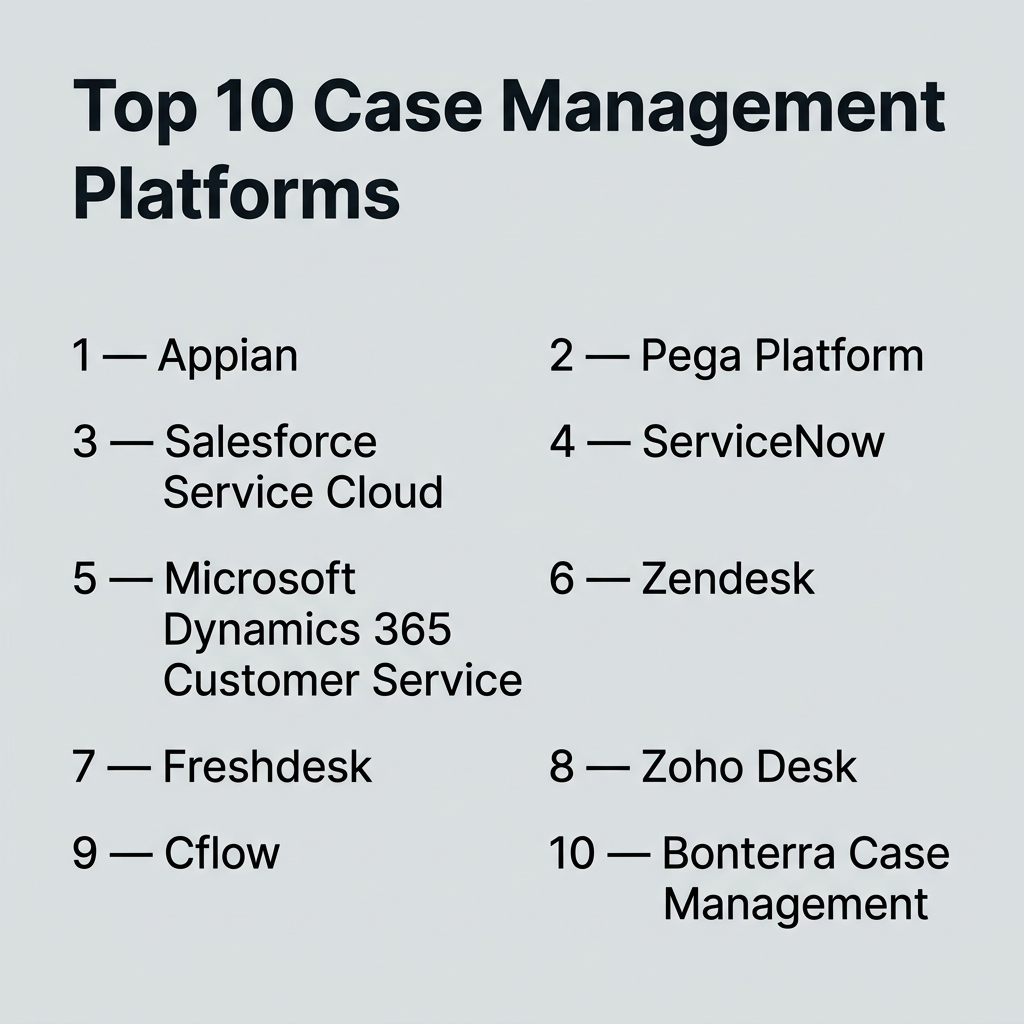
Top 10 Case Management Platforms
#1 — Appian
Short description: A leading low-code platform offering advanced case management with automation and AI capabilities.
Key Features
- Case lifecycle management
- Low-code development
- Process automation
- AI-driven insights
- Integration tools
Pros
- Highly scalable
- Strong enterprise features
Cons
- Premium pricing
- Learning curve
Platforms / Deployment
Cloud / Hybrid
Security & Compliance
Enterprise-grade security, RBAC
Integrations & Ecosystem
Appian integrates with enterprise systems and APIs.
- CRM systems
- ERP platforms
- APIs
Support & Community
Strong enterprise support
#2 — Pega Platform
Short description: A powerful case management and BPM platform with AI-driven decisioning.
Key Features
- Dynamic case workflows
- AI automation
- Process orchestration
- Real-time analytics
- Case lifecycle modeling
Pros
- Strong AI capabilities
- Flexible case handling
Cons
- Complex setup
- Expensive
Platforms / Deployment
Cloud / On-premise
Security & Compliance
Enterprise-grade security
Integrations & Ecosystem
- Enterprise systems
- APIs
Support & Community
Enterprise-level support
#3 — Salesforce Service Cloud
Short description: A customer service platform with robust case management and CRM integration.
Key Features
- Case tracking and routing
- Omnichannel support
- Automation workflows
- Customer data integration
- Reporting dashboards
Pros
- Strong CRM integration
- Easy to use
Cons
- Expensive at scale
- Customization complexity
Platforms / Deployment
Cloud
Security & Compliance
Role-based access, encryption
Integrations & Ecosystem
- CRM ecosystem
- APIs
- SaaS tools
Support & Community
Large global community
#4 — ServiceNow
Short description: A leading enterprise platform for IT and service case management.
Key Features
- Incident and case management
- Workflow automation
- Knowledge base
- Analytics
- ITSM integration
Pros
- Strong IT use cases
- Highly scalable
Cons
- Complex
- High cost
Platforms / Deployment
Cloud
Security & Compliance
Enterprise-grade security
Integrations & Ecosystem
- IT tools
- APIs
Support & Community
Strong enterprise support
#5 — Microsoft Dynamics 365 Customer Service
Short description: A case management solution integrated into the Microsoft ecosystem.
Key Features
- Case tracking
- Workflow automation
- AI insights
- Omnichannel support
- Reporting
Pros
- Strong Microsoft integration
- User-friendly
Cons
- Limited outside ecosystem
- Licensing complexity
Platforms / Deployment
Cloud
Security & Compliance
Enterprise-grade security
Integrations & Ecosystem
- Microsoft 365
- Azure
Support & Community
Large support network
#6 — Zendesk
Short description: A customer support platform with strong case and ticket management capabilities.
Key Features
- Ticketing system
- Case routing
- Automation workflows
- Reporting tools
- Customer interaction tracking
Pros
- Easy to use
- Strong customer support features
Cons
- Limited advanced customization
- Pricing tiers
Platforms / Deployment
Cloud
Security & Compliance
Encryption, access control
Integrations & Ecosystem
- SaaS apps
- APIs
Support & Community
Large user base
#7 — Freshdesk
Short description: A cloud-based customer service platform with built-in case management.
Key Features
- Ticketing system
- Workflow automation
- Omnichannel support
- Reporting dashboards
- AI chatbots
Pros
- Affordable
- Easy setup
Cons
- Limited enterprise features
- Customization limits
Platforms / Deployment
Cloud
Security & Compliance
Not publicly stated
Integrations & Ecosystem
- CRM tools
- APIs
Support & Community
Strong support
#8 — Zoho Desk
Short description: A cost-effective case management platform for customer service teams.
Key Features
- Case tracking
- Workflow automation
- AI assistant
- Reporting tools
- Multichannel support
Pros
- Budget-friendly
- Easy integration
Cons
- Limited scalability
- UI limitations
Platforms / Deployment
Cloud
Security & Compliance
Not publicly stated
Integrations & Ecosystem
- Zoho ecosystem
- APIs
Support & Community
Good documentation
#9 — Cflow
Short description: A workflow automation platform with strong case management capabilities.
Key Features
- Case tracking
- Workflow automation
- Reporting tools
- Data centralization
- Low-code builder
Pros
- Easy to use
- Flexible workflows
Cons
- Limited advanced features
- Smaller ecosystem
Platforms / Deployment
Cloud
Security & Compliance
Not publicly stated
Integrations & Ecosystem
- APIs
- Business apps
Support & Community
Moderate support
#10 — Bonterra Case Management
Short description: A platform focused on nonprofit and social impact case management.
Key Features
- Case tracking
- Data management
- Reporting tools
- Workflow automation
- Custom forms
Pros
- Good for nonprofits
- Data-focused
Cons
- Limited enterprise features
- Niche use cases
Platforms / Deployment
Cloud
Security & Compliance
Not publicly stated
Integrations & Ecosystem
- Data tools
- APIs
Support & Community
Moderate support
Comparison Table (Top 10)
| Tool Name | Best For | Platform(s) Supported | Deployment | Standout Feature | Public Rating |
|---|---|---|---|---|---|
| Appian | Enterprise | Web | Cloud/Hybrid | Low-code + case mgmt | N/A |
| Pega | AI workflows | Web | Cloud/On-prem | Dynamic cases | N/A |
| Salesforce | Customer service | Web | Cloud | CRM integration | N/A |
| ServiceNow | ITSM | Web | Cloud | Incident mgmt | N/A |
| Dynamics 365 | Microsoft users | Web | Cloud | AI insights | N/A |
| Zendesk | Support teams | Web | Cloud | Ticketing | N/A |
| Freshdesk | SMB | Web | Cloud | Omnichannel | N/A |
| Zoho Desk | Budget teams | Web | Cloud | AI assistant | N/A |
| Cflow | Workflow-based | Web | Cloud | Automation | N/A |
| Bonterra | Nonprofits | Web | Cloud | Data mgmt | N/A |
Evaluation & Scoring of Case Management Platforms
| Tool Name | Core (25%) | Ease (15%) | Integrations (15%) | Security (10%) | Performance (10%) | Support (10%) | Value (15%) | Weighted Total |
|---|---|---|---|---|---|---|---|---|
| Appian | 10 | 7 | 9 | 9 | 9 | 9 | 6 | 8.7 |
| Pega | 9 | 6 | 9 | 9 | 9 | 8 | 6 | 8.3 |
| Salesforce | 9 | 8 | 10 | 9 | 8 | 9 | 7 | 8.8 |
| ServiceNow | 9 | 7 | 9 | 9 | 9 | 9 | 6 | 8.6 |
| Dynamics 365 | 8 | 8 | 9 | 9 | 8 | 8 | 7 | 8.2 |
| Zendesk | 8 | 9 | 8 | 8 | 8 | 8 | 8 | 8.2 |
| Freshdesk | 7 | 9 | 7 | 7 | 7 | 7 | 9 | 7.8 |
| Zoho Desk | 7 | 9 | 7 | 7 | 7 | 7 | 9 | 7.8 |
| Cflow | 7 | 8 | 7 | 7 | 7 | 7 | 8 | 7.6 |
| Bonterra | 7 | 8 | 6 | 7 | 7 | 7 | 8 | 7.4 |
How to interpret scores:
- Enterprise tools score highest in scalability and governance
- CRM-based tools excel in customer service use cases
- SMB tools prioritize ease of use and affordability
- Scores are comparative, not absolute
Which Case Management Platform Is Right for You?
Solo / Freelancer
- Best: Zoho Desk, Freshdesk
- Affordable and easy to use
SMB
- Best: Zendesk, Freshdesk
- Balanced features and usability
Mid-Market
- Best: Salesforce, Dynamics 365
- Strong integrations and scalability
Enterprise
- Best: Appian, Pega, ServiceNow
- Advanced case handling and governance
Budget vs Premium
- Budget: Zoho Desk, Freshdesk
- Premium: Appian, ServiceNow
Feature Depth vs Ease of Use
- Advanced: Appian, Pega
- Easy: Zendesk, Freshdesk
Integrations & Scalability
- Strong: Salesforce, ServiceNow
- Moderate: SMB tools
Security & Compliance Needs
- Enterprise: ServiceNow, Appian
- Basic: SMB tools
Frequently Asked Questions (FAQs)
What is a case management platform?
It is software that helps track, manage, and resolve cases in a centralized system.
How is case management different from workflow automation?
Case management handles dynamic processes, while workflow automation handles fixed processes.
What industries use case management tools?
Healthcare, legal, insurance, IT, and customer service industries widely use them.
Are these tools cloud-based?
Most modern case management platforms are cloud-based.
Do they support automation?
Yes, workflow automation is a core feature.
Can they integrate with CRM systems?
Yes, integration with CRM and enterprise systems is common.
Are case management platforms secure?
They include access control, encryption, and audit logs.
Can non-technical users use them?
Many platforms offer low-code or no-code interfaces.
How scalable are these platforms?
Enterprise platforms can handle large-scale case workloads.
What are alternatives?
BPM tools, helpdesk systems, or workflow automation platforms.
Conclusion
Case management platforms are essential for handling complex, dynamic workflows where each case requires unique handling and decision-making. From customer service tools to enterprise-grade platforms, each solution serves different levels of complexity and scalability. The right choice depends on your business needs, integration requirements, and workflow flexibility. Focus on tools that offer strong automation, collaboration, and analytics capabilities. Start by testing a few platforms to find the best fit for your case management processes.