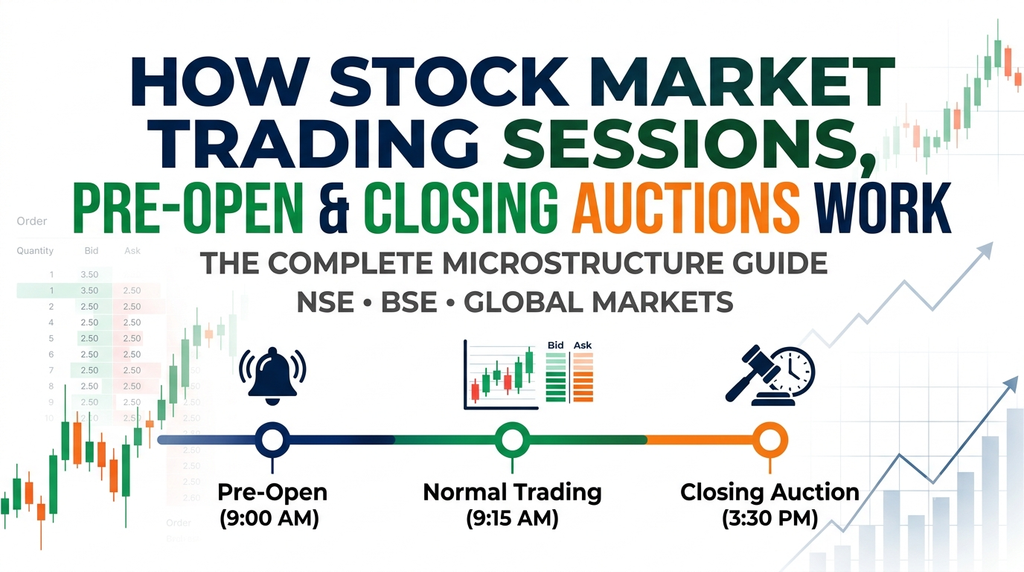
Every trading day on a modern stock exchange operates on a precisely engineered schedule. While most retail participants watch the ticker move between 9:15 AM and 3:30 PM, critical price discovery happens before the opening bell rings and during the final minutes before the market shuts down.
If you have ever wondered why a stock opens 3% higher than its previous close with zero intraday candles in between, or why your market order placed at 9:04 AM did not execute immediately, the answer lies in market microstructure. Stock exchanges divide the day into specialized sessions—combining call auctions and continuous order books—to absorb overnight news, concentrate liquidity, and prevent closing price manipulation.
Here is a complete, technical breakdown of how trading sessions, pre-open call auctions, continuous trading, and closing mechanisms work on Indian stock exchanges (NSE and BSE), along with how they compare to global auction models.
Why Exchanges Divide the Day Into Distinct Sessions
If an exchange opened directly into continuous trading at 9:15 AM without preparation, overnight earnings announcements, global index swings, and macroeconomic news would trigger chaotic price spikes. Early orders would hit thin liquidity, causing severe slippage for retail investors and erratic volatility across benchmark indices.
Similarly, institutional funds—such as mutual funds, index funds, and exchange-traded funds (ETFs)—rely on an accurate, manipulation-resistant official closing price to calculate daily Net Asset Values (NAVs) and settle derivative contracts.
To solve both problems, exchanges separate the trading day into distinct operational phases:
| Trading Session | Timing (IST) | Core Mechanism | Primary Function |
| Morning Block Deal Window 1 | 8:45 AM – 9:00 AM | Fixed Reference Price | Large institutional block trades at previous close |
| Pre-Open Session | 9:00 AM – 9:15 AM | Single-Price Call Auction | Absorb overnight information and discover opening price |
| Normal Market Session | 9:15 AM – 3:30 PM | Continuous Order Book | Real-time price discovery via price-time priority |
| Afternoon Block Deal Window 2 | 2:05 PM – 2:20 PM | VWAP Reference Price | Mid-day institutional block execution |
| Closing Price Calculation | 3:00 PM – 3:30 PM | 30-Minute VWAP | Establish manipulation-resistant official closing price |
| Post-Closing Session | 3:40 PM – 4:00 PM | Fixed Closing Price | Execute residual orders strictly at the official close |
Phase 1: The Pre-Open Call Auction (9:00 AM – 9:15 AM)
Unlike continuous trading where buyers and sellers match instantaneously, the pre-open session operates as a call auction. All orders are pooled together over a set window and matched simultaneously at a single calculated clearing price—known as the equilibrium price.
On the NSE and BSE, this 15-minute session is strictly segmented into three sub-windows.
1. Order Entry and Modification Window (9:00 AM – 9:08 AM)
During the first eight minutes, market participants submit, modify, or cancel both limit orders and market orders. No trades execute during this period.
To stop algorithmic traders from placing fake orders to manipulate the indicative price and canceling them at 9:07:59 AM (a practice known as spoofing), exchanges enforce a random closure. The order collection window automatically terminates at an unpredictable second between 9:07 AM and 9:08 AM. Once the random cutoff triggers, no further modifications or cancellations are permitted.
2. Order Matching & Equilibrium Price Discovery (9:08 AM – 9:12 AM)
After the order book freezes, the exchange matching engine runs an optimization algorithm to determine the exact opening price. Rather than averaging bids and asks, the system tests every price level in the order book against four hierarchical rules:
- Maximum Tradable Volume: The engine selects the price at which the highest cumulative quantity of shares can be matched and executed.
- Minimum Order Imbalance: If two or more price levels generate the exact same maximum tradable volume, the system selects the price that leaves the smallest quantity of unmatched orders.
- Proximity to Previous Close: If volume and order imbalance are still tied, the engine chooses the price closest to the previous trading day’s official closing price.
- Previous Close Fallback: In rare cases where a tie still persists, the previous closing price itself becomes the opening price.
Once the equilibrium price is locked in, all eligible buy orders priced at or above the equilibrium price and all sell orders priced at or below it execute at that single uniform price.
Practical Example of Equilibrium Price Discovery
Suppose Stock X closed at ₹500 yesterday. During the pre-open order collection window, the cumulative order book builds up as follows:
| Price Level (₹) | Cumulative Buy Quantity | Cumulative Sell Quantity | Executable Volume | Unmatched Imbalance |
| ₹508 | 4,000 | 18,000 | 4,000 | 14,000 (Sell) |
| ₹505 | 9,500 | 13,000 | 9,500 | 3,500 (Sell) |
| ₹503 | 14,000 | 12,500 | 12,500 | 1,500 (Buy) |
| ₹500 | 19,000 | 7,000 | 7,000 | 12,000 (Buy) |
In this order book, ₹503 maximizes executable volume at 12,500 shares. Every matched buyer—even those willing to pay ₹508—gets filled at ₹503, and every matched seller gets ₹503. The remaining 1,500 unmatched buy shares at ₹503 carry forward into the continuous session.
3. Buffer and Transition Period (9:12 AM – 9:15 AM)
No order entry, modification, or matching occurs during these three minutes. The exchange finalizes trade confirmations from the call auction and migrates all unmatched limit orders from the pre-open book into the regular order book, preserving their original timestamps. Unmatched market orders are converted into limit orders at the newly discovered opening price (or canceled, depending on order validity settings).
Note on Special Pre-Open Sessions: For stocks listing on the exchange for the first time via an Initial Public Offering (IPO) or relisting after corporate restructuring, exchanges hold an extended 45-minute special pre-open session from 9:00 AM to 9:45 AM (with order entry closing between 9:34 AM and 9:35 AM) to handle heightened price uncertainty.
Phase 2: The Normal Continuous Trading Session (9:15 AM – 3:30 PM)
At exactly 9:15 AM, the market shifts from a single-price call auction to a continuous double auction governed by a Central Limit Order Book (CLOB).
In this environment, orders are matched continuously in real time based on strict Price-Time Priority:
- Price Priority: A higher buy bid always takes precedence over a lower buy bid; a lower sell ask always takes precedence over a higher sell ask.
- Time Priority: When multiple orders sit at the exact same price level, the order that entered the exchange matching engine first executes first.
Risk Controls During Continuous Trading
To maintain orderly markets during sudden news shocks, exchanges enforce two primary circuit mechanisms:
- Individual Stock Price Bands: Stocks without derivatives contracts have daily upper and lower circuit limits (typically 2%, 5%, 10%, or 20%). Stocks traded in the Futures & Options (F&O) segment do not have hard daily circuit caps; instead, they use dynamic price bands (usually 10%) that automatically flex when genuine demand or supply pushes the price against the boundary.
- Index-Wide Market Circuit Breakers: If the Nifty 50 or BSE Sensex breaches thresholds of 10%, 15%, or 20% in either direction, trading across all equity and equity derivative markets halts temporarily (or for the remainder of the day at 20%) to let investors cool off and reassess information.
Phase 3: Closing Mechanisms and the Post-Close Session
The closing price of a stock carries enormous financial weight. Mutual fund NAVs, index fund tracking, futures mark-to-market settlements, and corporate valuation benchmarks all depend on it. If an exchange simply took the final trade executed at 3:29:59 PM as the official close, a trader could buy or sell 1 share at an artificial price in the final millisecond to distort the closing figure.
Global exchanges prevent closing manipulation using two distinct approaches:
1. The Indian VWAP Closing Model (3:00 PM – 3:30 PM)
On the NSE and BSE, there is no separate call auction at 3:30 PM for standard daily trading. Instead, the exchange calculates the official closing price using the Volume-Weighted Average Price (VWAP) of all trades executed during the final 30 minutes of the continuous session (3:00 PM to 3:30 PM).
$$\text{Official Closing Price} = \frac{\sum (\text{Trade Price}_i \times \text{Trade Quantity}_i)}{\sum \text{Trade Quantity}_i}$$
Because every transaction is weighted by its share volume over a full 30-minute window, a tiny trade in the last second cannot move the official closing price. If a stock records zero trades between 3:00 PM and 3:30 PM, its last traded price earlier in the day becomes the official close. (On major index rebalancing days—such as MSCI or Nifty rebalances—exchanges may also utilize specialized closing call mechanisms or extended institutional windows to absorb passive fund flows).
2. Dedicated Closing Call Auctions (US & European Exchanges)
Major international exchanges like the NYSE, NASDAQ, and London Stock Exchange (LSE) run a formal Closing Call Auction in the final minutes of the trading day. Traders submit specialized Market-on-Close (MOC) and Limit-on-Close (LOC) orders ahead of a cutoff time (for example, 3:50 PM EST on the NYSE). At 4:00 PM EST, the exchange matches all closing auction interest at a single equilibrium price—the exact mirror image of the morning pre-open auction.
3. The Post-Closing Session (3:40 PM – 4:00 PM IST)
After the NSE and BSE compute and publish the official VWAP closing price around 3:40 PM, they open a 20-minute Post-Closing Session:
- Fixed-Price Execution: Investors can place buy or sell orders only at the exact official closing price. Price discovery is turned off.
- Time Priority Matching: If a buyer places an order at the closing price and a seller places an order at that same price, the trade executes immediately based on entry timestamp.
- Institutional Utility: Mutual funds and foreign portfolio investors (FPIs) frequently use this session to clean up residual cash inflows or outflows at the exact NAV benchmark price without suffering market impact.
Periodic Call Auctions for Illiquid Securities
Beyond the daily pre-open session, exchanges also use Periodic Call Auctions throughout the normal trading day (9:30 AM to 3:30 PM) for illiquid stocks—typically thinly traded small-cap or micro-cap companies that fail minimum liquidity criteria.
Instead of trading continuously—where a single small order could swing the price by 10%—these stocks trade in one-hour call auction cycles (six sessions per day). Each 60-minute cycle mirrors the pre-open structure: 45 minutes of order collection, 8 minutes of order matching and equilibrium price discovery, and a 7-minute buffer before the next cycle begins.
Strategic Takeaways for Traders and Investors
Understanding these session mechanics directly improves trade execution and helps you avoid common pitfalls:
- Never use market orders at 9:15 AM sharp: During the first 60 to 120 seconds after the pre-open buffer ends, order books are still adjusting, and bid-ask spreads can be unusually wide. Always use limit orders near the opening bell to control your maximum purchase price or minimum sale price.
- Treat early pre-open prices (9:00 AM – 9:06 AM) as tentative: Indicative opening prices displayed on trading terminals during the first six minutes often reflect retail orders. Institutional desks routinely enter large orders in the final 90 seconds before the random cutoff, which can dramatically shift the final equilibrium price.
- Expect heightened volume after 3:00 PM: Because the 3:00 PM to 3:30 PM window determines the official closing price—and because brokers automatically square off intraday margin positions around 3:15 PM to 3:20 PM—liquidity and short-term volatility typically surge in the final half hour.
- Remember order expiration rules: Standard “Day” orders placed during normal hours expire automatically at 3:30 PM. If you want to participate in the 3:40 PM to 4:00 PM post-closing session, you must place a fresh order specifically during that window.
Frequently Asked Questions (FAQs)
1. Why is the Last Traded Price (LTP) different from the Closing Price on NSE and BSE?
The Last Traded Price (LTP) is simply the price of the very last trade executed before 3:30 PM. The official Closing Price is the volume-weighted average price (VWAP) of all trades executed between 3:00 PM and 3:30 PM. If a stock rallies or drops sharply in the final two minutes, the LTP will differ from the official closing price.
2. Can retail investors place orders in the pre-open session?
Yes. Any retail investor with a standard demat and trading account can place buy or sell orders between 9:00 AM and 9:08 AM. However, aftermarket orders (AMO) placed the previous night are also pushed into the exchange system during this pre-open window by brokers.
3. What happens to an unexecuted pre-open limit order after 9:08 AM?
If your limit order does not execute during the pre-open matching window because your price was below (for a buy) or above (for a sell) the discovered equilibrium price, it is not canceled. The exchange automatically carries it over into the normal continuous trading session at 9:15 AM.
4. Why does the pre-open order window close randomly between 9:07 AM and 9:08 AM?
Random closure prevents traders from manipulating the indicative equilibrium price. Without a random cutoff, a large participant could place huge buy orders at 9:07:55 AM to make a stock look bullish, lure other buyers in, and cancel their orders at 9:07:59 AM before matching begins.
5. Are derivatives (Futures & Options) traded in the pre-open session?
Historically, the Indian pre-open call auction applied strictly to the equity cash segment, while F&O contracts began trading directly at 9:15 AM. Market regulators and exchanges periodically review extending pre-open auction mechanics to index and stock futures to align opening price discovery across cash and derivative segments.
Conclusion
Every phase of a stock exchange’s daily schedule serves a specific economic purpose. Pre-open call auctions distill overnight information into a single, fair starting price; continuous order books deliver immediate liquidity throughout the day; and volume-weighted closing mechanisms protect end-of-day valuations from last-second distortion. Aligning your order types and timing with these rules ensures you trade with the market structure rather than against it.