Introduction
Starting your journey in the stock market can feel exciting. You hear stories about people doubling their money in weeks, and you want a piece of that success. But behind the glamorous headlines lies a harsh reality: a large majority of individual retail investors lose money over time.
Why does this happen? Is the stock market rigged against everyday people, or are investors making avoidable mistakes?
The truth is, the market itself is neutral. It does not care who you are. People lose money not because they lack professional tools, but because of how they react to stress, uncertainty, and greed.
In this article, we will break down the top reasons retail investors lose money, explain the core concepts in simple terms, and show you practical ways to protect your hard-earned cash.
What Is a Retail Investor?
Before looking at why investors lose money, let us define who a retail investor is.
A retail investor is an individual non-professional investor who buys and sells stocks, bonds, or mutual funds through brokerage accounts for their own personal portfolio. Unlike institutional investors—such as mutual fund managers, pension funds, or giant banks that trade with millions or billions of dollars of other people’s money—retail investors trade with their own savings.
Why It Matters
Because retail investors trade with their own personal money, financial losses hit them emotionally and practically. A bad trade does not just hurt a portfolio sheet; it can hurt a family’s savings, college funds, or retirement plans. Understanding these risks is the first step toward protecting yourself.
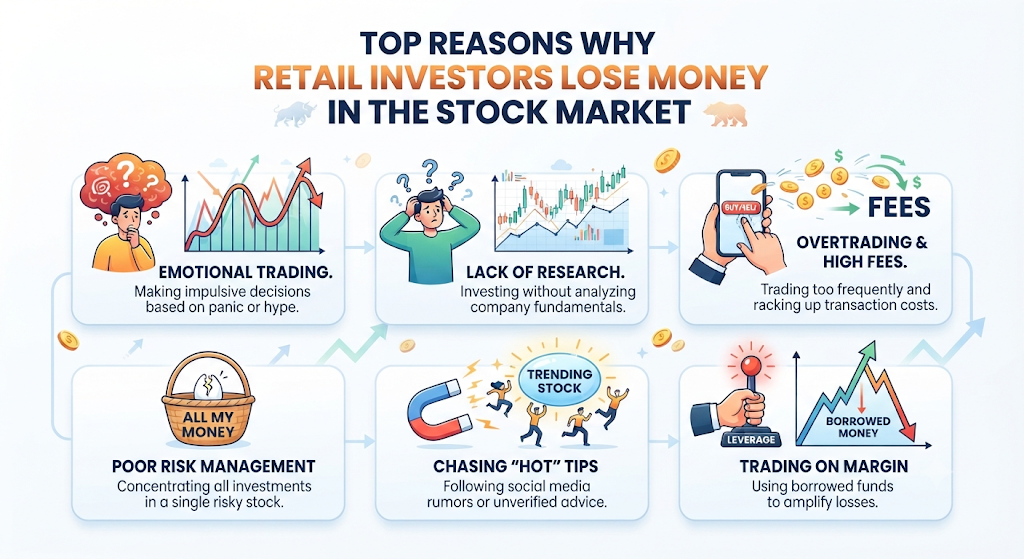
Top Reasons Why Retail Investors Lose Money
1. Emotional Trading (Fear and Greed)
Human emotions are an investor’s worst enemy. When the stock market goes up rapidly, greed takes over. People buy stocks at inflated prices just because “everyone else is making money.” This is often called FOMO (Fear of Missing Out).
Conversely, when the market drops, fear kicks in. Panic sets in, and investors sell their good stocks at a heavy loss just to stop the pain.
- The Mistake: Buying high out of excitement and selling low out of panic.
- Why It Happens: Our brains are wired for survival. When we see our money shrinking, our instinct screams “run away.”
- How to Fix It: Create a clear investing plan before you buy anything. Decide beforehand why you are buying a stock and when you plan to sell. Stick to your plan no matter how much the market jumps around.
2. Lack of Proper Research and Due Diligence
Many retail investors buy stocks based on tips from social media, chat rooms, or casual conversations with friends. They do not know what the company actually sells, how it makes money, or whether it has massive debt.
- Professional Term: Due Diligence refers to the independent investigation and research a person does before buying an asset or signing a business agreement.
- Simple Meaning: Doing your homework.
- Example: Buying a stock just because a popular influencer posted a rocket emoji on social media, without looking at the company’s financial health.
- How to Fix It: Always read a company’s basic financial reports (like quarterly earnings) and understand its business model. If you cannot explain how a company makes money in two sentences, do not invest in it.
3. Overtrading and High Transaction Costs
Some retail investors treat the stock market like a video game. They buy and sell stocks every single day, trying to catch every small price movement.
- The Mistake: Trading too frequently.
- Why It Causes Problems: Every time you buy or sell, you pay brokerage fees, taxes, and transaction costs. These small costs add up quickly and eat away at your returns. Furthermore, frequent trading increases the chances of making a bad emotional decision.
- How to Fix It: Adopt a long-term mindset. Think of buying a stock like buying a small piece of a real business. Businesses take time to grow, so give your investments months and years, not minutes and days.
4. Poor Risk Management and Lack of Diversification
Putting all your savings into a single hot stock is one of the fastest ways to lose everything. If that single company runs into trouble, your entire portfolio suffers.
- Professional Term: Diversification is the practice of spreading your investments across different industries, asset classes, or geographical regions to lower overall risk.
- Simple Meaning: Not putting all your eggs in one basket.
- Example: If you invest 100% of your savings into a single electric car startup, and that startup goes bankrupt, you lose all your money. If you spread that money across ten different companies in technology, healthcare, and banking, the failure of one company will not ruin you.
- How to Fix It: Build a diversified portfolio. Spread your capital across different sectors so that a downturn in one industry does not wipe you out.
5. Chasing Trendy “Hype” Stocks
When a new technology or market trend explodes—such as meme stocks, artificial intelligence crazes, or cryptocurrency manias—retail investors often rush in at the absolute peak.
- The Problem: By the time everyday investors hear about a hot trend on the news, professional investors and early buyers are often already preparing to sell and take their profits. Retail investors end up holding the bag when the price crashes.
- How to Fix It: Avoid hype. If an investment sounds too good to be true, or if everyone around you is talking about how easy it is to get rich quick, step back. Stick to solid, boring, reliable businesses with proven track records.
6. Trading with Borrowed Money (Leverage)
Some retail investors want to get rich fast, so they borrow money from their brokers to buy more stocks than they can afford with their own cash.
- Professional Term: Margin Trading (or using leverage) means borrowing funds from a broker to purchase securities, magnifying both potential gains and potential losses.
- Simple Meaning: Trading with borrowed money.
- Why It’s Dangerous: If the stock goes up, you make extra money. But if the stock goes down, you lose your own money plus you still have to pay back the borrowed money, often triggering a margin call where the broker forces you to sell at a massive loss.
- How to Fix It: Never use borrowed money to trade stocks, especially as a beginner. Only invest money that you can afford to leave untouched for years.
7. Falling in Love with a Losing Stock
Sometimes, an investor buys a stock that starts dropping. Instead of accepting a small loss and moving on, they tell themselves, “It will bounce back soon.” They hold onto the losing stock for months or years, watching it drop further and further.
- The Mistake: Letting ego or hope override logic.
- Why It Happens: Admitting a mistake is psychologically painful. Investors hold onto losers hoping to break even, missing out on opportunities to put that money into better-performing assets.
- How to Fix It: Evaluate every stock objectively. Ask yourself: “If I didn’t already own this stock today, would I buy it at its current price?” If the answer is no, sell it and move on.
Comparison of Winning vs. Losing Investor Habits
| Feature | The Struggling Retail Investor | The Successful Long-Term Investor |
| Mindset | Looks for get-rich-quick shortcuts and hot tips. | Treats investing as a patient, long-term wealth building process. |
| Research | Relies on social media hype and rumors. | Studies company fundamentals, balance sheets, and business models. |
| Portfolio | Concentrated in 1–2 trendy or high-risk stocks. | Diversified across multiple stable companies and sectors. |
| Emotions | Sells in panic during drops; buys in greed during peaks. | Stays calm during market drops and sticks to a pre-planned strategy. |
Practical Decision-Making Framework for Retail Investors
Before you buy any stock, run through this simple 4-step checklist:
- The Business Check: Do I understand how this company makes money? Is the business growing?
- The Risk Check: What is the worst-case scenario if this company fails? Can I afford that loss?
- The Time Horizon: Am I planning to hold this investment for at least 3 to 5 years?
- The Emotion Check: Am I buying this because of genuine value, or just because everyone else is talking about it?
If your answers align with logic and patience, you are ready to make a sound investment decision.
Key Terms
- Retail Investor: An individual person who invests their own money through personal brokerage accounts.
- Institutional Investor: Large organizations (like mutual funds or insurance companies) that invest huge sums of money on behalf of others.
- Due Diligence: The research and investigation done before making an investment.
- Diversification: Spreading investments across different assets to reduce risk.
- Margin Trading: Buying stocks using borrowed money from a broker.
- Volatility: How fast and how much the price of a stock goes up and down.
Frequently Asked Questions
Why do most day traders lose money?
Day traders try to predict short-term price movements, which is extremely difficult even for professionals. High transaction fees, emotional stress, and competition from high-speed computerized trading algorithms make consistent day trading very difficult for retail investors.
How much money do I need to start investing?
You do not need a fortune to start. Many modern brokerage platforms allow fractional share trading, meaning you can start investing in solid companies with as little as a few dollars.
Is the stock market just gambling?
No. Gambling relies purely on chance with negative mathematical odds. Investing in the stock market means buying fractional ownership of real, revenue-generating businesses. Over the long term, strong businesses grow, create jobs, and generate profits, rewarding patient owners.
Should beginners buy individual stocks or index funds?
For most beginners, broad market index funds (which hold a small piece of hundreds of different companies at once) are much safer and easier than picking individual stocks because they provide instant diversification.
How do I stop myself from panic selling during a market crash?
Keep an emergency fund of cash in a safe bank account so you never have to sell your stocks during a market dip to pay for unexpected living expenses. Knowing your living expenses are secure makes it much easier to stay calm when stock prices drop.
Conclusion
Losing money in the stock market is common, but it is not inevitable. Most retail investors fail not because they lack intelligence, but because they fall into predictable traps: trading on emotion, chasing social media hype, ignoring diversification, and failing to do proper research.
By slowing down, doing your homework, managing your risks, and thinking like a long-term business owner rather than a gambler, you can protect your capital and let time work in your favor. Investing is a marathon, not a sprint—patience and discipline always win in the end.